For nearly 30 years after the inception of APRA’s Silver Scroll songwriting award in 1965, Patricia Bell was the driving force of the event. Bell was a stalwart of APRA New Zealand for most of her working life. She began there in the early 1960s as secretary to the first manager, Bert Rolfe, and she remained at the organisation until her retirement in 1992. During that time – between the appointments of Don McKinnon (not the politician) and Bernie Darby – she had a spell as branch manager of APRA.
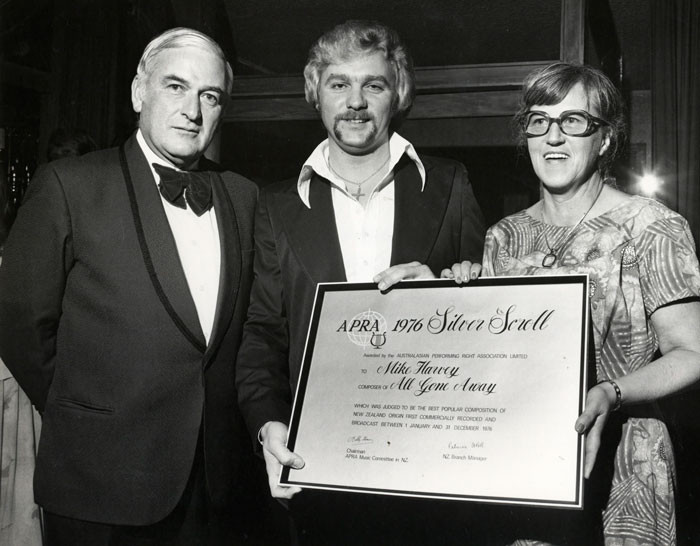
Patricia Bell (right) with Mike Harvey, winner of the 1976 Silver Scroll for 'All Gone Away'. In the tux is Ashley Heenan, writer-director of APRA NZ from 1966 to 1980.
APRA was based in a small, wood-panelled office in Wellington, and behind the scenes Bell was the dynamo who got things done. A memorable early task was giving an anxious Douglas Lilburn a glass of milk to settled his stomach before going to Parliament to confront politicians about proposed changes to the Copyright Act, which squeezed the rights of creators such as writers, composers and songwriters.
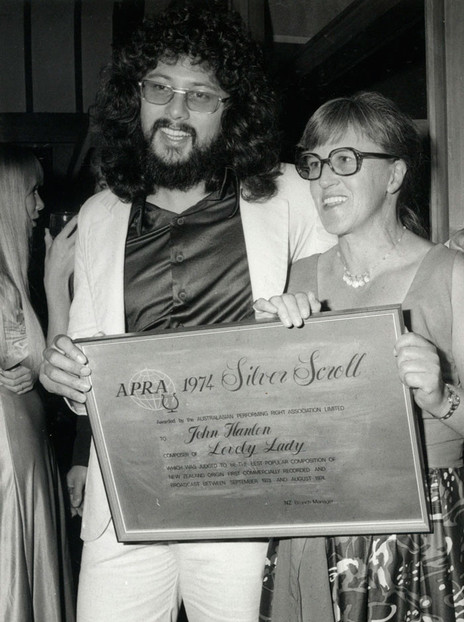
Pat Bell with John Hanlon, awarded the 1974 Silver Scroll for 'Lovely Lady'
In the early 1960s, radio and music all-rounder Edd Morris returned from a visit to Australia with the idea of creating a New Zealand music awards event to celebrate locally written pop songs. His managers at the NZBC – the predecessor of Radio New Zealand – were encouraging but thought music awards should be handled by the private sector.
Morris approached Pat Bell at APRA, the Australasian Performing Right Association, which collects royalties on behalf of songwriters and composers. She was enthusiastic and by 1965 the idea had evolved and expanded into the APRA Silver Scroll, to be run alongside the hit record oriented Loxene Golden Disc award sponsored by household products conglomerate Reckitt & Colman.
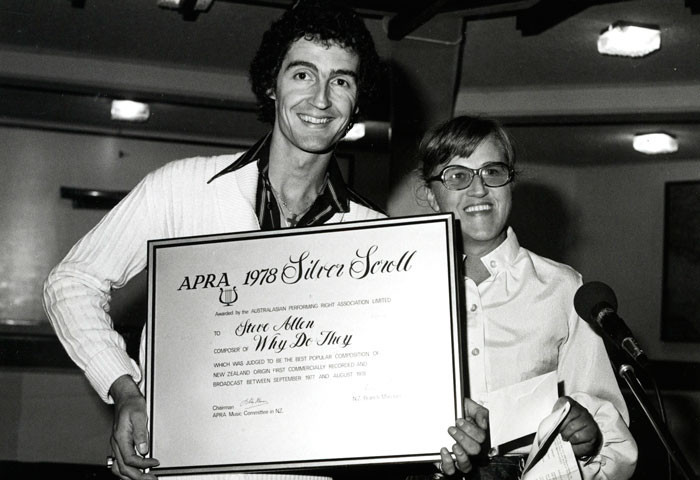
Steve Allen and Pat Bell with the 1978 APRA Silver Scroll for 'Why Do They'
Bell was born in Australia to New Zealand parents in 1925, and moved to New Zealand when she was 25. She was a secretary at several businesses before joining APRA, and while her role there was originally secretarial, she became the backbone of the organisation – and her love and knowledge of music and musicians meant she thrived.
It was Bell’s ebullient nature that first struck Wellington composer Ashley Heenan – an APRA member since 1942, and the New Zealand writer-director from 1966-1980. At Bell’s funeral in 2000, Heenan gave the eulogy. “She was given to wild enthusiasms,” he said, “particularly for APRA, and she always tried to measure up to Bert’s expectations of her. She rapidly came to know all the composers of the early days – Vernon Griffiths, Llewellyn Jones, Douglas Lilburn, and countless others.” Heenan recalled that Bell was an efficient secretary who “never seemed to lose her jolly nature and she had a very sharp, retentive mind.”
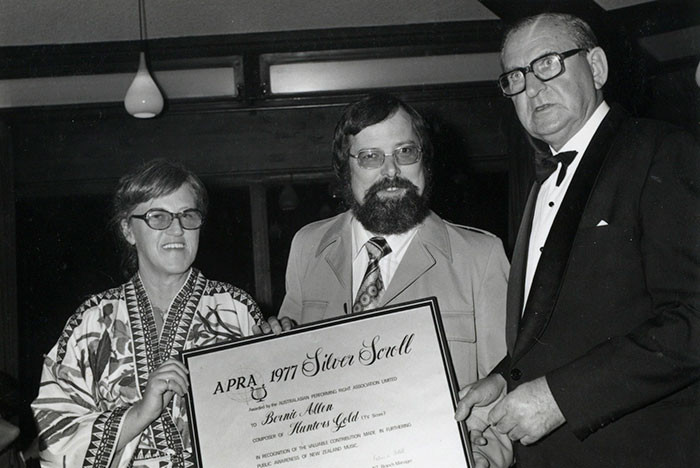
APRA Silver Scroll, 1977 (L-R): Pat Bell of APRA NZ, Bernie Allen, and Bob Hughes, Australian composer and chairman of APRA.
Well-meaning Heenan’s comments may have been, but they minimise her role at the organisation. Dealing with the “serious” composers such as Heenan – and their sense of entitlement – had to be balanced with representing the pop songwriters, who would soon bring in the bulk of local income. Handling radio returns and divvying up royalities was a complicated task – adding machines and ledgers were the only tools – but she was also skilled at dealing with APRA’s head office in Australia.
From the early Silver Scroll events until her retirement, Bell acted as the hostess of the function. Judging by the enjoyment seen in these photos, it was a highlight of her year. “The pop composers owe Pat quite a bit,” said Heenan. “When the Loxene Gold Record competition discontinued [in 1972] and it looked like the Silver Scroll was doomed, she played no small part in retaining the Silver Scroll on its own.
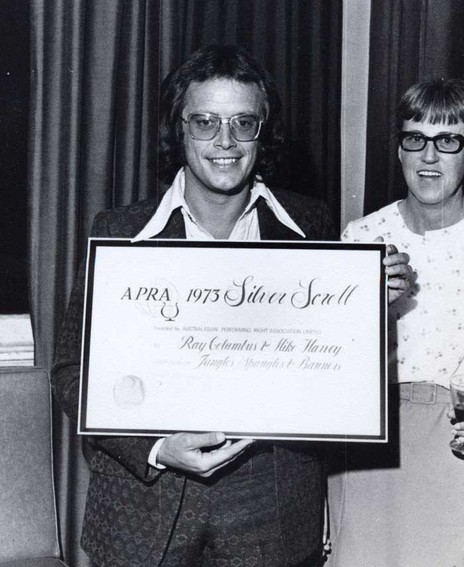
Ray Columbus next to Pat Bell, the guardian of the Silver Scroll, at the 1973 function.
“It was held annually at the Tāmaki Boat Club in Auckland and Pat attended to all the invitations and publicity, persuading composers to attend the function. Pat, by nature, assumed the position of hostess.” She knew all the composers personally, said Heenan, and nothing was too much trouble. She even organised taxis to get impaired composers home safely after meetings and functions. (It was a much smaller organisation in the 1960s.)
Heenan recalled she was very supportive of Bernie Darby, who succeeded her as APRA manager, even though “she did not quite agree with some of Bernie’s ideas about the Silver Scroll function. She very loyally went along with them and became an indispensible part of his team.”
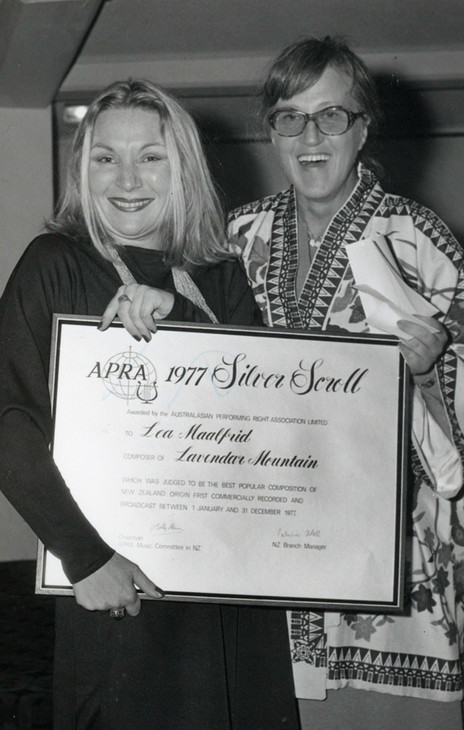
Lea Maalfrid and Pat Bell with the 1977 APRA Silver Scroll for 'Lavender Mountain'
Crucially, Bell got on well with John Sturman, for many years the CEO of APRA in Australia. He visited New Zealand often and supported the local composers’ case to have their own music foundation, “very much against the opinions of some of the Australian composers,” said Heenan. (For all the superior tone that Heenan’s comments often convey towards “the pop writers”, it was the early New Zealand composer members such as Heenan and Lilburn who lobbied the Australian head office to take New Zealand writers seriously.)
Bell was essential to the running of the Silver Scroll: its judging panel, and the event itself. “She knew the winner many days ahead of the announcement,” Heenan recalled, “but her responsibility was such she never let on who it was.”
In 1983 APRA presented Bell with a special award – and $1000 – to acknowledge all the extra work she had done for the organisation. She lived with relatives in Wellington, and was a keen traveller overseas and tramper. The household looked after many international students who were in New Zealand studying under the Columbo Plan, making lifelong friends.
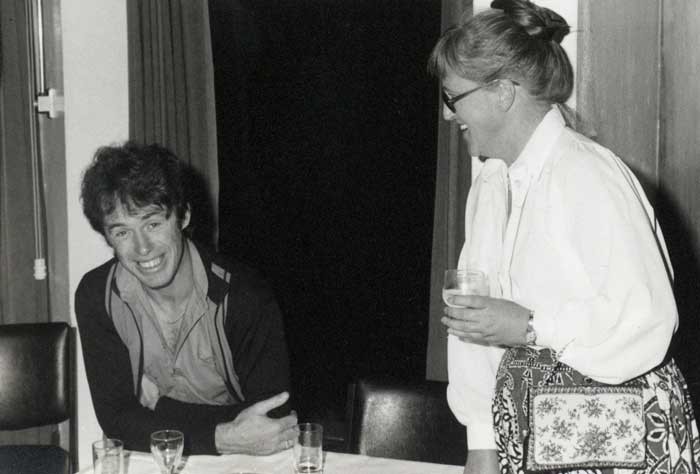
Wayne Mason with APRA's Pat Bell. Mason has been a finalist several times. In 2001 his song 'Nature' - the 1970 winner - was voted the best song of the previous 75 years.
While in Auckland for the Silver Scroll or other APRA business, she would stay with relatives. Among them was her young cousin Janet Hogan, who was “hugely impressed” by her work with New Zealand’s leading pop singers. “She was a wonderful person,” she says. Other aunts were “quite formal but Pat was much more in tune with us as the next generation.”
Hogan says “It’s a sadness that we didn’t talk more about her work at APRA.” From all reports, however, “in this day and age she would likely have been appointed as the manager.”
Pat Bell retired from APRA in about 1992, aged 67, just prior to the organisation’s move to Auckland. She settled in Waikanae but, later in the decade, became unwell from cancer. Despite the ordeal she wrote bright and positive letters to her nieces. Music remained central to her life. She continued to go to NZSO concerts until just before her death, in November 2000.
--