Jon Toogood has won the NZMA/Aotearoa music award for male vocalist of the year three times, for his work with self-dubbed “reasonably loud and heavy” rockers Shihad. The Foo Fighters’ Dave Grohl once called Shihad “the best live band on the planet”, and – with Hayley Westenra – they share the achievement for most No.1 records for any Aotearoa artist.
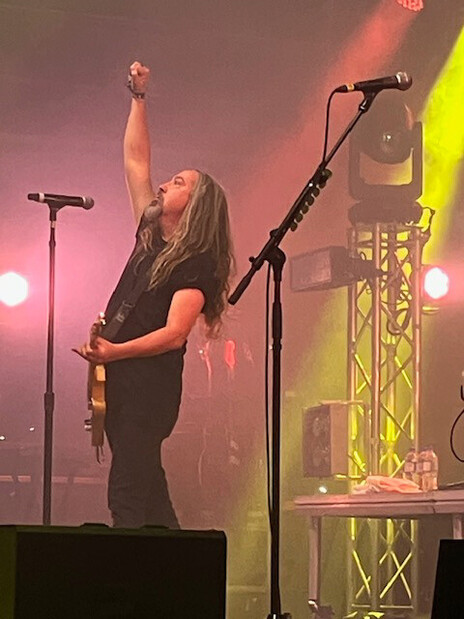
Jon Toogood playing with Shihad at the Homegrown Music Festival, Wellington, 15 March 2025. - Photo by Bee Trudgeon
He completed a Masters in Fine Arts from Massey University Toi Rauwhārangi in 2018, paving his path into music academia, amidst a plethora of side-projects. He’s done stints in broadcasting, including his Planet of Sound show for Radio Hauraki, and mentoring through the New Zealand Music Commission. Still, as it ultimately would for 37 years, Shihad always came first for Toogood – until now.
Watching him scream through a chest infection, while wielding an axe like Paul Bunyan, at Shihad’s final show at Meow Nui in March 2025, it was easy to recall the music’s roots in a bed of mayhem.
He tells me afterwards, “There’ve been times where we’ve been driving like idiots in crazy places, just crazy days of punishing myself, and then still waking up.”
That would, however, be ignoring the precision elements, and heavy lifting, at the band’s core. As Sunday crept toward Monday, no one present wanted the show to end.
At the distinctly un-rock and roll hour of 10am, on a Monday morning during Ramadan, just a week after that show, Toogood (who converted to Islam in 2014) has been up since 5.30am. He’s fasting, which means no food or drink between sunrise and sunset. He’s done the school lunches and school drop-off run since then, saying he misses not taking his part in such parental regularities when he’s away. With Shihad recently over, he says he and wife Dana still need to work out a way to share the task.
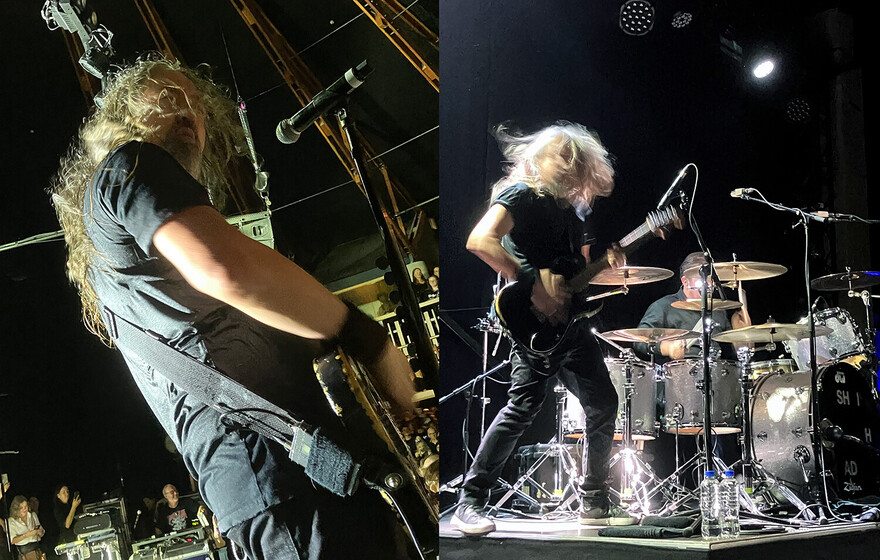
Jon Toogood in stereoscope at Shihad's last show, Meow Nui, Wellington, 16 March 2025. - Photos by Bee Trudgeon
Six months after the October 2024 release of his solo album Last of the Lonely Gods – which peaked at No.9 in the New Zealand albums chart – it’s impossible to avoid the topic of family. His new album reflects soberly on a series of family bereavements, and his children are the main reason he’s jumping off the Shihad juggernaut.
“I just feel like I want to be a dad,” he says. “My family is my priority. For a while, it’s always been that Shihad was the priority. There was always that understanding, and it's great, a unique commitment, but my kids are six and nine now, and when Covid happened in Melbourne, the initial shock of losing eight months work in a week, everything slowed down, and I got to see these beautiful kids I was missing out on. Everyone's so busy hustling, making sure that things get paid, that you miss things that are important. So, I‘m looking forward to them being my priority, rather than the band.”
The youngest of three children, born to a pair of “Ten Pound Poms” – both parents keen Spurs fans – Toogood recalls “such a loving upbringing.”
“I didn't realise we were poor,” he says, remembering a fun family dinner treat which consisted of toasting white bread in front of the gas heater.
He could have been a Black Cap, captaining a Wellington Secondary Schools representative cricket team that included future rugby league legend/Charlie’s juice entrepreneur Marc Ellis, and Dam Native rapper Danny Haimona. Meeting Tom Larkin at Wellington High School – “... he went, ‘Fucking join a band with me’” – changed the course of both rock and (potentially) sporting history in Aotearoa. While dad Mike may have initially been a bit disappointed, Toogood junior says his father came around once he saw the band was really driven and going places.
“I had very supportive parents, and that just went straight into Shihad.”
Under the initial guidance of the band’s manager Gerald Dwyer, Toogood, Larkin, and bandmates Phil Knight and Karl Kippenberger, would soon be touring the world, sharing stages with a veritable who’s-who of the biggest names in rock. Independently of Shihad, as well, Toogood would find music taking him from Wellington neighbourhood studio The Stench Room (where he Larkin, and Nigel Regan from Head Like A Hole recorded as SML), to Khartoum (for a visionary Aghani al-banat/hip-hop fusion project recorded under his The Adults moniker), and playing with bands as massive as the Christchurch Symphony Orchestra (for The Adults Live with the CSO album).
Toogood is a starring player in Come Together, the New Zealand supergroup with a various artists membership, who cover classic rock albums live on stage. Thus far they have recreated eight albums in their entirety, including The Beatles’ Abbey Road, Fleetwood Mac’s Rumours, Elton John’s Goodbye Yellow Brick Road, Neil Young’s Harvest and Live Rust, Dire Straits’ Making Movies and Brothers in Arms, and Tom Petty’s Damn the Torpedoes.
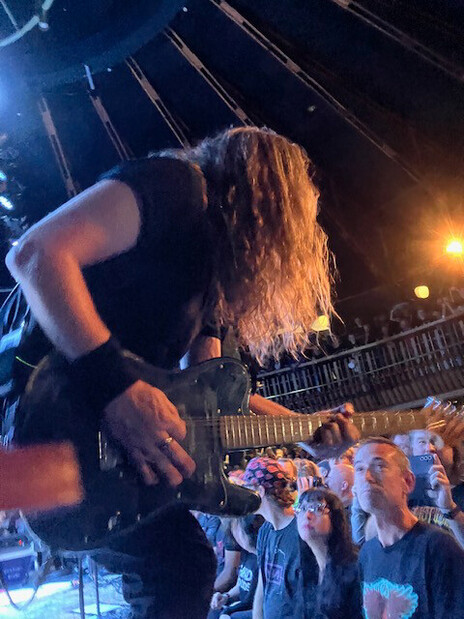
Jon Toogood at Shihad's last show, Meow Nui, Wellington, 16 March 2025. - Photo by Bee Trudgeon
Nevertheless, it’s hard not to imagine him being bracket-dubbed (Shihad frontman) for the rest of his life, even now that band is no more. While more than a few tears were shed for Shihad at their final shows in 2025, he says he has come out of them carrying the “joyful” emotions of the audiences.
“That’s the main emotion that I saw – joy,” he says. “Coming down off that feels pretty good, like being surrounded by joy, in this fucked-up world. Love it. I thought that two months of work was hard work, but it was also very satisfying.”
There was so much love in the audiences of the final Homegrown performance and surprise Meow Nui show. Some have even described the vibe in Meow Nui that night – perhaps aided by the building’s former use as a Salvation Army Citadel Church – as ”spiritual”.
“It ended up being a perfect place to end, beautiful,” says Toogood.
The power of a mezzanine floor, and the capacity for an audience to wrap around the stage, sees him comparing it to Auckland’s Powerstation.
“What I like about the Powerstation is, you can see every face if you look at it, and that's what Meow Nui does for me as well. It's actually quite big, but it's like, if I zone in, I can see everyone; like, big and intimate, perfect size.”
Of Shihad’s Loud Forever farewell tour, he says, “It was just as much about the audience as it was about us. It was to celebrate them, all their support, and all their love as well. So, it was a pretty positive experience. Every show had something magical about it. Every show had four guys that, you know, had our little barnies along the way, and we're quite different people. Still, every show was 110%.”
Watching him tearing around the stage – a constant whir of chopping arms, sneakered kicks, and long hair, periodically leaping up to play on the speaker at stage edge – one wonders how he balances the physicality of it with ageing.
“I try to walk about six to eight kilometres a day. I had kids late – I'm 53 now, sort of an older dad – so I want to stay as healthy as possible, and stick around for as long as possible. When it’s your time to go, it’s your time to go, but I'm doing everything in my power I can. I haven't drank alcohol for about six years – don’t miss it at all – and I do exercise regularly. The thing where I fall down is I’m a sucker for tasty food.”
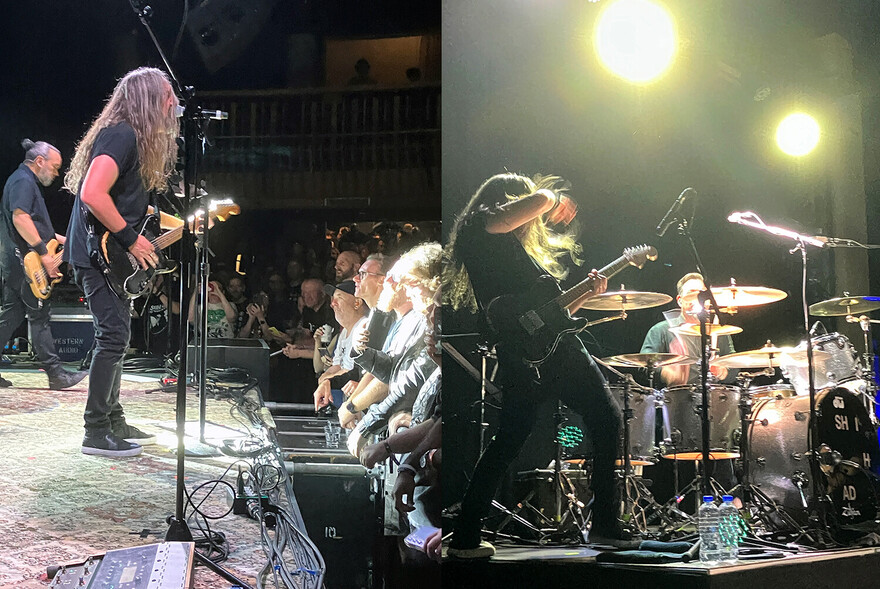
Jon Toogood at Shihad's last show, 16 March 2025: the final gigs got longer and longer, to ensure all their albums were represented. - Photos by Bee Trudgeon
He says that, prior to Shihad’s farewell phase of shows, 90 minutes was probably the limit of a show, but shows got longer and longer as the band strove to ensure all their albums were represented. Their final show – where they performed full-throttle, complete run-throughs of Churn and Killjoy in succession, then took requests, ending with a triumphant ‘Home Again’ – clocked in at well over three hours.
“Even the quiet moments are intense,” Toogood says, “So, yeah. So I'm amazed that my body could deal with it.” He acknowledges that the final gig turned out to be the longest show Shihad ever played.
Waiting in the wings, Dana – who had no idea of Toogood’s public profile when she met him – and his children, watched on. Seeing a thousand (let alone, many times, thousands of) people reach their arms out in your husband (or dad’s) general direction must be a little weird, no?
“I think they're really proud of my work in Shihad. They're really proud of me when I do my solo stuff. They see me for who I am. I perform in front of audiences. That's my job. It's an unusual job. It's not like their schoolmates’ parents, but it's still a job. This is what I do for a living. And I think they just enjoyed it. My son made it through pretty much the whole show. My six year-old made about an hour-and-a-half.”
He credits the fact his parents were working class Londoners with helping him to always look at being in Shihad as a great job, never seeing it as any more important than anyone else's job.
“I was very fortunate to find out that I loved music, really at an early age, and went on that journey to find out how music was made, and how do you perform live, and found three like-minded people who wanted to go on that journey too. So, very fortunate. But I never, ever, think my job is any more important than any other person’s job. It’s just a cool job that I made a living out of, which is ridiculous to me, because it’s something I would have done for free … but I would have had to subsidise that with another job.”
Perhaps he remembers, in the implied ellipsis, writing Killjoy in his head while sweeping a bakery’s floors.
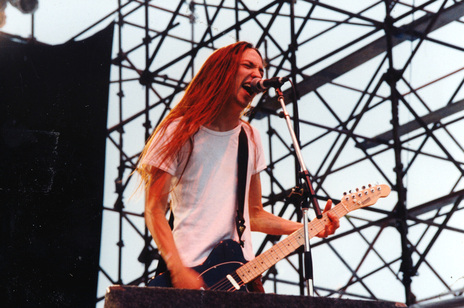
Jon Toogood fronting Shihad, Big Day Out, 1995. - Photo by Murray Cammick
His new album – Last of the Lonely Gods – is a different animal to any other he’s raised. It finds its creator both wounded, and healed – dealing largely with themes of personal loss centred around the deaths of his mother and brother-in-law. Doubly painful were the circumstances surrounding his mother’s final days, which occurred during a Covid lockdown, rendering him physically estranged from the bedside proceedings, having to bid her farewell in Wellington, over the phone from Melbourne. He moved home, in shock, in time to see his brother-in-law – “my older brother, for all intents and purposes” – become ill with cancer, and die within a year.
“It was just, like, whoa. Like, really? That? That was really brutal too, a one-two punch. I picked up the guitar, and I just wrote for myself. I think that was something I needed to do, and I think the circumstances made it easier to be honest with myself, and easier to tap into what I was actually feeling. It took a couple of songs – I think ‘Love is Forever’ was the first song I wrote …”
“You were there / Now you’re gone / Just a picture on my wall …”
“Okay, that's the feeling,” he recalls thinking. “Then I start to branch out. ‘Us Against the World’ was the last song I wrote, which is me becoming more at peace with it, but looking at what life is like going forward from there.”
“You better sing, while you can …”
Those two songs were placed side by side on the album, encapsulating the tone for this album of grieving and recovery.
“I think the more vulnerable,” he says, “the more human. Therefore, it makes you know what I’m saying, and people – creatures that are human, right – maybe find something to relate to in it. Not all humans, but if you’re being honest, and you're being vulnerable, I think that's good. I think that's the best actually, being honest and vulnerable.
“Sometimes, it’s hard. Sometimes I want to run away and go on long walks with history podcasts. I do that to stay sane. I'm an all-or-nothing guy. Always have been. When I want to connect, I want to connect fully, but then I’ll retreat into hiding.
I’ve never been one for both – I can't do it like that. You need to recuperate, and recalibrate. I can be very engaging, and then very not engaging. I get how that can completely drive people around me absolutely barmy.”
His interest in history is for educational purposes only. He says there’s no other time period he’d like to travel back to.
“I like living in the moment, and I like looking forward to the future. I don't like looking back. I like looking back to understand where you are now. That's how you find out why the politics of this country are what they are. You know, it’s so important to know where you are.”
Regarding the subject of his ever-present righteous anger, he mentions ZB radio host Mike Hosking asking him why he still holds onto it.
“Why am I still angry? Because there’s fucking inequality,” he says. “I was brought up by working-class people that always batted for the underdog. That’s why I look at the world going, ‘Well, why? Why are there people like that, and people in the same city like that?’ That's why I still get angry.”
“Why am I still angry? Because there’s fucking inequality,” says Toogood.
Early in their relationship, Dana — who he has described as unflinchingly generous – introduced him to the experience of feeding the homeless, “dragging” him to Flinders Street Station in Melbourne. This reinforced his fundamental antipathy towards the Western capitalist idea of mine versus yours.
Considering the politics of Aotearoa at present, he says: “I'm interested in pushing this country back to a bit more of an equitable phase. We’ve got biracial kids. We did a year in Howick when we moved back home. We found it wasn’ t the right place for us after Melbourne. It was pretty conservative. Christopher Luxon was our local MP [for Botany], and Simeon Brown [MP for Pakuranga] was just down the road. I’ d never really lived in a conservative place.”
The whānau subsequently moved their kids to a different school and resettled in West Auckland. Although his diary is rarely empty, Toogood says some serious time has been blocked out for writing in the immediate future.
“I'm going to take the rest of this year. There'll be a few things where I play and stuff like that, because I love performing, and I still love playing guitar, love singing, the art of singing, and the art of writing. So, I don’t think those things are going away. I think they’ll be a bit more paced …”
A return to Sudan is on the cards. “We haven’t seen my wife’s parents for a while. We need the kids to be around their grandparents, so we might go for a bit of a trip.”
We talk briefly about how he’s suffered from tinnitus since about the age of 21, and how it got a lot worse as a result of suffering Covid, which turned it up really loud, a volume from which it hasn’t retreated. He uses a bit of cognitive behavioural therapy, coupled with pacing himself, to address the issue, and playing acoustic guitar has been part of his centering process. His first-ever instrument was a 3/4-size nylon-string acoustic guitar, purchased for him by his parents when he was just seven. While talking about his mother, he reaches for an acoustic guitar.
“In the end, she got ill, and turned into the child, and we ended up looking after her,” he says of what he calls the “long goodbye” that was losing her to Parkinson’s Disease.
He clearly draws some primal comfort from holding an evolved version of the original instrument she helped furnish him with. He also intermittently toys with a pen, and a pair of spectacles, giving the impression our conversation is stirring something he doesn’t want to let slide, his mind constantly working at making musical sense of his world.
“I've been writing like a demon, and I’m still really, really in love with music, which is very lucky.”
--
Jon Toogood’s autobiography Home Again: My life and times in a band called Shihad was published by Moa Press in August 2026.
--