Jane Egan is one Aotearoa’s most highly respected music teachers – this was acknowledged when she won the Kaiārahi Puoro o te Tau | Music Teacher of the Year award – at the Aotearoa Music Awards in 2021. Jane has taught at Gisborne Girls’ High School (GGHS) since 1996 but initially started at the school as a year nine student in 1988. It is a very rare thing to have spent close to 40 years in one school environment – and I believe this is one of the reasons that GGHS music department is one of the most successful in Aotearoa.
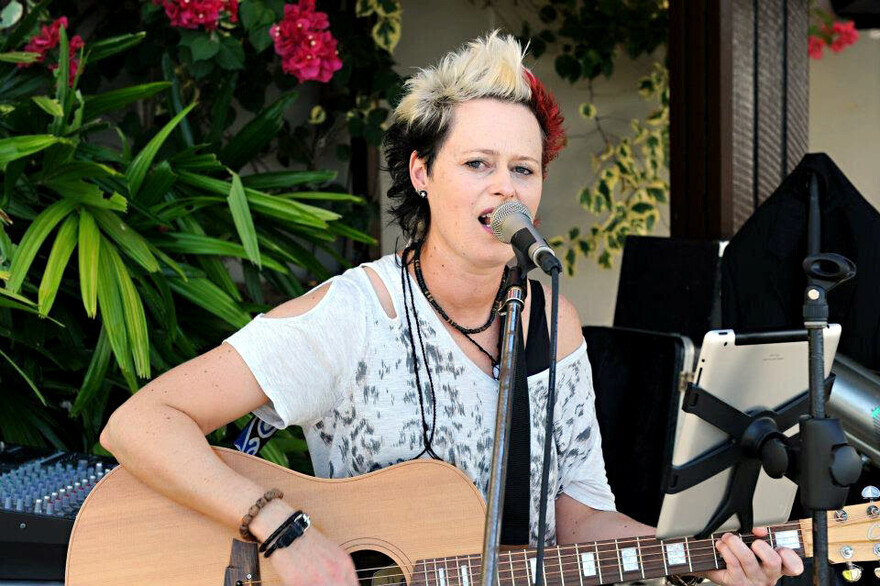
Jane Egan
Gisborne Girls’ High School is a high achieving school with strong and repeated successes in Smokefree Tangata Beats national finals and Play It Strange – GGHS has taken out the School of the Year with the most songs in the top 50 eight times.
Early music experiences
Jane’s musical journey started when she asked to learn the flute. “I don’t even remember requesting that but my mum swears I did. Back in the day I did the Bentley Test and did quite well”.
The Bentley Test is an archaic aural test which was used in almost every music class in the country (and overseas) to “test” a students “aptitude for music”. Many schools used this as a blunt tool to “rank” students for music lessons, directing learners with high scores to certain instruments.
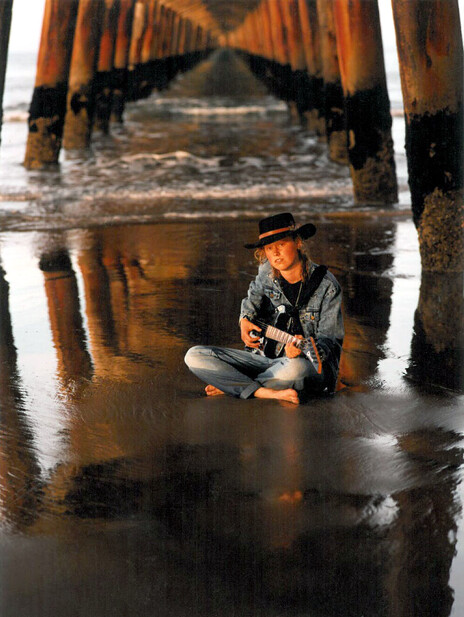
Jane Egan
“I learned flute during primary and intermediate, then at Gisborne Girls’ High School. I was pretty shy – I’d come from a rural school where there were only eight in my class, and I was put in this year 11, 12, and 13 music class. The only reason I was actually in that class was because the music teacher was really nice to me – I took the subject because she was really lovely. She’s 84 and still one of my best friends. She lives three doors up, so it’s awesome to have her still around and in my life.”
Jane’s high school class was mixed levels and things changed when a “really cool” year 13 wandered over and said, “Do you want to be in a band?” Jane was so terrified that she just said yes on the spot, the student then asked “do you play guitar?” – she didn’t, but went home and told her mum “I need to know how to play guitar by tomorrow”. Fortunately Jane’s mum played guitar and Jane had tinkered as a child, so she launched into playing and her life became all about guitar from there.
The craft of songwriting
Jane became friends with Mahinaarangi Tocker through her work as a mentor with the New Zealand Music Commission. From Mahina, Jane learned a lot about songwriting, and Jane identified that this was a seminal period for her own songwriting development. Mahinaarangi had a huge impact on Jane and was one of her biggest inspirations. Mahina eventually asked Jane to play a few gigs and introduced her to Shona Laing who also came to mentor for NZMC.
Jane has always made the most of the opportunities that bloom when mentors connect with students. When mentors came to Gisborne Jane would try and organise gigs for them so they could earn a little extra money. Jane played a gig with Shona because she had worked with Mahina. “We did a set of Mahina’s songs and there was some kind of synergy that happened on stage. It was pretty awesome.”
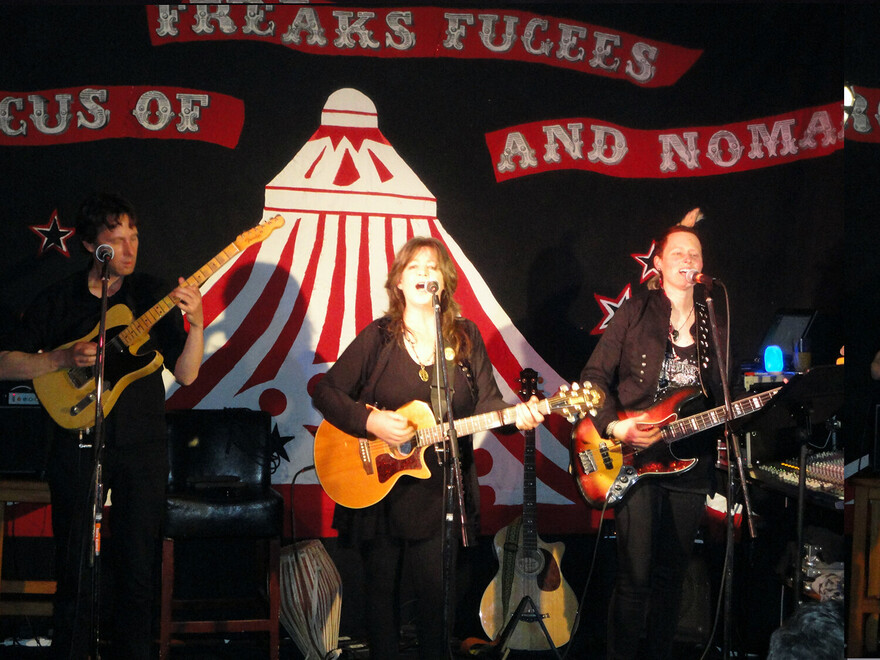
Jane Egan playing bass with Shona Laing
After this Shona asked her to go on tour with her. “I don’t have a spot for guitar because we had a guitarist from Christchurch, so do you want to play bass?” So at this point Jane launched into this six month crash course playing bass.
“I took six months off work and did a bit of touring with Shona, so that was cool. I learned heaps about songwriting and always will be very appreciative of what I learned from Shona and Mahina – it definitely has helped me with my own writing and also for teaching songwriting in the classroom.
“Being able to study someone like Shona and her back catalogue is a privilege. Being up front and close to songs written when someone is 15-16 and then observing their development/trajectory over decades is extremely inspiring. How technology developed during this time was a major game shifter. This was when music technology developed rapidly and women taking up MIDI and tech stuff in the country were such a minority. Yeah, there was a lot of learning in that time.”
Jane spoke of her “imposter syndrome” as she had not explicitly studied sound technology formally. From all of the practical experience she has gained by just doing it – she has now come to the conclusion that she is skilled and can be an excellent role model for other women to give it a go. “Yeah. I think I’m very lucky in terms of that tech and stage stuff. I feel quite respected when I’m doing the Rockquest and Tangata Beats finals, when I’m on stage.”
From my perspective, some of the best professional development that I have ever done was in workshops Jane presented at MENZA (Music Education New Zealand Aotearoa) and teaching delegates about sound technology and songwriting.
The pressures of teaching music
In term one Jane found herself stepping forward to pick up some additional teaching over and above her day to day classroom teaching leading a department, and extra curricular responsibilities. The pressures on a teacher in a thriving department and with leadership responsibilities are immense. There are a number of extra pressures on top of your day to day teaching that other subjects do not face. Jane has pondered about “what’s next” but hasn’t yet found anything to draw her away from teaching.
When asked about being able to balance work and life – Jane replied “I don’t think there is a balance. It’s interesting because a kid said to me a couple of weeks ago, what did you do on the weekend?” I said, ‘Well, I went and played. We had a three and a half hour gig at a restaurant and then I went to “Relay for Life” and played another gig with two bands.’ The student responded with ‘Miss, did you know your whole life is like music?’” It caused reflection and Jane acknowledged that it is very hard to not give all of yourself as a teacher – especially as a music teacher in a thriving music space.
Personal philosophy
Jane says that it is her expectation – and she explicitly says this to her students – “we look after our own. If you’re going out there and you’re going into the industry and there’s one of ours that needs help – I want you to know you are personally responsible to help them”. This is VERY important to Jane
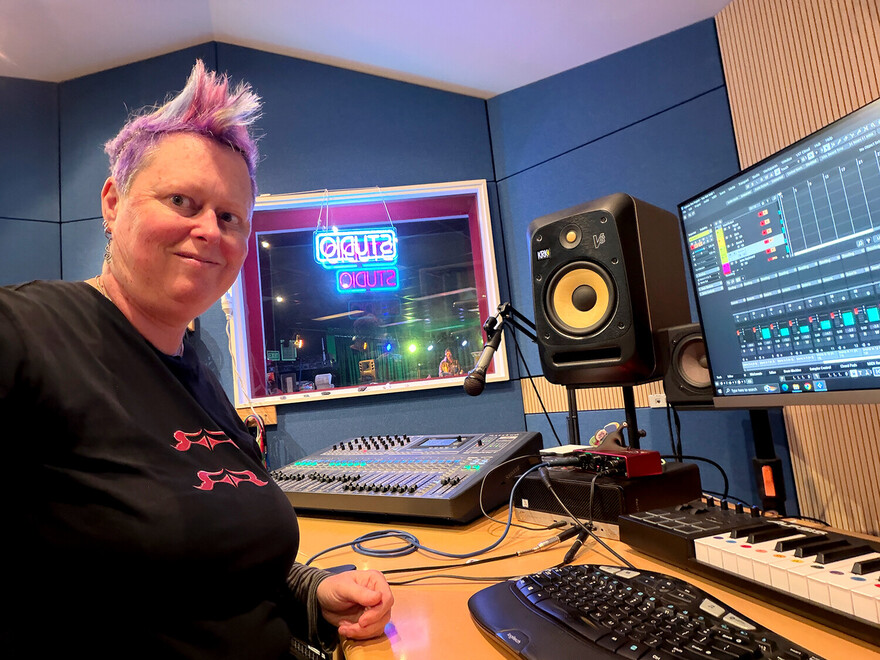
Jane Egan
“I had a student working on the “Waiata Anthems” project at Massey University. She was a student at GGHS. She was doing translation for someone who was recording a single down at Massey Uni and then the person who was putting all of that together was another one of my past students. It was really cool seeing those people looking out for previous people.
“I think for us when we build kids up we get them to a point where they’ve got great things happening and then they leave/graduate. In my classroom we have a celebration wall and it highlights past students that have gone into the industry. So what I am probably most proud about seeing is seeing it going out further and we’ve got people in movies and TV. So we’ve got Bronwyn Turei, Roimata Fox, and Tioreore Ngatai Melbourne. So we’ve got those women in film who came through music. We’ve got people like Tessa Hills who’s performed at Glastonbury as a DJ, and Lucy Suttor who’s in the band Dick Move.”
In my opinion Jane has created a “scene” and a “Gisborne sound” – creating a new “scene” through a single music department is a very special contribution to music in Aotearoa.
Smokefreerockquest
“My first Rockquest was in 1991, as a student playing in Rockquest – back then there wasn’t a regional in Gizzy, so we actually had to travel to Hamilton. So we got on a bus to Hamilton, we played on a floor in a gym and then the next year, they brought it to Gizzy.”
Jane was a huge fan and supporter of Smokefreerockquest so she would hang out being helpful until she was finally offered some work. “So my first kind of jobs were tuning and being on the side of the stage as a guitar tech.”
Her persistence paid off and she was offered other Smokefreerockquest gigs and jobs.
“Eventually Napier was added on and then there was a great night in Napier where Glenn (Common) said to me, do you want to take over from me on the road?” Jane instantly said yes. “I’ve worked my whole life for this and I’ve been there ever since. So I’m fiercely loyal to Rockquest. I love what we do. I really believe in who we are and what we give. So, it’s a really important part of who I am.”
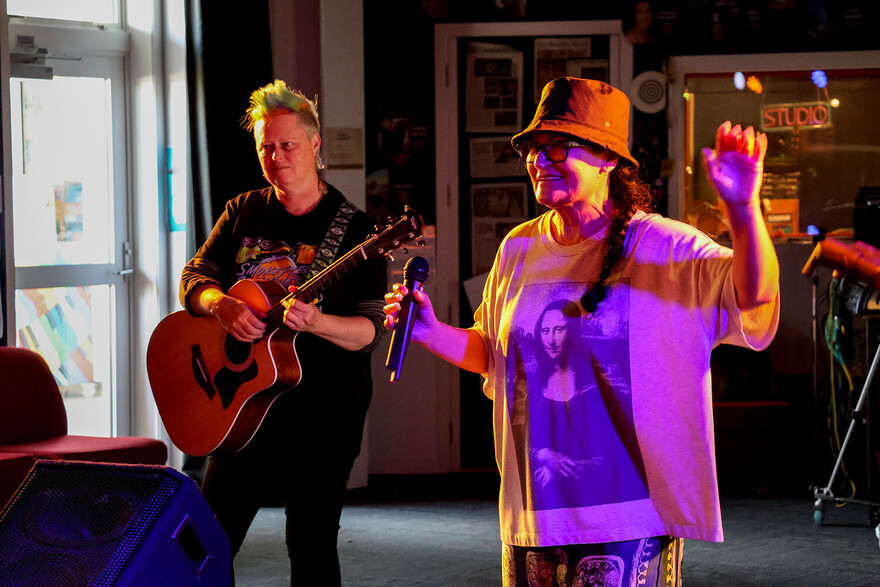
Jane Egan and Annie Crummer
“But I think what excites me is that we’re very much a grassroots organisation.” Jane described going to visit the Nelson office for the first time and thinking she had been given the wrong address when she arrived to find a very basic office. “Funding is not spent on fancy offices – everything goes back to the kids.”
Post-Covid student behaviour has changed significantly – there is more anxiety in the classroom, and teachers not only teach their subject, they must also notice those moments of struggle for students. “Yeah, it’s just such a demanding job, we do a lot of counseling in classes and we’re not trained counselors. Music seems to provide the space for emotions – you can’t just walk into a room and not provide support through referrals to support systems – like counsellors. It’s the nature of the job. It’s amazing what a teacher can learn from the lyrics their students write.
Life balance
For Jane, life is a balance of teaching and learning, role modelling by being a professional musician and sound tech, her long term relationship, and birdsong and the calmness in her garden. May she long be a teacher – her contribution to our music industry has had a huge impact which has supported the development of dozens of students who now move around in the music industry and creative arts in general. Jane is truly a tāonga in Aotearoa.