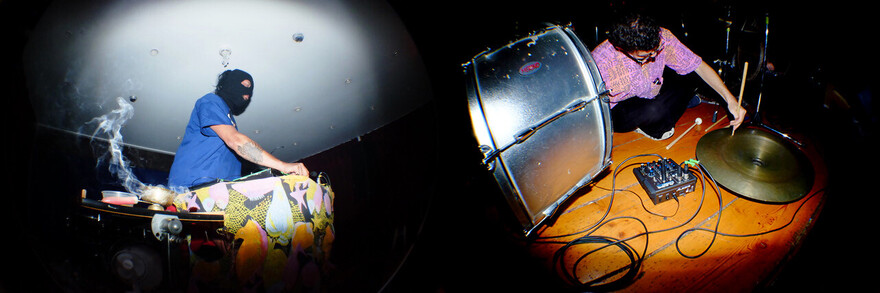
E N T at Pyramid Club, November 2017 x Chris Wratt at Pyramid Club, December 2017 - Photo by Evan Dubisky
We shuffle into the room and sit down in rows of white plastic chairs, close enough that I’m aware of other people’s coats touching mine. Voices drop to a murmur as sounds drift in through the open windows: tires hissing on wet asphalt.
Trying an audio experience that sits outside contemporary popular music always feels slightly risky to me. I don’t know the artist or her work. I’m not sure what’s expected of me. Will I understand it? Can I look at my phone while it’s happening, or would that be rude? I register where the door is, and how many people I’d have to pass to leave without being obvious.
I go to the small bar at the side of the room, which is dimly lit and cash only. I buy two cans of beer, counting out the coins. As I return to my seat, the house lights dim, and we are immediately hushed.
The stage is framed by heavy blue velvet curtains, with patterned rugs laid across the floor. A single pink light comes on. A woman walks out. She’s Singaporean, wearing a black pinafore dress, and she moves in an unselfconscious way, like someone crossing a familiar room at home. The stage is low, which makes her feel close to us, less elevated than present. She faces forward, looking past our heads rather than at us, and we sit together in silence for a moment before she begins to sing.
The melody is strange and reedy, not recognisable to me as a song in the usual sense. It feels improvised but also oddly settled, as though it belongs to her in a deep way. I find myself paying attention without deciding to. I stop thinking about whether I’m enjoying it and just follow the sound as it unfolds. I wonder where it’s taking me, though I don’t feel impatient for it to arrive anywhere.
At one point, she steps into the audience, vocalising sounds that feel uncannily familiar, though I can’t place where I’ve heard them before. Moving through different parts of the room, she explores the sonic resonances as her voice bounces off walls, corners, and glass, creating shifting textures and vibrations.
We remain transfixed by the quiet intensity of the performance. If anyone were to speak, the spell would shatter – but no one does. We stay suspended in the environment she has created. When it ends, we know. There’s no gesture to mark it, but the moment arrives clearly. We clap, a little tentatively at first, then more fully. Afterwards, she talks with people who come up onto the stage, answering questions, listening to what they want to say. I learn that the piece is about babies’ sonic play, about motherhood.
The performer is Dr Natalie Alexandra Tse, a member of SAtheCollective (SA) Ltd, an innovative arts company based in Singapore. Tse’s work spans performance, research, and sound practice. The performance took place at Pyramid Club.
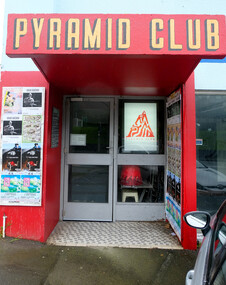
Entrance to Pyramid Club - Photo by Daniel Beban
Pyramid Club is an artist-run venue, listening room, gallery, and collection of studios on Taranaki Street in Te Whanganui-a-Tara, Wellington. The club is dedicated to experimental practice and performance by artists whose work sits outside the scope of commercial music. Both national and international artists are featured, exploring a broad spectrum that includes sound art, noise, drone, avant- and free jazz, ambient, glitch, electroacoustic music, experimental electronica, avant-metal, art rock, and other hybrid forms that resist easy classification. The sheer range of cross-pollination is striking.
Field recordings, sound collage, and indeterminacy (chance music) are common tools. This is music you won’t hear on commercial radio or see promoted on streaming platforms alongside advertisements for major artists. That’s precisely what makes it refreshing. Creativity here is not constrained by industry expectations of marketability or success. While the work may sound serious, there is also humour, joy, and playfulness, depending on the artist’s intentions and personality. Experimental music feels like it’s operating as a psychedelic effect on my brain, subtly and permanently altering how I listen to and think about sound.
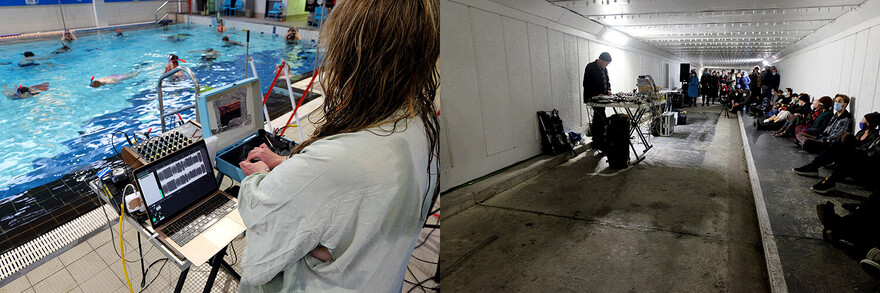
Left: Ducklingmonster, underwater listening event at Kilbirnie Aquatic Centre, Wellington, November 2022. Right: Omit offsite at Wellington Airport Pedestrian Tunnel. Presented by Pyramid Club in April 2022. - Daniel Beban
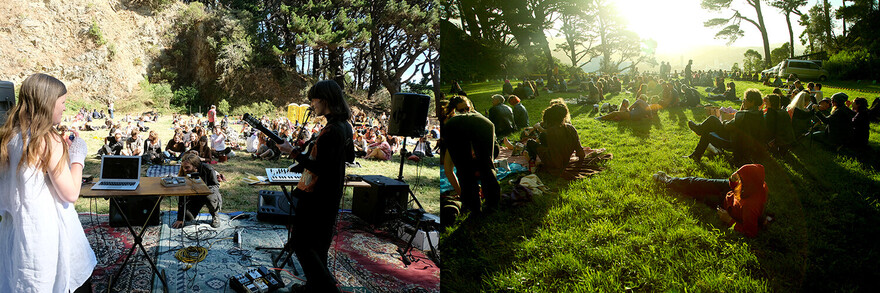
Left: Lorazepam, featuring (L-R) Lora and Lochi, 2024, Mt Victoria quarry. - Daniel Beban. Right: a quarry gig c.2023. - Thomas Lambert
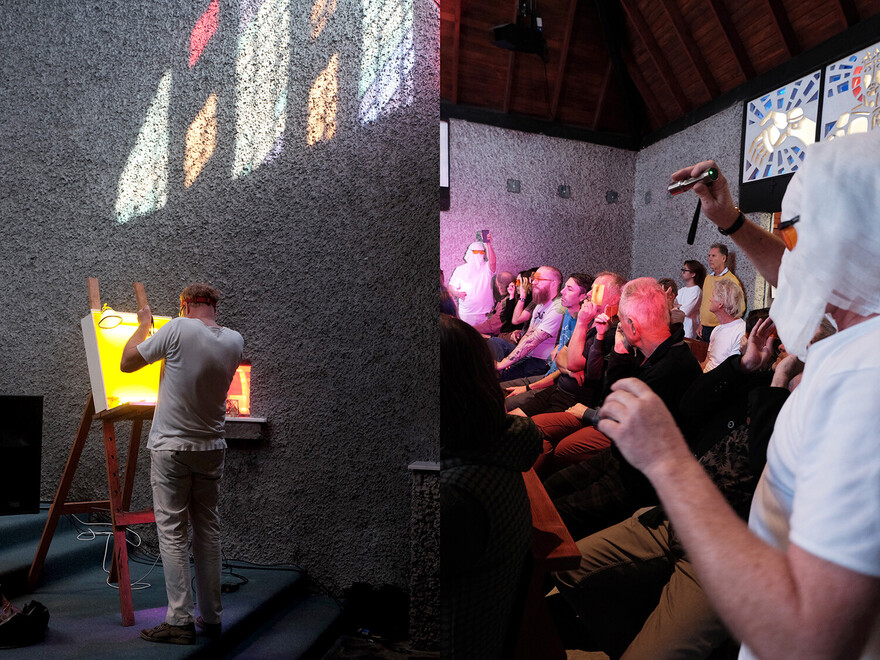
Tim Barlow, offsite at Futuna Chapel, Karori, 2023, from two angles. - Daniel Beban
Pyramid Club operates as a not-for-profit organisation, supporting non-commercial musicians and fostering alternative culture in Wellington, with connections throughout Aotearoa and internationally. While most events take place at the Taranaki Street venue, others occur offsite in the bush, reserves, chapels, private homes, or in collaboration with partner organisations.
Artists who perform at Pyramid Club range from seasoned practitioners to first-time performers, as well as musicians transitioning from pop or rock contexts. Line-ups usually feature two or three acts curated to complement or productively contrast with one another. Even radically different performances can share a bill, thanks to the considered oversight of director and curator Daniel Beban.
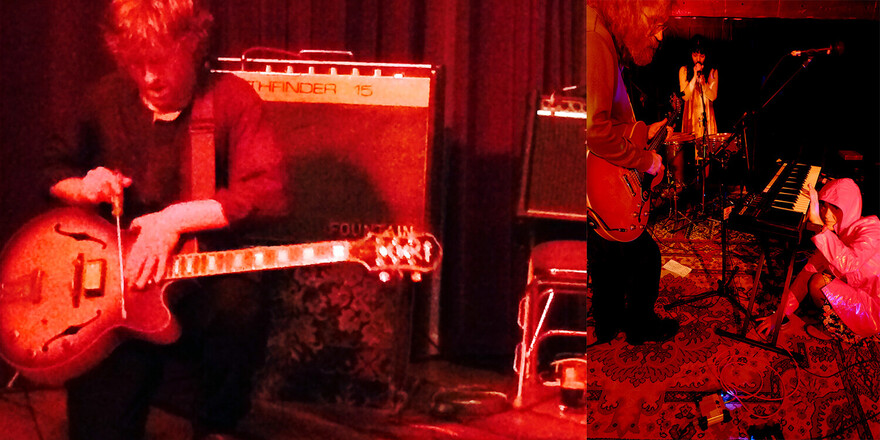
Left: Daniel Beban at Pyramid Club, May 2014. Right: Negative Nancies at Pyramid Club, 2019 (Mick Elborado, Tess Mackay, Emilie Smith).
The venue is run by The Sound and Light Exploration Society (SLES), a registered charity and collective of practicing sound and visual artists. Its board includes Daniel Beban, Nell Thomas, Jonny Marks, Nicole Gaston, Thomas Lambert, and Ruby Solly. Grounded in sustained study, firsthand practice, and extensive overseas experience, the group brings a deep and informed understanding to the local scene, strengthened by ongoing connections with similar organisations internationally. The SLES traces its lineage back to earlier Wellington artist-run spaces from the 1970s onward, including the Braille Collective and Artist Coop.
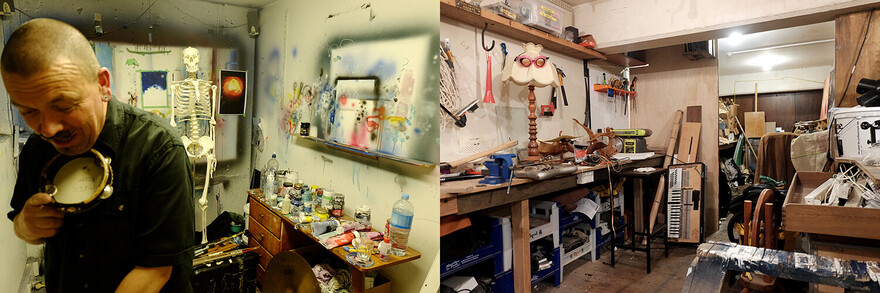
Left: Kieran Monaghan, Pyramid Club's Pyramid Power Festival, May 2019. Right: Pyramid Club's workshop space, June 2024. - Daniel Beban
Alongside its role as a music venue, Pyramid Club provides 10 studio spaces for sound and visual artists. It commissions and curates creative projects and festivals, hosts artist and inventor talks, publishes audio works and essays, runs free improvisation nights, workshops, screenings, exhibitions, and symposiums, and maintains strong links with Victoria University of Wellington’s Sonic Arts programme and festivals such as the Wellington Jazz Festival. The Club offers rehearsal space, operates its own recording studio, and records all live performances, which are made freely available through its online archive. Podcast interviews with artists from a wide range of disciplines are also published.
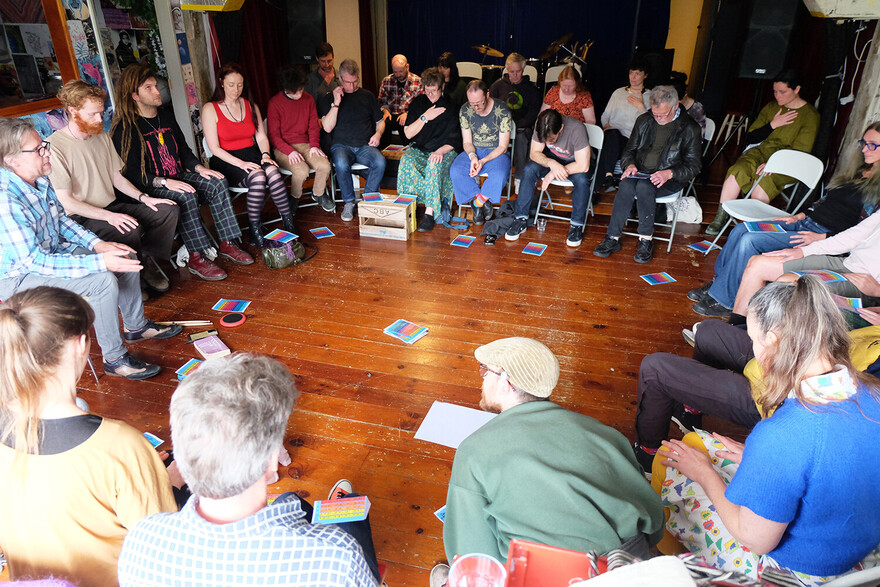
Chris O'Connor workshop in 2023. - Daniel Beban
The current iteration of Pyramid Club grew out of the Frederick Street Sound and Light Exploration Society (Fred's, 2009–2012) and the offshoot space The Garage (2012–2013) in central Wellington. Fred's was established by Beban and the community behind previous Wellington experimental music and arts venues Happy (2003–2009), and The Space (1999–2003). Happy and The Space were founded by musician/sound artist Jeff Henderson who moved to Auckland in 2012 and now runs the Audio Foundation.
The Club gained particular momentum during its time as Fred’s, in an old church on Frederick Street, where interdisciplinary collaboration between musicians and visual artists was actively encouraged. The move to Taranaki Street in 2014 was aided by the acquisition of some of Henderson’s PA equipment, left behind when he relocated.
Pyramid Club functions as a listening room: a small, intimate venue designed for focused listening. Located on the first floor of a warehouse, the space has a DIY, basement-style atmosphere reminiscent of New York venues. Capacity is around 90 people, with seating for approximately 60 on chairs, floor cushions, or standing room. The low stage blurs the boundary between performer and audience, encouraging immersion. Modest stage lighting and a video projector are available, and the overall feeling is closer to a shared living room than a traditional music venue.
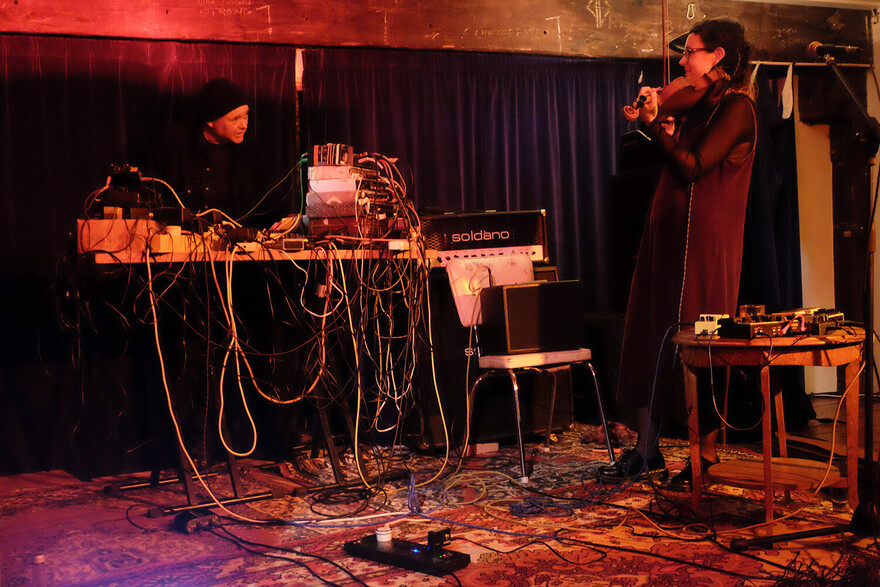
Clinton Williams and Anita Clark at Pyramid Club's Pyramid Power Festival, May 2019. - Daniel Beban
Listening rooms require a particular attentiveness. Talking during performances is discouraged, and audience members may be gently shushed if they become distracting. Every sound – whether microscopic or overwhelming – can be heard clearly. During a performance by Anthony Pateras and Daniel Beban, Pateras’s aggressive electronic blasts made me physically jump, while Beban responded with ambient murmurings on a vintage reel-to-reel tape deck. The contrast worked beautifully. We could hear every intention as the musicians conversed in real time, weaving a piece on the spot.
This kind of listening experience is difficult to achieve in conventional venues, where music often competes with chatter, clinking ice, and background noise. Here, volume can remain comfortable, earplugs are unnecessary, and short sets (typically 20-30 minutes) support sustained concentration.
Internationally, listening rooms are gaining popularity among audiophiles and adventurous music lovers. These spaces are often discovered rather than advertised. While some boast rare audio equipment or carefully curated playlists, the deeper appeal lies in how music is experienced – as something that reshapes perception, slows time, and invites deep attention. Whether listening to contact microphones capturing mushrooms absorbing water, or a cherished vinyl record played on a high-end stereo, the emphasis is on presence and listening.
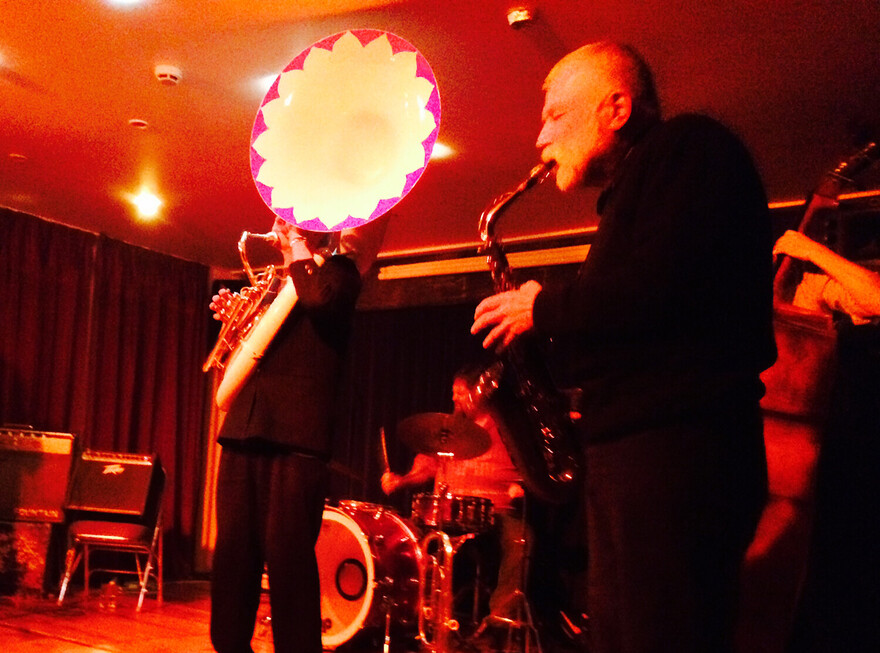
Gerard Crewdson (sousaphone), Rick Cranson (drums), Peter Brötzmann (saxophone), Tom Callwood (double bass) - live at Pyramid Club, May 2014. - Daniel Beban
First-time visitors to Pyramid Club often express surprise that they hadn’t heard of it sooner. The Club does little formal advertising beyond a beautifully composed newsletter for folks on their mailing list. The Facebook and Instagram pages link to the Pyramid Club website. Many people arrive through word of mouth. Tickets can be purchased at the door or on Under the Radar. In a cultural landscape saturated with promotion and branding, Pyramid Club communicates simply and directly to a community with shared interests. It exists as an embodiment of its organisers’ ideals and as a deliberate alternative to mainstream music culture.
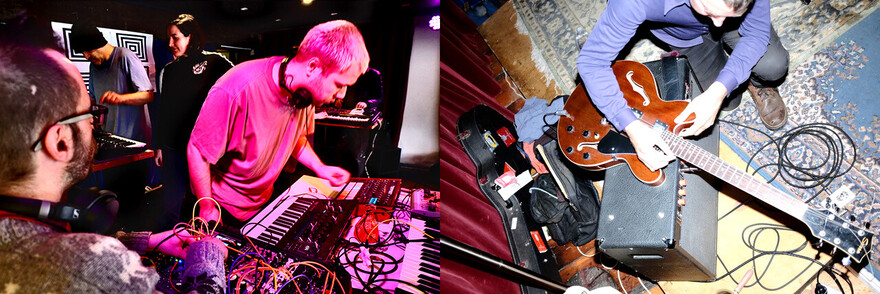
Left: Murdabike Orchestra (Isaac-Smith, ISO12, Rachel Blackburn, Nikolai Sim, David Sanders) at Pyramid Club, October 2023. - Daniel Beban. Right: Peter Porteous at Pyramid Club, November 2017. - Evan Dubisky.
Operationally, the club differs markedly from other Wellington venues. Shows start early and finish before 10.30pm. Alcohol is available but not central; volume levels remain moderate, and the focus is on experimentation, works-in-progress, and new ideas, rather than a polished spectacle. Much of the music is improvised and unrehearsed, and there is a noticeable absence of rock-star attitudes, with more nuanced performances. Performers are always paid, no venue fees are charged, and the emphasis remains firmly on creative integrity.
Like all venues, Pyramid Club is affected by broader pressures – gentrification, rising rents, and increasing power costs. Despite modest arts funding and ticket sales, maintaining financial viability while staying true to its principles is an ongoing balancing act. What you won’t encounter, however, are popular or commercial bands. Even the music between sets is more likely to be Sun Ra or Nala Sinephro than chart hits. However, spaces like this are important to the life-blood and culture of any city and community of artists with a long and influential history. Through volunteer labour, careful curation, and thoughtful financial management, Pyramid Club has sustained a distinctive and vital presence in Wellington’s cultural life. It continues to champion non-commercial, original, and exploratory music, and offer a rare space where listening itself is the main event.
Archival live streams from Pyramid Club
--