Ko Hikurangi te maunga.
Ko Waiapu te awa.
Ko Putaanga te tīpuna.
Ko Tikitiki te ahuru mōwai.
Ko Ngāti Porou te iwi.
Tipuranga
Henare Rangihuna Waitoa was born on 13 April 1910 in Te Araroa, on the East Cape. His parents were Te Wai Nepia and Reverend Wī Paraire Rangihuna. Henare was gifted to Reverend Hone Waitoa and Ani Copeland, who also raised 10 other children and they all resided in Te Araroa for a time. At the age of six, Henare went to live with his eldest sister Ema Ryan.
Kura
Henare Rangihuna Waitoa didn’t necessarily have an illustrious journey with education, however he was very rich with the learnings and teachings of his elders and hands-on experiences. These ensured that he could provide for his whānau. He attended te kura Māori o Te Araroa and then went off to Te Aute College in Hawke’s Bay, where he stayed for two years.
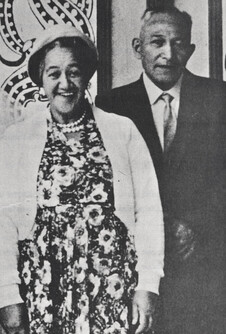
Henare Waitoa and his wife Amiria Te Atamira Karaka. - Waitoa family collection
His elders had gathered enough money to send him to Te Aute but after two years Henare decided to leave school and return to Te Araroa and work in the farming and dairy industry. The reason for leaving Te Aute after only two years was because Henare found out that it was his elders who were putting their hard-earned money towards Henare’s school fees, living costs and uniform exspenses.
Kāinga
In 1931 Henare married Amiria Te Atamira Karaka and they settled in the Mokonui district, near Te Araroa. They continued farming and dairy in Mokonui for at least five years before moving south to Tikitiki with their seven children. Later on they adopted two more children. They earned a living by dairy farming and all of their children would help to make sure that jobs were completed daily.
Mahi
The family’s main source of income came from dairy farming and other odd farming jobs. Sometimes Henare would be paid in money and other times with kai. Tikitiki was a thriving community where everybody knew everybody and there was plenty of work for families to sustain themselves. It was a tight-knit community in which everything was done together.
The local Tikitiki native school was opened in 1887 and in 1940 a new main block of classrooms was added to acknowledge Te Hokowhitu a Tū soldiers who went to the Second World War. This block was called Pae-o-te-riri and Henare and Amiria frequently and actively supported the school and its endeavours.
Henare and Amiria participated in the many kaupapa at the local kura, and they were active patrons of the local sporting and cultural kaupapa that were held in Tikitiki and right across the East Coast. Also, they formed a haka group that consisted of aunties and uncles as well as cousins and siblings and their children; this became known as Te Roopu haka o Ngāti Putaanga. They attended several hui throughout the country as well as Koroneihana gatherings and numerous kaupapa throughout Aotearoa.
Ngāti Putaanga were often called upon by Sir Āpirana Ngata to attend various kaupapa such as opening ceremonies for wharenui, hui ā iwi and other fundraising and community hui to support the kaupapa and entertain the masses. This period was known in our family as the golden years for Henare as is for these occasions that several of his compositions were created and performed by the whānau of Ngāti Putaanga.
Tito
Henare Waitoa composed many waiata for many different occasions and for various reasons. These included composing waiata to raise funds for marae and other kaupapa across the East Coast, and composing waiata for Ngāti Putaanga to perform and different events around the motu. There are many waiata that were composed by Henare that are still being sung by descendants today.
The period of 1940-1965 was considered the most prolific time in Henare’s composing career. Among the waiata he composed are:
‘Karanga mai’ (1940s) – A song of welcome by Henare Waitoa, including two verses by Sir Āpirana Ngata.
‘Awhi mai i ahau’ (1940s) – “Embrace me”, a traditional waiata by Henare Waitoa.
‘Pae o te riri’ (1940s) – This waiata was composed for the opening of a new block of classrooms at the school as well as the unveiling of a memorial tablet that acknowledges and honours the deeds of the many Ngāti Porou and local soldiers who fought in the Second World War. This particular waiata became somewhat of an anthem for the school, spanning across several decades.
‘Tomo Mai’ (1946) – This was written for the welcome of the soldiers who returned home from the Second World War. Henare was asked by Tā Āpirana Ngata to compose a song that would be used as part of the welcome celebrations for the soldiers who returned from the war. The song’s name was coined while Henare was out splitting firewood one day. Āpirana was spotted entering through two piles of chopped wood and Henare asked his brother in law how would he describe Āpirana’s entrance. The reply was “Tomo mai” – “Come in”. [“Welcome Home: the birth of ‘Tomo Mai’ aka ‘Hoki Mai’” tells of this song's evolution.]
Henare Waitoa composed many waiata for many different occasions and for various reasons
‘Moni Penihana’ (1946) – This waiata was a song composed to encourage Te Tairāwhiti to continue their support for Sir Āpirana Ngata as the member of parliament for the East Coast. Āpirana had long represented the area in parliament but in year he had local opposition forming in the form of the Rātana-Labour movement, and he was replaced by Tiaki Ōmana.
‘I hākiri tō reo’ (1962) – written for the ‘Hui tōpū’ that was held in Waikato.
‘Toro noa’ (1967) – adapted from the melody of ‘My Shoes Keep Walking Back to You’ (recorded by Bob Wills and Johnny Cash), which Koro Dewes says was a rare translation by Henare.
‘He tau manaaki mai’ – Wi Waitoa, Henare’s son, born in 1935, told Koro Dewes that this song really illustrated the spirit of his father.
‘Hauiti’ – A composition honoring the ancestral lineage of the Ngāti Porou.
Henare Waitoa was known for his skill in using well-known tunes of the time to carry the messages within his compositions. This would prove to be a powerful tool that engaged all generations of the community as well as keeping te reo and tikanga relevant for all.
During the 1950s-1960s Henare became unwell and it was his love for music and composition, as well as his whānau, that kept him going. When Henare was unwell he would just sleep and his wife Amiria would encourage their children to leave him alone and let him rest.
However if Henare was playing guitar, tapping his feet to a rhythm or humming or singing a tune, then the whānau knew that he was feeling well and things were looking up for him.
Despite the up and down nature of his health, he still composed waiata that continue to stand the test of time and his waiata are still being sung to this day both by his descendants and the vast majority of Aotearoa.
Henare passed away surrounded by his loved ones in the year 1968, aged 57. The reason for his passing is still unclear as he became sick during one of his visits to Wellington around 1960. He spent time in Porirua Hospital looking after his health and making a full recovery before returning to Tikitiki.
Henare never really fully recovered from his sickness and once he passed he was mourned by the multitudes who gathered to pay their respects and acknowledge the contribution that Henare made to Ngāti Porou, to Te Tairāwhiti and to te iwi Māori throughout Aotearoa. His waiata have given insight to the life and times of our elders as well as the thoughts of our kaumātua during the Second World War.
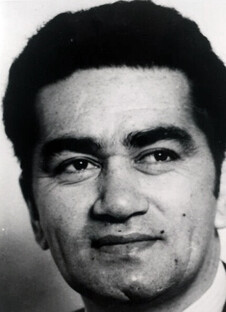
Ngāti Porou kaumātua and scholar Te Kapunga Matemoana (Koro) Dewes. - VUW photo, c. 1970
In Koro Dewes’ thesis about Henare, he quotes the famous Ngāti Porou carver Pine Taiapa, who wrote to say, “I knew Henare Waitoa well, and he’s remembered by me for his song ‘Karanga mai’. He was able to summarise his thoughts in very few words. He wrote songs about everything of his own time, he even composed a song in praise of the pension/benefit. Because of his ability to reflect the soul of the Māori people and indeed the people of Ngāti Porou, he has left many compositions for future generations to treasure.”
Henare Waitoa is regarded as one of the renowned composers of his time especially during the Second World War. His compositions have inspired generations of composers and served as a template for future generations to compose songs and haka that stand the test of time – like so many of his songs. Although he passed away over a half century ago, his compositions and are still sung and performed today.
--
Hōhepa Waitoa is a grandson of Henare Waitoa
Read more: Welcome Home: the Birth of ‘Tomo mai’ aka ‘Hoki Mai’
--
Listen to a 30-minute radio documentary on Henare Waitoa
A series of 12 songs by Henare Waitoa with explanations about the songs. These tapes are dubbings of material from Koro Dewes, lecturer at Victoria University. This documentary is hosted at the Ngā Tāonga Sound and Vision website.
1. ‘Tomo mai’ – ‘Goldmine In The Sky’ – Maru Karaka (explanation)
2. ‘Karanga’ – Maru Karaka (explanation)
3. ‘Moni Penihana’ – ‘Coming ’Round The Mountain’ – Maru Karaka (explanation)
4. ‘Hauiti Te Tipuna’ – Hapuku Nihara (explanation)
5. ‘Ihakiri to reo’ – ‘You're The Reason’ – Maru Karaka (explanation)
6. ‘Ko te whakapono’ – ‘Closer Walk’ – Hapuku Nihara (explanation)
7. ‘Hauiti’ – Hapuku Nihara (explanation)
8. ‘Awhi mai i ahau’ – Maru Karaka (explanation)