Just as the departure of the Māori Battalion to the Second World War inspired a song that became a standard in New Zealand’s repertoire (‘Blue Smoke’), the soldiers’ return also helped create a song that has been loved and performed for generations. That song is ‘Tomo Mai’, whose lyrics were written by Henare Waitoa – to the melody of a Gene Autry hit, ‘Gold Mine in the Sky’.
On the NZ On Screen site is a 10-minute newsreel from 1946 called Māori Battalion Returns. The footage never fails to bring a tear to the eye. A year after the war ended, the Māori Battalion veterans were among the last soldiers from Aotearoa to return home. It shows the men on the Dominion Monarch as it enters Wellington Harbour, and then disembarking with their kitbags onto the wharf.
NZ On Screen describes their welcome: “The soldiers are greeted with a huge pōwhiri and ensuing hākari at Aotea Quay where the kaimoana and pia flow freely. The reel then follows the regional celebrations of men returning home in Kuku and Ngāruawāhia. The narrator soberly recalls the casualty rate of the Māori Battalion: five men in seven.” Of those, 649 men were killed in action or died on active service: nearly one one in five.
Dispersing through the country, many emotional ceremonies followed, but it is the return of C Company to Ruatoria that has its place in music history.
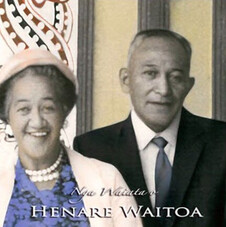
Amiria Te Atamira Karaka and her husband Henare Waitoa, from Ngā Waiata a Henare Waitoa, a CD produced by Radio Ngāti Porou, 2011
While chopping wood, East Cape songwriter Henare Waitoa had been working on Māori lyrics to the melody of an old US cowboy song, ‘Goldmine in the Sky’. Written in the 19th century, the song had been a hit in the 1920s for Carl T Sprague and, in the 1930s, Gene Autry.
Waitoa asked his brother-in-law Maru Karaka how he would describe somebody making an entrance. “Tomo mai,” replied Karaka: come in. That night, Waitoa didn’t sleep; by daybreak, he was sitting in the kitchen singing ‘Tomo Mai’.
At short notice Sir Āpirana Ngata – the MP for Eastern Māori – asked Waitoa for a song to greet members of the Battalion’s C Company on their return to Ruatoria. Waitoa quickly completed the words of ‘Tomo Mai’ so it became a welcome home as well as a lament for those who were killed in battle. That same evening in Ruatoria, the Ngāti Putaanga haka party learnt and rehearsed ‘Tomo Mai’ then performed it as an action song for the return of Lt-Col Peta Awatere and men from Ngāti Porou in C Company.
Tomo mai e Tama mā ki roto, ki roto / Enter boys into
I ngā ringa e tuwhera atu nei / These arms outstretched;
Ki ngā mōrehu o te Kiwi / To the survivors of the New Zealand Army,
Ki ngā Tama Toa o tēnei riri nui. / To the brave sons of this great war.
Hoki mai, hoki mai ki te wā kāinga, / Welcome, welcome home
Kua tutuki te tūmanako, / Our wish has been fulfilled,
Kei te kapakapa mai te Haki, te Haki / As fluttering over there is the flag
O Ingarangi i runga o Tiamana e. / Of England over Germany.
In little more than a decade, ‘Tomo Mai’ would find a life beyond Ruatoria and outside of the marae. Renamed ‘Hoki Mai’ and given an exuberant tempo, it became a staple at New Zealand parties and singalongs.
In the mid-1950s a vocal quartet based in Rotorua was in demand performing overseas hits and Māori popular favourites such as ‘Pōkarekare Ana’ and ‘Haere Rā E Hine’ at shows in the Bay of Plenty and Waikato. Auckland promoter Benny Levin saw them at Rotorua’s Ritz Hotel in 1956, invited them to join a variety show at the Auckland Town Hall, and introduced them to Eldred Stebbing to see if they had recording potential.
Stebbing took his portable Grundig tape-recorder to Rotorua and recorded an EP with the newly named Howard Morrison Quartet. The first singles – released on 78s by Zodiac in 1958 – were a mix of popular songs and Māori favourites. ‘There’s Only One of You’/‘Big Man’ was followed by ‘Hoki Mai’/‘Pō Kare Kare Ana’.
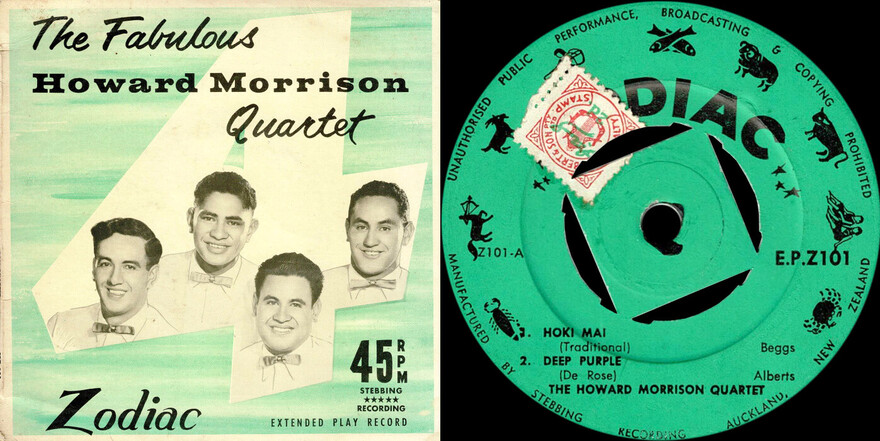
The Howard Morrison Quartet EP featuring Hoki Mai (Zodiac, 1958)
‘Hoki Mai’ gave the Quartet an immediate, breakthrough hit. They had transformed the song from its origins as the maudlin country ballad ‘Gold Mine in the Sky’ that became Henare Waitoa’s lament ‘Tomo Mai’. It now had an irresistible upbeat swing:
Hoki mai e tama mā ki roto, ki roto
I ngā ringa e tuwhera atu nei
(A hī! Aue! Aue!)
Kei te kapakapa mai te Haki, te Haki
Ingarangi runga o Tiamana e
On the day ‘Hoki Mai’ came out, Howard Morrison saw a queue outside a Rotorua record store. He recalled that the song was playing on a speaker above the pavement, and the crowd was already singing along. ‘Hoki Mai’ quickly became a massive hit, but some Māori were upset that the Quartet had not given the song the respect it deserved for its place in Māori Battalion history.
“The recording of the Howard Morrison group of Rotorua has popularised this song throughout the country,” Ngāti Porou kaumātua Koro Dewes wrote in his 1974 thesis about Henare Waitoa. “At present the wrong words are on the lips of the majority. Despite some disappointment for this state of affairs, the efforts of such groups will perpetuate and popularise some of the most significant modern Māori song-poetry and dance-poetry.”
Morrison said the Quartet’s spirited interpretation was appropriate for an inspirational song that “encouraged the Māori Battalion troops to go forth and valiantly hold the values of their people – but to come home.” But some on the East Coast were offended that the Quartet had not realised the song’s significance. Morrison eventually conceded the gaffe. In 2001 he told RNZ’s Caitlin Cherry, “At that time I was rather ignorant about the sanctity of the words. It became a hit because everybody was singing that song at parties before we even recorded it, and it became an instant hit.”
Poignantly, one who did fully understand the song’s background was Quartet singer and guitarist Gerry Merito. Eight years old in 1946 and growing up at a family farm at Tāneatua, a small railway settlement on the edge of the Urewera ranges, he witnessed the return of the small contingent from his whānau.
In a 2007 interview, Merito recalled a busload of soldiers arriving from Whakātane; seven of his family were among them. All the men on the bus briefly got off, then stood to attention and saluted the seven who were from Tāneatua.
The men washed up at a tap beside the cowshed then enjoyed a hāngī and long celebration with their whānau. “I can’t remember much about the night because it just went on and on – and they were singing Italian songs. They were all singing Italian songs. They had no guitar – they just sang. And it was just memorable – something you never forget.” After a few days at Tāneatua, the seven soldiers got on the next scheduled bus and travelled along the road to reunite with their fellow veterans from the Battalion: they missed their comrades.
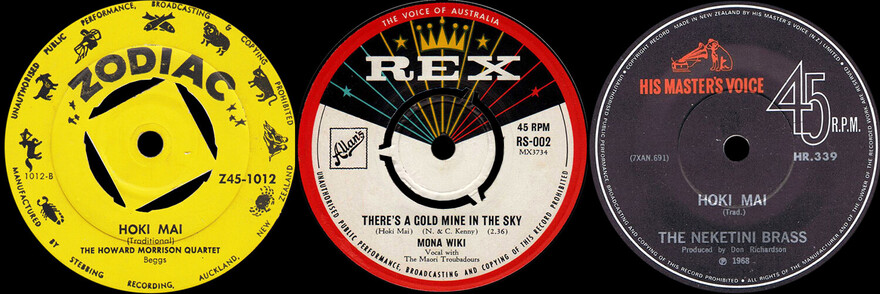
Hoki Mai through the years: The Howard Morrison Quartet (Zodiac, 1959); Mona Wiki with The Māori Troubadours (medley with 'There's a Gold Mine in the Sky', Rex, Australia, 1960); The Neketini Brass (HMV, 1968)
Does it matter that the original melody of ‘Tomo Mai’ – like many Māori popular songs of the 20th century – was from a US song? Henare Waitoa, Sir Āpirana Ngata, and Koro Dewes didn’t think so. Ngata, a songwriter himself, believed the message of a song was what was important – and its use of te reo. The songs helped revitalise the language. Dewes writes that events held on marae – hui, memorials, dances, fundraisers – often required a topical song, written quickly. The Pākehā melodies were readymade, and known by the participants. Dewes reported Waitoa saying to him, “No matter what the event, the composer wouldn’t bother to create an individual tune for his or her words. Because it wouldn’t be a song sung by people all the time. It was like a butterfly with a short life.”
Dewes continued, “Pākehā have said Māori are simply picking up inferior songs from Tin Pan Alley. Who cares what they think! They urge the composer to compose their own tunes … No matter what the tune or the composer, it’s the topic of the song and the words which are the main thing to Māori.”
The affection towards ‘Hoki Mai’ – and its long popularity, on record and at gatherings – leaves no doubt that Waitoa’s welcoming message was understood, and lasting. That an English translation of his words has never gained traction indicates its contribution to the widespread survival of te reo.
Read more: ‘Tomo Mai’ at Aotearoa Songbook
Sources
Te Kapunga Matemoana Dewes, Ngā Waiata Haka a Henare Waitoa o Ngāti Porou: Modern dance-poetry by Henare Waitoa of Ngāti Porou – Dept of Anthropology and Māori, Victoria University of Wellington, 1974
Howard Morrison, with John Costello, Howard, Moa Beckett, Auckland, 1992
Interview with Howard Morrison by Caitlin Cherry, RNZ, 2001
Interview with Gerry Merito by Chris Bourke, Cambridge, 2007
Chris Bourke, Blue Smoke: the Lost Dawn of New Zealand Popular Music, 1918-1964, Auckland University Press, Auckland, 2010.