For much of the 20th Century, the recorded music sold to New Zealanders was dominated by a single company in a way we can’t imagine today. For the first five decades of the century, that company had almost exclusive control of the market.
His Master’s Voice (New Zealand) Limited was initially an outpost of the British company The Gramophone Co. Ltd., and later of the multinational conglomerate Electrical & Musical Industries Limited, better known as EMI. Strong worldwide, nowhere was EMI more dominant than in the most distant part of the British Empire and the Commonwealth: New Zealand.
Nipper
The story begins in 1897 in London, where William Barry Owen and Trevor Williams incorporated The Gramophone Co Ltd on behalf of US inventor Emile Berliner, who had created the gramophone, a system that played pre-recorded sound from flat discs. Initially, it operated as an importer, but it soon expanded into production and recording and served as the agent for the US Victor company (later RCA), a relationship that lasted until 1956.
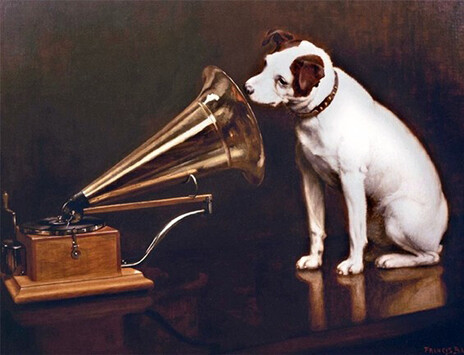
Nipper listens to his master’s voice on an Edison cylinder phonograph, painted in 1898 by Francis Barraud. The famous image later became a much-used symbol of the His Master’s Voice company.
The company rapidly expanded throughout Europe and the British Empire, as did its new logo: a painting by Francis Barraud, of a dog named Nipper listening to a gramophone. The painting was dubbed His Master’s Voice, and soon so would the company after the slogan appeared prominently on its record labels. In Germany, they founded a subsidiary called Deutsche Grammophon, which later became part of PolyGram (and eventually a subsidiary of Universal). In other regions, they either acquired or established subsidiaries or agencies.
In 1917, the US Columbia company created a UK subsidiary, Columbia Graphophone Company Ltd., which was purchased in 1922 by its manager, Louis Sterling. In 1925, this company acquired two companies: its original US parent and the German Carl Lindström AG, better known as Parlophone.
Before the Great Depression, these two British companies dominated the global music market outside the US. However, the economic downturn, declining music sales, and the rise of radio led to a need for restructuring. On 20 April 1931, they merged to form Electric & Musical Industries Ltd under Louis Sterling. As a result of US antitrust laws, the new company had to sell the American Columbia subsidiary. EMI continued to distribute US Columbia music outside the US until 1951 and retained the Columbia trademark outside North America until 1990.
The new company owned several labels, including His Master’s Voice, Columbia, Angel, Zonophone, Parlophone, Regal, Capitol (from 1955), and later World Record Club, Music For Pleasure, EMI, and Harvest.
New Zealand, outpost of Empire
The HMV story in New Zealand officially started in 1905, but even before that, New Zealand was quick to embrace recorded music. Back then, two formats competed. The all-wax cylinder was developed and patented by the US Edison company, named after Thomas Edison, who invented the phonograph in 1877. By the early 1900s, these cylinders could be played around 100 times. In 1902, a celluloid cylinder called the Lambert Cylinder was introduced, but it hardly reached New Zealand before Edison, which had taken a brief interest in the format, crushed its popularity. Some of these, no doubt, ended up in our stores before the cylinder faded out around 1912.
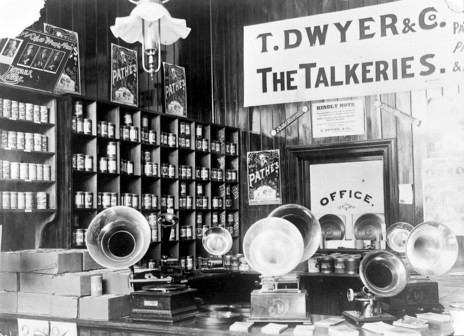
Cans of beans? No: shelves of Edison cylinders, inside the Masterton branch of The Talkeries cylinder and disc store, c.1909. - Alexander Turnbull Library, 1/2-043062-F.
The competing format was the flat disc, created by Emile Berliner, available in both single- and double-sided variations, and various sizes, courtesy of Victor Talking Machine Company, Columbia, and The Gramophone Co. Ltd. Initially, speeds differed, but they eventually settled on approximately 78 revolutions per minute for music.
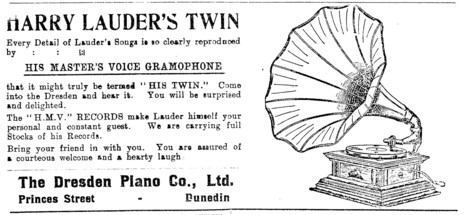
“Every detail of Harry Lauder’s songs is clearly reproduced by a His Master’s Voice gramophone ... The HMV records make Lauder himself your personal and constant guest.” - NZ Tablet, 7 January 1915
New Zealand was an outpost of the British Empire, which was at its peak in those early years of the century. British companies saw the colony (which became a Dominion in 1907) as just an extension of their market, similar to Australia. In 1900, Mr P H Bohanna from The Gramophone Co Ltd was sent to Australia to set up an agency. From there, it seemed natural to head across the Tasman to New Zealand, where he arrived on June 30 of that year. He travelled around New Zealand, and while it is unclear who he spoke with, the Dunedin company Begg’s was probably a target, given their many branches and advertisements showing Gramophone machines and records for sale.
It wasn’t until 1905 that the company finally got its own dedicated agency. Wellington merchant E J Hyams Ltd – owned by Elias Hyams – signed a deal with the Australian company Hoffnung, which handled Gramophone in the region. This agreement led to the next 108 years of HMV and, later, EMI in New Zealand, and to much of our recorded music across the second half of the 20th Century.
In November 1905, Hyams announced that 15,000 records had just arrived in the colony, and a few weeks later, they started advertising Gramophone players as ideal Christmas gifts. The early artists included Dame Nellie Melba, John McCormack, Peter Dawson, and Enrico Caruso, all of whom had exclusive contracts with Gramophone and appeared on the company’s Angel or Zonophone labels. In 1909, the His Master’s Voice (HMV) record label was introduced, with Nipper in the centre. Gramophone’s partnership with the US Victor label also gave New Zealand access to their records.
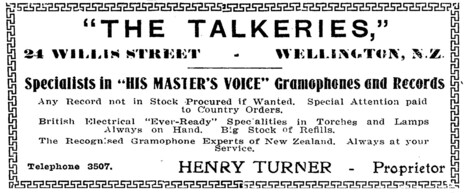
The Talkeries retail chain supplied HMV gramophones and records, with "special attention paid to country orders." - New Zealand Illustrated Sporting & Dramatic Review, 18 April 1918
In the years before World War I, sales of machines and discs grew rapidly in New Zealand. Hyams supplied Begg’s and The Dresden Piano Company, both of which had branches nationwide. Increasingly, the image of Nipper and the words His Master’s Voice became synonymous with recorded music in New Zealand as the competing Edison cylinders faded. Hyams’s success with The Gramophone Co. Ltd.’s products led the UK company to offer them a direct license and agency in 1913.
Hyams’s subsidiary, Gramophonium Ltd., run by Alfred Wyness, was established that year to sell Gramophone products and remained in business until 1926. The war made it harder to get players and records but, in 1917, Begg’s and the Bristol Piano Company (the Dresden Piano Company renamed because of anti-German feelings during the war) both advertised new arrivals imported by Gramophonium. The advertisements claimed that His Master’s Voice was the “best known trademark in the world”. It probably was.
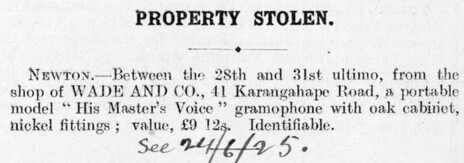
An HMV gramophone, value £9 12s ($1200 in 2026 dollars), is stolen from a shop on Auckland's K Road. - NZ Police Gazette, 27 August 1924
The end of the First World War eased restrictions and sparked a boom in sales. By 1921, Begg’s was offering a wide catalogue of HMV products, with pricing designated by the colour of the labels, a practice that would continue until the end of the 1950s. Among the artists introduced to New Zealand by Gramophonium in the early 1920s was Paul Whiteman, a US bandleader whose Zonophone and Victor records were among the country’s earliest “jazz” releases (including George Gershwin’s Rhapsody in Blue). Jazz was a genre that would transform the nation’s musical tastes in the years to come.

A year later, the thief is sentenced, but the gramophone is nowhere to be found. - NZ Police Gazette, 24 June 1925
Nipper arrives on Wakefield Street
On 21 March 1926, Hyams reached an agreement with the UK Gramophone Company to create a new, jointly owned company in New Zealand to take over the Gramophonium business. The company, His Master’s Voice (New Zealand) Limited, was set up on May 10. The initial ownership was Hyams with 66%, The Gramophone Co. Ltd. with 25%, and A J Wyness with 9%. This new company took over the office at 118-120 Wakefield Street in downtown Wellington, where Hyams had been operating his gramophone and music trade. At the same time, the UK company gave the new firm an exclusive license for New Zealand. This was granted directly by The Gramophone Co. Ltd., not through Australia. HMV/EMI NZ would remain independent from Australia until the 1980s.
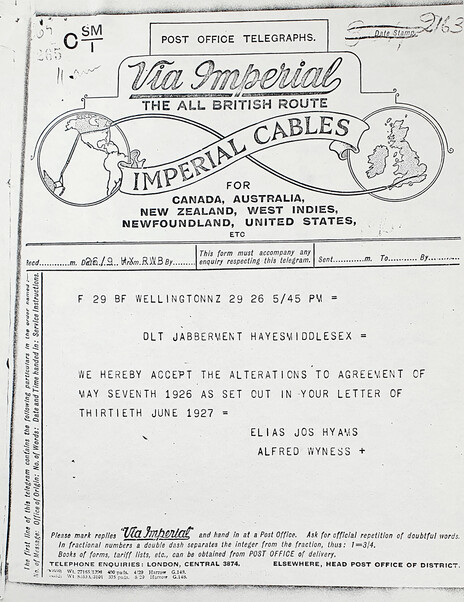
Wellington, September 1927: E J Hyams and Alfred Wyness use Imperial Cables’ “all-British route” to telegraph HMV’s head office in Hayes, Middlesex, accepting changes in their contract. - Bruce Anderson Papers, Alexander Turnbull Library, MS-Papers-9762-6
The licence covered all of Gramophone’s goods, including players. HMV aggressively marketed these to select dealers, who could obtain HMV’s records only if they stocked HMV products exclusively. This included the new Ernest Dawson’s at 40 Manners Street in the capital, as well as the well-established Begg’s and Bristol chains. Soon, other stores around the country also became “authorised HMV dealers”.
pressing plants opened in Sydney in 1926 changed the Australian and New Zealand record industries
It was a monopoly system that lasted into the 1950s and arose in part from a perceived threat from the UK Columbia Graphophone Company Ltd., which had set up in Australia in 1925 as the Columbia Graphophone (Aust.) Ltd. and opened Australasia’s first recording studio along with a large 50,000 sq ft pressing plant at Homebush in Sydney in October 1926.
The Gramophone Co Ltd had already opened its own 40,000 sq ft plant in Erskineville, Sydney, in January that year, after Trevor Williams, the company’s chairman, visited Australia. These factories and the studio would change the record industry in Australasia over the next 20 years.
No longer would people have to wait months or even years for records to arrive by ship; they could be made locally for the trans-Tasman market at a lower cost. Customers would also be able to buy the latest machines to play the records on, again at a domestic price. The first advertisement for the new Gramophone pressings from Australia was placed in the Dominion on 15 May 1926.
Columbia in New Zealand
From 1904, US Columbia’s records and players were sold in New Zealand. After Louis Sterling set up a UK branch, which became a separate UK company in 1917, their products also made their way to the Dominion. Bannatyne and Hunter were appointed exclusive agents in Wellington, Arthur H Nathan handled Auckland, and Webley, Son and Gofton covered the South Island. Records made in the UK – on Columbia’s own label and the cheaper Regal brand – were popular imports. Bannatyne and Hunter also secured a government deal to supply Columbia records and players to schools across New Zealand.
In August 1926, Australian Columbia pressings began arriving in New Zealand, and the company confidently announced that it would soon be able to produce 11 million records annually. It was a very good time to be a music buyer in New Zealand, as shops were filled with shellac discs at affordable prices, when the community seemed to have money to spend on such things.
Home recordings and recording advances
In 1927, the first music recorded specifically for local consumption arrived – our music made by New Zealanders for New Zealanders, and eventually marketed back at the world.
The story begins with an orchestral recording in London, with Alfred Hill conducting the company’s in-house Mayfair Orchestra in renditions of his compositions ‘Waiata Poi’ and ‘Tangi (Lament)’ for the HMV label. Hill, an Australian composer and conductor married to a New Zealander who regarded both countries as home, then created another 78rpm recording of ‘Lake Music (A Māori Cantata)’ (taken from his 1895 cantata Hinemoa), backed with ‘Waiata Māori’. Both were issued domestically in New Zealand and sold extremely well.
Recorded in London, Alfred Hill’s ‘Waiata POI’ was issued in New Zealand and sold extremely well
In 1927, HMV came out with the Model 101 portable player, which they said was perfect for the beach, although one wonders how many people actually carried that heavy box down to places like Mission Bay or New Brighton. Still, it was smaller than most earlier models and was made until the 1950s in both Australia and New Zealand. The next year, the government also cut all import taxes on Australian-made records, which made them cheaper and helped boost sales of 78s and the machines that played them.
In October 1926, Columbia in Australia introduced electrical recordings in its Sydney studio. The technology, which would change the recording process, was first used in the UK in 1920 to record the funeral service for The Unknown Warrior at Westminster Abbey. Although it wasn’t widely adopted until 1925, it allowed for live recordings. The company also encouraged New Zealanders to come to Australia to record, and some likely did. The most important immediate result, however, was the arrival in Rotorua in February 1927 of a recording crew from Parlophone Records, the Australian branch of the UK Columbia subsidiary The Parlophone Co. Ltd. It operated independently in Sydney but pressed its records at the Columbia plant in Homebush. In New Zealand, Parlophone was distributed by Billiards Ltd, who, despite their name, were also manufacturers of the popular Melotone Gramophone cabinets licensed from a Chicago company. Not coincidentally, the distribution deal with Parlophone had been signed a month before the recording trip. The Australian branch was told by London to record local vocalists to build a catalogue for international sales. The visit also coincided with the Duke and Duchess of York’s visit to the city.
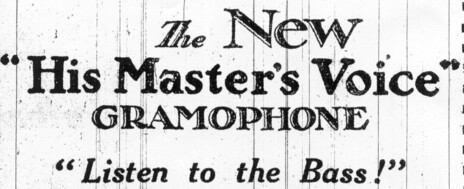
HMV advertisement from 1928
Aotearoa music, on record
Ana Hato’s performance of 16 songs at the Tūnohopū meeting house for the royal party, some with Deane Waretini, some with pianist Te Mauri Meihana, and others with the Rotorua Māori Choir, were the first recordings made in New Zealand. They weren’t recorded electronically – instead, they used the old acoustic method, singing into a large horn. The recordings were released across a number of 78rpm discs, selling in large quantities, with their bespoke label designs featuring Māori chiefs. Billiards’s promotional efforts included live performances in cinemas, where Ana Hato appeared as part of The Māori Maidens.
These records stayed in the Australian and New Zealand catalogues for nearly 30 years; the last 78rpm pressings were made at HMV’s Lower Hutt plant in the mid-1950s. They were also released in the UK and, in 2022, appeared again in the catalogue of Universal (the contemporary successor to HMV), both digitally and on CD, after being remastered in 2021. Ana Hato and Deane Waretini recorded another 18 songs in Sydney in 1929, some of which were re-recordings of earlier records.
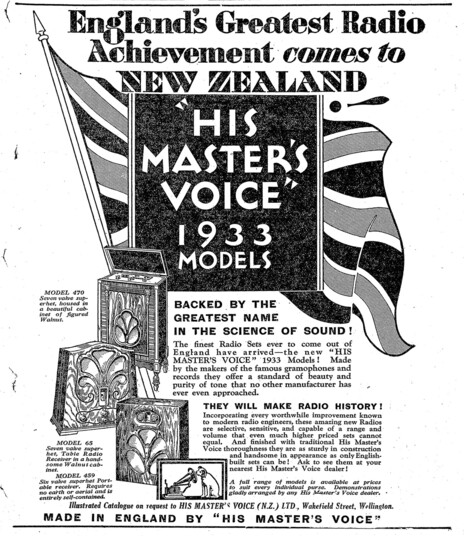
Rule Britannia: England's great radio achievement comes to New Zealand. - Radio Record, 19 May 1933.
In April 1930, Columbia headed back to Rotorua, as part of a project called “Māori Recording Expedition”. The year before, Arthur Eady, the head of the Auckland music retailer and publisher of the same name, signed a contract with three members of the Rotorua Māori Choir. He then reached out to Columbia in Sydney and encouraged the company to cross the Tasman and record the choir. After a visit by a representative, Columbia took its mobile unit to Rotorua. There, they recorded some 50 songs at Ōhinemutu, beside Lake Rotorua, covering both traditional and more modern waiata. These recordings were issued on eye-catching 78s, probably designed by their in-house artist, likely a New Zealander, given the Māori-influenced graphics. The records appeared in stores across New Zealand and Australia from August 1930 and sold very well, staying in the catalogue in various forms for many years. Arthur Eady didn’t live to see these releases; he died in late 1929. His company, including the music-publishing copyrights for these Choir recordings, was bought by Begg’s of Dunedin in the mid-1930s. Further New Zealand-related discs included the 1930 Columbia release of ‘When You Come To The End Of The Day’ and ‘South Sea Rose’, recorded by Wellington radio host and baritone Billy Hart from 2YA, in Sydney’s Homebush Studio. Also recorded at Homebush was the 1932 issue on Columbia’s Regal sub-label of several 78s by Lex MacDonald, a boy soprano from Dunedin. MacDonald promoted these with a concert in Wellington on October 12 that year.
Electric & Musical
In 1930, the company went through a major change when E J Hyams sold his controlling stake in the New Zealand branch. On January 31, the share register showed The Gramophone Co Ltd owning 75%, Hyams holding 22.5%, and Wyness with 2.5%. From that point on, His Master’s Voice (NZ) Ltd was no longer a majority New Zealand-owned company. This shift happened as Hyams resigned and retired to London as managing director, being replaced by Alfred Wyness. Although it wasn’t clear at the time, this move paved the way for a bigger change: on 20 April 1931, the Columbia Graphophone Company Ltd and The Gramophone Co Ltd merged in the UK to create Electric & Musical Industries Ltd, better known as EMI – the world’s biggest record company.
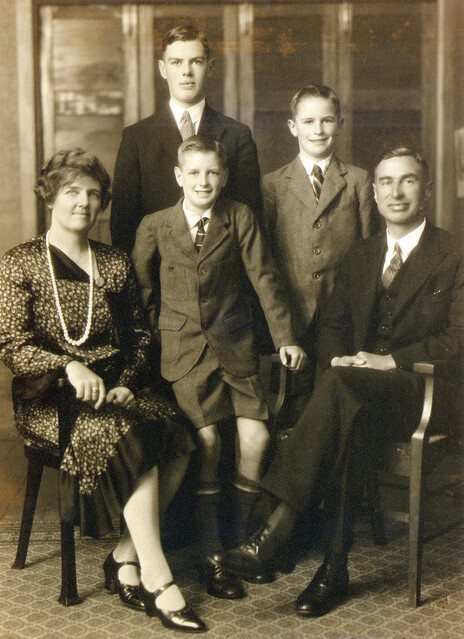
The Wyness family in the early 1930s. Seated at right is HMV NZ co-founder and longtime managing director Alfred Wyness. Standing at the back is the son who succeeded him for two decades, A J (Alfred John, aka Jack) Wyness. At left is Harriet Angus Wyness, the mother of A J and (between Harriet and Alfred snr) his brothers Arthur and Keith. - Julie Bell-Booth collection
In the UK, there were three competing record firms: the Columbia Graphophone and Gramophone, plus The Parlophone Company, which operated somewhat independently. The New Zealand company held the local rights for all three catalogues, plus the Decca label (from 1936). Decca was the UK’s second biggest label, founded in the 1920s by ex-stockbroker Edward Lewis, who later became Sir Edward. The company also had rights to the Victor labels from the US, soon to become RCA Victor. When the merger happened, Columbia’s rights went from Bannatyne and Hunter to HMV, but the license wasn’t valid until mid-1933.
Decca, which had set up a branch in the US in 1932, had also been very aggressive in acquiring smaller US and UK independent labels, including Melonote, Vocalion, Brunswick, Edison and Panachord, so these labels’ catalogues were also distributed by HMV.
In 1931, US anti-trust laws forced EMI to divest its US Columbia subsidiary, but the UK company kept rights to the label outside the US until 1952. By the mid-1930s, HMV controlled most of the world’s music releases and dominated the local market aggressively.
Across the Tasman, EMI consolidated manufacturing at Homebush in July 1931, ending the need for two large plants. The factory then supplied both Australia and New Zealand until this country’s first pressing plant opened at the end of the 1940s.
Into the 1930s
Alfred Wyness’s appointment as managing director coincided with another major change in HMV’s business. The country had been undergoing a radio revolution in the late 1920s, with more stations and listeners. The Great Depression then caused record and player sales to fall. HMV responded by importing radiograms – record and radio players. The first UK-made His Master’s Voice radiograms arrived in January 1930 from Australia, followed by models from the UK and the US. These were marketed by a new radio department at 118-120 Wakefield Street, in the old Hyams building, now partly leased by HMV.
Built in 1903 for J M (John) Richardson as a warehouse and offices, the building was rented to E J Hyams in 1910. The head lease was transferred from Richardson’s son, Alfred, and partner Ernest Gil, to Hyams in 1920, and the building was renamed the Hyams Building. Hyams held the lease until 1954. During that time, it served as HMV’s main factory and warehouse. It was renovated in 1930 by Swan & Lovelle, possibly to accommodate HMV’s business.
The growth of radio and the slowly improving economy again saw a rise in record sales in the 1930s, with a million steel gramophone styli being imported in each shipment, as well as a wide range of domestic whiteware, irons, heaters and other appliances. Many of these products were made in Homebush and branded with His Master’s Voice or related brands, but from 1930 were increasingly made in New Zealand, especially radios.
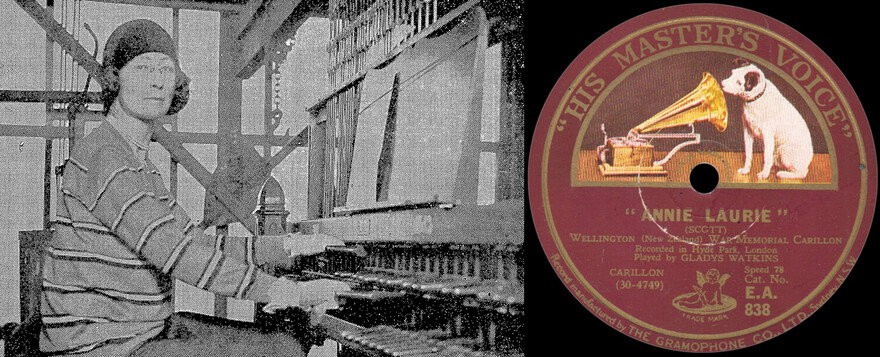
New Zealand musician Gladys Watkins plays on a makeshift carillon in Hyde Park, London, 1929. Several of her live performances were recorded, then pressed by HMV in Sydney and released in New Zealand on 78rpm discs. The event was to demonstrate the bells purchased for the National War Memorial carillon in Wellington, before they left the UK. - Radio Record, 28 February 1930.
In 1931, they introduced another New Zealand artist, Gladys Elinor Watkins, whose carillon recordings of ‘Annie Laurie’ and ‘The Bells Of St Mary’ from a performance in Hyde Park on Christmas Eve, 1929. She used the newly made bells from Croydon – then just outside London – intended for the new National War Memorial Carillon in Wellington, where she would become the official carillonneur.
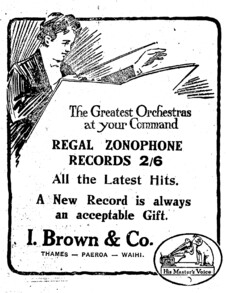
"A New Record is always an acceptable Gift." Regal Zonophone advertisement, The Thames Star, December 5, 1933
In November 1933, they launched a new label called Regal Zonophone, which combined Columbia’s mid-priced Regal and The Gramophone Company’s Zonophone brands into one. This brand lasted all the way into the 1970s and was eventually used for New Zealand artists as well. Its low price at the start (just 2/6d, although that is the equivalent $41 in 2026) helped it sell a lot over the next few years, as New Zealand and the world worked to pull itself out of the financial grand slam that affected many families. The Regal Zonophone discs also became a helpful way to introduce new artists to the market, even though for most Depression-era households, records probably still felt like a luxury until later in the decade.
On 9 August 1934, The Gramophone Co. Ltd. finally acquired the last of E J Hyams’s shares, raising the UK parent’s holding to 97.5%, with Mr Wyness’s family retaining 2.5%. That shareholding would remain unchanged until 1969, when the UK EMI subsidiary, EMI Overseas Holdings Ltd, acquired 100% of the company.
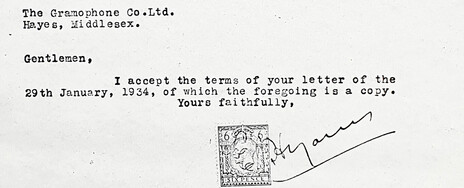
EJ Hyams sells his shares to The Gramophone Company of UK, aka His Master's Voice, 1934. - Bruce Anderson Papers, Alexander Turnbull Library, MS-Papers-9762-6
--
Read more at HMV NZ, part 2: radios and records
--
With thanks to Mark Hector of the Alexander Turnbull Library for research assistance.