Continued from part 1 – HMV NZ: birth of an empire
Prior to the incorporation of His Master’s Voice in 1926, Hyams’s Gramophonium operated retail premises at 120 Victoria Street in Wellington, but these seem to have closed before HMV’s arrival as a company. Instead, the public was invited to write to a post office box for a catalogue, leaving street retail to the dealers it sold to. Initially, HMV continued that policy, which may have been intended to placate the network of dealers the company had developed nationwide in the late 1920s and 1930s for its wholesale products. The stores in the network were able to stock the full range of HMV-branded goods. Following the 1931 merger, the addition of Columbia’s catalogue to HMV and the licence for Decca in place (a licence that would be repeatedly renewed until 1980) left the record side of the New Zealand company in an impregnable position by 1936, and it both moved back into retail and began to introduce very restrictive terms of trade.
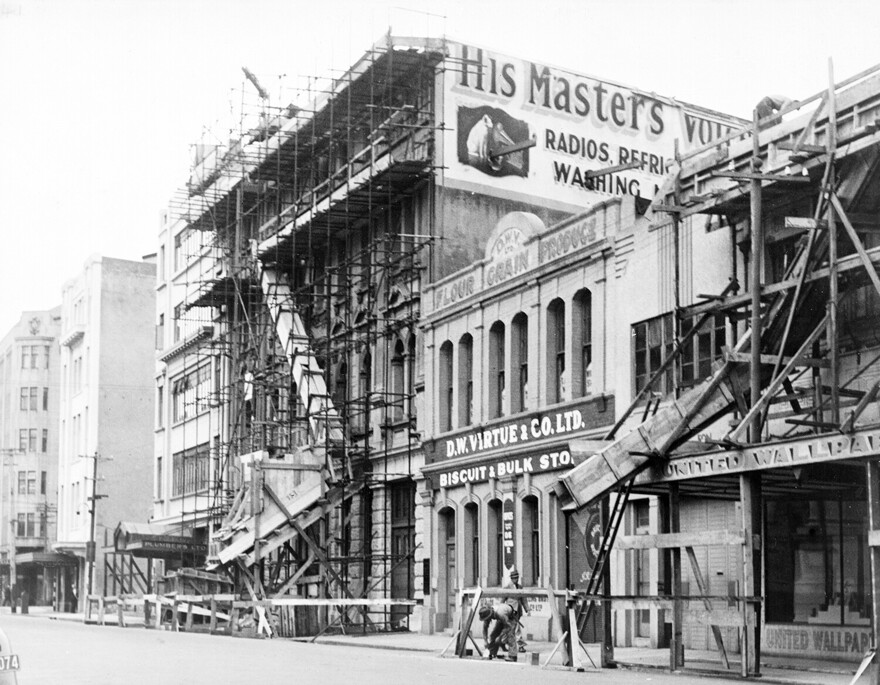
The E J Hyams Ltd Building at 118-120 Wakefield Street, Wellington, c. 1942. Note the His Master’s Voice NZ Ltd sign: the company’s office and warehouse were inside. It is thought the scaffolding is to enable the removal of concrete trim after the 7.2 magnitude earthquake of 24 June 1942. - Alexander Turnbull Library, Wellington, PAColl-0646-06
Vanvi’s was founded in 1936 by H F Vivian and G F Vance, who are best known for their once-nationwide menswear chain (which still exists in Wellington). The store offered a variety of whiteware and electronics, as well as 78s, from its store at 91 Cuba Street in Wellington. In November that year, HMV opened His Master’s Voice Supplies at the corner of Cuba and Wakefield Streets, where they sold refrigerators, irons, washing machines, gramophones, radios, and bicycles.
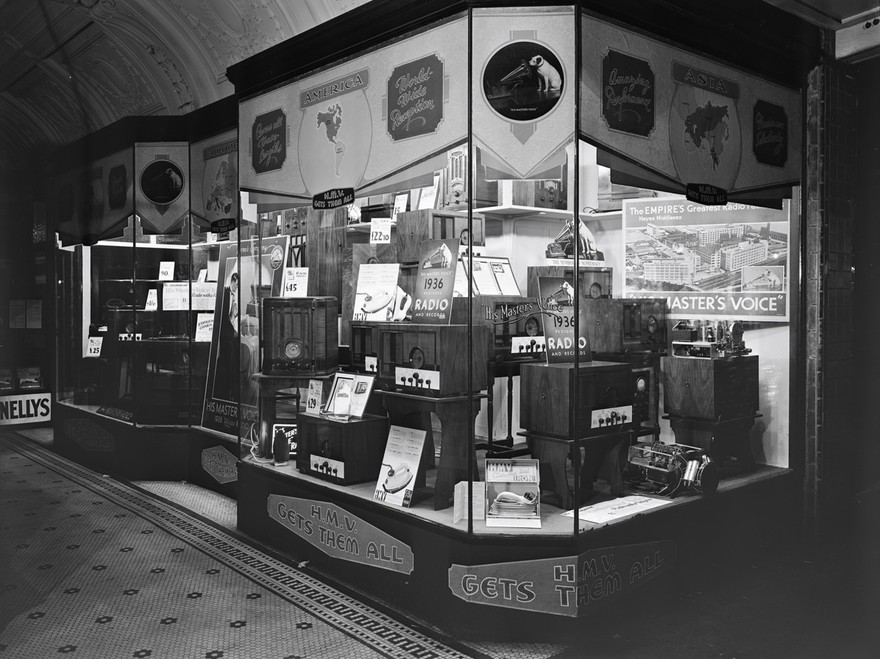
“The Empire's Greatest Radio Company”: HMV (His Master's Voice) music shop, 91 Cuba Street, Wellington, 1936. - Ken Niven, Gordon H. Burt Ltd. Te Papa (C.002510)
By late 1936, HMV seems to have taken ownership of Vanvi’s too. While the record store kept its original name, the address was shared with another branch of His Master’s Voice Supplies. By late 1938, the 91 Cuba Street address was listed as His Master’s Voice Retailers, but the original HMV store at the other end of the street had closed. In 1940, His Master’s Voice Retailers advertised a sub-agent at 22 Manners Street and a store in Lower Hutt.
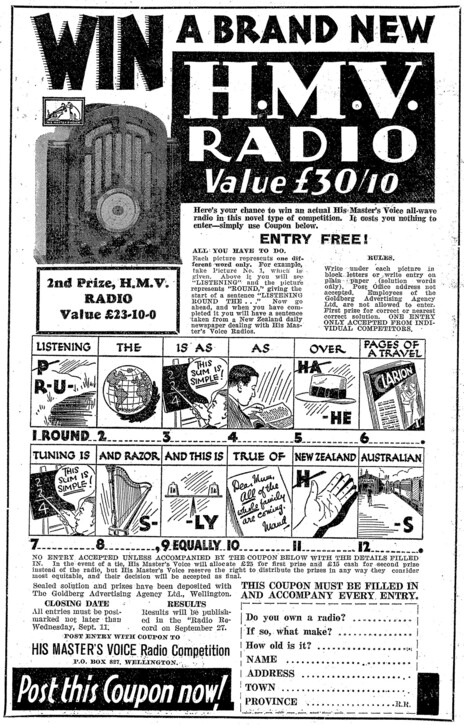
Win an HMV radio worth £30/10 (equivalent to $4716 in 2026). - Radio Record, 6 September 1935
Outside Wellington, the company sold only through its approved suppliers – at least until the early 1960s, when its affiliated World Record Club stores opened in Auckland and Christchurch. These suppliers were carefully vetted and tightly controlled, with HMV insisting on having a monopoly on the music releases in each store. With over 80% of the local music market – and nearly all of it by the end of the war – HMV made sure its dealers only stocked its products. This monopoly was strictly enforced until the mid-1950s. If a dealer stepped out of line, they lost the chance to sell the releases by the money-making HMV group artists.
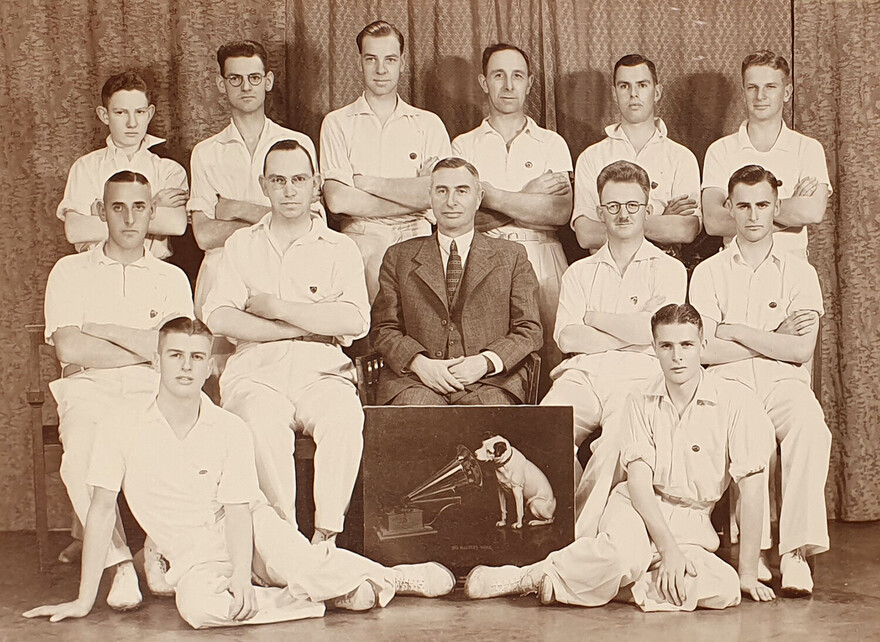
The HMV Cricket Club, Wellington - winners of the Mercantile Special Grade, 1937-38 season. Back row, from left: E W Prince, H S Isaac, G Leitch, E C Gregory, A J Wyness, W L Jacobsen. Seated: E V Henderson, R Bull (captain), Alfred Wyness, E J Isaac, A S Wyness. In front: K G Wyness, Nipper, K I Jacobsen. - P Jauncey Studio, Alexander Turnbull Library, Wellington, PAColl-0646
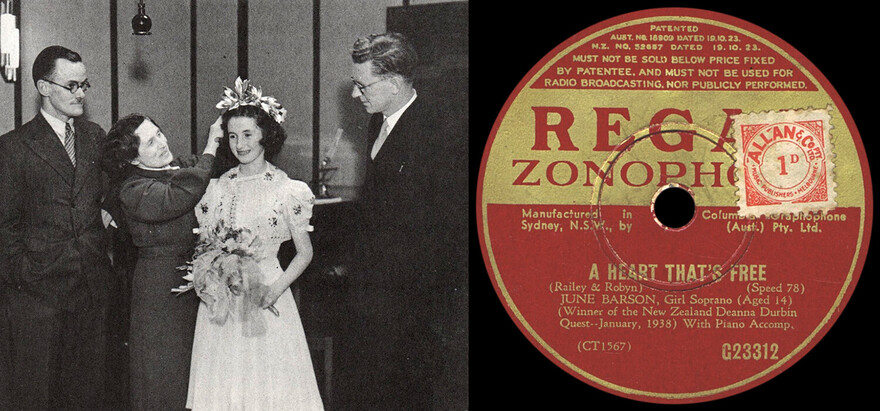
Auckland teen June Barson won a nationwide commercial radio contest in 1938 to discover the New Zealand Deanna Durbin. In this photo she is being crowned by broadcaster Aunt Daisy and, at right, Colin Scrimgeour (controversial controller of the National Commercial Broadcasting Service). At left is 2ZB station manager, K W Kilpatrick. – Peter Downes Collection
In 1938, 14-year-old Auckland soprano June Barson was recorded at Sydney’s Homebush Studios after winning the New Zealand “Miss Deanna Durbin” title – named after the North American teenage star – sponsored by the Turnbull and Jones store in Courtenay Place. The recordings came out on two 78s under the Regal Zonophone label, and June caused a bit of a national buzz, touring cinemas around the country before fading from the spotlight. She is perhaps New Zealand’s first teen pop star.
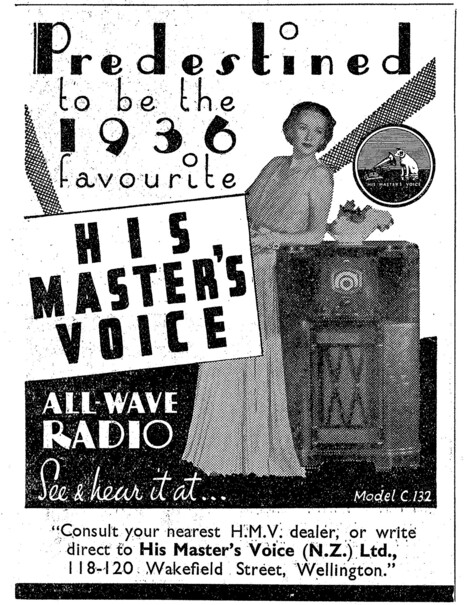
An HMV radio for an art deco lifestyle. - Radio Record, 17 July 1936
That same year, HMV rolled out the first electric gramophone, which meant winding up the spring was no longer required to play records, revolutionising reproduction and ease of play. The new machines proved very popular, and others soon arrived in the marketplace.
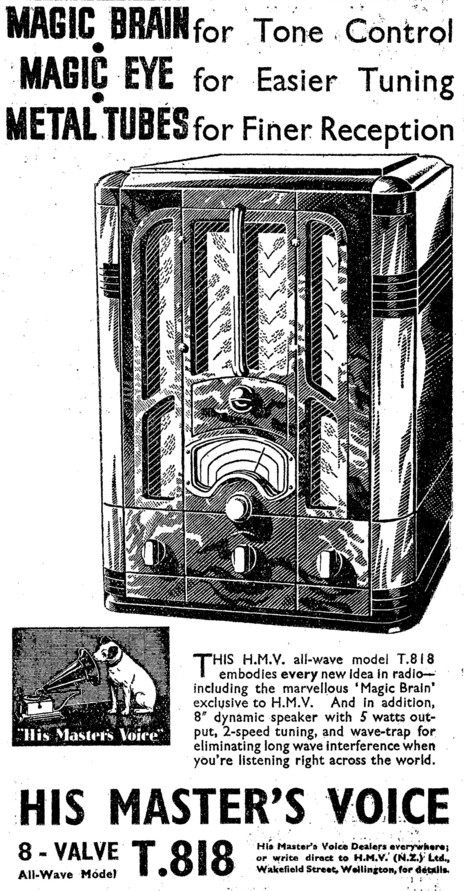
The HMV T.818 model came with its own “magic brain” for tone control. - Radio Record, 25 September 1936
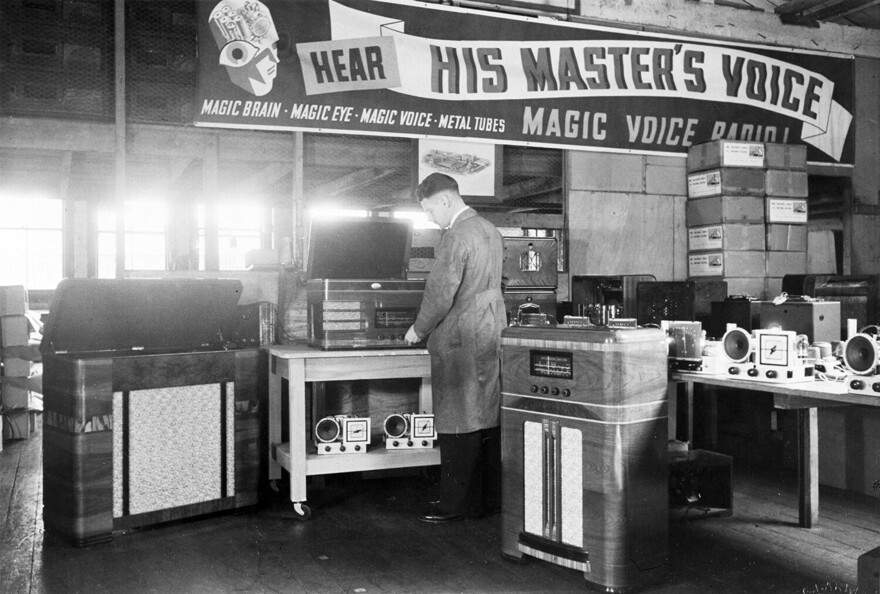
Don Greg in the radio department of HMV (NZ) Ltd inside the E J Hyams Building, Wellington, taken c. 1938 by Frank Giles Barker. - Alexander Turnbull Library, Wellington, PAColl-0646-01
In 1939, Frank Wiseman Ltd, trading as Wisemans, was appointed the exclusive agent for HMV in Auckland and Northland, supplying all other retailers.
The Dominion goes to war
Following the declaration of war in September 1939 and the Dominion’s efforts to provide manpower and equipment to support the Empire’s war endeavours, in 1940 HMV gradually shifted its production at the Wakefield Street factory from domestic electronics and whiteware to wartime manufacturing, primarily radios. The last domestic radios were advertised in 1942, likely remaining stock. By late 1940, the factory was seeking workers to wire radios for military use and had employed 18 full-time staff by 1944. It also claimed to have produced more radio units than any other radio manufacturer in the country by the end of the war.
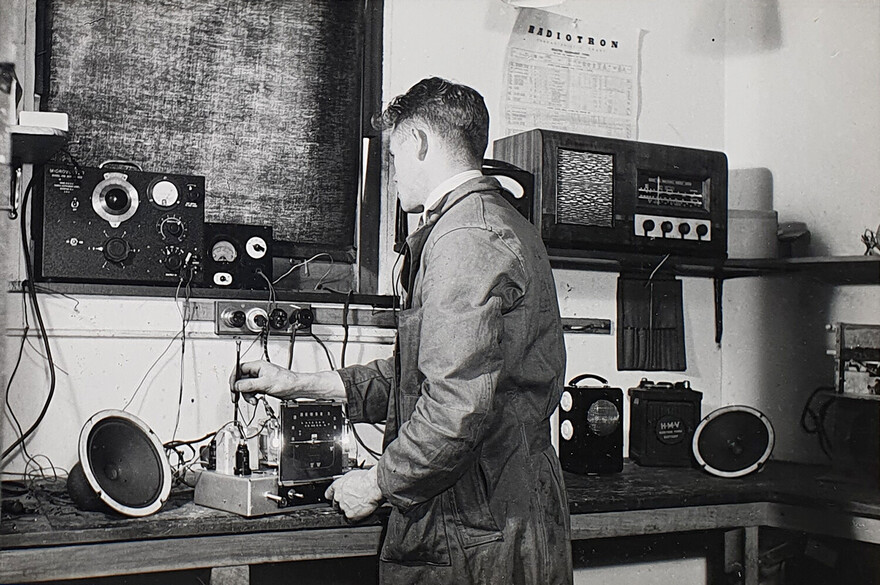
Mace Lawrence tests electrical equipment in the HMV radio department, Wellington, c. 1938; photo by Frank Giles Barker. - Alexander Turnbull Library, Wellington, PAColl-0646-05
Records, as would be expected, became quite rare, with a six-month wait for customer orders from the catalogue, if they arrived at all. New releases were limited to a few hundred copies each week, distributed among retailers every Friday. Two available recordings by New Zealanders were the Band of The 5th Infantry Brigade of the New Zealand Expeditionary Force performing ‘Māori Battalion’, ‘Haere Ra’, and ‘Gallant Hearts’ on one record, and ‘Rotorua and a Tour Of Whakarewarewa’ and ‘A Māori War Haka’ on the other. Recorded in the UK in late 1940, they were pressed in Australia on the Regal Zonophone label for release in New Zealand.
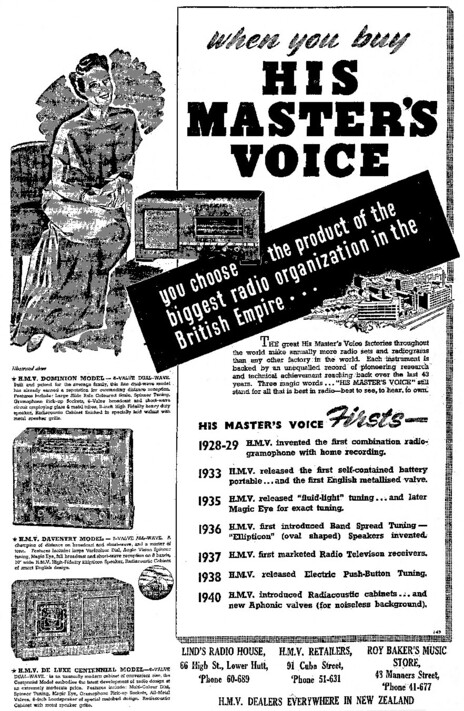
HMV celebrates its achievements since 1928. - Dominion, 18 September 1940
Peacetime
When peace returned in 1945, the company went back to its pre-war manufacturing, often highlighting its busy war years in its marketing. They fondly joked, “Excuse our backs, but we’ve been busy,” and “War has taught ‘His Master’s Voice’ technicians many valuable lessons. Ceaseless investigation and research have yielded a wealth of knowledge that will be embodied in ‘HMV’ post-war Radio Receivers and Radiograms … craftsmen instruments that will combine today’s knowledge of construction and design with yesterday’s traditions of leadership.”
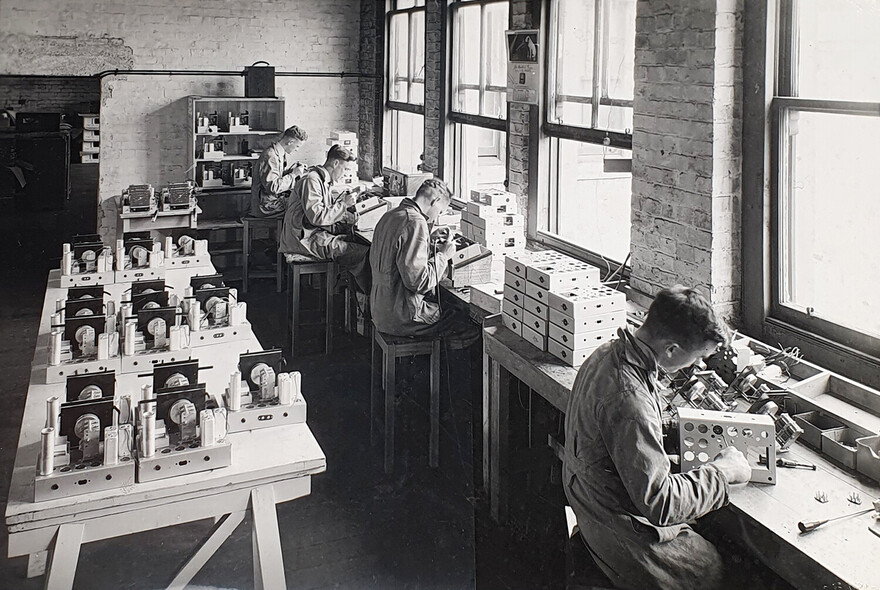
HMV workers assembling radios in the Hyams building, c. 1938; photo by Frank Giles Barker. - Alexander Turnbull Library, Wellington, PAColl-0646-02
Other marketing included a fun “Little Nipper” contest to celebrate the launch of a small radio with the same name. Wisemans, working with HMV’s distributors in Auckland and Whangārei, asked people, “Does your terrier look like “Nipper” of His Master’s Voice?” The winner received a radio, although there seems to be no surviving imagery of the lookalike mutt or its owners.
Oddly, despite its market share, HMV never had an office in Auckland or Christchurch. Instead, they relied on local agents to sell their products in those cities and regions. That changed in 1946 when they opened an office on Fort Street in Auckland; Christchurch didn’t get theirs until 1955. Mr E G Isaac was appointed as Auckland branch manager. At the same time, HMV announced they were the agents for Raleigh and Rudge bicycles. Rudge didn’t last long, as the UK company shut down the next year, but HMV continued to distribute Raleigh bikes until the mid-1960s.
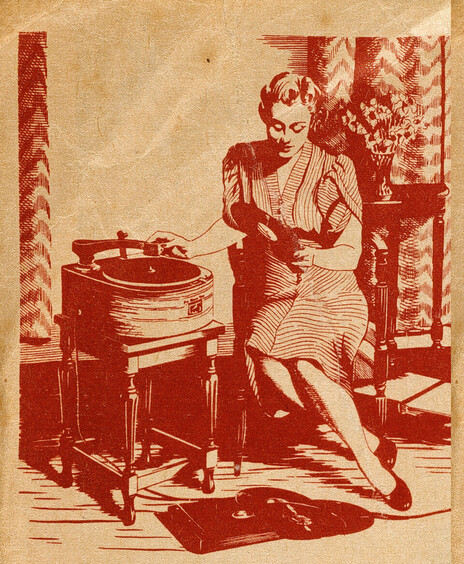
A music fan enjoys a new, electricity-driven HMV record player, 1939. The turntable was connected to an HMV radiogram which served as the amplifier and speaker. - Alexander Turnbull Library, Wellington, Eph-B-PHONO-Covers-1930s-01
It took about six months for a steady supply of 78s to arrive in New Zealand after the end of the war, with stock coming from Australia and the UK. Reduced import taxes helped, and aided the UK’s financial recovery. By early 1947, retailers in all centres were stocking 78s within a few months of UK release, with much the same range as could be found in Sydney or London. Records were released on Fridays, and a retail frenzy each Friday lunchtime – especially in Wellington and Auckland – saw new releases flying off shelves.
While HMV had the record market almost entirely to itself and was able to, and did, claim in 1947 that every record played on the radio was released in New Zealand through HMV, the radio market was different, with several competitors. Among them was the Radio Corporation of New Zealand (known colloquially as Radio Corp), founded by Wellington radio repairman William Marks, who had emigrated from Russia in 1926 as William Markoff. Radio Corp was legally incorporated in 1931 and immediately began manufacturing radios, eventually introducing a brand they called the Columbus. In 1937, Marks opened his Music Centres, soon the Columbus Radio Centres. By the end of 1945, there were 27 stores across the nation; by 1950 there were 40. They sold only radios and radiograms until 1946, when Marks died and his son Alex took over. Alex and his manager Fred Green decided to move into selling records and, after Green had made an exploratory visit to the UK, to record New Zealand artists, something that HMV had shown little prior interest in.
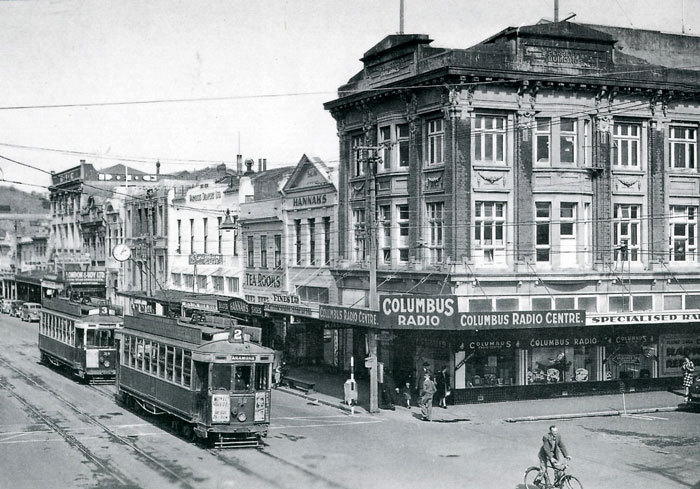
The competition: a Columbus Radio Centre branch, on Victoria Avenue, Whanganui, 1945. In the 1940s these stores, the retail arm of Radio Corp, were prominent in 27 New Zealand cities and towns. They sold the firm’s radios and gramophones – and, from 1949 – Tanza discs.
Alfred Wyness already disliked Radio Corp, given that they were in direct competition with HMV as a radio manufacturer. He blocked the supply of records to the Columbus retail chain, as that would put them in competition with HMV’s dealers. The only exceptions were stores in Dannevirke and New Plymouth, where HMV had no dealers. Soon these two outlets were also cut off. This forced Radio Corp’s hand, and the decision was made to enter both the music manufacturing and studio recording businesses. They would make their own records, on a label called Tanza (“To assist New Zealand artists”). A space was leased at 262 Wakefield Street, an old foundry three blocks from HMV on the same street, and this opened in July 1947 as Columbus Recording Studios. In October 1948, they began advertising that they were open for business. In the rear of the 262 Wakefield St building, Green and his engineer Stan Dallas created New Zealand’s first record pressing plant, although it would soon be joined by another.
It was this studio and plant that recorded and pressed New Zealand’s first commercially released local recording, ‘Blue Smoke’ by Ruru Karaitiana and Pixie Williams, issued with a flurry of publicity in June 1949 (although recorded in October 1948). That publicity was not well received down the street, where the HMV executives had long considered they owned the local record industry, although up to this point they never took up the opportunity to record local musicians.
HMV moves into pressing
By the time ‘Blue Smoke’ was released on Radio Corp’s Tanza label, the company faced new competition from HMV. In the immediate post-war years, EMI’s UK head office encouraged its country branches to press records locally. This became more urgent in New Zealand due to the return of import restrictions and delays of up to six months from Australia and Britain as local markets gained priority.
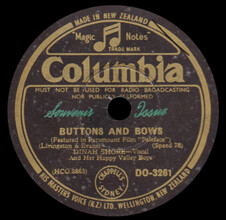
Dinah Shore - Buttons and Bows (HMV NZ's first pressing, from its Kilbirnie plant in 1948)
In October 1947, HMV announced they would soon start pressing records in New Zealand. After sending staff to the UK to explore options, in 1948 they imported three 78rpm record presses from EMI’s production base in Hayes, Middlesex, and installed them in a new factory in Kilbirnie, Wellington.
With plans to produce “one record every 40 seconds or 50,000 per month,” they officially opened in March 1949, with Bob Semple, the Minister of Public Works, cutting the ribbon. The first record produced was ‘Buttons and Bows’ by American singer Dinah Shore, paired with The Marlin Sisters’ ‘My Happiness’ on the Columbia label; this was called the “Souvenir Issue”. This initial pressing also had a note stating it “Must not be used for radio broadcasting nor public performance”.
Ironically, the new National government relaxed import restrictions when they won the election in December that year, but by then the plant was producing most of the company’s 78 needs, using imported stamper plates from the UK.
Despite the availability of pressing facilities, it would be several years before the company released local artists in any numbers, concentrating instead on the vast catalogue available to them via EMI in the UK.
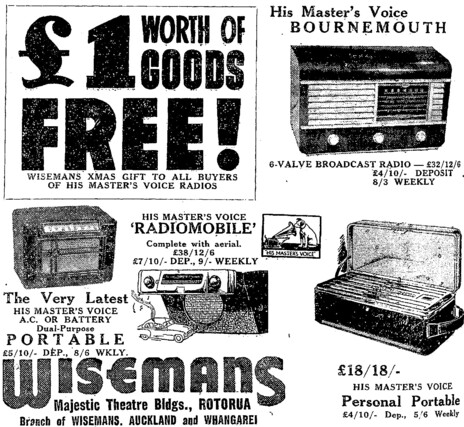
HMV radios for Christmas. - Rotorua Morning Post, 19 December 1949
In late 1950, after 24 years, the company decided it had outgrown its premises at 118-120 Wakefield Street and purchased the site of the Glide Skating Rink (aka Luna Park) at 164-167 Wakefield Street, Wellington, moving in 1951. The same year, Alfred Wyness resigned as managing director and was replaced by his son, A J “Jack” Wyness, who – like his father – was described as an austere, deeply conservative and religious man. They were a curious pair to run a major record company, especially in a decade when pop music was about to become more provocative.
EMI in the UK did not start pressing LPs until 1952. Since New Zealand (and Australia) had no presses for them, HMV’s first LP releases came in late 1951, when a shipment of Decca 10-inch LPs arrived, mostly classical and middle-of-the-road. The first from Hayes arrived in 1953, again 10-inch, as the UK was still resistant to 12-inch LPs until 1955.
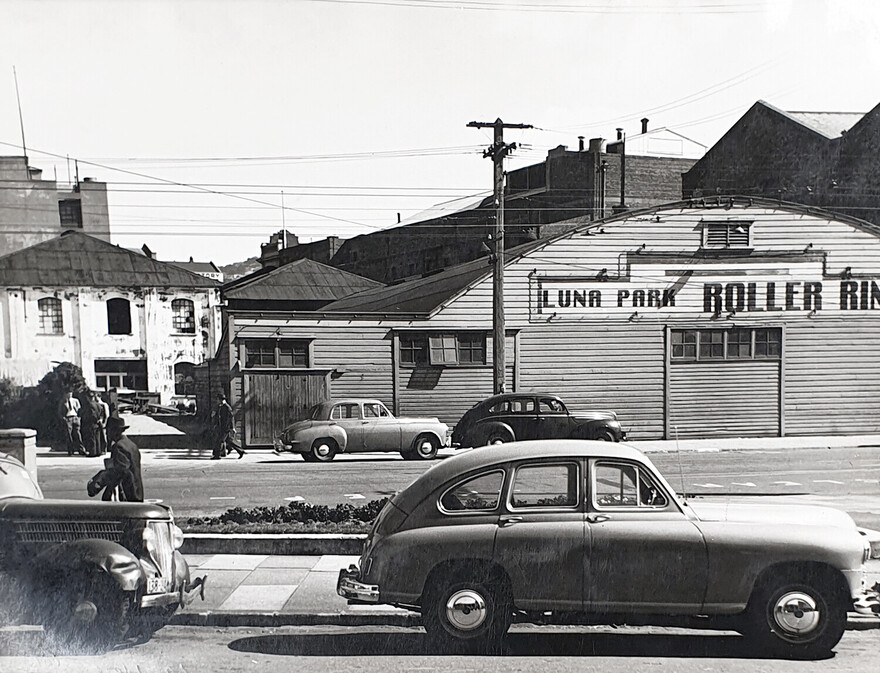
The location of HMV NZ’s compound at 162-172 Wakefield Street, Wellington, in 1950, before the building on the left, and the skating rink, were converted into offices and a factory. - Alexander Turnbull Library, Wellington, PAColl-0646
Columbia, RCA and Capitol
In 1952, EMI’s worldwide relationship with US Columbia came to an end. The deal had given EMI the rights to the vast US CBS-owned Columbia catalogue (which was a separate catalogue to UK EMI-owned Columbia) in return for the US rights to much of the EMI catalogue, especially its valuable classical labels. For a variety of reasons, not least the fact that CBS sales were rocketing globally, the US giant felt like it was time to go it alone and, from 1953, they aligned with the Dutch Philips group to manufacture and distribute.
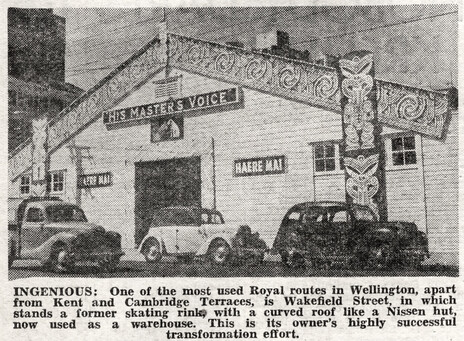
Although initially reluctant to record New Zealand artists, HMV decorated its Wakefield St factory with Māori carvings so that Queen Elizabeth II could take note while driving by on her 1953-54 tour. - NZ Truth, 13 January 1954
In New Zealand, that initially meant that CBS – on its new Australasian Coronet label – came via Radio Corp and, from 1955, via the new Gramophone Records Division of Philips Electrical Industries of New Zealand Limited. This left HMV NZ with a big product gap.
That gap widened substantially when EMI’s other US partner, RCA, announced in 1954 that it too would leave EMI worldwide, setting up independently from 1956, when its contract expired. RCA and Columbia were not only the biggest record companies in the US, but also the hitmakers on which EMI relied, having spent little to develop its own acts worldwide since the end of the war.
With the promise that EMI was about to lose almost all of its US catalogue – which provided the company with much of its turnover – Len Wood, the UK music boss, moved with urgency. The company had already done a deal with MGM, a second-tier American label, but it needed a bigger source of hits and a catalogue.
The answer was in Hollywood. Capitol Records was created in 1942 by three investors, one of whom was songwriter Johnny Mercer. In the decade since, it had become a powerhouse, with Nat “King” Cole and Frank Sinatra selling substantial numbers of records. And Capitol was for sale.
In New Zealand, the label was distributed and pressed by Radio Corp, via their relationship with the Australian Record Company (ARC). Its sales provided the finance to support their extensive Tanza local artist catalogue, mostly recorded in Wakefield Street or in Auckland at Noel Peach’s Astor studio.
In January 1955, Len Wood and EMI acquired Capitol Records for US$8.5 million, and the catalogue moved from Radio Corp to HMV in New Zealand on 1 January 1956. Although the deal was not fully approved by shareholders until May 1955, in January of 1955 Nat “King” Cole – a director of the company as well as its biggest-selling act – arrived at Whenuapai airport in Auckland for a concert tour. On the tarmac he gave the seismic bad news to Bart Fortune of Radio Corp/Tanza and the good news to HMV’s Jack Wyness.
But before that happened, two other major changes happened at HMV.
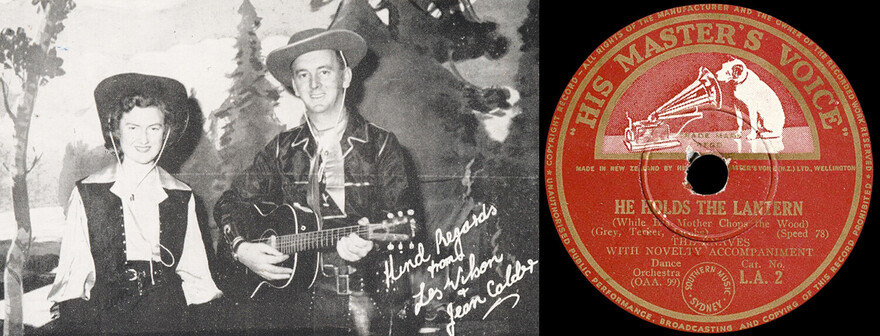
Early HMV (NZ) recording artists: Les Wilson (with Jean Calder), whose ‘Old Faithful and I’ was released as HMV LA4 in 1950, and The Knaves, whose ‘He Holds The Lantern (While His Mother Chops The Wood)’ was HMV LA2 in 1949.
HMV NZ’s first local recordings were made in 1949. First off the Kilbirnie presses was Warwick (Wally) Ransom & His Rhumba Band featuring Esme Stephens (‘Clarinet Samba’ b/w ‘You Can In Yucatan’). Recorded at Astor Studio in Auckland, HMV LA1 proudly says “Made in New Zealand” on the label. Then came The Knaves – also from Auckland – with ‘He Holds the Lantern’ b/w ‘Powder Your Face With Sunshine’. At the end of March 1950, Dunedin country singer Les Wilson’s ‘Old Faithful and I’ b/w ‘Shadows On the Trail’ went on sale.
In January 1951 the Rotorua Morning Post advertised a selection of Māori records available as “lasting souvenirs” at Wisemans, all produced by HMV (NZ): Auckland baritone Henry Murray with his recent ‘Pokarekare’ b/w ‘Haere Ra’ (HMV LA5), and earlier recordings by Mere Amohau and the Rotorua Māori Choir, re-released on the Columbia label, but manufactured by HMV in Wellington.
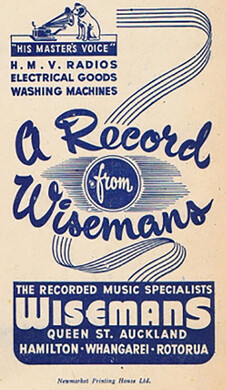
An illustration from a 78rpm disc sleeve in 1950 shows how dependent retailers were on HMV products. - 78rpm.nz
Mr Wyness had initially doubted that there was sufficient demand in New Zealand to produce local stampers to press from, and all such metalwork – including these – came from either Australia or the UK. After seven releases in 1950, he seems to have called a stop to this brief series (in the LA catalogue number sequence).
In September 1952, HMV NZ began to show more interest in recording local music, after direction from the UK following the loss of its key US catalogues. The first recordings didn’t exactly promise substantial revenue. It is likely that a combination of Jack Wyness’s moral rectitude and lack of any understanding of how to produce music locally played a role. That month, HMV recorded organist Reg Madden and the Wellington Citadel, both live performances. In 1953, they conducted recordings at the Salvation Army Music Festival on March 20 and the Church Choir Music Festival on April 30, both under Hugh Reid’s baton. Of these, only the latter appears to have been released, in late 1953.
However, in 1953 HMV decided to commit to putting local music on their dealers’ shelves more regularly.
HMV’s first local single release in the new HR sequence was released in June or July 1953; the HR series would eventually run to 640 singles, including some of our greatest 45s. The first artist was the established Wellington romantic pianist John Parkin who, over the next eight years, would record at least another 10 singles, three EPs and three LPs for the label. Perhaps HR1, ‘Piano Medley No 1’, was eased into production by a previously reluctant HMV because Mr Parkin also owned Parkin Plating Limited, which now made the factory’s important pressing plates.
It was followed by some 60 singles over the next three years, notably several from Jack Thompson, a pianist who would make (count ’em) 25 rollicking piano albums for the label. There were also big-selling 78s by Les Wilson, both solo and with his wife Jean Calder, and a brace of 78s by the Māori bass-baritone and actor Inia te Wiata. (These have been reissued and compiled repeatedly, not only in New Zealand but globally.)
In 1953, HMV decided it needed to upgrade its production facilities to meet anticipated demand for the two new formats, the 10-inch LP (the 12-inch was still some years off locally) and the 45rpm single. It began looking for a site and found one on Hutt Road in Lower Hutt, where it leased a building and built a new plant in a few months, importing seven new presses from the UK. EMI Manufacturing Limited opened in March 1954, with the ribbon cut by the soon-to-be-outgoing global head of EMI, Sir John Wall (he was replaced by Joseph Lockwood, who took EMI into its very profitable next two decades).
The old Kilbirnie plant, complete with presses, had a second life. Later that year it was sold to Green and Hall Ltd, a company owned by Radio Corp’s former manager Fred Green with Tom Hall. It operated as Green and Hall, then (from 1974), as Music Carriers (NZ) Ltd, then (from 1978) as PolyGram Record Service Ltd. It was finally shut down in April 1986, when PolyGram ceased manufacturing in New Zealand.
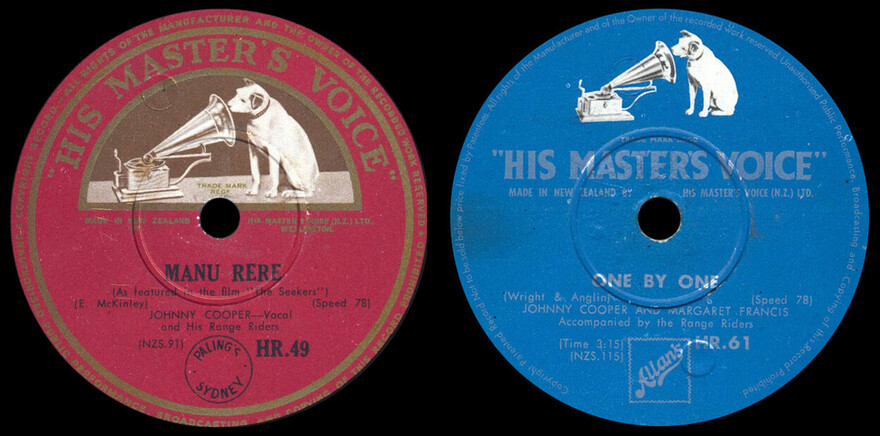
Johnny Cooper on 78 in 1955: ‘Manu Rere’ (HMV HR49) and, with Margaret Francis, ‘One By One’ b/w ‘Look What You’ve Done’ (HMV HR61; the blue label version is a reissue from 1957). Featured in the film The Seekers, ‘Manu Rere’ was the second Johnny Cooper single to be released, although it was the first to be recorded.
The label’s most important early signing was the act they called The Māori Cowboy. Hawke’s Bay-born Johnny Cooper would go on to make our first rock ‘n’ roll record, but in 1955 he was a country and western singer, already a well-known name thanks to his excursions to Korea to entertain our troops. Initially, HMV reluctantly recorded Cooper after he won a talent quest with an HMV recording session as first prize.
Cooper’s first released single was HR48, ‘The Convict and the Rose’ b/w ‘Humming Bird’, released in early 1955, but his biggest hit was his fifth 78, ‘One By One’ b/w ‘Look What You’ve Done’ (HR61), released later in the year as a duet with Hutt Valley singer Margaret Francis. ‘One By One’ was a cover of an American hit by Kitty Wells, while ‘Look What You’ve Done (Lonely Blues)’ was composed by Cooper, something almost unheard of in New Zealand at the time, despite the industry being kick-started by six years earlier by ‘Blue Smoke’, an original.
Both sides resonated with the public, and ‘One By One’ sold at least 80,000 copies, remaining in the catalogue until the end of the 1950s. The single’s cultural footprint was such that ‘Look What You’ve Done’ featured as a song in Once Were Warriors some 30 years on, sung by Jake the Muss. Cooper was HMV’s most significant local artist in the 1950s and his next major release was another cover version: Bill Haley’s ‘Rock Around the Clock’.
However, before Johnny rock and rolled, HMV was called to account in Parliament for its exclusionary retail tactics. Its monopoly was evaporating.
Read more at HMV NZ, part 3: acting local
--
With thanks to Mark Hector of the Alexander Turnbull Library for research assistance.