Continued from part 2 – HMV NZ: radio and records
From its earliest days as a company, HMV had most of the New Zealand recorded music market to itself. By the middle of the 1930s, with a catalogue that included every major and many smaller international labels, it was effectively a monopoly, to which it had come to feel entitled. Post-war, with the entry of other distributors into the marketplace, that began to change.
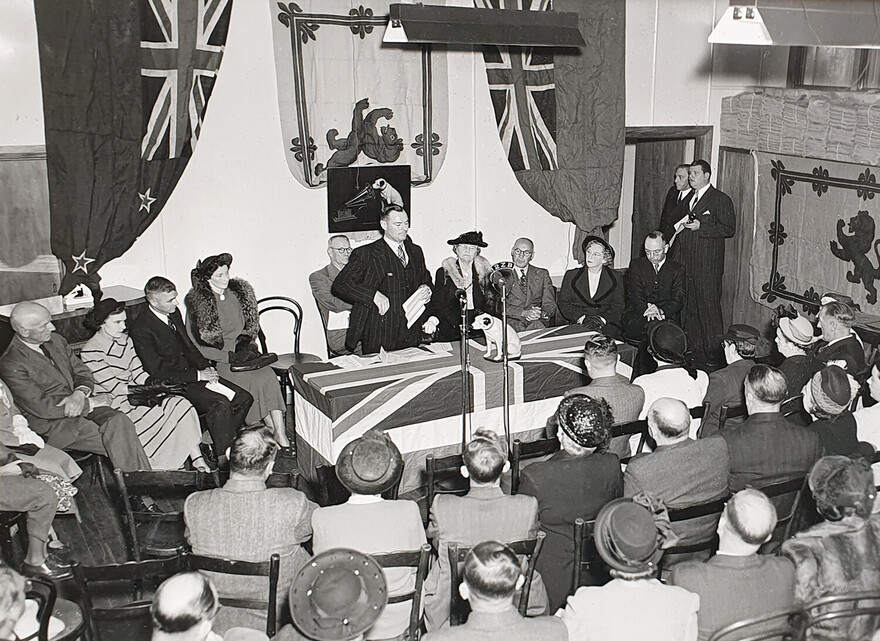
The opening of New Zealand’s first pressing plant, built by HMV at Kilbirnie, Wellington, April 1949. Deputy managing director Jack Wyness is at the microphone; behind him is Robert Semple, the Minister of Public Works. The new presses could produce a disc every 40 seconds, and 200,000 in a year. - Alexander Turnbull Library, Wellington, PAColl-0646
First came Radio Corporation, with connections to the Australian Record Company and Capitol Records. The Stebbing brothers in Auckland picked up several important indies, not least the US company Mercury. That was followed by Pye, based in Waihi, which distributed its UK parents’ Pye and Nixa catalogues and, at the start of 1956, struck a deal with the newish Australian indie Festival Records, which gave them US Decca, Brunswick, Westminster and other independents.
Both Radio Corporation with its Tanza label (the record division was soon renamed Recording Corporation of NZ), and Stebbing with its self-titled and Zodiac labels, also had growing catalogues of local music – something that HMV did not yet have. HMV considered any sale to the others as a lost sale that was rightly due to the giant.
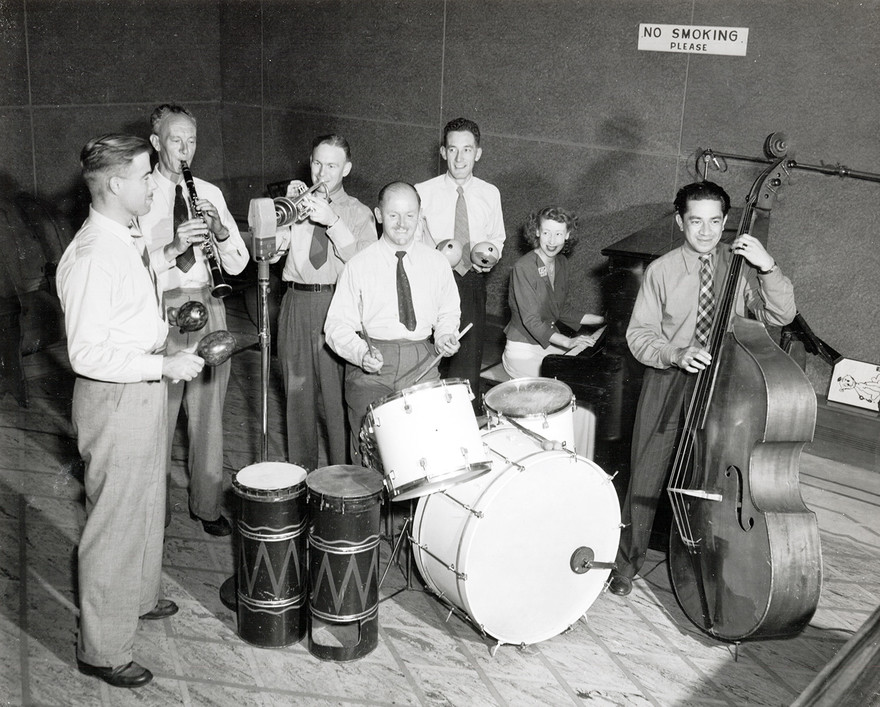
Wally Ransom’s Rhumba Band rehearse without vocalist Esme Stephens, Astor Studios, Auckland, 1949. From left: Lee Humphreys, Charlie Welch, Jim Warren, Wally Ransom, Phil Maguire, Nancy Harrie, George Campbell. - Jim Warren collection
The monopoly was enforced in several ways. Firstly, by price: retailers that stocked other companies’ records were forced to pay higher wholesale prices for HMV records, which meant customers went elsewhere. Secondly, by exclusion: retailers who sold competitors’ records were not offered the new releases or invited to the Friday afternoon new releases presentations in Auckland and Wellington. Finally, by taking away retailers’ franchises to sell profitable and heavily promoted HMV whiteware, radios, and household goods.
The pressure in 1953 forced brothers Eldred and Phil Stebbing to make what must have been a very difficult decision, given their passion for the record industry: to shut down their business. This was not just music retail but also included recording and a pressing plant in Grey Lynn (which, in 1954, they sold to Green & Hall, the new operators of the original HMV plant in Kilbirnie). Eldred Stebbing would successfully re-enter the business with Zodiac later in the decade, after HMV’s monopoly had been largely broken. So did other adventurous indie labels in direct competition for the customer’s pound: Viking, Prestige and Kiwi.
Meanwhile, in 1951, the Musicians’ Union entered the fray, under pressure from its members and public unhappiness. The union backed down, but HMV’s defence brought the issue back to the fore. As Chris Bourke notes in Blue Smoke, the company said it was “quite entitled to insist on dealers, music shops, etc, stocking their records only …”
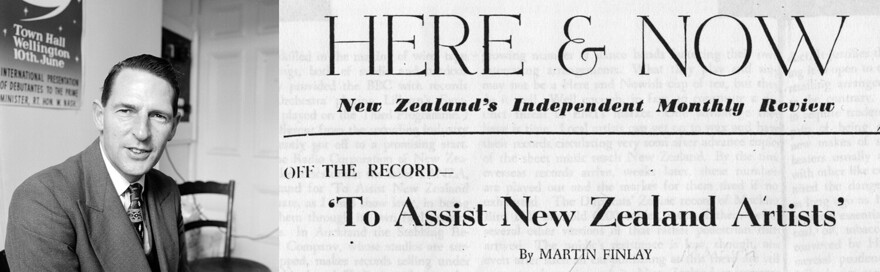
Martyn Finlay (in 1960), Labour MP and later a cabinet minister, and his declarative essay about HMV NZ’s monopoly in Here & Now, March 1952. - Alexander Turnbull Library, Wellington, EP/1960/2103-F.
The matter came to a head in March 1952 when Martyn Finlay, a Labour politician and future Minister of Justice, published an editorial in the well-read and influential monthly review Here & Now.
Finlay took few prisoners in a scathing attack on HMV’s business practices, including a letter from a retailer stating that they “do wish to carry stocks of ‘Zodiac’ etc” but were restricted from doing so by HMV’s exclusionary business practices.
Questions were asked in the House, and the end was nigh for HMV’s monopoly, but what eventually killed it was public demand and availability. HMV had, for two decades, controlled what was released and sold in New Zealand. No longer.
As the 1950s began Radio Corp and Pye had broken through that wall, offering more and more records that the public wanted, and it was increasingly bad for business for retailers not to stock records that were being played on the radio and were in demand.
Then, in 1955, Philips entered the field. The giant Dutch organisation had the license for CBS’s Coronet label (after HMV lost the licence in 1952, Coronet discs were imported by Radio Corp as finished stock from ARC), which included hugely popular American stage shows and movie soundtracks. In late 1956 Radio Corp picked up the licence for RCA, which included Harry Belafonte, the soundtrack to South Pacific, and, crucially, a young hitmaker from Tupelo, Mississippi called Elvis Presley. While HMV would continue to dominate for another decade and a half, the monopoly game was largely over.
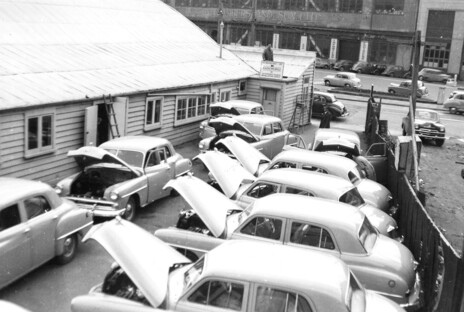
Plymouth cars waiting for radios to be installed by HMV's Radiomobile division, Wellington, 1952. John Charles Gannaway, Alexander Turnbull Library, Wellington, PAColl-8004-2
The 45 and LP
In its first year, the EMI plant in Lower Hutt was tooled up to produce only shellac 78s. From EMI Australia, plus EMI and Decca in the UK, HMV NZ imported limited quantities of vinyl albums (primarily 10-inch) and 7-inch EPs. In 1955, HMV imported new presses and began pressing 7-inch 45s and EPs, as well as both 10-inch and, from 1956, 12-inch longplayers.
HMV NZ issued its own first 10-inch albums late in 1955, and their pressings of 7-inch 45rpm records and 12-inch LPs arrived in 1956. As far as can be ascertained, the first local 7-inch release was Johnny Cooper and Margaret Francis’s ‘One By One’, in 1956. (In April 1957 advertisements for Cooper’s live appearances claimed his “record sales are now far in excess of 100,000.”) Until later in the decade – given the low penetration of 45rpm players in New Zealand – most sales of singles were still on the shellac 78rpm format.
The single that followed ‘One By One’ is one of those strange releases that litter the local HMV catalogue. Following the success of that single, HMV A&R man Dave Van Weede offered Cooper a five-year contract (the earlier singles seem to have been recorded on a record-by-record basis), and suggested they look at a song that had done huge business in the US but was unreleased in New Zealand.
Bill Haley & The Comets’ ‘Rock Around The Clock’ had been recorded in 1954 and was originally released as a B-side. Then, in 1955, it was added to the opening credits (and played four more times) in the teen movie Blackboard Jungle, a film that kick-started rock’n’roll as a mass phenomenon. That pushed Haley’s single to eight weeks at No.1 on the Billboard chart. In the UK, it became the first single to sell one million copies, with 1.4 million sold in 1955.
In Australia, it was released by Festival Records, which held the rights under its deal with US Decca; there, too, it was the biggest-selling recording in the country that year.
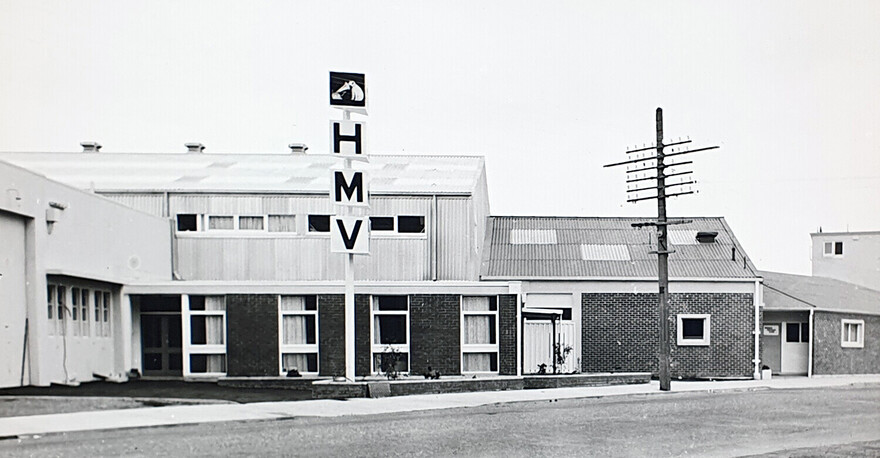
HMV's new plant on Hutt Road, Lower Hutt, 1954. It remained at this location until record pressing finished in 1987. - Alexander Turnbull Library, Wellington, PAColl-0646
It was more complex in New Zealand. US Decca had a licence with HMV, set to expire in late 1955, with Festival picking up NZ rights too; however, Festival was not going to launch in NZ until 1956, so Dave Van Weede had an idea. He had already turned down the Haley record for local release but quickly rang Johnny Cooper. He suggested that Cooper, as his next single, record ‘Rock Around The Clock’, but the singer was bemused. As Chris Bourke writes, reluctance and confusion were Cooper’s first reactions: the words made no sense, and neither did the beat. “I sang love songs. It was foreign,” he recalled.
Cooper had no idea what rock’n’roll was. The phrase was alien, but Van Weede insisted. The first recording was made at Wellington’s Majestic Cabaret, but when it was given to radio, there were sonic issues, so it was re-recorded at Alan Dunnage’s studio in Island Bay on 27 August 1955, and issued by HMV in early October 1955. It may or may not be the first rock’n’roll record recorded and released outside the United States; there are alternative claimants, but it can be said to be among the earliest rock’n’roll recordings made outside the US and is widely regarded as New Zealand’s first locally recorded rock’n’roll roll release.
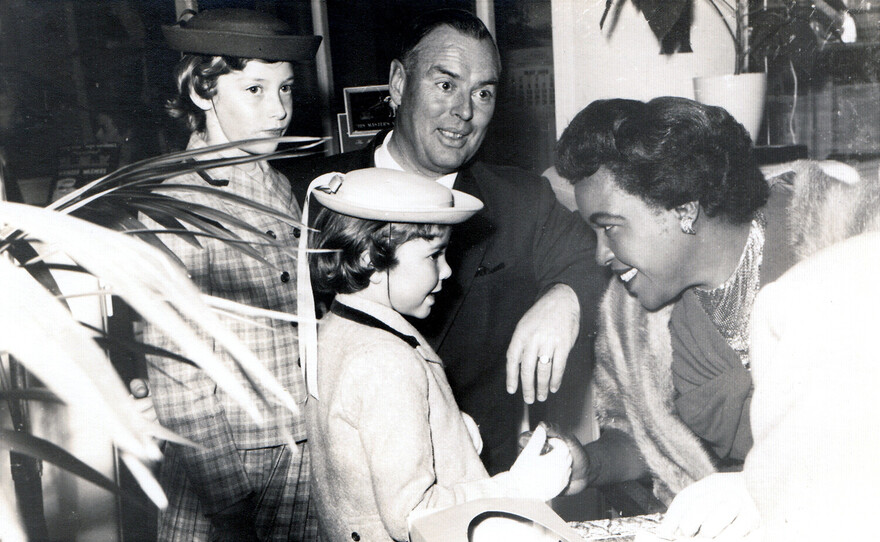
HMV NZ managing director Jack Wyness introduces his daughters Joan (left) and Julie to “queen of the piano” Winifred Attwell, touring from the UK, 1955. - Photo courtesy Julie Bell-Booth
The recording itself is perhaps best described as an admirable attempt, especially given that the band, Ken Avery and His Rockin’ Rhythm, were jazz and dance band musicians who had heard little or no rock’n’roll before they ventured into the Majestic that Autumn evening.
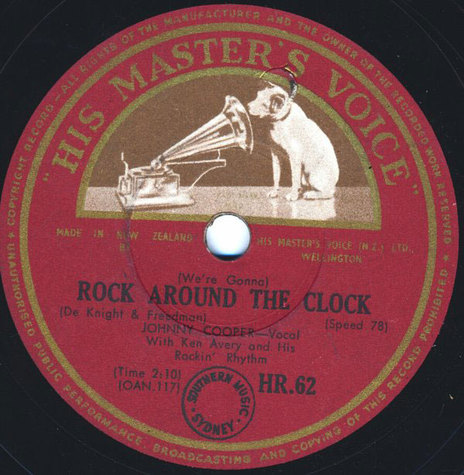
Rock Around The Clock (HMV HR62), by Johnny Cooper, released in September 1955. Possibly the first rock’n’roll record released outside the US, it was issued in New Zealand before the Bill Haley version.
In the weeks that followed, the Australian pressings of the Haley original began to be imported into New Zealand by retailers, and Festival Records finally released it locally in early 1956, rendering the HMV cover version largely worthless. It was soon removed from the catalogue. Unlike other Cooper records, it was never issued on 7-inch 45. However, it did appear as the first track on HMV’s Johnny Cooper 10" compilation of earlier singles, Rock and Sing With Johnny Cooper, which hit the stores in early 1957. While this was not HMV’s first local LP (that honour went to three 10" collections of the 1930 Rotorua Māori Choir recordings, in 1955), it was their first local pop LP and, if the numbers still in circulation six decades on provide evidence, it sold very well. Cooper’s cover of Bill Haley’s ‘See You Later, Alligator’ was also on the Rock and Sing album, having been issued on both 7-inch 45 and 10-inch 78 in May 1956.
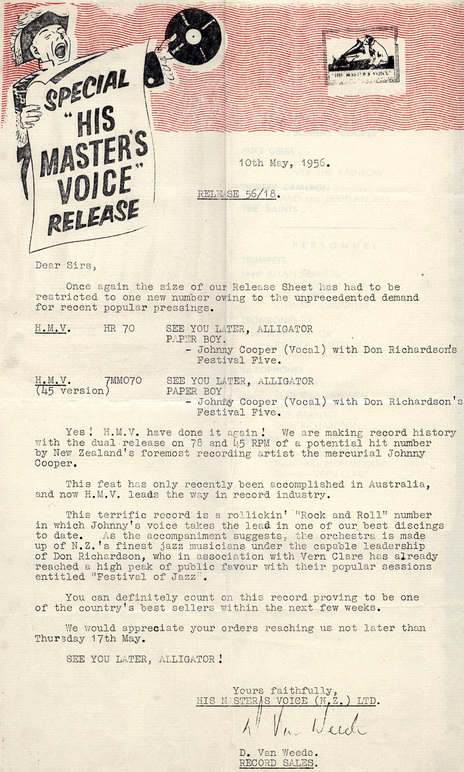
HMV announces the release of Johnny Cooper's ‘See You Later Alligator’, 10 May 1956. - Mark Nicolle Collection
Cooper’s final contribution to this story may be his most important, as a songwriter and writer who documented his homeland. In October 1957, his song ‘Pie Cart Rock And Roll’ – recorded in a room in Wellington that made the slap bass ring – was pure Kiwiana. The band had learnt to swing, and while it was slightly out of time with the rapid changes that followed Elvis, it was still very much ours, as possibly the first New Zealand-written rock’n’roll recording issued. It was Cooper’s final single for the label but remains one of the most collectable, a bona fide New Zealand rock’n’roll classic. (Almost simultaneously, ‘Resuscitation Rock’ by Wellington teenager Sandy Tansley was released on EMI subsidiary Parlophone.)
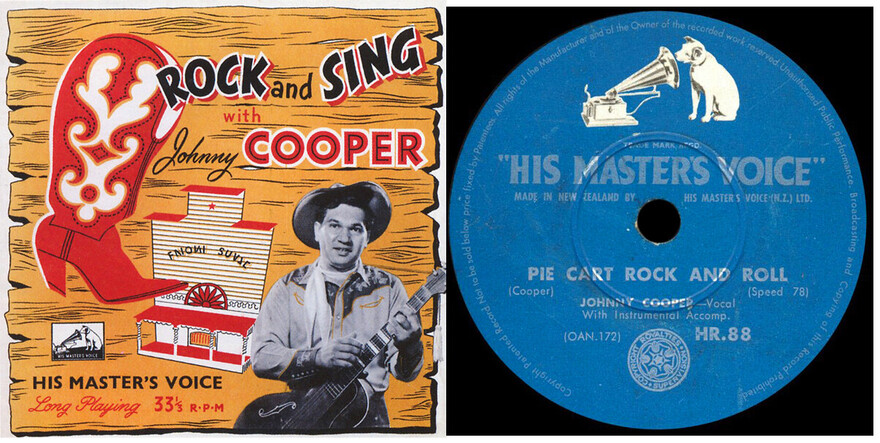
Rock and Sing with Johnny Cooper (HMV 10-inch LP, 1955), and ‘Pie Cart Rock and Roll’ (HMV HR88, 1957)
RCA moved to Radio Corporation at the start of November 1956, allowing HMV time to be first to release two singles by the hottest act on the planet. Elvis Presley’s ‘Heartbreak Hotel’ was issued in July, and ‘I Forgot To Remember To Forget’ b/w ‘Mystery Train’, from the Sun sessions, in August. Both sold well but had to compete in the shops with imports from Australia, where RCA, already independent of EMI there, had issued many more titles. Why HMV did not issue more in 1956 is unclear, because RCA’s contract only gave them access to the older tracks (up to and including ‘Heartbreak Hotel’). That still gave HMV the rights to eight Sun-era tracks that they ignored. Both Presley records were issued on 7-inch and 78, and there was a crossover period in which both HMV and RCA were selling Presley in quantities.
In April 1956, Jack Wyness was invited to and attended the opening of the iconic Capitol Tower in Hollywood. The same month, Sinatra’s Songs For Swinging Lovers was HMV NZ’s first locally released 12-inch LP, just a month after the US release.
HMV had opened its first South Island office in May 1955, with a staff of six, which meant that local retailers could avail themselves of the same in-office selection of new stock and reordering that the North Island offered: no more waiting for the monthly visit by the sales rep or echoing party lines.
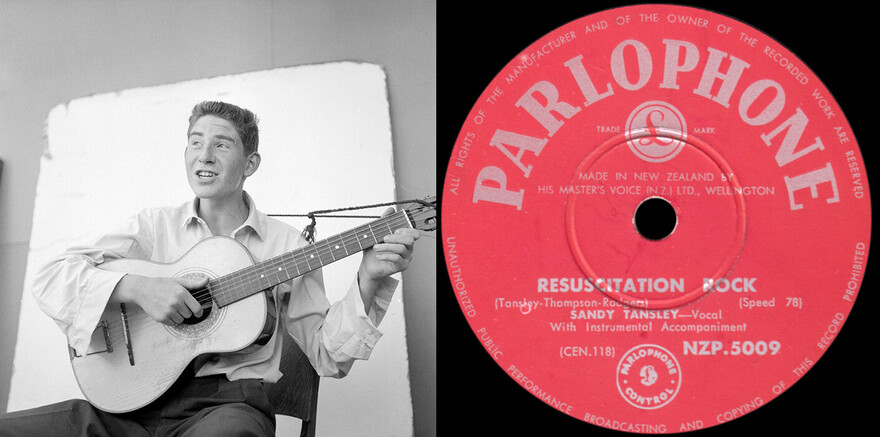
Sandy Tansley, late February, 1957. His song ‘Resuscitation Rock’ is advertised as a new release at the Lamphouse, in the Evening Post of 3 October 1957. - Evening Post Collection, Alexander Turnbull Library, Wellington, EP/1957/0592-F
Meanwhile, the Hutt Valley factory was now producing all the stampers in-house: again, no more waiting for metalwork from Australia or the UK, or, for local releases, for Mr Parkin in Wellington to deliver. This should have meant faster releases, but local reluctance to risk new things and HMV’s conservative business practices still meant that the A&R team relied on foreign success before taking the local leap. So New Zealand was still often many months behind the UK, especially in releases by unknown or new acts, which seem to be released in a scattershot manner – some were, especially on Decca’s London label, others not at all.
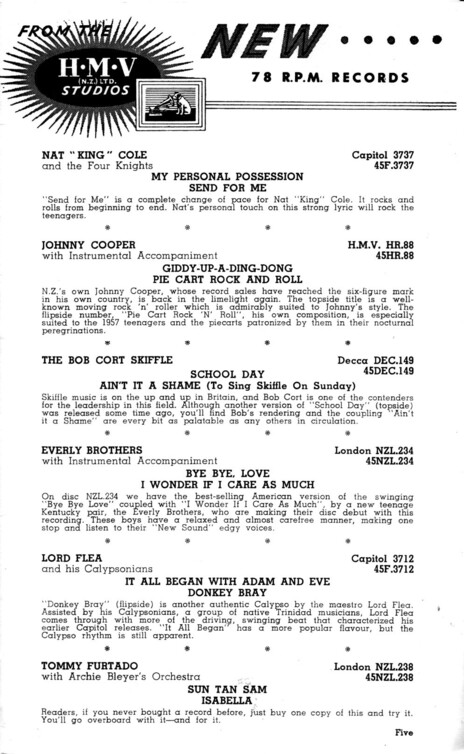
HMV (NZ) Ltd release catalogue for October 1957 includes Johnny Cooper’s ‘Giddy-Up-A-Ding-Dong’ b/w ‘Pie Cart Rock and Roll’. - Chris Mousdale Collection
It seems to have been decided on whim and personal taste. That mattered less when retailers were able to import reasonably freely, but with the imposition of very strict import licensing on 1 January 1958, the music-buying public became almost immediately reliant on what the record companies decided to release. This, in turn, was arguably very good for locally recorded music, something indies such as Prestige, Zodiac and Viking were ready to exploit.
Recorded in New Zealand
HMV’s risk-averse conservatism also meant that, despite the successes with Johnny Cooper, the company still remained unwilling to invest money or effort in local talent. Their major local release of 1956 was The Woolston Brass Band with the ‘All Blacks’ Football Song’, which launched EMI UK’s premier pop label, Columbia, locally (cat # DNZ101) and allegedly sold 100,000 records. That was followed by DNZ103, the same band with, no surprise, ‘On The Ball’, paired with the Papanui High School Boys’ Chorus; on the B-side they covered the traditional Afrikaans marching song ‘Sari Marias’.
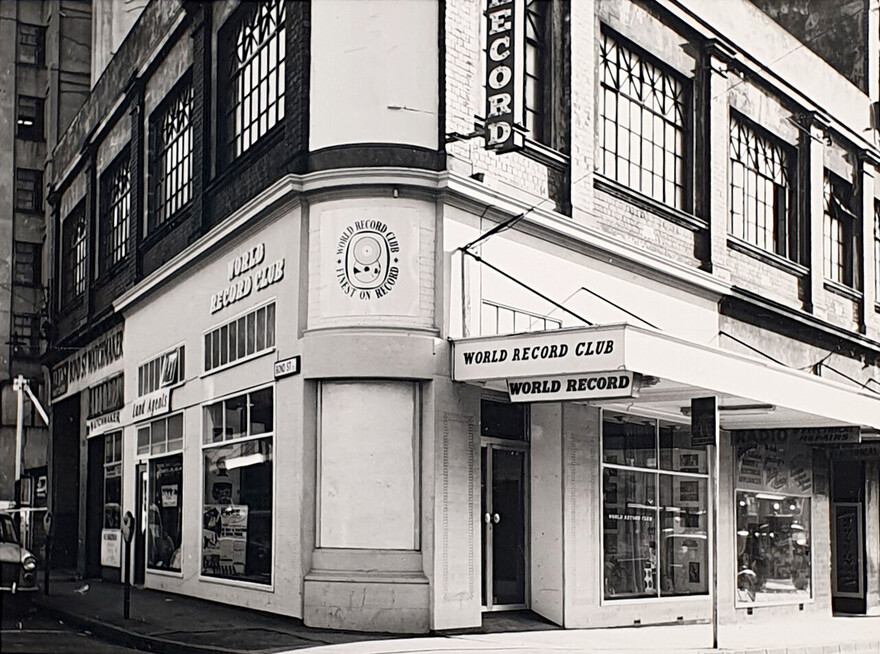
The World Record Club shop, owned by HMV, 1956. It was situated on the corner of Farish (now Victoria) and Bond streets in Wellington. - Alexander Turnbull Library, Wellington, PAColl-0646
Meanwhile, local pop languished at HMV. The company, with money to burn and a pressing plant, had invested nothing in a studio and – if it recorded anything – was reliant on Astor in Auckland, Christchurch Recording Studio (Robbins after 1958) in Christchurch, and Sonic in Wellington.
HMV largely missed the proverbial boat on the Hawaiian and Pacific craze that dominated the Auckland scene for much of the 1950s. As rock’n’roll arrived and evolved from a novelty into a national craze, Nipper was, with a couple of exceptions, absent after they let Johnny go. While HMV languished, Howard Morrison, Bob Paris, Bill Wolfgramm (with one exception), Johnny Devlin (turned down by Dave Van Weede), Bill Sevesi, the Jive Centre bands, Cole Wilson, Ronnie Sundin, and others all sold substantial quantities of local vinyl and 78s.
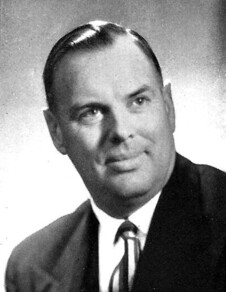
HMV NZ managing director A J “Jack” Wyness, 1959.
Between 1955 and 1960, there were some 80 releases in the local HMV HR sequence, assigned to local records, yet bizarrely most were anything but local pop with sales potential. Instead, the pious managing director, Jack Wyness, channelled the company’s resources into literally dozens of religious releases, many of which were US-recorded. HR90 to HR125 were all sanctified, and only 23 singles across those years could be deemed secular, with even fewer targeted at the pop market that would, in the next couple of decades, define the company.
Ironically, as the rock’n’roll era arrived and dominated, HMV’s head office on Wakefield Street was surrounded by venues and halls, often filled with teens dancing to local acts. Few made it onto the HMV roster. One who did was Paul Walden.
From rural Whanganui, Walden made his way to Wellington, where he started singing with local dance bands and was signed to HMV in 1958 by Dave Van Weede, not because of his live prowess in the nearby clubs of Te Aro, but because he was heard by the A&R scout at a 2ZB talent show. His first single, ‘Poor Little Fool’ b/w ‘Kewpie Doll’, was the very first single recorded at HMV – in the staff cafeteria by Ivan Fisher. It was also the first local HMV 45 in a picture sleeve, and was a substantial hit. It was broadcast on the Lever Hit Parade radio show (a hit parade in name only), and launched the balladeer into a long career. Walden’s next single, the traditional ‘Tom Dooley’, was equally successful, although it would be 1965 before HMV allowed the singer to record his debut album. The company did, however, record its first local albums in 1958 (the earlier Johnny Cooper was a collection of his 78s transferred to LP). The artists were Jack Thompson (The Thompson Touch) and John Parkin (John Parkin Plays), both on 10-inch.
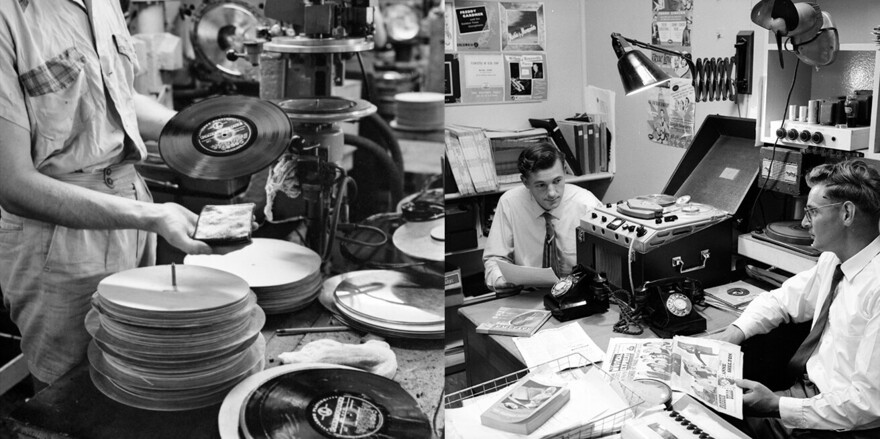
Inside the HMV factory and offices, 1957. Left, checking newly pressed LPs. Right: A&R men Dave Van Weede and Ray Isaac discuss possible future releases while consulting the NME. - Morris James Hill, Alexander Turnbull Library, Wellington, PA-Group-00375
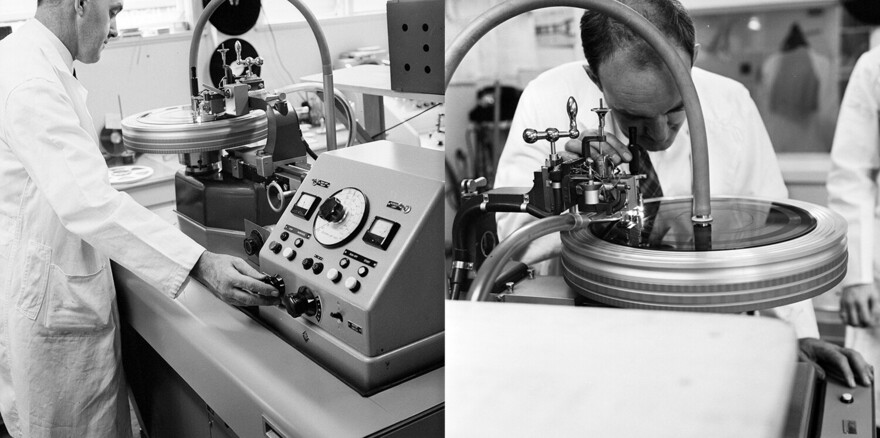
HMV at Lower Hutt, 1957: cutting and monitoring a master. - Morris James Hill, Alexander Turnbull Library, Wellington, PA-Group-00375
In 1959, HMV decided to phase out the 78-rpm shellac disc. Internationally, they were obsolete, at least in developed nations (India would continue to press them well into the Beatles era, as did other nations in Africa and South America), and while there were still many players in homes nationwide, especially in rural New Zealand and in the Māori community, vinyl LPs and 45s were the future. It is unclear what HMV’s last 78 was, although Green & Hall seem to have pressed 78s well into 1960, and the early Zodiac single by the big-selling Howard Morrison Quartet, 1958’s ‘Deep Purple’ b/w ‘Marie’, was only ever in the 78rpm format and was still being distributed and sold in 1960.
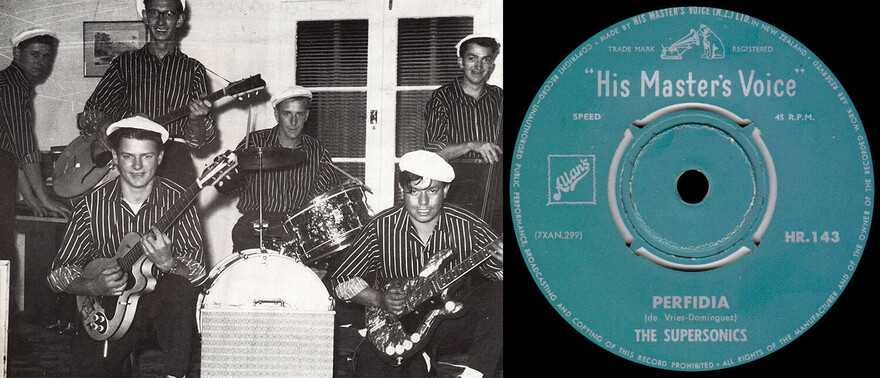
Wellington band The Supersonics, and their 1960 single ‘Perfidia’. Back row, from left: Pat Southee, Barry Walden, Jim McNaught, Richard Cooper. In front: Bob Southee and Phil Campbell.
In 1959, HMV signed Paul Walden’s backing band, The Mana Quartet, but their young manager, Ken Cooper – later a key figure in Wellington’s music business in the next decade – decided that The Supersonics would be a better name. He was probably right, and the band’s December 1959 single was a credible cover of The Ventures’ ‘Walk Don’t Run’. The Supersonics released three more singles over the next couple of years and were a precursor to the golden age of New Zealand pop that HMV would bring us in the years to come.
In retrospect, there were other signs that the Wellington label was on the cusp of moving from musical inertia to a point where it could use its resources to do something special. Among them was the signing of a young man and his band from Christchurch. Local promoter and band manager Trevor King insisted that the Christchurch office tell head office to sign Max Merritt and The Meteors. To be fair, they would have been nuts not to; the band was attracting weekly frenzied crowds of 800 or more, and their leader was a local superstar.
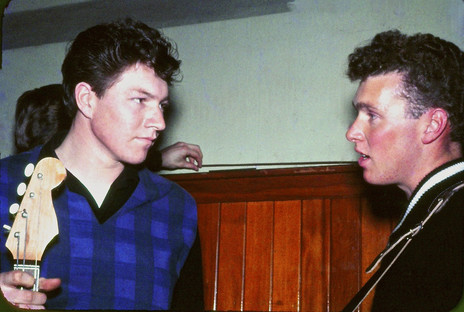
Meteors bass player Billy Karaitiana (left) with Max Merritt, 1958. - Billy Karaitiana collection
It is unknown how much effort it took to convince Wellington, but it is apparent just how little effort Wakefield Street seemed to put into the group once they signed them. Merritt told John Dix, “HMV was hopeless. We did everything ourselves, arranging the recordings and promotion, the record stores. We recorded at Keith Robbins’ home studio, and the album was recorded at the 3YA studio, and we more-or-less produced everything ourselves.”
The album C’mon Let’s Go was released in 1960, accompanied by six HMV 45s by the band, all of which sold very well to an audience that the company had practically ignored to date, but one which would soon become its key local market.
On 1 January 1960, an independent Wellington recording studio, Lotus, opened on Victoria Street, Wellington. Owned by Tasman Vaccine Laboratories, it was managed by Frank Douglas, formerly an engineer at Radio Corp’s studio in Wakefield Street. Both the studio and Douglas would play pivotal roles in HMV’s 1960s, as would the arrival of two UK bands on the scene, Cliff Richard with The Shadows, plus The Beatles.
This would have a profound, positive impact on the balance sheet of HMV (NZ) Ltd – and New Zealand music.
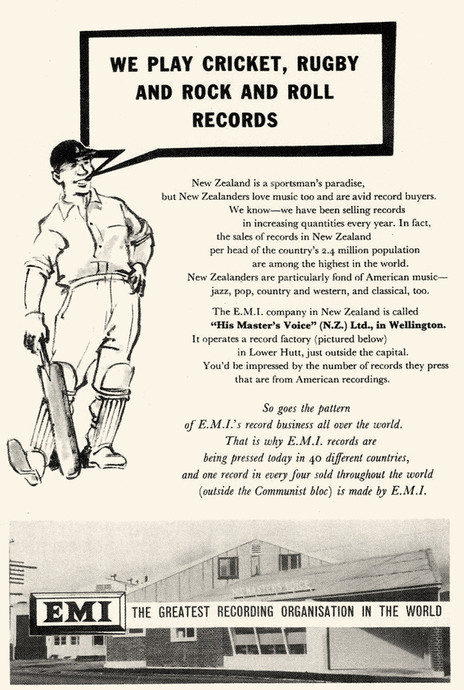
HMV (NZ): “We Play Cricket, Rugby and Roll and Roll Records ... One record in every four sold throughout the world (outside the Communist bloc) is made by EMI.“ - Billboard, January 1963; Chris Mousdale Collection