Continued from HMV NZ, part 3: acting local
This opinion piece about HMV NZ’s monopoly over the New Zealand record industry in the early 1950s – and the tactics it used to protect its dominance – was first published in Here & Now: New Zealand’s Independent Monthly Review, March 1952. The author Martyn Finlay, an Auckland lawyer, later became a cabinet minister in Norman Kirk’s Labour government in the 1970s.
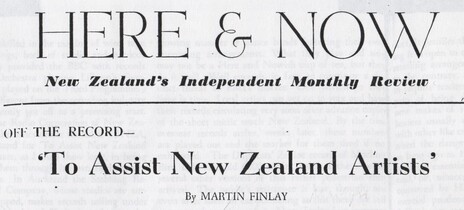
HMV plays Monopoly: headline to Martyn Finlay's essay in Here & Now, March 1952
“To Assist New Zealand Artists”
For much of its music – serious, light and swing – New Zealand has always had to depend on gramophone recordings. In the early 1930s these were provided by a number of companies that started as independent organisations but gradually became linked by mergers, arrangements and understandings.
In New Zealand gramophone records are big business, and what are merely mergers overseas threaten to become a squeeze in this country. Here is some of the background:
In the United States two companies are fighting for the dominant position, with dozens of others competing more or less successfully on a smaller scale. The big two are RCA-Victor and Columbia, both of them being also linked with radio and television networks. They not only contract for the exclusive services of their own artists but maintain their own technical laboratories, which seem designed less to benefit the public than to create monopoly conditions. (Remember all the ingenuity that went into devising and spacing the holes on safety razor blades so that they would not fit any but the manufacturer’s razor?)
Columbia scooped the pool with long-playing (33 1/3 rpm) records, whereas Victor came a poor second with their records revolving 45 times per minute. But in England (and for that matter everywhere outside the United States and Canada) the hatchet is buried, and HMV – the European counterpart of RCA-Victor – and Columbia have joined forces in an organisation known as Electrical and Musical Industries Limited (EMI) to carve up the markets among themselves.
technical developments seem designed less to benefit the public than to create monopoly conditions
They retain their old labels, doubtless for the sake of the advertising spent on them in the past, but operate as one organisation. Their only serious competitor in England today is the Decca Company, which by a display of dash, enterprise, and courage greater than the EMI group feels called upon to show, maintains a vigorous existence and puts out a high proportion of the best in British records. Decca introduced a new recording system a few years ago which was a greater step towards making the gramophone a faithful reproducer than any since the change from acoustic to electric recording, and pioneered the notion of selling gramophones and equipment at less than cost to stimulate the sale of records – a policy from which, of course, its competitors derived equal benefit.
More important, it was the first producer of long-playing records in England, although the former Columbia factory was well equipped to lead the field. So far the big companies have denied this great development to the British public, whereas, quite recently, both HMV and Columbia have been forced to make some long-playing records in France in the face of stiffer competition. (Incidentally, how much longer is the New Zealand Broadcasting Service, which should have installed the necessary equipment months ago, going to deny us the privilege of hearing long-playing records?)
The position is further aggravated in New Zealand where His Master’s Voice (NZ) Limited not only but represents the Big Two joined in the EMI group, also Decca, Parlophone, and in fact all British record manufacturers of any consequence. The monopoly would be complete, were it not for one or two New Zealand record manufacturers whose activities are becoming rather irksome to it.

Martyn Finlay (in 1960), Labour MP and later a cabinet minister. - Alexander Turnbull Library, Wellington, EP/1960/2103-F.
Recording for commercial sale is a fairly new development in New Zealand. Indeed it is only within recent years that there has been much that was worth recording. Some years back Parlophone did make and ship overseas for processing some records of Māori groups, and the Broadcasting Service has become quite accustomed to and skilled in the making of wire, tape and acetate recordings, both of studio and outdoor events. (It recently provided the BBC with records of the National Orchestra playing Lilburn’s Symphony, which were played on the Third Programme.)
Both of these are different from the recording industry as such, which recently got off to a promising start. In Wellington the Radio Corporation of New Zealand make and market discs under the label TANZA, which is said to stand for “To Assist New Zealand Artists”. It is fortunate, as I shall show later, in being able to distribute them through its own fairly extensive chain of shops. In Auckland the Stebbing Recording and Sound Company, whose studios are surprisingly well equipped, makes records selling under the names of Stebbing and Zodiac, and they also market under the name of Bosworth discs recorded overseas but pressed here.
HMV also press records in New Zealand but have not, as far as I know, yet recorded New Zealand artists in this country and sold them here under their own label. However, some records made by Radio Corporation and originally released with the Tanza label have later appeared as HMV’s; and another Auckland company, the Astor Recording Studios, has supplied master records for some HMV discs. This company also makes master records for Tanza, which has no Auckland studio, and occasionally, to make matters a little more complicated, puts out a record bearing its own Astor label.

Auckland's 1950 jazz concert, featuring Mavis Rivers who recorded for Tanza and Stebbing in the early 1950s. - Auckland War Memorial Museum, EPH-PT-15-1_001; Alexander Turnbull Library, Wellington, ref: PAColl-6388-13
Astor may have been the first in the field. It started off by recording local dance bands for their own amusement and instruction. The fee charged was 30/- a side, and the records so made became the property of the performers. Some of these were so good that the players were commissioned to make records for commercial release. The fee paid for them – a royalty of 3d a record, of which a guaranteed advance of £25 (2000 sales) is paid to the leader, who makes his own arrangements with other performers – has become the generally accepted rate.
HMV and Astor figures are not available, but between them Radio Corporation and Stebbings have put out some 50 records. Almost all of them are light or popular in character, but this does not mean they are unworthy of serious attention. Of their kind, they are hearteningly good, comparing favourably with similar overseas efforts and technically of a high order. Excellent performances have been given by Buddy Kane, a most accomplished electric guitar player who has now unhappily left this country; Julian Lee, a versatile instrumentalist whose inventiveness and musicianship have been enhanced by his blindness; the Knaves, a smooth male quartet; Mavis Rivers and Esme Stephens, torch-singers better than their British and as good as their American equivalents: and a growing number of dance bands featuring their own interesting arrangements.
What they play and sing may not be a Here and Now-ish cup of tea, but they do it well. Well enough, in fact, to constitute a distinct threat to EMI’s market. One advantage they have is time. Local artists can get on to wax and have their records circulating very soon after advance copics of the sheet music reach New Zealand. By the time overseas records arrive, weeks later, these number are played out and the market for them tired if no exhausted. The Duplicats’ Zodiac record of ‘Mocking Bird Hill’ has sold 6000 copies, most of them before several other versions of that rather pedestrian ditty arrived. The public’s resistance is low, though, and even after such an ear-punishing as this there are still not enough versions of it, New Zealand or overseas to satisfy the demand. Not all of the local productions reach such a level of supply and demand (though the general level would have been higher had it not been for the “squeeze”), but obviously a few weeks’ start in the short life of a “hit” tune is a great asset and goe far to meet our limited market.

Marbecks, Auckland, c. 1960: Hayden and Murray Marbeck at your service. - Roger Marbeck Collection
The challenge has not gone without response. Until recently these sales were made through the usual music and other stores whose business it is to handle records – all kinds of records.
A few weeks ago the products of the New Zealand companies began to disappear from the big music stores and the only explanation given to people enquiring for them was that they were not in stock. The Musicians’ Union began to take an interest in the matter at this stage, naturally regarding it as a matter affecting the welfare of its members. It found that pressure was being put on dealers by overseas manufacturers and that anyone handling local records would not be supplied with their products. This included, of course, not only popular records but the whole output of the EMI Group.
At first this was denied by the HMV Company representing in New Zealand the EMI Group as well as other British manufacturers. Dealers themselves were reluctant to speak up publicly but this extract from a letter written by a trader to one of the New Zealand manufacturers is proof enough:
“We do wish to carry stocks of ‘Zodiac’ etc., only we are placed in rather an awkward position, as we have always handled the HMV Group in records. HMV dislike the idea of us handling other recordings, and threatened to cut supplies when we started handling your records sometime ago, hence the delay in further orders.”
Every shilling less spent on HMV’s Boogie means a penny less for HMV’s Bach
Following further publicity by the Musicians’ Union the company has come out into the open and admitted it has forbidden dealers to handle the domestic product. It justifies this as normal commercial practice, saying it is open to every supplier of goods to make his own retailing arrangements. This is disingenuous. HMV to the contrary, it is not common for manufacturers to require traders to handle their lines exclusively on pain of being deprived of supplies altogether, and new makes of shirts or radios or chocolates or egg-beaters usually appear on the shelves in competition with other like commodities.
The legislature has recognised the dangers inherent in exclusive trading and as long ago as 1910 specifically forbade it in the case of such essential articles as agricultural implements, coal, oil, tobacco and all foodstuffs. The impression conveyed by HMV’s statement is one of great commercial prudence, involving long-standing and carefully drawn contracts with retailers. It is hard for one not in the trade to be certain but this is probably nonsense. When gramophone records came on the market they were naturally marketed through music stores, just as radios were when they became popular.
Before the creation of EMI there were no stores selling HMV records only and no others; and with the development of the monopoly there has been no need for arrangements of this kind. But the very monopoly has given it absolute control of the field. To forbid the local producers access to all shops now normally dealing in records is to strike them a death blow, and it is no answer to say there are other shops not so far handling records. The local catalogue is too limited to be very attractive and the profit from the few records it provides will not offset the potential loss resulting from the hostility of a firm handling a fairly extensive range of electrical imports.
Yet one can see HMV’s position. Popular records are the big profit-makers and all companies rely on them for their bread and butter – and incidentally to subsidise the small profit involved in handling stocks of slower-moving records of serious music. Every shilling less spent on HMV’s Boogie means a penny less for HMV’s Bach, a thought that should discourage hasty condemnation.
The solution? Not easy, if it is to satisfy all parties, including the public. One that may gather support if the present ban is continued, and one that could provide a dangerous precedent, would be action to prohibit the importation of certain kinds of records altogether. This could develop into a clamour to record the National Orchestra and then exclude all others, or the argument that as Miss X sings no less loud and clear than Elizabeth Schwarzkopf, Miss X should make records in New Zealand to replace Miss S’s. No, let’s keep away from that one.
And I think we can do so. The field involved is not one where virtuosity counts for a great deal. What buyers of New Zealand-made records want is the tune, competently but not necessarily brilliantly played. The challenge these discs offer is not to the headliners, even in the popular field. Donald Peers, Bing Crosby, Perry Como, the big-name dance bands, still have their following and still sell well in New Zealand. Those affected are the almost-anonymous groups, whose name on the label nobody bothers to read. And indeed the competition hurts because the New Zealand groups and artists are just as good. Little would be lost to our musical life if these strictly run-of-the-mill performances made so little headway here that it was not worth importing them. Primo Scala, Victor Silvester, and the like, have nothing to offer that cannot be done just as well, and much better, in New Zealand.
To forbid the local producers access to shops is to strike them a death blow
To replace them HMV could do as Stebbing and Tanza have done – use local performers. Not all the competent artists in New Zealand appear on wax, and as encouragement is given, more will doubtless come forward. It is not just a matter of the “record industry” as, from its published statements, HMV appears to think. It is also, and more importantly, a matter of giving New Zealand musicians an opportunity of reaching a wider audience. A record is heard by far more people than a radio broadcast, and some of the local pressings have been released and favourably received in Australia. If HMV feels the local people are not good enough to qualify for their own label, there are always Regal-Zonophone, MGM, and others under its control, and goodness knows they cannot pretend to an exalted standard of performance. The overseas group could, if it employed local musicians and singers, meet the local companies on equal terms, reaching the market with popular discs at the same time, and later bringing in the performances that connoisseurs are willing to wait for.
An additional advantage of this would be the greater chance it would give for more ambitious music to be recorded locally. At the moment the Schola Cantorum is probably the only group that qualifies for the world market in serious music, but occasional performances of the National Orchestra, the Auckland String Players and perhaps others have been good enough to warrant a trial. As long as the local industry is limited to two studios with few overseas contracts concentrating on light music they are unlikely to have the opportunity. The point might be carried further by requiring the Broadcasting Service to devote a certain proportion of its time to local performers, whether recorded or in the studio.
Two footnotes could be added to leave the picture in a state of uneasy suspension. One is that arrangements have recently been made for Capitol records to be imported into New Zealand from America [by Tanza], where they have under contract a number of artists, mostly swing-bands and the like, well known by name to fans here but not heard except on the radio. It will be interesting to see how this new onslaught on the monopoly fares.
The other is that HMV is having its troubles too. “Pirates” have been recording broadcast performances of artists under exclusive contract to RCA-Victor, its American associate, and issuing them through side-street shops. They pay nothing for the performers, who are always high-price people, and with no other overhead than the cost of materials are able to issue virtually the same record as Victor at a fraction of the cost. Certain legal difficulties are involved in securing adequate protection against such competition, which is unfair not only to the gramophone company but to the artists as well, and Louis Armstrong has been put up to sue one of these fly-by-night organisations for “invasion of privacy”.
--