The Wasteland
Its 1966 and I’m 11 years old. I’m standing in what used to be native bush, but instead of the hushed tranquility of nature there is the incessant whirl and chatter of band-saws and other implements of construction. I’m in the promised land – recipient and receptacle of the bountiful gifts the welfare state has bestowed upon me. I look up at the large architectural construct of concrete; inside there are small dwellings soon to be stuffed full of wide-eyed children and their taciturn parents, prescient explorers of the new world that has laid waste to the bucolic geography that once stood there.
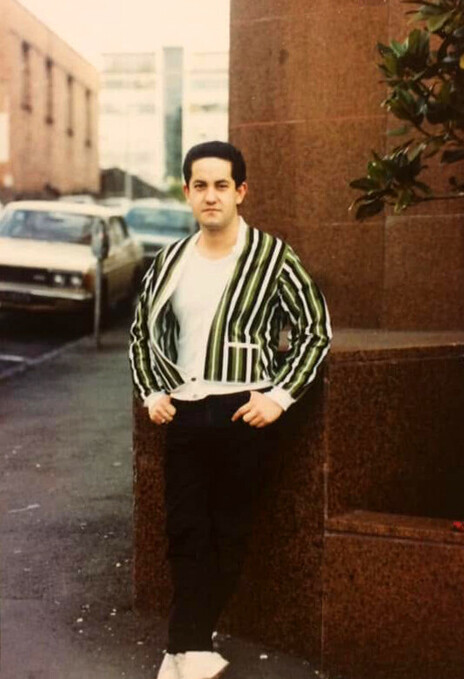
Kerry Buchanan in central Auckland. - Simon Grigg Collection
Tonar Street, Northcote: state housing for the working class – those ready to assume the position of the labourer, the cleaner and all forms of servicing capitalism’s cogs. My mother is Māori, my father Scottish; once these were cultures but here they mean nothing. We are the dispossessed, standing brand new and naked.
We have no need for any old and lost meaning. We have this. We have the wasteland.
Within that land of dreams, there is a culture. We are the pioneers, ready to fill it with sustaining myths, kick-starting it into action, pummelling it like the makeshift punch bags that hang from every second house in the street. We manufacture it from what surrounds us. Songs are sung, guitars strummed as we channel the spirit of Elvis, strained through our parents’ drunken renditions of ‘Blue Smoke’ and ‘Pōkarekare Ana’.
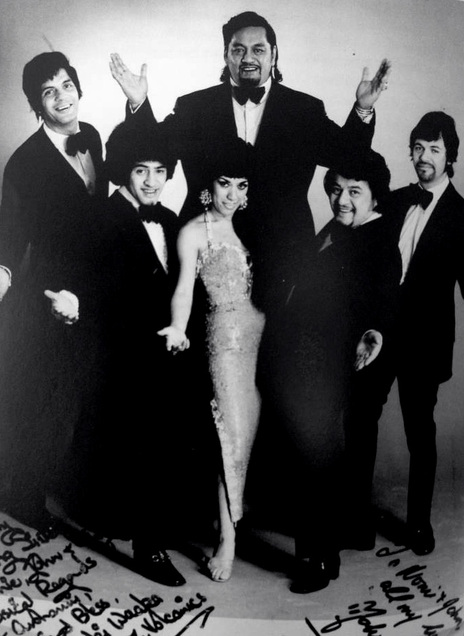
Prince Tui Teka (at back) and The Māori Volcanics. Front row from left: Nuki Waaka, Gilbert Smith, Mahora Peters, Hector Epae, John Nelson.
Rock’n’roll has already stolen our hearts and flushed through every tissue of our corporeal and spiritual being, but we are a generation betwixt. Johnny Devlin has already shaken his hips in communion with overseas devils, bodgies and milkbar cowboys – has already strode with arrogance and playful insolence before us. For me the new culture is all those black-suited entertainers, Māori boys dressed up for a night out singing in nightclubs, segueing from big ballads through a “medley of Irish and Scottish favourites” into postmodern confectioneries of ironic displacement like Howard Morrison and his Quartet’s ‘My Old Man’s an All Black’. My mother swells with pride and tells me “They’ve been on airplanes” and informs me of great warriors like The Māori Volcanics who have taken “our culture” to America. Now we look with shame upon these ambassadors, call their music “cabaret” as if it was stupid, and praise the next generation of rock musicians waiting in the wings.
Well, fuck that.
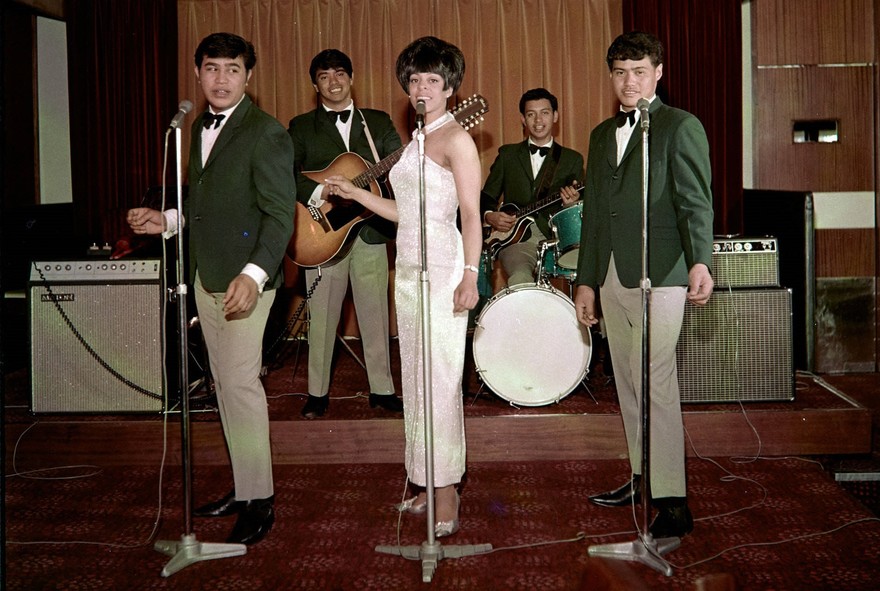
The Tikiwis performing at the Logan Park Motor Hotel, Auckland, in October 1967. In January 1968 they arrived in Vietnam for a six-month tour. From left: Philip Rivers, Paul Watene, Helene Johnston, David Rivers and Winiata (Wini) Watene. - Rykenberg, Auckland Libraries Heritage Collections 1269-19671031-07
No, back in the wasteland we dug their smooth moves, their sharp clothes, their emotive evocative desires to “wear my ring and show the world that you were made for me.” Gerry Merito of The Howard Morrison Quartet was a hipster saint and, as my mother informed me, “He’s related to Te Kooti,” which had a whole heap of cachet right there.
Most of all I liked the cheeky class-struggle inherent in the songs. A personal favourite of mine was ‘Māori Car’ as performed by Lou and Simon on their Back to Sorrento album of 1966. Here we find our protagonists driving said car, which breaks down as they venture to the TAB. The vehicle has flowers growing from it, the gearshift won’t work (“It’s there to hang your gear on”) and the headlights face both up and down, one way for Pākehā to look for Unidentified Flying Objects and the other – in an early comment on the foreshore and seabed question – “for Māori to dig toheroa out of season.” The song ends on the ultimate joke with “we fixed it nuts and bolts and sold it to a pākehā.” State house culture writ large; we laughed and laughed.
We were bereft of traditional culture. We had missed out on rock’n’roll’s early bloom, but we had Lou and Simon, Howard Morrison, and The Keil Isles; we had elegance and style that instilled pride in both race and class. Despite the passing of the decades in which various rock paradigms shifted and unfurled in my consciousness, I always go back to the wasteland and the concrete blocks we called home, and I think of those well-dressed entertainers who forged a cultural path of sophisticated urbanity that became a conduit to the life outside.
--
Kerry Buchanan’s Top Ten
Dam Native – Kaupapa Driven Rhymes Uplifted (1997)
Toy Love – Toy Love (1980)
Upper Hutt Posse – Against the Flow (1989)
Various Artists – AK79 (1979)
Various Artists – Pioneers of a Pacifikan Frontier (1999)
Dinah Lee – Introducing Dinah Lee (1964)
King Kapisi – Savage Thoughts (2000)
Ray Columbus and the Invaders – Till We Kissed (compilation, 1966)
Various Artists – How Is the Air Up There? (1980)
Prince Tui Teka – The Man, The Music, The Legend (1982)
--
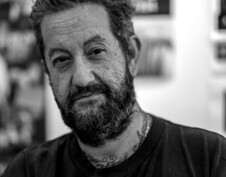
Kerry Buchanan. - Simon Grigg Collection
Kerry Buchanan (Ngāti Kahungunu) was born in 1955, is the father of two daughters, and loves pitbull pups. He grew up in numerous state house areas, nurturing a bad boy attitude mixed with old-school leftist beliefs. He has written on hip hop and popular culture since the early 1980s for publications including Rip It Up, Republican, the NZ Listener and Real Groove. He was also the drummer in nascent punk bands Rooter and The Terrorways, which will “haunt him till his goddamn grave.”
--
This first appeared in Soundtrack: 118 Great New Zealand Albums, by Grant Smithies (Craig Potton Publishing, Nelson: 2007), and is republished here by permission. Thanks Grant.