Changing currents in the wider society would soon change the course of Nancy Kiel’s music. Influenced by initiatives in Britain and America, in the 1970s the women’s liberation movement reached New Zealand, challenging traditional gender roles in homes, the workplace, government – and music. Nancy was drawn to the movement, sympathetic to its principles and aims.
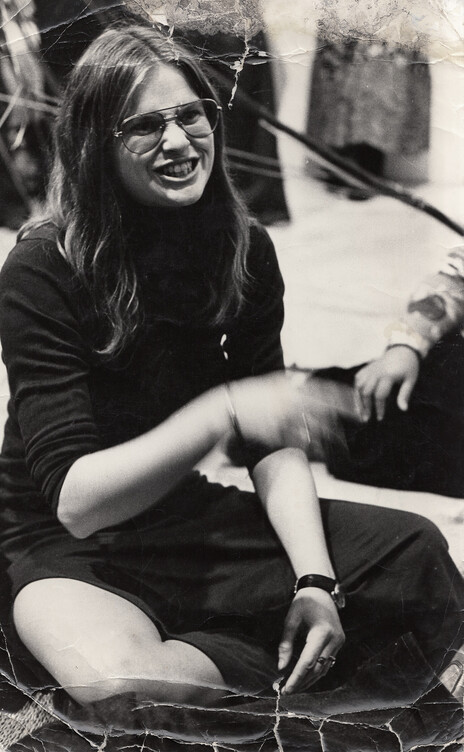
Nancy Kiel at The United Women’s Convention in Christchurch, 1977.
The biennial United Women’s Convention was launched in Auckland in 1973, and the 1977 convention took place in Christchurch. “They asked me if I would help with the music and I said, “absolutely love to.’”
As Christchurch did not yet have any all-female bands, the line-ups for the Convention were put together hurriedly. Most sang a cappella. Still, the exercise connected Nancy to other women artists and performers, many of whom would become lifelong friends, including broadcaster and comedian Lee Hatherly, theatre-makers Kate JasonSmith and Sandi Hall, and musician and entrepreneur Di Cadwallader.
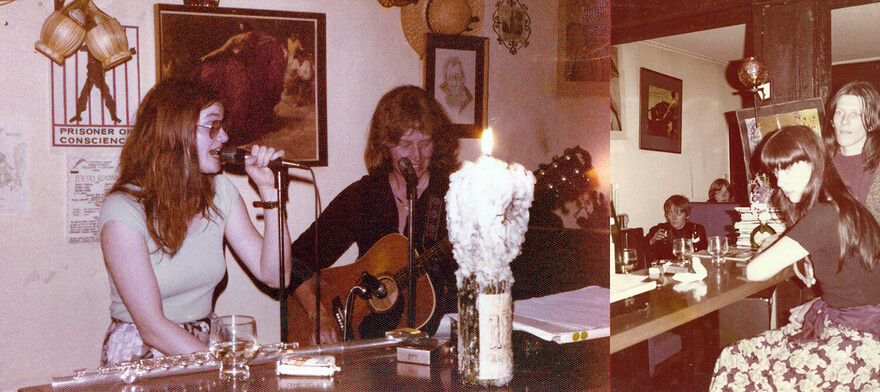
Nancy Kiel (left) with Diane Cadwallader, performing in an Auckland café, 1978; in the audience are Jane Walker and Paul Kean, soon to be in Toy Love. "We had a duo called Kiel and Cadwallader," says Kiel. "We did support for Th’ Dudes and a couple of other big bands at that time." - Nancy Kiel Collection
Cadwallader had cut her teeth in the 1960s managing teen idol Mr Lee Grant, and would go on to oversee the career of The Topp Twins. But before she had stepped into that role, the yodelling cowgirls had already attracted the attention of Nancy Kiel.
Nancy was playing at the Gresham Hotel in one of the later line-ups of Baby when she first noticed two identical figures on the dance floor. The Twins had just completed a six-week territorial training course at Burnham Military Camp and rather than return to the family’s Waikato farm they had decided, with their parents’ blessing, to stay on in the South Island and “see the world”.
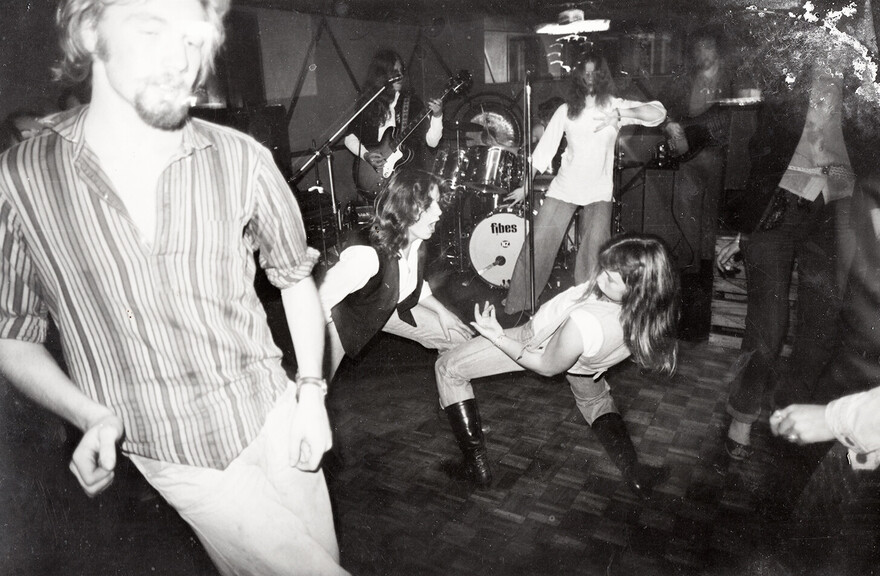
The Topp Twins hit the dance floor to the Baby Boogie Band, Captain Cook Hotel, Dunedin, 1977. On stage, from left: John Purvis, Ray Eade, Danny Bennett on drums, Nancy Kiel. On the parquet, Lynda and Jools Topp. - © Nancy Kiel Collection
“At that stage you could hardly tell them apart,” says Nancy. “They came bouncing up in their boots and territorial gear and started dancing. Oh my God, they were just so glorious. And they were straight then too. They hadn’t kind of discovered their, you know, lesbian roots, yet. And they danced the whole night, basically right in front of me.”
The Topp Twins became instant Nancy Kiel fans. Lynda Topp would later recall, “She was amazing, she was technically brilliant, with the best voice, and the most amazing stage performance.”
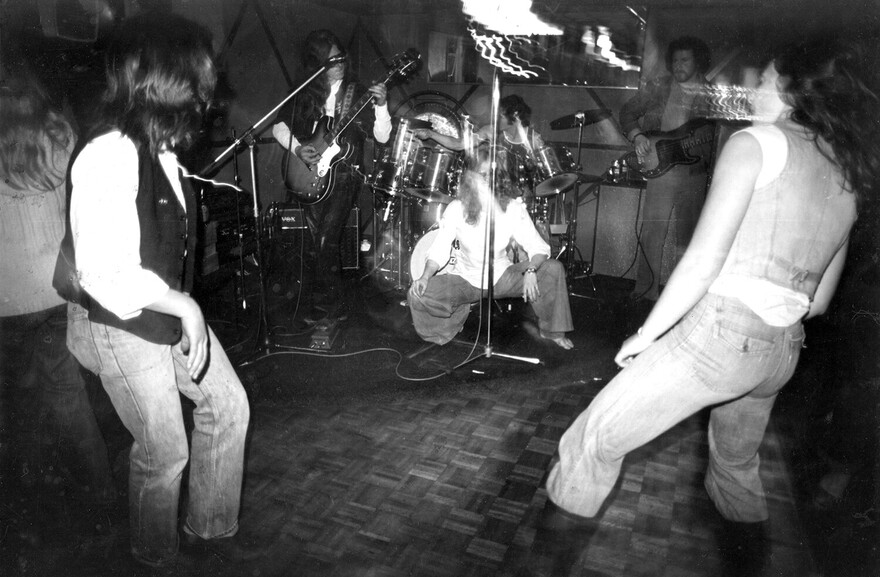
Nancy Kiel watches the Topp Twins on the dance floor: "my gorgeous girls." Captain Cook Hotel, Dunedin, 1977. - © Nancy Kiel Collection
Though the Twins were still under the legal drinking age, the sympathetic couple who ran the pub turned a blind eye. Lynda recalled: “They knew that we were absolutely smitten. Absolutely completely and utterly drawn to that performance of Nancy Kiel. We weren’t drinking, we’d just go up there and dance. We just loved it, it was magic. She was the Janis Joplin of Christchurch.”
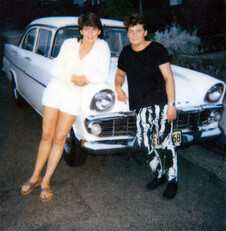
The Topp Twins in Sydney, 1986, "more than a bit jealous of my 1960 EK Holden." - Nancy Kiel Collection
Nancy: “So I started talking to them, farm girl on farm girl, we just instantly hit it off. A couple of weeks later they said, ‘Look, we’re having a party, and we were wondering if you’d like to come over?’ And I said ‘Yeah, fabulous.’
“So I walked in and they’ve made a pumpkin soup and they had it in the pumpkin, bless their hearts. Good country girls, put on some food with that party. And there they were, with their guitar, singing. It would have been kind of country-oriented stuff, before they started writing their own stuff, and their voices were so in sync it was like hearing stereo, it was quite uncanny. But I just remember being absolutely delighted and blown away by that sense of abandon that they have. And you almost feel like … you’re not intruding, but that you’re part of something that’s so very intimate when you watch them play, and that’s something they’ve just always had.”
Before long Nancy found herself sharing a house with the Twins in Springfield Street. “I had the front half and they actually had the back half. And then I got them, I think, their first gig in Christchurch, which was at the Gresham in the downstairs bar.
“We did a lot of political events together. I remember the classic one. I think it was the Women’s Day March and we started out, Lynda, Jools, Di Cadwallader and me, marching through that department store, it could have been Ballantyne’s, dressed up as suffragettes saying ‘Strike a blow, strike a blow for freedom’, stupid stuff that we’ve just thrown together. And they were dressed up as miners. When they went into the loo an old woman attacked Jools with her handbag because she thought she was a boy.”
As the 70s went on, divisions emerged within the women’s movement, when some lesbians began to reject working on what they saw as heterosexual issues. Nancy, who had played with male musicians her entire career, understood where the separatists were coming from, yet remained firm in her own sexuality.
“It was very, very strong, the separatist movement during that time, and … who can blame them? Because, honestly, they’ve just been hammered their entire life, their entire history, you know. So finally, they were getting a voice and the gay community was getting a voice and the lesbian feminist movement was definitely using that voice and so they should. I remember it getting a bit volatile and everyone trying to work out a way, because the beauty about women is that they do actually try to figure it out to benefit as many possible people as they can.
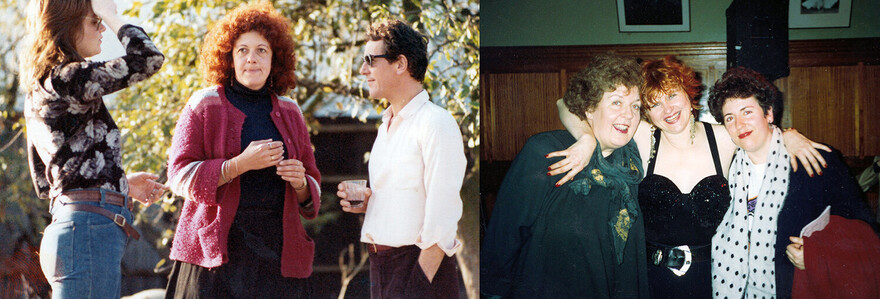
Left: Nancy Kiel, Annie Davies, Malcolm McNeill, Christchurch, 1976, "in an a capella trio we put together for fun." Right: Leone Hatherly, Nancy Kiel, Katrina Hatherly, Marlborough Hotel, Sydney, 1988.
“I was very open about the fact that I wasn’t a lesbian and I wasn’t going to be a lesbian. You know, I like men and, not that lesbians don’t, I’m not saying that at all. But, you know, I like men sexually. You know, that’s my deal. [Television executive] Caterina De Nave said to me, ‘Nancy, you’re one of the only women I know who has a lesbian consciousness with a heterosexual appetite.’ I wore that badge very proudly.”
A short spell in Sydney saw Nancy collaborating with an all-women line-up (though it briefly included John Purvis) in a band called Garbo. “It was a rock band and all the women were dynamite musicians,” she told Sandra Coney in a 1979 interview for Broadsheet. “With Garbo, I actually went to an audition, the first time in my entire life I had ever had to audition. The girl that was before me singing was doing a J J Cale song, ‘Magnolia’, and they didn’t know the chords and I said, ‘Look, it’s an A major seventh’ or whatever it was. And they went ‘Oh, oh, you’re actually a musician!’ I suppose, instead of just a singer.
“When I auditioned for Garbo, they said to me, ‘Look, not taking anything away from your voice, great voice, but it’s just too American. We want an Aussie singer.’ I said okay. But that singer left within months and I became the lead singer anyway, then I went back to New Zealand.”
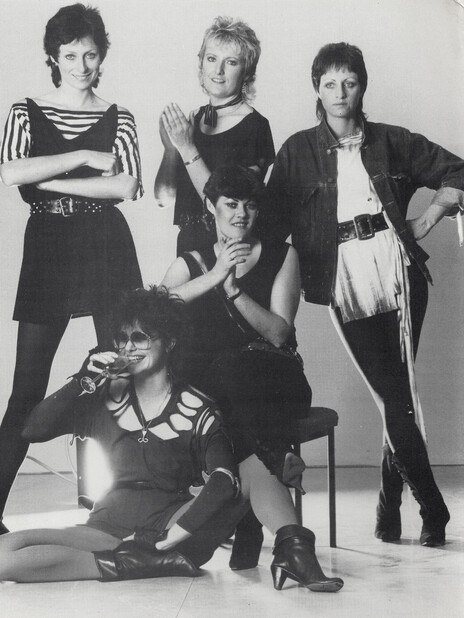
Early Party Girls, Sydney, 1983. Clockwise from top left: Judy Costello, Faye Reid, Veda Meneghetti, Louise Hughes, and Nancy Kiel (in front). - Nancy Kiel Collection
On her return to Christchurch, she reunited with John Purvis in a new group calling themselves Yo Yo’s. By now it was the age of post-punk and Nancy and John seemed to be caught between eras and styles. In addition to a handful of originals, they were still playing songs from the early Baby era such as Jefferson Airplane’s ‘White Rabbit’ alongside more contemporary covers – The Pretenders’ ‘Private Life’, Eno’s ‘Baby’s On Fire’, Talking Heads’ ‘Heaven’.
Reviewing a November 1980 gig at the Gladstone for Rip It Up, Michael Higgins found a group “selling themselves well short by approaching their craft in such a pedestrian manner. They have the musical ability and the resources, especially Nancy Kiel, to do a lot better.”
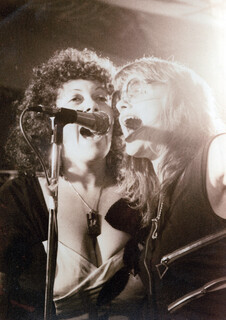
Annie Davis, Nancy Kiel, with Nude Wrestling, Christchurch 1982. - Nancy Kiel Collection
It wasn’t long before Yo Yo’s had morphed into Thumbs Of Brass, but John Purvis’s insatiable appetite for volume had finally brought his working relationship with Nancy to breaking point. “It’s like something from Spinal Tap, when I look back at it. It was at the Hillsborough Hotel in Christchurch, and we had the biggest PA in New Zealand, and I said ‘If you buy one more speaker, that’s it. I’m leaving the band. I’ve had it.’ And he came back with two more JBLs, and I said ‘Fuck you, that’s it’ and I left for good.”
Other short-lived groups followed, with headline-grabbing names such as Nude Wrestling, in which Nancy sang and played keyboards in a line-up that included Welsh singer-saxophonist Annie Davies, bassist Ross McDermott and guitarist Gary Verberne, and Sixtits, again with Annie Davies as well as veteran entertainer Janice Gray. Sixtits? “We were all big Amazon women,” she explains. “You know, it’s just a hoot.”
She was also playing in women’s concerts up and down the country, with friends including Di Cadwallader, The Topp Twins, Val Murphy and Hillary King. This loose sisterhood of musical soulmates would be immortalised as the Web Women’s Collective on the 1982 album Out Of The Corners, but an earlier recording, never released, was made at EMI studios in Lower Hutt, during which a few members of the group, including Val Murphy and Nancy, put down live versions of their original songs.
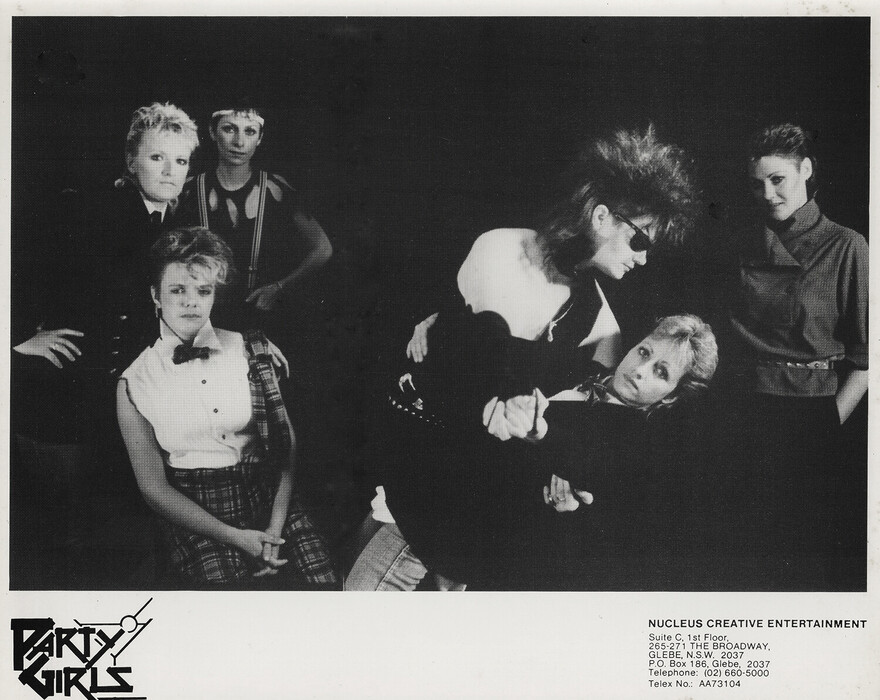
A promotional photo of the Party Girls, Sydney. - Nancy Kiel Collection
Nancy doesn’t feature on Out of the Corners; by the time it was recorded she had left for another spell in Sydney. This one would be permanent. She reunited with some of the musicians she had first played with in Garbo, now calling themselves Party Girls – a deliberate riposte to Party Boys, an all-star band of blokes (including Kevin Borich) who were cleaning up on the Australian rock circuit with a repertoire of contemporary covers and classics.
Party Girls included another Kiwi musician, Fay Reid, formerly of Auckland all-female band The Fair Sect. “We ended up with a seven piece. We had a fantastic trumpet player, Linda Bacon, and stunning saxophonist Pam Whignall. And that’s when we actually became quite well known. We just never got a record deal, I think because the all-girl thing and the fact that the band was a lot of lesbians.”
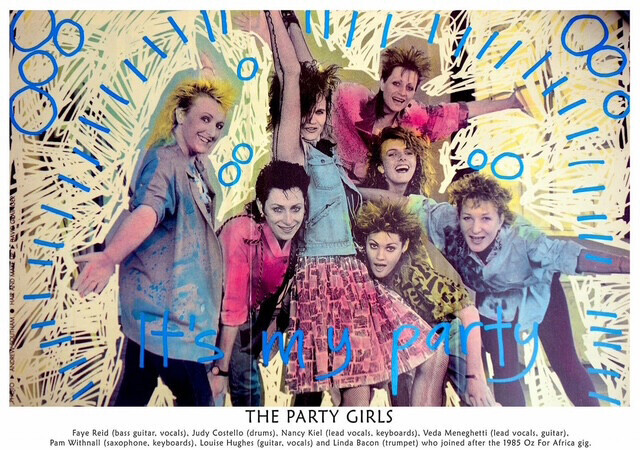
The Party Girls in Cleo magazine, Sydney, 1985. Nancy Kiel is in the centre, in red skirt. - Nancy Kiel Collection
Party Girls toured extensively, playing on bills with such international names as Meat Loaf, Eurythmics, Simple Minds, and Talking Heads, as well as Australian favourites including Cold Chisel and Midnight Oil. In 1985 they played at the Oz For Africa Concert, the Antipodean outpost of Live Aid. “After we played with him at the Oz For Africa concert, James Reyne did an interview, and they asked him who the best female band was that he had ever seen and he said, ‘Party Girls absolutely, hands down best female band.’ He said, ‘They’re not just the best female band. They’re just a great rock band.”
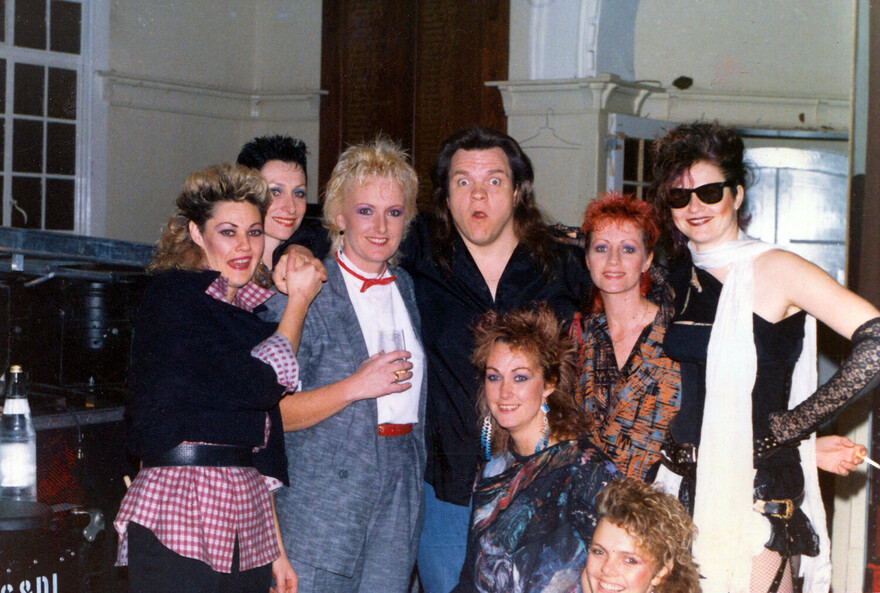
A photo opp with Meatloaf when he was supported by The Party Girls on a 1985 tour. From left: Louise Hughes, Judy Costello, Meatloaf, Faye Reid, Veda Meneghetti, Nancy Kiel; in front is Pam Withnall. - Nancy Kiel Collection
Party Girls were a favourite at the Manzil Room, an iconic late-night live music venue in Kings Cross where visiting stars could often be seen. “It was the darkest, smelliest, seediest, most spectacularly wonderful nightclub in Sydney. All of the bands played there. I don’t even think it started until 11 o’clock, and if you got the 11 o’clock slot you weren’t considered that great. The best slot was about one o’clock.
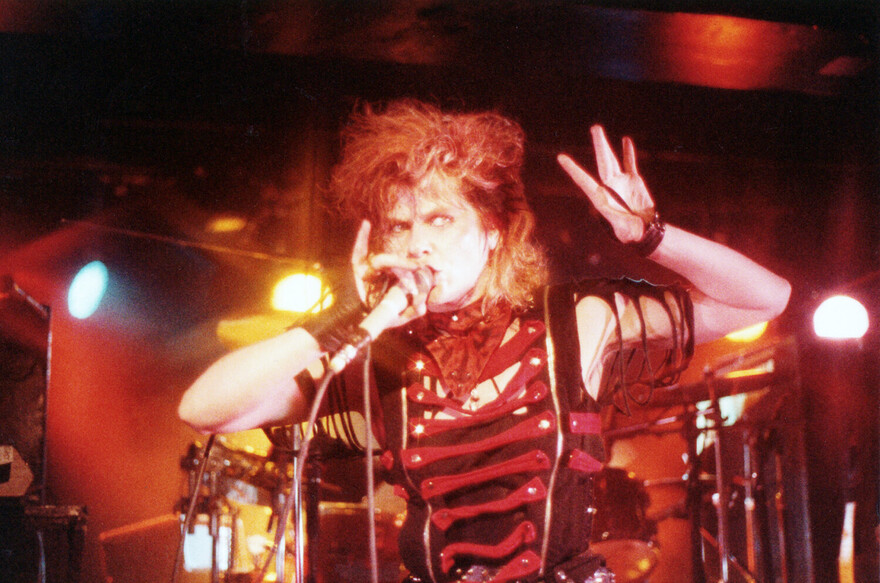
Nancy Kiel with The Party Girls c.1984. - Photo by Julie Ainsworth; Nancy Kiel Collection
“It’s where all the musicians went after they finished their gigs. Joan Armatrading came to see us play. I met Frank Zappa there. And I met George Michael. I actually met him as he was passing out on the floor, bless his heart. The keyboard player turned to me and – this is a true story – I said, ‘Do you think we should wake him up and put him in a chair?’ And he said, ‘No, I think we’ll wake him up before we go go.’ Oh, I know. It’s terrible, but it’s true.”
Those were peak years for live music in Australia, and Nancy thrived, first with the Party Girls, briefly with a gay male duo from Brisbane called Sadomachismo (“we did stuff like ‘Don’t Walk Away, Renee’. And all the gay bars, they just loved it. ‘Why Must I Be a Teenager in Love?’ All those camp old rock songs”), eventually forming her own group, the Nancy Kiel Band
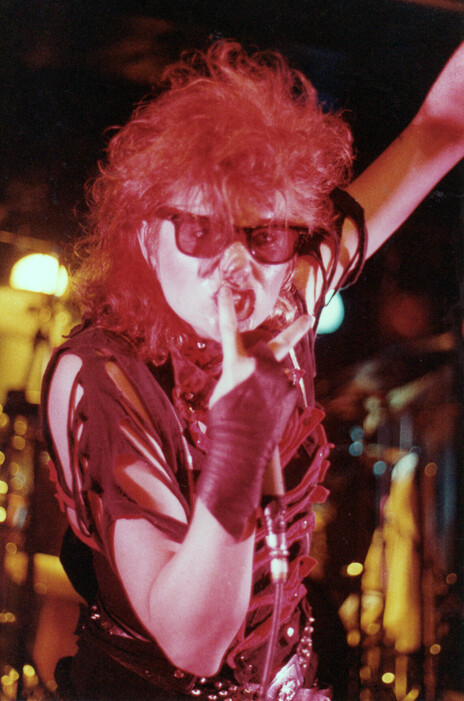
Nancy Kiel, 1984, during her stint with The Party Girls. - Julie Ainsworth
“The music scene back then, was just spectacular. I think we played six nights a week. And it wasn’t residencies, it was every club – leagues clubs, bowling clubs. This is Party Girls, although later on with my own band, Nancy Kiel Band, I was working four or five nights a week then too, but that was with kind of interchangeable musicians. I got to the stage where I had two or three bass players that I used, all spectacular. I ended up with normally just one drummer, which was Lloyd Gyi. Peter Northcote was my guitar player, spectacular talent. He’s one of Australia’s great guitar players.”
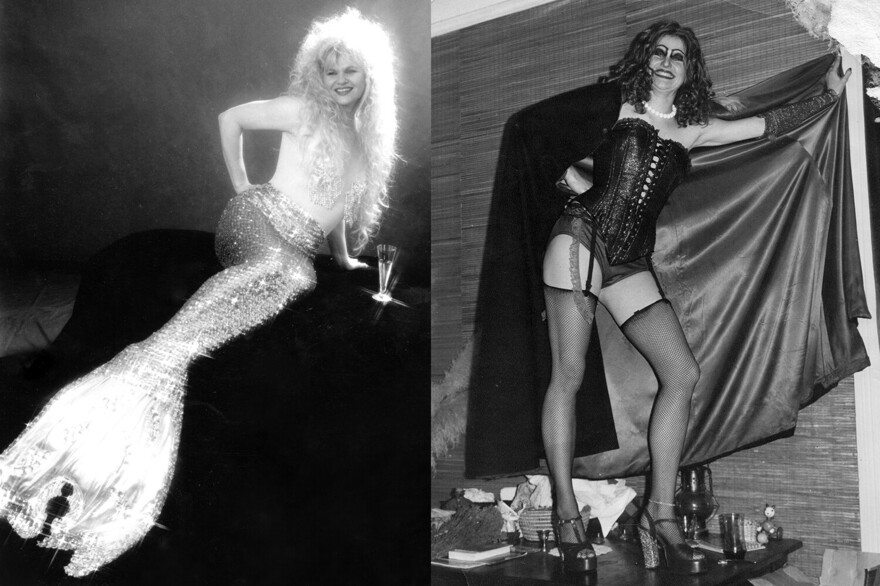
Nancy Kiel as mermaid, for a one-woman show The Divine Miss N, in theatres and clubs in Sydney and surrounding suburbs. Photo by Irena Jauncey. Right: "A photo for a fancy dress party in Christchurch, 1976. I was obviously going as Frank N Furter." - Nancy Kiel Collection
On keyboards she often used expat New Zealander Mike Gubb, a former member of Rough Justice who had crossed the Tasman in the 80s, who she calls “probably my favourite keyboard player, blues player. He’s just outstanding. Such a fabulous guy. I remember one night a fight broke out in front, some guy went to nail me, and Gubby … it felt like he leapt over his keyboard. And I thought to myself, ‘That’s a good Kiwi boy right there.’ While everyone else was ‘Ah! don’t break my guitar!’ Gubby came flying through like a superhero.”
A live CD It’s Just a Race was released in 1993, but by the turn of the century the live music scene was in decline, and a car accident in 2008 nearly put Nancy off the road altogether. “I would have won a Darwin award, because I didn’t actually hit anything. I’d just had a massage and I managed to stop myself from hitting a tree, good farm girl that I am, but I was so relaxed that I actually whiplashed myself, and I herniated eight discs, snapped a vertebrae. I drove myself home, in exceptional farm girl form. And when I got out of the car – it was a truck – I hit the deck.”
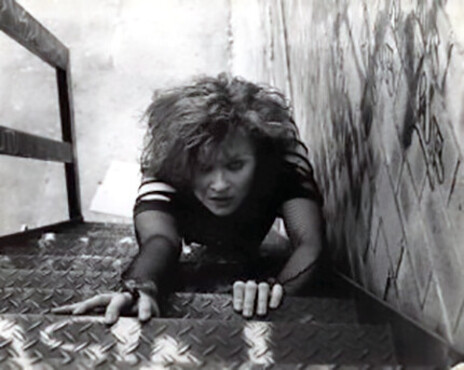
Nancy Kiel takes the stairs. Kings Cross, Sydney, 1986. - Tony Mott, Nancy Kiel Collection
When Nancy returned to New Zealand in 2008 for the filming of Leanne Pooley’s concert documentary of The Topp Twins’ Untouchable Girls, she was still wearing a back brace from the accident. “I sat next to Hillary King saying, ‘Please don’t make me laugh.’”
But as the gigging slowed down, Nancy began channelling her formidable energies into other areas. “I’d pulled back a bit, played probably two, three nights a week, and did financial consultancy at the same time, and I started my own business, Miss Nancy’s Dried Berries.
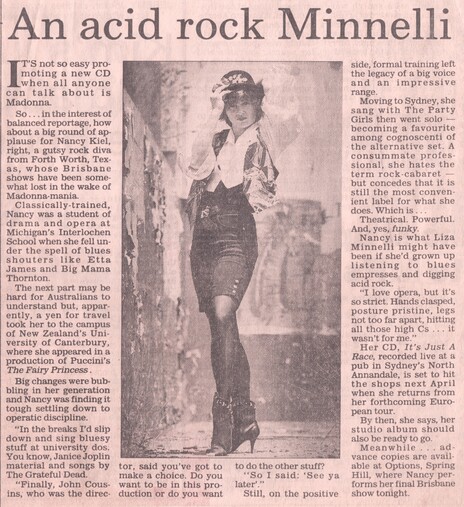
Nancy Kiel on a trip to Brisbane, early 1990s.
“At one stage, I said to my mother back in Michigan, ‘For God’s sake, I’ve got to make some money. I’m sick of being broke all the time.’ She said to me ‘Oh, honey, why don’t you get some of those berries that those boys do up the road?’ And I thought ‘What a great idea.’ I started importing premium-grade dried blueberries, cranberries, cherries. They’ve got like, two-and-a-half years shelf life. Perfect! And I was the first person to bring dried blueberries and cherries and cranberries into Australia. I only dealt with the premium-grade stuff. A lot of the stuff that you find in the stores is skins, reconstituted skins. This was the real deal stuff, it is just beautiful. I’m a fifth-generation blueberry farmer.
“So I’ve become Miss Nancy. Before it was like, ‘Are you Nancy Kiel, the woman that used to sing?’ Now it’s like, ‘Oh my God, you’re not Miss Nancy are you?’ ”
--