Kevin Clark can hardly believe his eyes. He’s just been looking at Discogs, the online database and marketplace for audio recordings, and seen a copy of a single he cut in 1970 with a band he named The 40 Watt Banana selling, 55 years later, for $353. A previous copy has already sold for $294.
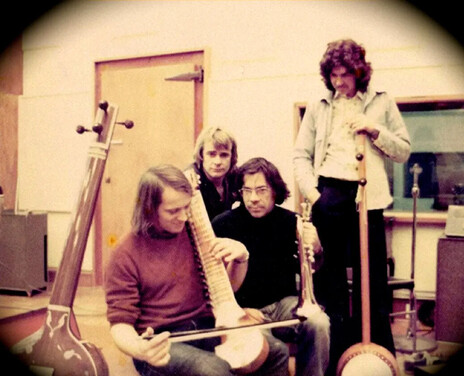
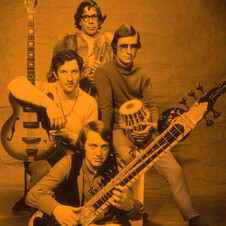
The 40 Watt Banana in a Broadcasting House studio, Wellington. From left: Dave Parsons, Mike Fullarton, Kevin Clark, Dave Pearson.
The 40 Watt Banana was a relatively brief chapter in a musical career that has spanned eight decades and even more styles of music. But who was to know that an experiment he labelled “Indo-alt-electro-prog-jazz-rock” and gave a tongue-in-cheek title would find a whole new market in the 21st century?
Kevin had been getting regular commissions from the NZBC to record half-hour jazz programmes at its Broadcasting House studios, a mixture of standards and his own compositions, which went to air under the formal name The Kevin Clark Group (or sometimes the Kevin Clark Trio or Kevin Clark Quartet, depending on the line-up). But the broadcast engineers were taken by surprise when David Parsons turned up for one of the sessions with a handmade Indian rug, upon which he sat crosslegged and proceeded to play his sitar and tabla.
Interest grew in the unusual fusion of jazz and Indian music. There were invitations from art galleries, festivals, and a television pop show on NZBC’s sole channel. For the latter occasion, they enlisted vocalist Colin Brown and purpose-wrote ‘Nirvana’, a song with lyrics that vaguely evoked an Indian philosophical perspective on Western culture. “Dying embers of confused minds/ Have lowered the state of all mankind …” sang Brown mournfully, while Parsons’s tabla and sitar blended with Dave Day’s electric bassline and Clark’s organ licks in a bubbling funky brew.
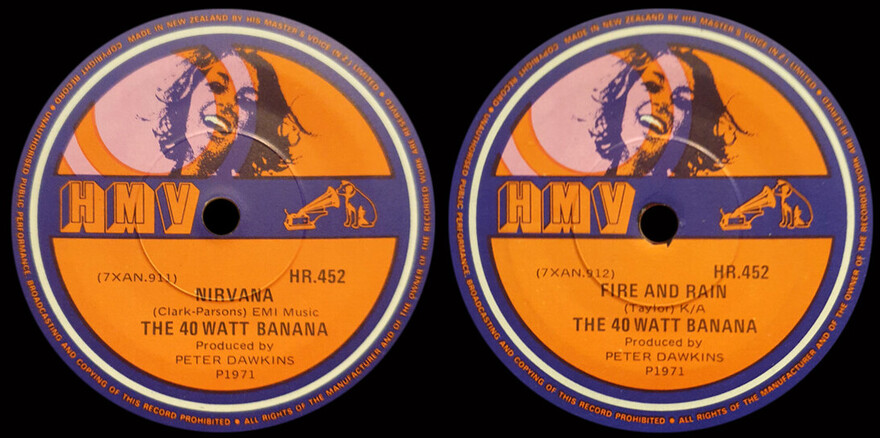
The 40 Watt Banana - Nirvana b/w Fire and Rain, produced by Peter Dawkins (HMV, 1971)
The TV producer loved it, but insisted that the name The Kevin Clark Group sounded far too straight for a pop show. Put on the spot, Clark came up with The 40 Watt Banana. With a faint whiff of Donovan’s ‘Mellow Yellow’ – “electrical banana is going to be a sudden craze” the Scotsman had sung, inspiring followers to pursue higher consciousness via the smoking of dried banana skins – it seemed right for the times.
With the encouragement of the TV producers, Clark took a dub of the television performance to Peter Dawkins, house producer at Wellington’s EMI studio. Dawkins was similarly enthused and produced a new recording of the track, embellishing the group’s sound with overdubbed harmonies, extra percussion, and Clark playing the studio Hammond B3 organ. When Dawkins then asked for a B-side, the band hurriedly came up with a boogaloo-slanted arrangement of the James Taylor song ‘Fire and Rain’. Recorded in 1970, the single would be released by EMI the following year.
The gigs kept rolling in, taking Clark further from the land of dine-and-dance. The 40 Watt Banana developed a mission to play only original music, and explore different form and structures, often fused with Indian sounds and concepts. Sometimes the essential trio of Clark, Parsons and Day would be enhanced with additional musicians.
“Dave got a call from the Indian Association asking that we play for a concert raising funds for Bangladesh. And Dave said, what should we play? I said, let’s call it ‘A Concerto for Bangladesh’, just tongue in cheek. And the next thing, he called me up a week later and said, jeez, look at this. They had printed a programme and a flyer: Kevin Clark and Dave Parsons Present Concerto for Bangladesh. All in this printed programme, so I thought, bloody hell, I’d better write a concerto! So I started writing stuff seriously. I got a flute player involved, Dave Pearson on acoustic bass. And so I actually wrote out some melodies, because by this stage, I was having to learn all about ragas from Dave.”
For performances like this, Clark expanded the line-up to include a flute player as well as Dr Balu Baalachandran on mridangam (double-ended drum.)
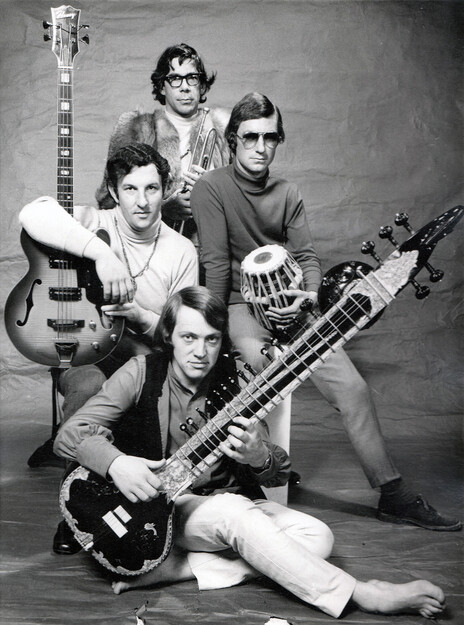
The 40 Watt Banana. From the top: Kevin Clark, Colin Brown, Dave Day, Dave Parsons. - Sal Criscillo
In October 1970 an augmented 40 Watt Banana, with Mark Hornibrook on electric bass and Randall Brandon on a Fender Strat and a battery of effects pedals, were booked to play at the Manawatu Jazz Festival. Indulging his penchant for absurd band names, Kevin renamed the group Scrotal Mange, but the festival director said it was unsuitable for printing in the programme. They reverted to The 40 Watt Banana.
On another occasion, The 40 Watt Banana headlined a concert at the University Arts Festival. The opening act was Split Ends, still in their pre-Enz prog-folk phase.
At a jazz concert at Wellington’s Majestic Cabaret, Clark put together a performance involving three musicians all playing synthesisers: Dave Parsons, Peter Pritchard and himself. “The three synths had different roles that I had mapped out on rudimentary guide charts. Dave did the rhythms (sort of early dubstep beats with Indian tabla drum flavours.) Peter provided the pads (background sounds and textures) and I played improvised passages using pitch-bending devices and indulged in other extra-terrestrial effects that one could get out of synthesisers.”
Controlling three synthesisers live proved to be a challenge and Clark had written the experiment off as a noble failure. But he was later approached by one impressed punter who asked whether he would repeat “that weird stuff” at an event to be held in a community hall in Palmerston North: an occult festival.
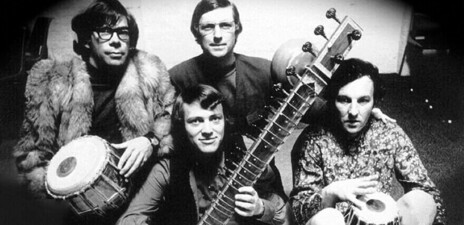
The 40 Watt Banana (L-R) Kevin Clark, Dave Parsons, Colin Brown, Dave Day. - Sal Criscillo
This time Clark and Parsons would perform as a duo, with the former handling synth and trumpet and the latter on electrified Indian instruments, phasers and loops. Clark describes it in his 2016 memoir From The Bandstand: Fifty Years of Gigs, Clubs, Studios, Freaks and Frolics: “The hall was fringed with stalls and kiosks with the predictable array of tarot card readers, palmists, crystal ball gazers, head-bump feelers, eye iris analysts, druid recruitment desks, eastern mystics, tantric massage manuals …” Barefoot women in white dresses danced around an altar with a pentagram painted on the floor. The Church of Satan had its own stall.
When it came Clark and Parsons’s time to play, the pair were surprised when their host “materialised on stage through the smoke, resplendent in full black cloak and hood, looking like a cross between Batman and Darth Vader with goat’s horns.” While this character wailed, chanted and writhed in an apparent trance, Parsons manipulated the drones while Clark played piercing sounds on the trumpet through the tape echo machine and added sonic textures with the synthesiser.
Clark and Parsons had developed their own sartorial style which came into its own on such occasions. “When my mother died, my father put all her fur stoles into a suitcase and sent it over here and said, Your wife might like these. So I dressed up in this great big fur jacket to look funny. A fully patched gang member came up to me one night and said, ‘Hey, swap jackets eh?’ ”
The 40 Watt Banana played a few more gigs, if not all as memorable as the Occult Festival, but by the end of 1972 Clark had largely returned to the more mainstream world of pub and restaurant gigs.
But recordings have a life of their own, and over the years interest in the ‘Nirvana’ single, 40 Watt Banana’s only release, was growing, spurred on by a burgeoning collectors market for New Zealand vinyl and a world-wide interest in obscure psychedelia. Clark had little knowledge of this, though, when in 2019 – almost 50 years since the single was made – he began going through some old reel-to-reel tapes, many of which were unlabelled. With engineer Dick Le Fort, he transferred the recordings to digital and was surprised by what they revealed: unreleased music from the 40 Watt Banana days.
He re-edited one of the tracks and put it on YouTube, along with the ‘Nirvana’ single. Maybe someone out there would enjoy them. A few months later he received an enquiry from Pharaway Sounds, a Spanish label specialising in Turkish and Iranian music of the 60s and 70s. Was there any more of this music, and would Clark be interested in releasing a full album?
The 40 Watt Banana - Peeled (LP compilation, Pharaway Sounds, 2019)
Around the same time he heard from Auckland-based music archivist John Baker, also interested in the possibilities of a release. In the end, Clark went with Pharaway Sounds, with Baker assisting, and a full album, Peeled, was put together from some of the highlights of the old tapes.
Peeled was released in 2019 on CD and vinyl to enthusiastic reviews. “Imagine Hugh Masekela crashing an Incredible String Band jam session, and you’ll start to get the picture”, wrote Mike Segretto on the Pyschobabble website. “Though Clark and Parsons aren’t quite virtuosos, they do brew up a heady sound … The liner notes include a caveat regarding the sound quality: only the single ‘Nirvana’ (a relatively pop-ish track that has appeared on a few compilations and is the one number with vocals) was culled from an original master tape. However, the warning is unnecessary since audio quality is always far from dire, and the lower-fi sound of some of this material just adds to the mesmerising atmosphere that is the main appeal of The 40 Watt Banana.”
--