Who would have guessed that a rather drab-looking two-storey construction, designed for a tea merchant in 1907, would go on to play a significant role in Wellington’s alternative music culture? By the time of Upper Cuba Street venue Thistle Hall’s 2007 centenary, it had hosted a mindboggling array of events and become something of a cultural institution, but much of its past is coated in the grime of neglect and the constant threat of demolition.
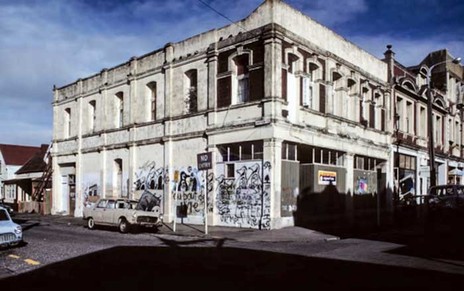
Grime of neglect: Thistle Hall in 1986. - Up The Punks collection
Had it not been so run-down by the 1980s, however, it’s unlikely that the hall – located on the first floor of 293 Cuba St and accessed via Arthur Street, at the back of the building – would have been available or affordable to two successive generations of Wellington punk bands that strongly identify with the venue.
When William Campbell bought the site in 1907, he also had a successful tea shop in Manners St, but Upper Cuba St at the time was already quite distinct, with a ragtag mixture of houses and shops and an unusually diverse community. At a time when most stores were tenanted, he had the means to buy the land outright and construct the building, though it was plain and utilitarian, with a shop downstairs and an upstairs area (the hall) that was most likely used for storage.
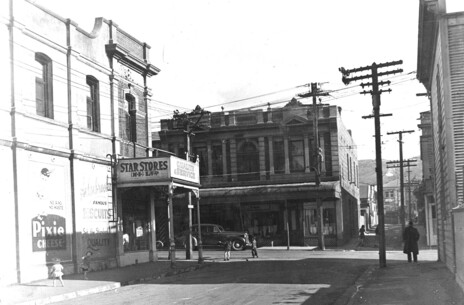
Thistle Hall at left, viewed from Arthur Street, 1940s - Wellington City Council Archives 00138-341
It was the purchase of the building in 1924 by the oddly named Protestant Hall Company that set things in motion. Its new owners converted the upper floor into a social hall called The Empire, which was hired to various organisations for meetings and dances. According to historian Georgina White’s 2007 booklet on Thistle Hall, while some moral guardians objected to the “young ladies and gents keen to kick up their heels to the latest jazz numbers … the Protestant Hall Company was not fazed by such debate.” A 1927 advertisement for an event at the venue promises the delightful likes of confetti, streamers, the All Starita Orchestra playing the latest hits, spot prizes and a dancing game called Monte Carlo.
It wasn’t long before the rot set in, however. The Great Depression of 1929 nixed plans to sell the hall and the Wellington Council soon announced that they were considering widening Arthur St, which would require its demolition. There was little incentive to renovate the premises. And then, a major earthquake in 1942 caused substantial damage to the building. Ultimately, it was sold to the Wellington Council the following year; the council refused to carry out the necessary modifications for many years, first because of the possible widening of Arthur St, then much later because of the motorway extension plans.
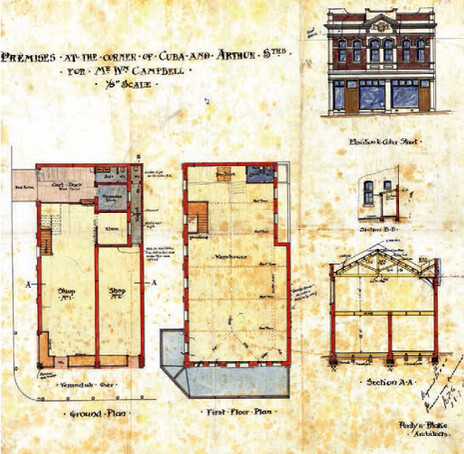
Thistle Hall plans - Wellington City Council Archives 00138-34
In 1951, the Wellington Association of Scottish Societies (WASS) moved in for what would be a 38-year tenancy and renamed it Thistle Hall after the emblem of Scotland, a name that stuck like mud. Apart from the inevitable Scottish Country and Highland Dance club meetings and competitions, the hall was hired out for other dances, but its increasingly down-at-heel presentation – the cracks in its totara floor, the rotting walls and leaking roof – made it less attractive. Come the 1970s, club members feared for their safety, both within the venue and in the surrounding community, which had become a refuge for an idiosyncratic cast of society outcasts looking for cheap rent.
By this time Upper Cuba Street had its problems but was also one of the most culturally rich and unique destinations in Wellington. Across the road was the oddball Mr Smiles curio shop; all around, a plethora of alternative lifestylers frequented the area, including a lesbian enclave and the inevitable gang activity, which added a dollop of danger. Daniel Beban noted in Future Jaw-Clap, his book on the Primitive Art Group and the Braille Collective, “... for the last few decades of the 20th century, Upper Cuba St and the surrounding area becomes home to a community of independent musicians and artists, whose work and energy helps define the character of the city.”
This set the scene for Thistle Hall’s hosting of some of the most notable post-punk and “outsider” gigs of the early 1980s.
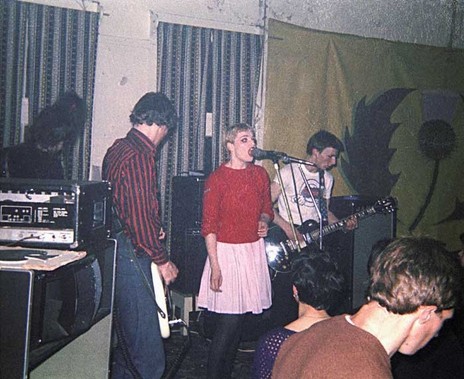
The Wallsockets at Thistle Hall, September 1980
In an AudioCulture article about Wellington’s alternative music venues, David Maclennan wrote, “Back in the late 70s, when it was looking a bit shabby, Thistle Hall became an early home for Wellington’s growing punk scene. It hosted the first of its many punk gigs on 25 August 1979, organised by The Wallsockets, who featured along with several other bands. A second gig with a similar line-up was held a month later, and there were many more punk gigs over the next several years.” Other groups to perform there included the Ambitious Vegetables, The Spies, Kevin Hawkins’ group IHP&S, and ultimately Hawkins’ more celebrated group Shoes This High.
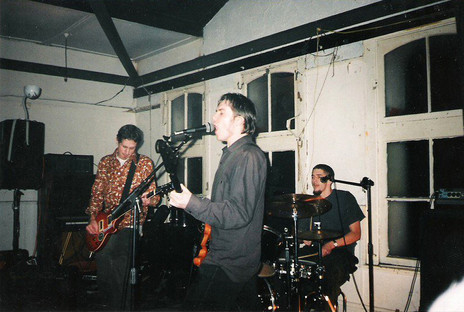
Ghidoragh at Thistle Hall. - Brian Holloway Collection
The shortage of venues willing to host alternative bands made Thistle Hall an obvious choice, and by May 1980, Rip It Up’s Rumours column was calling Thistle Hall “the Capital’s punk HQ”.
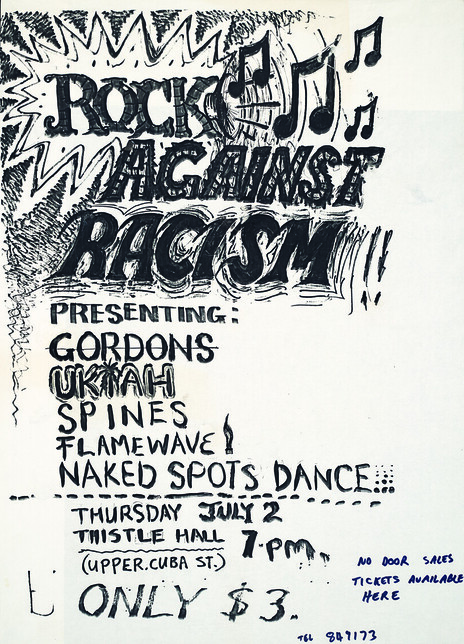
Seven acts for $3 at Rock Against Racism, as the 1981 Springbok tour began. - Ref: Eph-E-MUSIC-Popular-1981-03. Alexander Turnbull Library
I wrote about one of its most legendary gigs in Wellington music freebie In Touch. The controversial Springbok rugby tour was gripping the nation and this inaugural Rock Against Racism gig on Thursday 2 July 1981 featured a rather bizarre lineup of female singer-songwriter Jasmin, jazz/improv outfit Primitive Art Group, mysterious new wavers Naked Spots Dance, art-pop group Spines, Rawa House hippies Flamewave, funk band Ukiah and… The Gordons.
“Friendly home of punk Thistle Hall in Upper Cuba St reverberates to the pre-Bok tour show of unity in diversity; our very own Rock Against Racism gig,” I wrote. “A motley crew of punks, James K. Baxter lookalikes, hippies, Rastas, gang men and their wimmin (and dogs …) shuffled round the floor.
“Potentially, this is a lethal assortment of subcultures. The atmosphere is one of studied passive effort. Black Power dance and drink with hard-core punks. The boys in blue are all there too: seems like a city’s worth. They appear deterred at little sign of riot likelihood.”
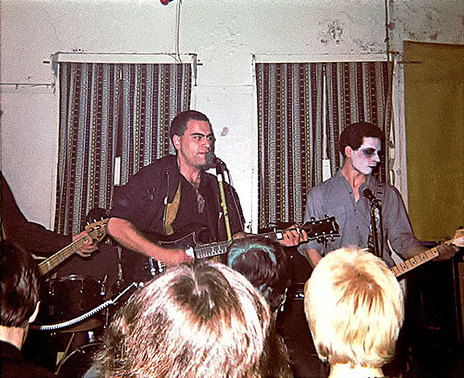
LIFE at Thistle Hall, Wellington - Up The Punks
In my review of the Thistle Hall gig I noted that the Christchurch trio’s sonic attack was incomparable, that the sheer blast leaves one gasping for oxygen, and how punters were either running to escape the noise, gazing in amazement or covering their ears, panic-stricken.
But it was the much-anticipated debut of Dunedin band The Clean on Thursday, 24 September 1981, that forever put Thistle Hall on the map, albeit not in a good way. According to organiser Angela Tidmarsh, as reported by In Touch, “At around 8pm several members of a notorious gang took over the stage for a time, and finally ended by fighting with the punk contingent outside the venue.” The police were called, and promised to keep a couple of police stationed outside the venue in case of further trouble, but baton-wielding “Blue Squad” cops with dogs turned up and closed the gig down at 10pm. Support band The Spines had played a short set, and so had The Clean, but that band’s second set was performed at a house on The Terrace later that night.
baton-wielding “Blue Squad” cops with dogs turned up and closed the Clean gig down at 10pm
Robert Scott of The Clean has a slightly different perspective on events that night, as recorded in Richard Langston’s 2026 biography on the band, In The Dreamlife You Need A Rubber Soul: “The Spines opened and we got a bit of a set in before the police came in. It was Ross Meurant’s Red Squad. A gang had come in and taken over the stage, and took our instruments off us and pretended to jam, and then the crowd got wild and the gang got wild and a brawl broke out. Before we knew it the police were in whacking everyone and cleared the place out.”
Sean Shadbolt, who attended the inaugural punk gigs at Thistle Hall and was briefly a member of Riot III, lived “two doors down from the Nomads gang” near Upper Cuba St at the time. He remembers nearby record shop Frontline – run by dreadlocked music nut Steve Hanify (RIP), who also organised some of the Thistle Hall gigs – and how the shop “had the first two Joy Division records anyone I knew had ever seen.”
“But there was all that violence that started after the tour and didn’t seem to fade for a few years”, says Shadbolt. “I got really sick of all that and there were definitely fewer gigs. I seem to remember that after a couple of violent episodes they stopped allowing gigs there for quite a while.”
One further notable – and happier - event did take place a few years later, however. In April 1984 the Wellington City Art Gallery sponsored Off The Deep End II, in what Beban describes as a “semi-derelict Thistle Hall.” The festival brought various kinds of experimental endeavour together over a weekend in what local arts listings mag TOM described as “a beatnik den of free expression” and included amusing punks ?Fog, electronic duo Free Radicals (Ross Harris and Jonathan Besser), Marie & The Atom, Kiwi Animal, Papakura Post Office and many others, all of whom got to ply their musical wares to an open-minded audience. If there were boot-boys, punks or gang members in attendance, they were well-behaved.
By the late 80s, however, the future of Thistle Hall was looking grim. The council announced that it would be demolished, which precipitated the local community starting a petition to preserve Upper Cuba Street. Georgina White notes, “Thistle Hall became a key part of the community fight and an identifiable centre.” A group of local women volunteered to take care of the venue, and subsequently, it became a community hub, with children’s birthday parties, aerobics classes, art-house movie screenings, get-togethers for senior citizens and under-age rages.
And then, in the 1990s, a second wave of punk rock came to Thistle Hall, in the form of young bands who appreciated the low hireage fee. Wellington anarcho-punk band SMUT (Sexual Mutants Under Tension) kickstarted things with their EP release party at Thistle Hall with support from Conventional Toasters and Josephine Bewitched on October 17, 1992.
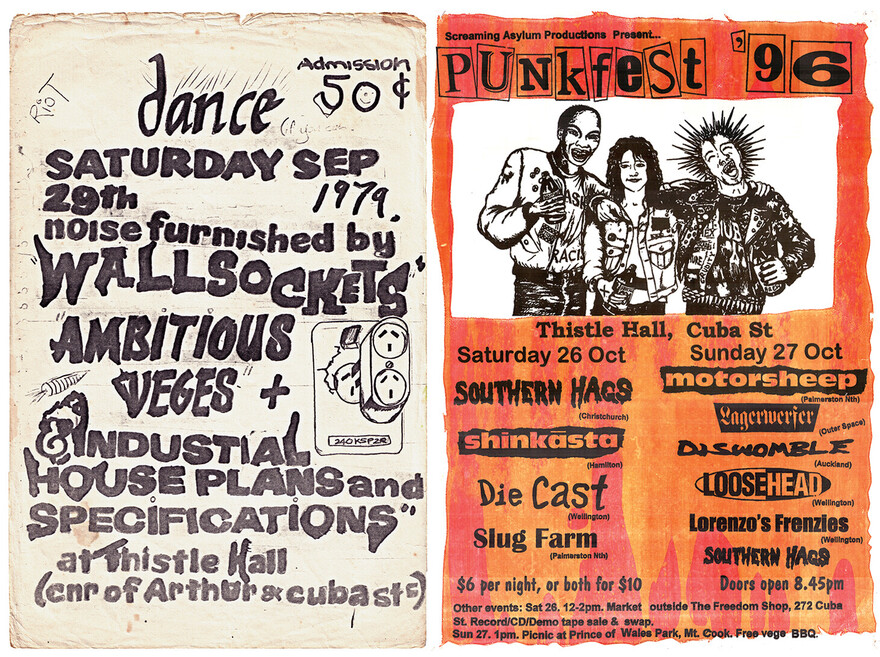
Thistle Hall gigs: Wallsockets, Ambitious Veges, Industrial House Plans and Specifications, 1979; and at right, Punkfest '96 poster: the debut of what became an annual celebration. - www.thistlehall.org.nz
“All members of the band were heavily involved in the NZAVS [anti-animal vivisection] movement at the time and the fringe anarchist political scene of the early 90s,” says Up The Punks owner John Lake. The group played there several more times before leaving for Sydney at the end of 1993, but they had started something, with Devoid, Loosehead and Septic Noise Grinder and others performing there the following year. Then, in 1995, Screaming Asylum Productions set to work organising DIY punk shows around the country, and Thistle Hall became the default venue for Wellington punk gigs featuring both local and international bands, including San Francisco outfit Spitboy and Citizen Fish from the UK.
Simultaneously, says Lake, Thistle Hall became a magnet for Lower Hutt punk bands. “Hutt Valley hardcore band Diecast had grown a large following playing all-ages shows and house parties in the Hutt, which brought in a new, younger crowd from the suburbs.” This culminated in the first Wellington Punkfest, which was held over two nights on Labour Weekend in 1996, and led to the festival becoming an annual celebration.
Thistle Hall remained a go-to venue for all-ages punk gigs up until 2005, when Wellington City Council closed it down to get stuck into the much-needed earthquake strengthening and renovations. After carefully examining the role Thistle Hall played in the community, in February 1994 Wellington City Council had finally agreed to save and revamp the space as a building of heritage significance.
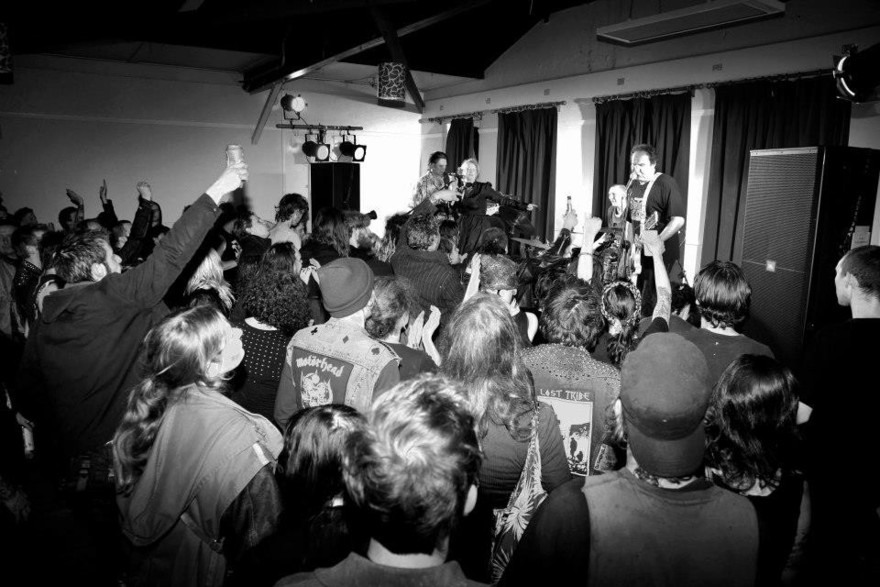
Flesh D-Vice at Wellington's Thistle Hall, 2012.
These days, the hall is a cherished community centre with a dedicated office space on the ground floor and an array of community-focused activities in the hall. Gigs are few and far between and the emphasis is on the venue’s storied history. Up The Punks had its first photographic exhibition there in 2002, a theme that was rebooted in 2012 (along with the so-called No Wave Spacktackular featuring a reconstituted Flesh D-Vice), 2019 and 2024.
While the demolition of some nearby houses for the motorway extension has inevitably changed Upper Cuba St’s unique atmosphere, and other city venues have largely taken up its mantle for music concerts, Thistle Hall’s now-historic reputation as a music venue for the otherwise dispossessed over several generations will not easily be erased.
--
Download Thistle Hall 1907-2007, 100 Years of Community, by Georgina White