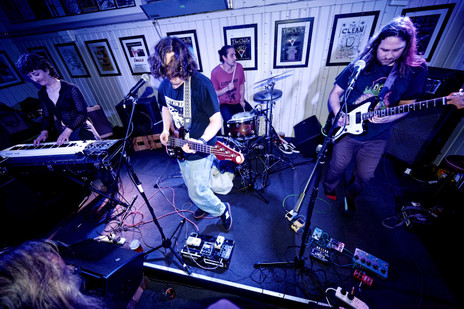
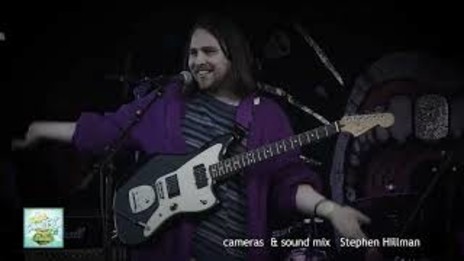
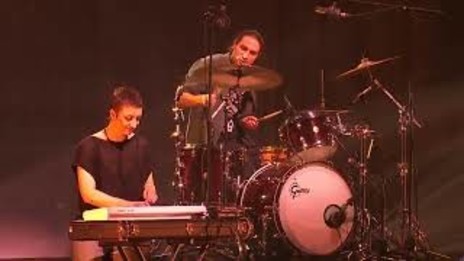
Friends is an understatement. Zac’s brother Josh has been his drumming partner-in-crime forever. The main reason for the break-up is not a case of less music, but more. Josh and Connor Blackie are both getting really busy with other bands.
“We always have our hands in so many pies” – Zac Nicholls
“We always have our hands in so many pies, which is a thing of Dunedin musicians in general,” says Zac.
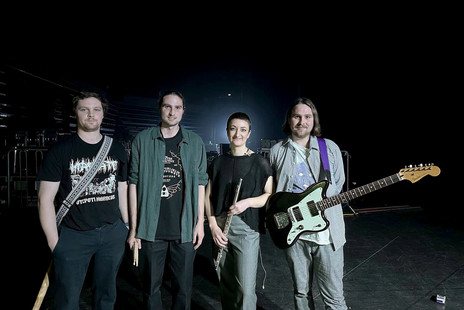
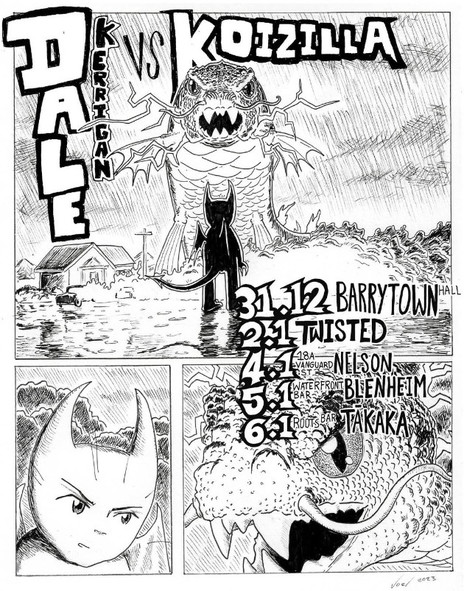
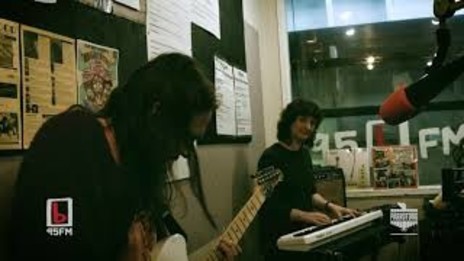
What are the current pies of the Koizilla alumnae? Josh and Connor are playing with Dale Kerrigan, led by sister Shlee Nicholls. Josh is also playing in Pearly*, who released their debut album Not So Sweet in August 2025, on Leather Jackets Records and Pinacolada Records, in collaboration with Flying Nun Records. Josh and Zac both play in Space Bats; Attack! Zac also has his solo project, Spoonicorn; and Hilary Faul (flute, vocals, keyboards, percussion) is pursuing her visual art.
Dialling time back a bit, it appears that to be born into the Nicholls family meant receiving healthy encouragement of one’s musical persuasions.
“[Our] parents have always been incredibly supportive,” says Zac. “They were music listeners, and would often play their favourite Aus-rock tunes for us: AC/DC, Midnight Oil, The Angels, Sherbet, and so on. They bought us our first instruments and only complained a little when Josh and I would make a racket all day. There were never any barriers in our musical journey and I can never thank them enough.”
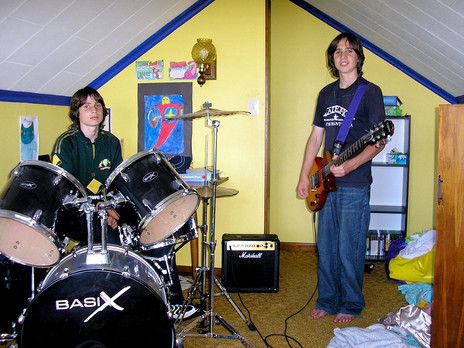
Their mum Jane was the keen photographer/ videographer/ archivist, documenting their growth. The boys’ childhood centred around making songs on GarageBand, breaking into learning their instruments in intermediate school.
“As soon as we each had an instrument at home, we would learn to play songs together. Lots of AC/DC and Black Sabbath. I think an important part of learning an instrument is learning how to play with other people. It pushed each of us to get better, and it made practising our instruments more fun, so it was kind of like a headstart towards starting a band.
“Our first band together was called Goodbye Blue Monday with a friend of ours on bass named Nikolai Sim. It was supposed to be a Mclusky/ Primus/ Noisy band, which I was not ready for fully, still being in my metal phase, and not really understanding noise.”
A video shows a beaming Zac in an AC/DC T-shirt, and Josh giving the drums the Animal treatment
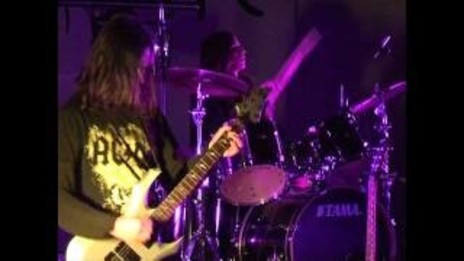
A video on Jane’s channel shows a bemused and beaming Zac in an AC/DC T-shirt, with Josh giving the drums the Animal treatment, and Sim occasionally coming into the frame her sons dominate. While Josh seems lost in his own world of rim smashing, Zac shoots him frequent glances. They are joined on one song by an unhinged violinist, and an enthusiastic tambourine player on another.
A few years later at high school, the brothers started Gunslinger, which Zac calls “a much more classic-rock kind of band,” with CJ Holley on bass, and Nick Tipa on guitar.
“That band morphed as we got older and started listening to bands like Explosions in the Sky, MONO and Godspeed you Black Emperor. With the same members, we became A Distant City.”
Parallel to A Distant City (aka Gunslinger), Zac and Nick started their first band with Connor Blackie, initially named Thoughtful and the Mighty Heart, later renamed Ruby Phantoms. After CJ left A Distant City, the band fused with Ruby Phantoms to become The Violet-Ohs, who played for a few years, slowly dissolving as everyone got busier. This was when Josh, Connor and Zac started Koizilla, in 2016.
“The roots of Koizilla’s sound really comes from the neo-surf/ kraut/ garage-rock traditions of the 2010s, bands like Osees, King Gizzard and the Lizard Wizard, La Luz, Ty Segal and Courtney Barnett,” says Zac. “I haven’t delved too deep into the classics of surf and psych rock, so I think any comparisons to the past are always refracted by the lens of the 2010s. When I listen to music, I always hear the music first and the lyrics last and I particularly love it when a band gives songs time to breathe and develop in the instrumental sections. King Gizzard’s ‘Head On/Pill’ or CAN’s ‘Halleluhwah’ are great examples. If it were only up to me, all the instrumental sections would be ten minutes long.”
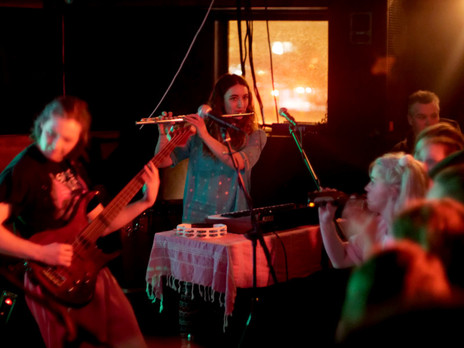
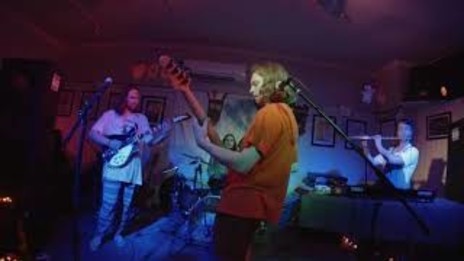
A flute in a rock band is a bold choice – the same could be said of a güiro – and yet, Koizilla treat us.
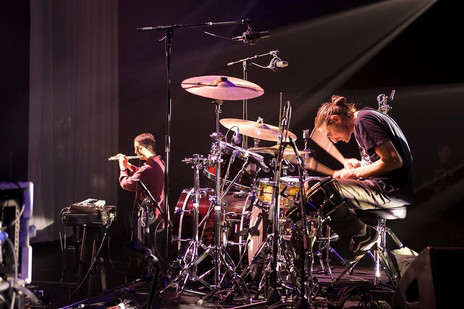
“The main impetus for adding flute to the band really just came from meeting Hilary and hearing she played,” says Zac. “I had always wanted to add an organ to the band to sound more like La Luz, so finding out Hilary played both keys and flute, and loved the same kind of music as us, made it an easy decision. I’m not a huge fan of having two of the same instrument in a band so it’s fun to play around with those kinds of sounds.
“It’s definitely not a new thing in garage/ psych/ surf music though. King Gizzard and Osees have both used it liberally throughout their discography, as have Jethro Tull – as every old man who comes to our shows likes to remind us.
“For the percussion side of things, I got really obsessed with African Psych and Afrobeat for a time. The likes of Ebo Taylor, Mulatu Astatke, Fela Kuti, Marijata, BLO, and others. And the way the percussion adds groove to the drum parts was very inspiring. So I slowly built up a basketful of percussion bits and I try to add them to everything. Usually I overdo it and we remove things afterwards. The song ‘Clouds’ though, it just had so much space in it so it was fun to build that up with percussion.”
The band’s lifespan has encompassed a pandemic, environmental devastation, political collapse and AI
The band’s lifespan has encompassed a momentum-meddling pandemic, environmental devastation, political collapse and AI. Geographic isolation is a common concern Zac touches on when asked about being a band from Dunedin; and gentrification within the city itself.
“Dunedin has the best bands in the world – I’m not biased – but we are quite isolated down near the bottom of the country. Being a musician in Ōtepoti does have its challenges. We are constantly overlooked by the wider music community, very few touring bands ever go further south than Ōtautahi if they even get there, so there are basically no opportunities to open for larger acts. Very few bands from Ōtepoti ever make it out of the South Island because flights cost so much, it is almost impossible to break even without getting any funding, and funding never goes to bands outside of Wellington and Auckland.
“On top of that, the Dunedin City Council – despite claiming that Ōtepoti is a cultural city with a storied history of the ‘Dunedin Sound’ – has done nothing to protect venues around the city from closing due to noise complaints, despite the venues being in the middle of town. We have had multiple venues close in the last few years for this reason.
“It is nearly impossible to find an accessible practice space for most bands. Neighbours complain about noise, the council tells us to find places in the industrial district but as soon as the landlords hear you are musicians, they stop talking to you.
“Despite all of that, the Ōtepoti scene is as strong as ever. I think, in some ways, the pressure to sound commercial has never reached Dunedin, so bands are so authentic and noisy in their own special ways, which I don’t think you get from the bigger cities.”
Koizilla are well placed to know, having played a representative selection of the smallest to biggest venues across the motū. They undertook their first tour around the South Island in 2016, playing a handful of towns Zac hadn’t heard of until they booked them. Two shows from that trip that really stood out.
“Barrytown Hall: we played New Year’s, and pulled 100 or so people from the surrounding farms, and had a brilliant night. Around midnight the whole community joined hands in a circle and sang ‘Auld Lang Syne’ together, before we got on stage and brought in the new year with ‘Miserlou’ by Dick Dale. We returned a couple of years later for New Year’s again and it went the same way, both times culminating in a huge jam with the Barrytown residents. Barrytown is an unassuming gig, until you look at the posters on the wall and see that the likes of The Mint Chicks, Fugazi, and Shellac have all played there.
“Another show from that first tour, we played the Millerton Hall. Millerton is an old mining town with a population of about 20 people, and most of them came along to the show. The Millerton town jam band opened for us, and I remember they had a singer improvising profoundish-sounding lyrics. I just remember him repeating, ‘This is America Live,’ for about 15 minutes.”
Early on, Koizilla practised at The Attic on George Street, home to much musical history
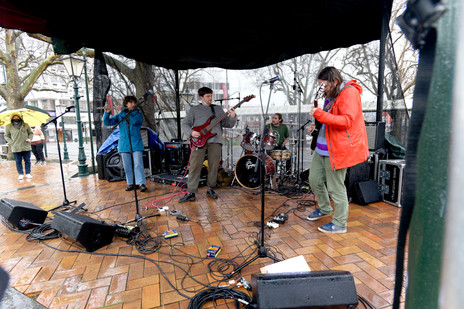
In the band’s early days, they practised at The Attic, a collective studio space on George Street and home to much musical history.
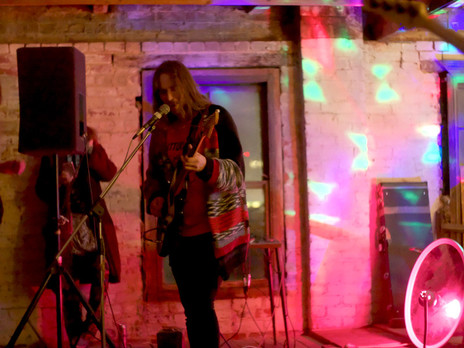
“It housed so many amazing artists and musicians, and the parties we would hold up there were some of the most raucous and fun gigs we ever played. It’s the closest we have felt to being in one of those crazy parties you see in movies, except our ones had better music.”
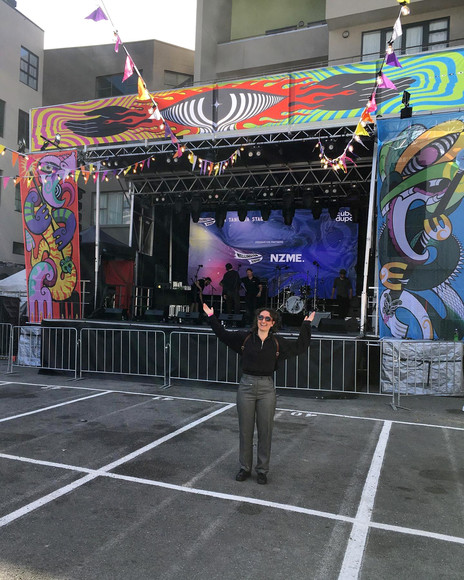
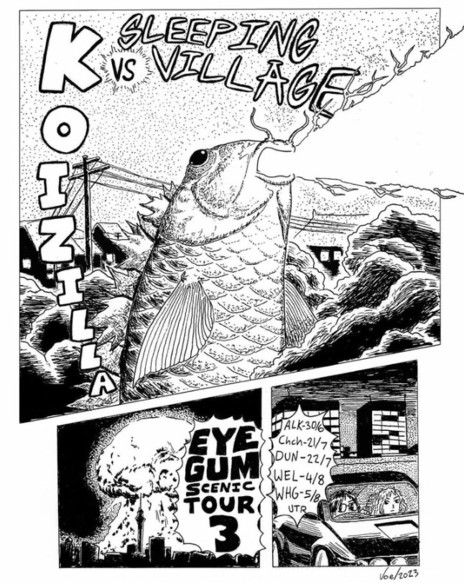
One of Koizilla’s favourite places to play was the Welcome to Nowhere festival, near Whanganui, organised by Eyegum.
“We are good friends with a few of the organisers, and it became a yearly visit whether we were playing or not. Last time we played it was one in the morning, the rain was coming down, and a huge crowd of tired festivalgoers chose to listen to us instead of staying dry. It was a magical night.”
It’s not audience-specific, but there’s often a magic moment in a Koizilla gig that particularly pleases Zac.
“Anytime we break out one of our Crash Bandicoot covers live from our Warped EP, it’s fun looking around the crowd and seeing a few faces light up with recognition. Somehow our Crash Bandicoot recordings found their way to the actual composer of the games Josh Mancell, who messaged us on Instagram, and I had a lovely chat with him. We ended up sending him a few tapes. It was very surreal.”
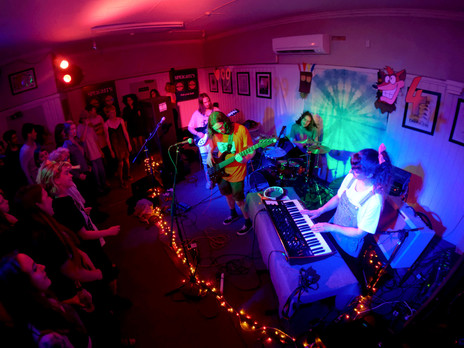
Importantly, more moments than can be noted have been spent at Jones Chin’s legendary Crown Hotel. As could be said by so many Ōtepoti musicians, “Every gig we have played there has felt like home,” says Zac.
They had their stadium moment when they were invited to play a cover of the Marlon Williams song ‘Don’t Go Back’ at Spark Arena for the APRA Silver Scroll awards in 2023.
“That was a crazy experience,” says Zac. They paid for all our flights and accommodation, they gave us free wine, and we got to perform in Spark Arena, by far the biggest room we have played. Then, at the afterparty we ended up sitting chatting with Marlon for hours, he let me talk his head off about songwriting for ages and is just an incredibly lovely man. His new album [Te Whare Tīwekaweka] is incredible.”
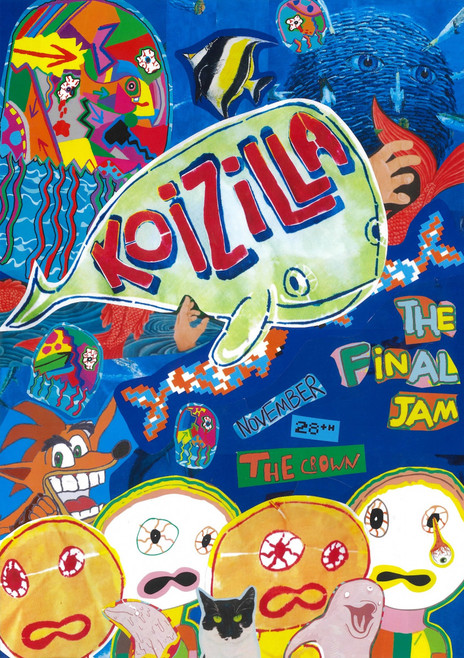
Zac says a conscious decision was made to end Koizilla on a high note.
“I would be really sad to let this band just peter out, it has been such a huge part of our lives and helped introduce us to so many wonderful people around the country. The final show is really for our benefit, a final catharsis.
“This band has been so much fun, and that’s all that matters to us. I’m proud that people listened. We are so lucky to have gotten all the opportunities we did. I’ll miss the times onstage when we start a song way too fast and all smile at each other knowing we can’t slow down. I’ll miss seeing my best friends for band practice every week. I’ll miss the hectic mosh pits, as much as they scare me every time. This band has a piece of my heart that I now have to live without.”