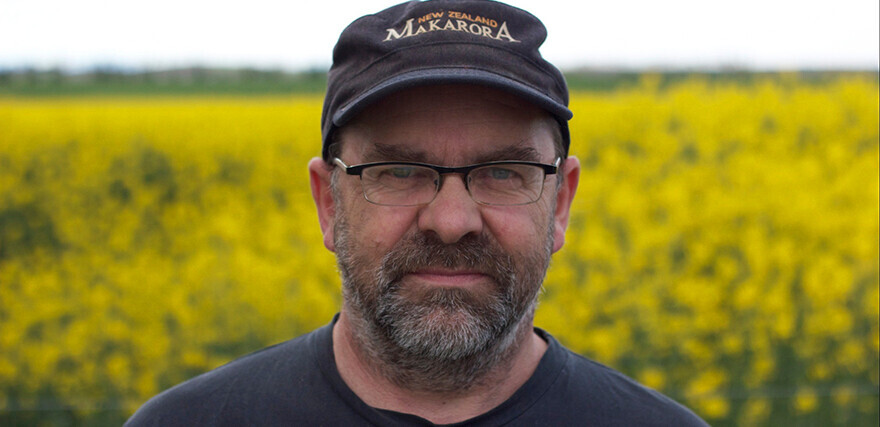
Robert Scott in 2017
In this interview for 2003 television series Give It a Whirl, Robert Scott looks back to the early days of The Clean and The Bats. Among the topics are his memories of recording the early Clean EPs Boodle Boodle Boodle and Great Sounds Great ... Robert also recalls moving to Christchurch, starting The Bats, touring the UK, Europe and the USA, and discusses gigs by Toy Love and visiting bands such as The Features. Another fond memory is the evening he woke up with The Gordons practising in his bedroom: “The Gordons were staying in my flat, all their equipment was in my bedroom. For some reason they didn’t realise I was in bed asleep and they came back at three in the morning for a practice, as you do … That was quite exciting, waking up to that.”
--
Watch below: Full-length interview with Robert Scott from Give It a Whirl (2003) via NZ On Screen (2023).
Watch below: Robert Scott talks about recording Boodle Boodle Boodle. “Chris [Knox] contacted us, he had the four-track, and Doug [Hood] had been doing a lot of live sound, so he was keen to operate the board. We found a little hall … we just went in and set up and chose five songs to do, did them all very quickly on the four-track ... It was very straightforward, very quick. I just remember it being very easy and natural, there wasn’t much agonising over anything or second-guessing. The songs had already been part of the set for a long time … It stayed in the charts for a long time and sold lots and lots.”
Watch below: “We went on to do Great Sounds Great … in Christchurch, in Jane Walker’s flat. That was a wee bit more involved, we were stretching out a bit and doing more overdubs although we still only had the four-track. There was a different choice of songs … ‘Beatnik’, ‘End Of My Dream’, ‘Slug Song’ … Probably a bit more variety. That one went to No.4 or 5 and sold as much as Boodle did. That was 82, we were touring a heck of a lot as well, probably too much, which led to David [Kilgour] getting up one day and saying ‘I want to have a break, it’s all a bit much’. By then we’d done the last single ‘Getting Older’ as well, at the same place we did Boodle. If someone wanted to stop that’s fine, you stop. You can’t carry on if someone doesn’t want to do it anymore, so we just stopped.”
Watch below: Robert Scott on moving to Christchurch and forming The Bats: “The Clean had moved to Christchurch to be a bit further up the country and do more stuff, so I was there when we finished in late 82. I pretty quickly bumped into Kaye [Woodward] and Paul [Kean] and Malcolm [Grant] in various guises, and formed a band before The Bats called Thanks to Llamas with Donna Sheen, and Jane [Walker] played a bit in it … At the end of the year it turned into The Bats. It stayed as a relaxed party band doing nurses’ balls and 21sts and things like that … It slowly got more serious in 84 or 85. It was quite slow because I was very average as a guitarist, and as a front man and singer. It took me a long time to get my confidence up, to actually say right, we’re going to do a tour, do a whole lot of shows, jump into recording. The early recordings were pretty bad I felt, I didn’t have a lot of confidence to take charge in the studio and to really get to grips with what I was doing … we just kept at it really, at our own pace. Things gathered a lot more momentum in 85, 86. We went over to England and Europe in 86, that was very good fun.”
Watch below: Robert Scott contrasts The Bats and The Clean: “The Bats, early on the bass guitar was the lead instrument. Paul’s playing was very forceful and I played a lot more with Malcolm with the drums and Kaye would be floating around the periphery on lead guitar. I was concentrating on keeping the rhythm going, and keeping singing through the song. As things changed more, the dynamic changed more. So the guitars probably came to the fore a bit more as well, as I was able to afford better guitars. The early guitars we had were very very bad. The Clean dynamic is very different ... the whole is greater than the sum of the parts; throw yourself into a song and come out at the other end. We didn’t really work on starts or beginnings; the middle was what really mattered … there was a lot of interaction, a lot of playing off each other. Hamish was a really good drummer to play bass to, very active on the kick which made it easy to play bass to. Very easy to fill up the space. I played a lot of three or four stringed parts to fill out the sound … also, it was fun playing keyboards … A very interesting beast.”
Watch below: Robert Scott on becoming aware of interest from other countries: “Early on with The Clean there was feedback from places like Germany and England, they were the first places I think, and America soon after that. Letters from the fans to the label, people trying to get hold of the product. And that just kept growing as things went on really. It was pre-email, so snail mail coming in, orders for one thing here, two things there. We found out after a while that fans overseas were very fanatical, they would buy everything that you put out, they would write a lot of letters … Eventually as we got over there, and as the 80s went on we got to meet a lot of those people ... When you meet people like that who are so enthusiastic it gives you a big pat on the back to keep doing it.”
Watch below: Robert Scott on overseas touring: “The Bats [tour] in 86 we did ourselves, we didn’t really have any contacts. There was Craig Taylor who was managing The Chills in London, so we just thought oh we’ll go over and hook up with him and he’ll get us some shows. We went there, all our own money and we bought an old battered Transit which we slept in. We made beds in the back; I slept on the front seat under the driver’s wheel. We stayed with friends in England, there’s lots of friends in London – and we did a few shows, recorded ‘Made Up In Blue’ at the studio there in London, Point Studios – and that was a really good experience. We had some really good shows in London, got some really good responses, had some good reviews in NME, Melody Maker and stuff. Then Craig said we should head over to Europe, there’s a promoter there in Germany, he’ll hook you up with some shows. We drove over and rang hm up and the first gig was just south of Nuremberg and that was with Alex Chilton, which was fantastic.”
Watch below: Robert Scott on the return of The Clean: “The Bats were on tour in England in 88, and David was there on holiday, and Hamish got flown over – Craig Taylor put it all together and got us a practice room for a night. We played the next night with The Bats at the Fulham Greyhound. That was recorded [by Jed Town] and released as In-A-Live. It was fun, exciting, very easy to get back together and play the songs, they all came out very easily.”
Watch below: Robert Scott on the songwriting dynamic and the sound of The Bats: “Mostly writing-wise I tend to come up with a semi-finished song – a vocal melody, the words, a set of guitar chords. I put them on tape and send them to Kaye, Paul and Malcolm, and they thrash around with them. Usually, a little while after that, say we’re getting ready for an album, the we’ll go over those tunes and reshape them in some way, sometimes they don’t change much, sometimes they change a heck of a lot … The sound is more a mixture of Malcolm’s very propulsive drumming – almost Neu meets disco drummer in parts – and what I’m doing is really folk based guitar. Kaye’s school of lead guitar is not really conventional. She’s got her own thing, which is great, very individual, organic … and Paul’s bass playing ties it all together and sometimes it pulls a song in another direction as well.”
Watch below: His philosophy as a songwriter: “I try and keep it as natural a process as possible, in terms of not second-guessing or agonising over things too much, and trying to access the untapped part of your brain for new ideas and feelings. There are certain songs that I hear that we’ve recorded over the years that you have a special connection with, you remember recording them say, or writing them. Each song has a different dynamic or different connection to it … it’s something you find out later when you’re hearing them again.”
--
This interview was recorded for the 2003 season of TV series Give it a Whirl. All audiovisual content is copyright to Visionary Film & TV, and may not be reproduced.
--
Further reading: Nick Bollinger on Give It a Whirl