Some of this country’s best-known songs began as poems. ‘God Defend New Zealand’ was originally written as a poem in the 1870s by Irish-born Thomas Bracken. ‘There Is No Depression In New Zealand’ started life as a sheet of words that poet Richard von Sturmer gave to Don McGlashan, wondering if he might be able to find some music for it.
But poems aren’t simply song lyrics in search of a tune. “Most poems if they’re any good are set to music already, and performing perfectly well on their own terms,” poet Bill Manhire said to John McAuliffe in 2021. “Hence it’s odd that so many composers want to set poetry to music, though no surprise that they often end up damaging the texts they believe they’re honouring. As the writer and musician Damien Wilkins says, a poem put to music is a dangerous thing because it’s music on top of music.”
I went looking for examples of poets and musicians who risked that dangerous fusion and triumphed. Here are 10 poets – including Manhire – in successful musical collaborations.
Denis Glover
Denis Glover’s poems might have been made for music. A prolific poet from the 1930s until his death in 1980, his most famous work – and ostensibly the most widely anthologised poem this country has produced – is ‘The Magpies’. First published in 1941, it has inspired picture-books, plays, films, and especially music.
On the page it is already shaped like a song; six stanzas, with a steady rhythm and rhyming pattern, each stanza ending with the onomatopoeic refrain ‘Quardle oodle ardle wardle doodle / The magpies said’.
It was Glover’s friend and contemporary Douglas Lilburn who, in 1954, had the first crack at putting it to music, having already set poems from Glover’s 1951 collection Sings Harry and Other Poems. (This song cycle can be found performed by singer Terrence Finnigan and pianist Frederick Page on the 1961 EP Sings Harry, and in a guitar treatment by Milton Parker on a 1977 album with singer Robert Oliver.) For a recent performance of Lilburn’s ‘Magpies’, here’s a 2021 recording for SOUNDZ featuring baritone Scott Bezzet, with two sopranos and an alto quardle-oodle-ardle-ing.
In 1983 Bill Direen and his band Builders set the poem against an unyielding riff suggestive of the Velvet Underground. Direen took considerable liberties with Glover’s text, though retained – and has plenty of fun with – the quardle oodle ardles.
Australian singer-songwriter Paul Kelly recorded his own version in 2019 for the album Thirteen Ways To Look At Birds, alongside settings of John Keats, Emily Dickinson and Gerard Manley Hopkins, and made it an instant Australian folksong. The fact that Glover’s magpies were an Australian import in the first place surely helped.
But the most entertaining interpretation might be the one by Wellington art combo the Six Volts, who performed it in 1987 for an apparently appreciative audience of feathered folk.
Sam Hunt
No New Zealand poet ever cut a more rock’n’roll figure than Sam Hunt. Swaggering tall in the stovepipe jeans he called his “Foxton straights”, adorned with scarf, sunglasses and the occasional spot of leopard skin, he took poetry out of the salons and into the pubs and rock festivals.
No surprise then that he was one of the first local poets to collaborate with a rock band – he cut the album Beware The Man with the Wellington group Mammal in 1972 which spawned the psych-rock classic ‘Beware the Man’ – or that he went on to fruitful collaborations in later decades with Dunedin guitar doyen David Kilgour.
His own voice has also been an attractive element for electronic artists. Listen to what duo SamsAmp (producer Jon Cooper and musician Ted Brown) did, slicing and dicing a recording of Hunt reading his poem ‘Your Body Has No Flaw’, with unexpectedly funky results.
In 2020 Fane Flaws, Peter Dasent and Tony Backhouse completed We Disappear, an album of Hunt poems turned into colourful jazz-rock opuscules, which they had started more than 30 years earlier. It includes a new version of ‘Beware The Man’, which Backhouse had previously composed for the Mammal album.
Lately Sam’s poetry has found a more upscale home in the recital hall. Victoria Kelly, with her background in both rock and orchestral composition, used Sam’s poem ‘Requiem’ – in which he depicts a departed friend as a lighthouse keeper who “climbs no spiral stairs but go he does to man the night / To reappear among his polished stars” – as one of the texts for a beautiful requiem of her own.
In the recording, Hunt’s words are sung by Simon O’Neill, noted for a powerful dramatic voice that has earned him his reputation as one of the finest Wagnerian singers in the world. And yet his performance here has an ethereal, almost fragile quality. “As a heldentenor,” Kelly says, “he represents the ultimate form of western music masculinity. Yet all of us are made small by our mortality. It was symbolic to ask him to be vulnerable and small.”
Neil Finn, who has worked with Victoria in his own band, has picked it as one of his favourite pieces of New Zealand music. “[Victoria] unfortunately lost her parents when they were relatively young and she was young,” he told RNZ in 2024, “and I think it was a very important piece of work for her, a long time in the making and incredibly resonant because of that. The first time my wife and I listened to this piece in the studio after she’d recorded it, we wept openly and I don’t think I’ve listened to it once since then and not had tears in my eyes.”
James K Baxter
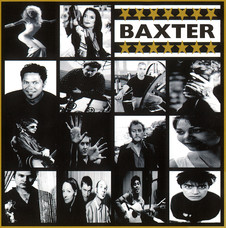
The James K Baxter compilation produced by Charlotte Yates, 2000.
It was reading one of James K. Baxter’s poems from the Vietnam War era that got Charlotte Yates imagining what an album of Baxter poems set to music might sound like. “It leapt off the page at me. I remember thinking, ‘This sounds like a rock song. Wouldn’t it be cool to put this to music?’”
James K Baxter’s work was both lyrical and topical, and his barefoot prophet persona was etched into the national consciousness, so it wasn’t a difficult sell when Yates began approaching other singer-songwriters about contributing to the 2000 tribute. The Baxter album and live shows that followed displayed a range of musical styles as broad as Baxter’s oeuvre: the late Mahinaarangi Tocker taking a melodic tightrope walk across ‘Never No More’; poet David Eggleton declaiming ‘The Maori Jesus’ against a radically dissonant David Downes soundscape; Emma Paki living inside the protest song ‘Oh Early In the Morning (Firetrap Castle)’; and the children’s rhyme of ‘Andy Dandy’, turned to jangling indie-pop by Andrew Brough.
And then there is Dave Dobbyn’s exquisite rendering of ‘Song of the Years’, as emotionally soaring as anything he ever recorded, and Sam Hunt – who always carried a volume of Baxter’s verse in his head alongside his own poems – standing on Gareth Farr’s sonic battlefield to recite the Vietnam war-era ‘Ballad of Old Grady’s Dream’.
There have been other fine settings of Baxter, from Lilburn to Charles Royal, but the Baxter album is a good place to start.
Ruby Solly
Ruby Solly is a poet, cellist and taonga pūoro player. She has published books of poetry, performed her own work, and collaborated in an adventurous range of musical settings.
In the short music video ‘Karaka – Tau’ you’ll find many of her skills combined.
The piece pays homage in words and music to the karaka tree that can still be found growing in some coastal landscapes, and to the tīpuna who first planted them there. With cello and kōauau (Māori flute), Ruby conjures the voices of the land – the wind, the trees, the pīwakawaka that nest and forage there – while the actual sounds of waves on a shore play counterpoint to the instruments.
Unlike the other pieces on this list, the words remain silent, appearing only as text on the screen, paired with beautifully observed images by video makers Sebastian J Lowe and Victoria Baskin Coffey.
‘Karaka – Tau’ is part of a larger project, Ruby’s 2020 album Poneke, which she has described as “a love letter”, not only to the city of Wellington where she lives, “but to all those who have lived here, have shaped this place, and have been kaitiaki of all the facets and layered histories of Wellington herself.
“In te ao Māori, I see time pulled around us like a korowai. We are layered in it, kept warm by the triumphs and resilience of our pasts and the hope of our futures. We are living in the present, past, and future all at once, and move between them.”
Bill Manhire
Bill Manhire’s work has earned him some weighty honours. He was the country’s inaugural Poet Laureate, is an Arts Foundation icon and has a CNZM for services to literature. He founded The International Institute of Modern Letters, New Zealand’s leading creative writing programme. And yet his poems carry themselves lightly, drawing on the rhythms and language – as well as moments of absurdity – in our quotidian lives.
Despite his own reservations about poetry-music syntheses (see the introduction to this article), he has engaged in a series of collaborations with composer/pianist Norman Meehan. On Making Baby Float, Meehan and singer Hannah Griffin lift Manhire’s poems gently off the page and set them down in a classy lounge bar, one where the musicians command more attention than the cocktails.
Making Baby Float is the second collaboration between Manhire and Meehan and, unlike the earlier Buddhist Rain, some of these pieces were written specifically for Meehan to make into songs.
Meehan’s music can be as deliberately plain as Manhire’s language (‘Across the Water’, ‘Rehearsing the Choir’). At other times he will subtly colour his chords, or throw another instrument against them, like the sax of Colin Hemmingsen on the eulogy ‘Kevin’. And there’s a solemn yet uplifting touch of gospel in the track that gives the album its name. Hannah Griffin honours both Manhire’s words and Meehan’s melodies with her clear, beautiful voice, and unerring timing and pitch.
Manhire has also collaborated with the composer Gareth Farr on Ornithological Anecdotes, poetic portraits of New Zealand birds for baritone and piano. Reviewing the recording of these pieces by Julien van Mellaerts (baritone) and James Baillieu (piano) on the album Songs of Travel and Home, Elizabeth Kerr wrote in the Listener: “Van Mellaerts’s flawless diction and witty story-telling combine with Baillieu’s luminous piano in lovingly humorous songs that capture avian quirks. ‘Huia’, sung with moving lyricism, provides a ghostly slow movement. Manhire initially rejected our national bird as “spectacularly boring”, but ‘Kiwi’, added for a Wigmore Hall recital, is perhaps the most cleverly entertaining of the set. Manhire pokes gentle fun at our national character while Farr invokes Gilbert and Sullivan: “I am a humble bird/ my word my word my word.”
Audrey Brown-Pereira
When poet and activist Audrey Brown-Pereira went to the United Arab Emirates in 2023 to attend the COP 28 conference on climate change, she went armed with this track. It is her poem ‘They Taking Pictures of Us in the Water’, reworked as a hip-hop epistle by Auckland producer Anonymouz (Faiumu Matthew Salapu).
The song was commissioned for the Moana Blue Pacific Pavilion, the base for all Pacific leaders attending the conference on behalf of their countries, and launched there during the event.
“There were two things I asked Matthew (Anonymouz),” Brown-Pereira told Te Ao Maori News. “It had to retain feminine elements and it also had to use elements of my voice to sample. Beyond that, it was his gift to explore using his talents and look at what he came up with. I’m so proud.”
The result is a true mix of mediums, the rappers taking lines from Brown-Pereira’s poem as jumping off points for their own rhyming excursions. For Salapu, it was the first time he had created work on this topic, and he was glad for the opportunity. He says: “Hip-hop being a voice for the voiceless, this was an opportunity for me to give a voice for the environment.”
Link: Audrey reads the original poem
Alan Brunton
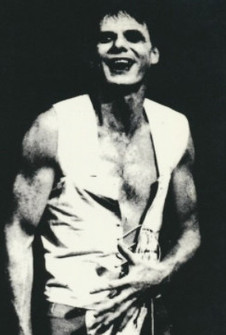
Alan Brunton, Red Mole.
Rock’n’roll crackles through the poetry of Alan Brunton, along with a myriad of other cultural signifiers, collected on journeys that took him from the Mekong Delta to New York City, and Amsterdam to the Chihuahuan Desert, usually with Red Mole, the radical theatre group he helmed with his partner Sally Rodwell.
As Martin Edmond says, “For Alan Brunton, poetry was inextricable from performance,” and it was Brunton’s poetry, as much as the masks, dances and theatrical stagings, that fuelled Red Mole. Over the 20 or so years Red Mole existed, he collaborated with a wide array of musicians: Midge Marsden’s Country Flyers, composer/musicians Jan Preston, Neil Hannan and Jean MacAllister, rock’n’rollers including Sam Ford, Trudi Green and Rick Bryant, free jazz players such as Stuart Porter and Jeff Henderson, and post-punk experimentalists Kieran Monaghan and Campbell Kneale, among others. Sadly, few of these collaborations ever made it to disc. The album Crossing The Tracks (1978) spotlights some of his early work with the Flyers and Jan Preston, including his recitation ‘Viet Vet Blues’ and the song ‘Slaughter On Cockroach Avenue’, written with Preston and sung by Beaver.
It wasn’t until 1997 that Brunton recorded an album of his own, separate from any of the Red Mole projects. Released on Bumper Records (an offshoot of his own Bumper Books imprint) 33 Perfumes of Pleasure features Brunton and an amalgam of Wellington jazz and post-punk musicians calling themselves the Free Word Band, intoning seven of his poems in spiky and explosive settings. Recorded live at Braeburn studios, Brunton brings his command of theatre to these dramatic, hypnotic and mysterious performances.
Hone Tuwhare
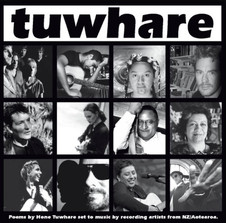
The tribute compilation album to Hone Tuwhare, produced by Charlotte Yates, 2005.
After the success of the Baxter tribute, Charlotte Yates was approached to put together a musical showcase around the writing of poet Hone Tuwhare, but some differences between the projects were obvious from the outset. For one thing, the subject was still alive. For another, Yates was acutely aware of the issues implicit in a Pākehā taking on the work of a Māori artist. But with the blessing of Tuwhare, who was by then 81 and living in the Catlins, and an even more diverse array of talent than Yates had marshalled for Baxter, the result was at least as satisfying.
It’s a feast of voices. Whirimako Black offers an exquisite, soulful ‘Spring Song’, accompanied by the late Jonathan Besser on piano. Against a reggae backdrop, Upper Hutt Posse founder Te Kupu brings dynamic force to ‘Speak To Me Brother’, reciting the poem as though he’s standing on a street corner, taunting passers-by with Tuwhare’s words. Staying in the reggae lane, Fat Freddy’s singer Dallas Tamaira forgoes his typical melodic style for a dramatic recitation of ‘We Who Live In Darkness’.
Organic-electronic duo Wai take their pulse from a traditional poi rhythm, to which they add synthesisers and a lovely melody by Mina Ripia for ‘On A Theme By Hone Taiapa’.
Hinemoana Baker, a poet herself, sings ‘Where Shall I Wander’ with experimental folk group Waiting For Donald (which includes in its line-up another well-known poet, Chris Price.)
Four different artists apparently wanted to set Tuwhare’s popular poem ‘Rain’ (‘I can hear you making small holes in the silence…’) but Don McGlashan won the toss, and his sparse arrangement, with David Guerin’s piano and his own plaintive vocal and euphonium, is another highlight.
Hinemoana Baker
Hinemoana Baker (Ngāi Tahu, Ngāti Raukawa, Ngāti Toa, Te Āti Awa, German) is one of those creative forces that seems to do it all. Poet, singer-songwriter, sound artist, performer and teacher, for her 2004 debut album Puawai she shifted between te reo Māori and English, between waiata and spoken word, sometimes within a single song.
Listen to ‘Nga Wēhenga (For Barbara Ringiao)’
In 2006 she created the soundscapes (along with percussionist Des Mallon) for I Can See Fiji, an album of spoken (and occasionally sung) poetry by the late Teresia Teaiwa, a Kiribati-African-American scholar and poet who spent the last years of her life teaching at Victoria University.
In between publishing several volumes of poetry, numerous essays, giving public readings and musical performances, she released a second album, Gondwanavista: An Outback Soundwalk, in 2009. The product of a three-month spell as Queensland Arts Council poet-in-residence, it presents a collage of field recordings and poetry.
Baker currently divides her time between New Zealand and Berlin.
Katherine Mansfield
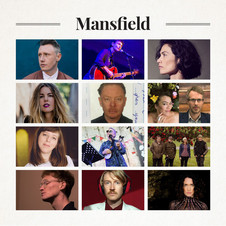
Mansfield (2020), a 12-song collection of New Zealand artists interpreting Katherine Mansfield’s poems. Curated by songwriter Charlotte Yates, the compilation includes songs from The Bats, Delaney Davidson, Anna Coddington, Lawrence Arabia and Julia Deans, among others.
Katherine Mansfield is renowned for revolutionising the short story, but not so well known as a poet. In fact, her poetry often appeared under a pseudonym – Boris Petrovsky, Lily Heron and Julian Mark were a few of her aliases – and much of it remained unpublished until after her death. Perhaps this is the reason Mansfield – an album of Katherine Mansfield’s poetry set to music by 12 different artists – is so fresh and surprising. This was another project conceived and curated by Charlotte Yates, who had overseen previous multi-artist tributes to James K Baxter and Hone Tuwhare.
Mansfield was a leading literary modernist, yet it is still striking just how contemporary these words sound 100-plus years after they were written. Interpretations range from Lontalius singing the intimate ‘Secret Flowers’ against a gently thrumming synthscape, to Delaney Davidson’s gnarly ‘Pic Nic’, with whammy-bar guitar and whistling.
And there is Yates herself, who discreetly slipped her shimmering setting of ‘The Awakening River’ into her 2017 album Then The Stars Start Singing, a contemporary singer-songwriter set, in which Mansfield’s ode feels completely at home.
--
Coming soon on AudioCulture:10 more examples of New Zealand poetry set to music.
--
--