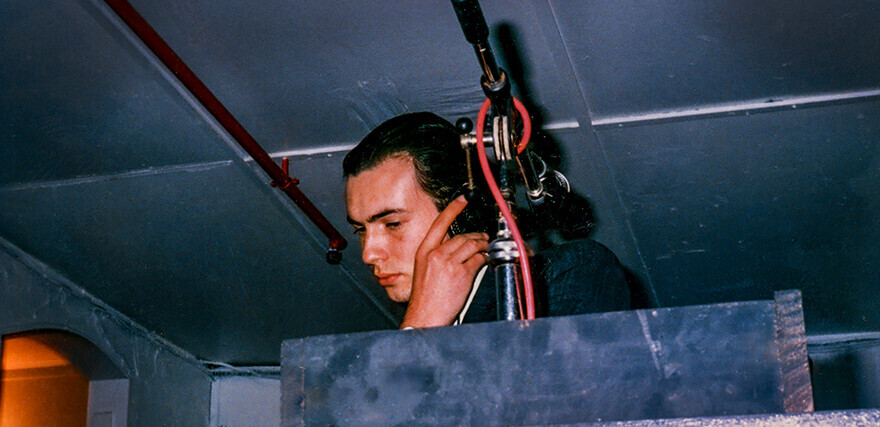
Roger Perry at The Playground, Nelson Street, 1988. - Ian Marriott
The Brat and The Asylum
The Six Month Club finally closed after eight months, and Peter Urlich and Mark Phillips found a new space under 51 Nelson Street. A large, cavernous labyrinth with two levels, it had once been The Foundry nightclub. They asked me to spin records there, and I worked with them to try to create what was possibly Auckland’s first contemporary inner-city funk, soul, and garage club, influenced by places such as London’s WAG and New York City’s Larry Levan-hosted Paradise Garage.
To do this, we needed gear. We needed a pair of Technics 1200 turntables and a good, fast, DJ mixer, preferably a Numark. No PA supply company in New Zealand had either product, so I got on my knees and begged Oceania Audio’s Greg Peacocke. He called Australia, and a week or two later, bingo, we were in business, opening successfully in February 1986.
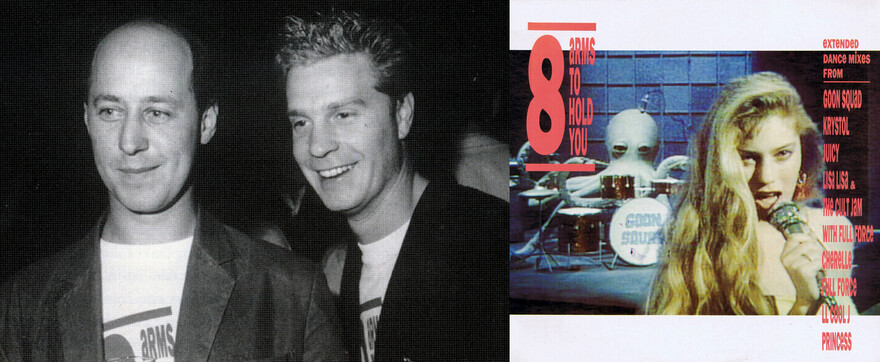
Simon Grigg and Mark Phillips at the launch of the dance compilation Eight Arms to Hold You, at the Brat nightclub, Auckland, 1986 (Stimulant label, 1986; compiled by Peter Urlich, Phillips, and Grigg). - Photograph by Murray Cammick
The DJ booth was perched high above the dancefloor, precariously mounted on a concrete beam. Up there, I began to teach myself the fundamentals of DJ mixing, a skill that never came easily to me. From day one, I had an enthusiastic teacher, Roger Perry, who also played from time to time.
The Brat was the club where we tossed the hits away completely. The audience, increasingly drawn from South Auckland as much as from the closer suburbs of Auckland, decided they liked this and filled the grimy cavern every night, often standing above the dancefloor, across from the DJ booth, looking down on the hundreds who crowded it. They were dancing to music that we had made our own, so much so that we released a compilation, 8 Arms to Hold You, on a label we launched: Stimulant. It topped the compilation charts and had a No.2 single with UK soulstress Princess’ ‘Say I’m Your Number One’, broken from The Brat’s dancefloor, and supported by Radio B.
My flatmate Tom Sampson was managing The Galaxy, a struggling live venue on Mount Eden Road, for owners Phil Warren and Don Lylian. One day, Phil pulled him aside and, aware of the crowds we were drawing at The Brat, asked whether I would be interested in creating a club in the space on nights when there were no live acts. The tale is beyond this story, but after a meeting with Phil, I agreed. I broke the news to Urlich and Phillips, who didn’t take it well. Tom and I went to work creating what was possibly the largest nightclub space New Zealand had seen to date, albeit one that could be assembled and disassembled into a live venue in a very short time.
We approached Roger Perry. I knew I needed Roger to make it work. He had the skills, musical taste, and DJ personality we needed to create the venue we wanted. He was the best young DJ in the city, and he didn’t want to compromise musically. So, one Tuesday night, a few weeks before we opened, Tom and I wandered down the stairs at Club Mirage and made Roger an offer: come and work with us. You can play what you want, how you want. We will pay you well, and we’ll be a team. I would set up an account or two to buy cutting-edge club records in the UK and possibly the US, but it was up to Roger how he used them. No other rules.
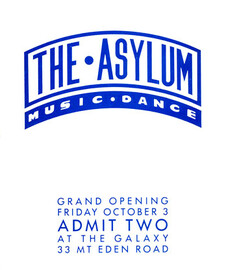
Asylum opening night invite. - Simon Grigg collection
The Asylum opened on October 3rd and as ChaCha magazine said, “The peacock blue dancefloor eagerly awaited.”
Roger didn’t disappoint. I’d built a relationship with a record shop in Manchester. Something called house music had started to break out of the gay clubs in Chicago and New York City. A raw, almost brutal and primitive groove, it paired early sampling technology with Kraftwerk and disco and arrived on a litany of indie labels. Across the seas, Manchester was the first place to turn house into an urban soundtrack. It was as if punk had arrived again and, as with punk, it offered momentary hope. Our supplier in Manchester was Eastern Bloc, a shop at the centre of all this, and every other week Guy Oldhams, the buyer, would ring me and reel off a list of records I’d never heard of. I said, “You choose”. I gave him my credit card and a maximum spend. And for the next year or so, we would get a weekly box of 10 or so records, records that Roger and I would listen to, love – or sometimes hate – and mostly play.
So in October 1986, Roger Perry played the first house record in New Zealand, and possibly Australasia (when we visited later that year, we soon discovered how far behind the gilded Western Isle was from us): Farley Jackmaster Funk’s ‘Love Can’t Turn Around’.
Hip-hop was also in the middle of what is now called the golden age, having evolved beyond the call-and-response clichés of its origin years. Acts such as Eric B & Rakim, EPMD, Mantronix and many more were selling millions of records on small NYC indie labels. We were playing them all, but one indie in particular was catching Roger’s attention.
Back then Def Jam was a label owned by two upstart street hustlers/producers, Rick Rubin and Russell Simmons. Despite having done a deal with CBS a few months earlier, it was still releasing confronting, experimental records, many of which didn’t go beyond one-off 12" singles. CBS NZ had no idea what to do with any of it, so they literally offloaded their US promos on us, and we walked out of their Parnell offices one afternoon with singles by the Junkyard Band, LL Cool J (who we’d earlier included on our 8 Arms collection), Original Concept, and the Beastie Boys. Each and every one said “play” to us, and we did.
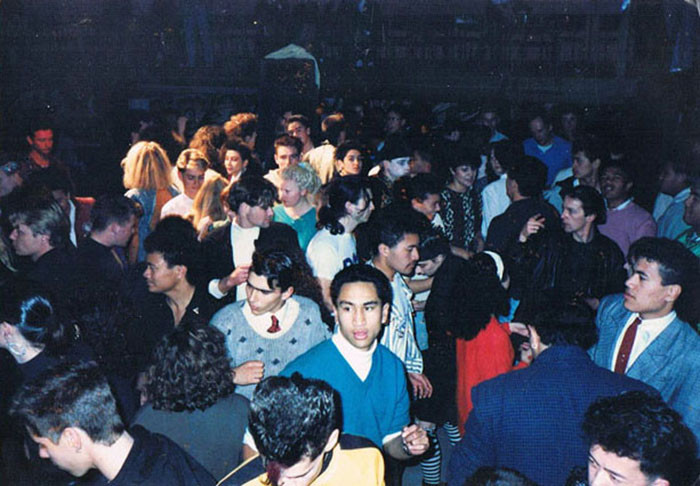
The Asylum dancefloor. - Photo by Ian Marriott
Def Jam mania became a thing on our dancefloor, with each and every one of these generating a frenetic explosion, drawing the skateboard kids who were now part of our crowd, the inner-city hip kids, and the South Auckland hip-hop kids together on the raised floor that was a stage on non-Asylum nights. The Beastie Boys were a massive thing, long before their soon-to-be platinum Licensed to Ill album troubled the charts or radio in the South Pacific. And Roger knew exactly when to drop a track to achieve maximum effect, as he equally understood when to break the frenzy with a house tune, a left-field indie disc or a 60s soul stomper.
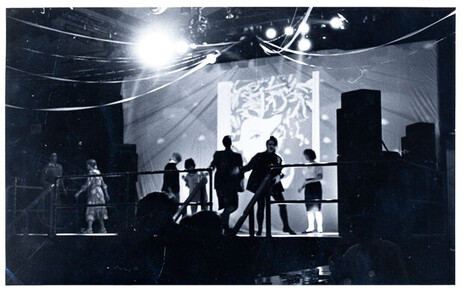
The second night of The Asylum, October 1986 - Chad Taylor
“You allowing me to play [Iggy Pop’s] ‘Real Wild Child, and things like [The Cult’s] ‘She Sells Sanctuary, and The Chills ‘I Love My Leather Jacket’, and what have you – it was having the freedom to play those things. And I remember at times, I’d think it wouldn’t work, and then I could see Harold [Rorschach] just getting down, and I’d think, right now I’m going to play this. We’ll make this shit work. When you reflect on it, man, some of the records that were playing there were very, very, very underground in the Northern Hemisphere. I don’t know how we managed to make all that different music gel, but we did.
“I came from the dance floor, and I was learning in front of 1000 plus people. For the young crews, seeing someone from the dancefloor, someone who’s just as much into the music and going out as they were, up there, just gave it that extra something.”
And the crowds Roger was drawing defined the wider city’s diversity.
“We had the North Shore crews, the West Aucklanders, we had the bogans from Laingholm, we had the Southsiders. We had the city crew, and we had the Sunday crew, you know, like the Satele boys, and they’d have to be home by midnight on a Saturday, all that sort of shit. And I understood all that, and to be honest, if you have a look at the track list of what [Larry] Levan used to play at the Paradise Garage, it’s a pretty similar sort of approach to music.”
What also made it different was its inclusivity.
Roger justifiably took pride in his pivotal role in the breaking down of racial barriers in inner-city clubs
“There were no horrible dress codes. Remember how you could get into a club with those shitty grey zips-up-the-side shoes you bought for 40 bucks, but you couldn’t get in with Puma States. And it was a huge thing for people to be able to go out – we’d been influenced by Beat Street and American hip-hop culture that was coming through. But also, you know, all the LA rocks, the new rock thing, and all the, you know, the Guns N’ Roses and all that stuff, and having this place where everyone could go along dressed as their favourite whatever, or in their favourite whatever, and not have the fear or the concern of being turned away. There was a huge, huge shift in the city. It was like mufti day at school."
Roger, justifiably, also took pride in the breaking down of racial barriers that The Asylum represented, and in his pivotal role in that.
“I was hanging with a pretty racially mixed crew, and some of the attitudes and the racism were, you know, there was no holding back there, but it was The Asylum too, when that all came together … a lot of shit went down in those first few months at Asylum, with fights and things as people got to know each other and sorted each other out.”
Roger’s dancefloor marked the first time the new inner-city urban Pasifika, embracing all the races and tribes that made up Tāmaki Makaurau, gathered to dance.
“Before that, there were only a couple of places that Polynesians went to when they went into town. Where they were welcome. But that initial rubbing up against each other you had to go through, there’s no doubt that some shit was going to kick up along the way. But I am very proud to have been a part of it, and allowing it all to come together.”
Records
The Asylum also generated albums, in this case two, somewhat problematically. The first was Devastating Dance, a late 1986 collection of WEA dance singles, conceived by the aforementioned Jimmy Hendriks. Jimmy had selected 15 tracks from the WEA catalogue and asked Roger to mix them onto a cassette as a sampler for his boss, Tim Murdoch, to approve.
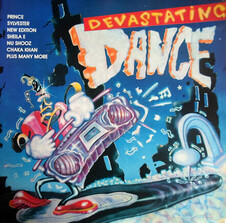
Devastating Dance, compiled by Jimmy Hendriks, DJ mix by an uncredited Roger Perry (K-Tel, 1987)
One afternoon, Roger, Jimmy and I met at The Asylum, and Roger mixed the tracks live to cassette. Roger was assured that if it was approved, he would get to mix it in a studio for a royalty. We heard nothing more and forgot about it until TV adverts for a K-Tel collection with the above title started appearing in mid-1987. Either Jimmy or WEA had done a deal with the budget TV marketing company to release Roger’s demo tape without asking. No money ever changed hands. That there was no credit wasn’t a problem, as much of the release was tracks Roger would never play in a club, but WEA wanted a professional DJ mix, and that’s what he gave them.
The second album was more directly inspired by the club’s dancefloor. In early 1987, I approached CBS in New Zealand with an idea for a Def Jam compilation, including a track by a new hip-hop act, Public Enemy, which Roger had turned into instant chaos on the Asylum dancefloor. Sure, said Annette Watson, the local product manager. Over the next couple of weeks, Roger and I put together a track listing, recorded it onto a cassette, sketched out a sleeve and label design (we wanted to use the dark-red colour found on early Def Jam releases) and a name, It’s The New Style!
Def Jam (it's the new style!), compiled by an uncredited Roger Perry and Simon Grigg (CBS, 1987)
We duly dropped it off, and Annette said she’d send it to the Australian office, suggesting they consider releasing it across Australasia. Cool. Then nothing. We assumed it had died a corporate death until an unimaginative black-sleeved collection with our title and track listing arrived as an Australasian release. (In their rush to cut us out of the process, they used the wrong version of LL Cool J’s big club hit, the album version rather than the very different 12" version of ‘Rock The Bells’.) No credit went to the compilers, and we never saw a cent. It was not CBS NZ’s fault, as they were not consulted either.
Throughout 1987, we continued to push the boundaries as far as we could, and the crowd largely followed. Asylum was an irregular club; it ran on nights when the parent club, The Galaxy, had no live acts, usually international, or, now and again, one of Phil’s dreadful dine-and-laugh theme nights or comedy. An Asylum night would be announced with a simple advert in the Auckland Star that read: Asylum Saturday or Asylum Friday & Saturday, coupled with a few 10-second adverts on Radio B (contra-ed for free staff and DJ entry) and a gig-guide mention. That’s it, and a crowd of a thousand or so would duly queue outside on the anointed night(s).
“The Asylum was a melting pot of new things coming through. And people.”
But it couldn’t last.
The Playground
In August 1987, Peter Urlich and Mark Phillips made us an offer: if we moved our club to their now co-owned former Brat premises at 51 Nelson Street, they’d make it financially worthwhile. The offer was hard to resist, so we gave Phil and Don notice. In September, Tom, Roger and I renovated the space, reopening as The Playground in the first week of October, exactly a year to the day after we’d opened The Asylum.
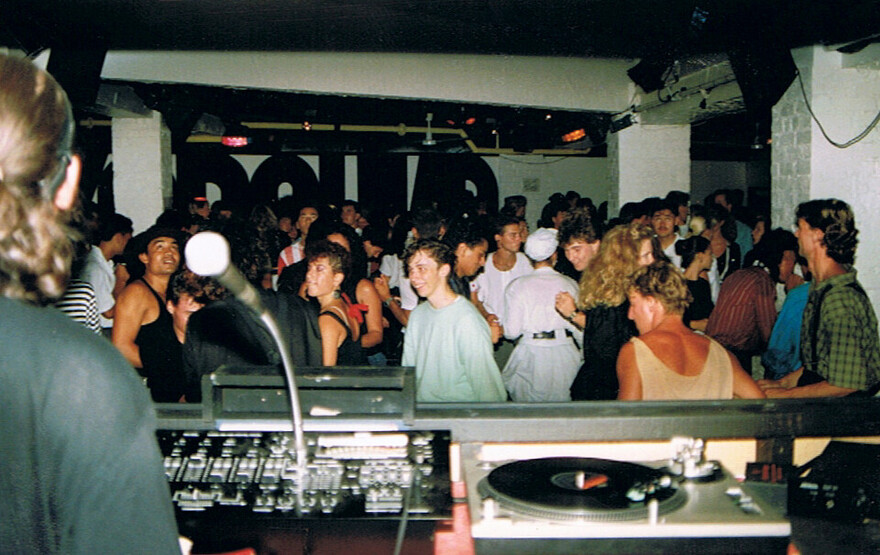
Roger Perry looking out onto the dancefloor, The Playground, Nelson Street, 1988. - Simon Grigg
The Brat and Playground shared the same physical space, both at 51 Nelson Street, but what was inside was quite different. Roger had worked with us to design the DJ booth, and we created an Auckland equivalent of the booths you saw in big New York clubs. It had sofas, a lockable room for records, and even a fridge for Roger’s beer supply. The dancefloor was surfaced with a rubber compound, and we’d lowered the ceiling to give the large floor a more intense atmosphere.
Roger: “The Playground was where everything worked. If you wanted to be in the big spaces, you went upstairs. Downstairs, the ceiling was low, with lots of little grottos and little side bars to hide away or just listen. It was something very, very special.”
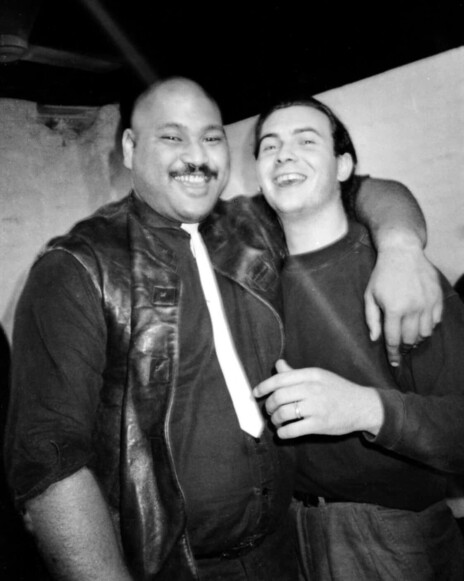
Doorman Selwyn and Roger Perry at The Playground, 1988. - Darryl Ward
Musically, The Playground was an extension of The Asylum (although we were now exploring more English music, such as Coldcut, Bomb The Bass, and Mancunian cut-and-paste house), but in a more stable environment – kind of. Peter and Mark fell out with their partners early in the new year and were gone from their restaurant, the glittering Le Bom with roller-skating waiters. It left us downstairs to fend off their increasingly unpleasant former partners.
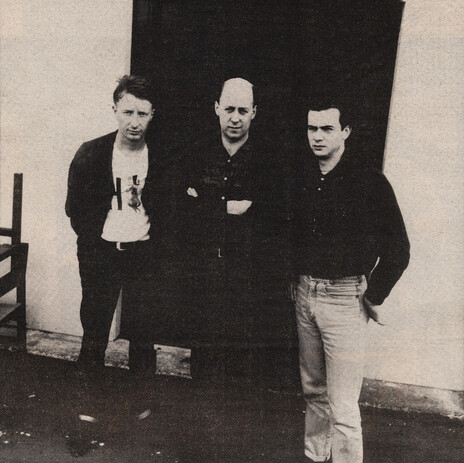
Tom Sampson, Simon Grigg and Roger Perry outside The Playground, 1988. - Paul Casserly
As part of Peter and Mark’s response to the scrap they were having, they hosted what were Auckland’s first warehouse parties, one in Parnell and another across the road on Nelson Street. Roger and I were hired to supply the music, which we did, though the second was complicated by the arrival of the police to confiscate the contents of the unlicensed bar.
The Playground also introduced a number of new players to the scene, names who would matter greatly in the years to come and whose worlds and work would be intertwined with Roger’s. One was Soane Filitonga, then a teenager with a job selling cars but passionate about music. Another was Manuel Matisi, equally passionate about the music Roger was playing and who would make his mark as Manuel Bundy. There was Phillip Campbell, who was about to host The Gothym City parties at Galatos and elsewhere with David Teehan and Risetti “Rose” Tanoi. Rose was then a doorman at the City Hotel, but in the 1990s he guided and defined a new generation of “gentle” doormen who, for a decade, made Auckland’s High Street the safe centre of Pacifica and inner-city nightlife.
With Peter and Mark gone, the complex suffered. Le Bom upstairs was integral to what we were doing, and while The Playground continued to do well, the writing was on the proverbial wall. We decided to call it a day in Easter 1988. An advertisement in the Auckland Star drew 7000 people over two weekends, all there to pay homage to the music Roger Perry was playing, and to the changes that music had wrought in Auckland over the past four years.
Back to Mt Eden and beyond
The Galaxy was sold in early 1988 to a consortium of Auckland businessmen. While we were Playgrounding, they were rebuilding. The stage was moved to the other end, where it still is, and new back bars and a music control complex were built, including what was probably the most advanced DJ booth in the country. They renamed it The Powerstation.
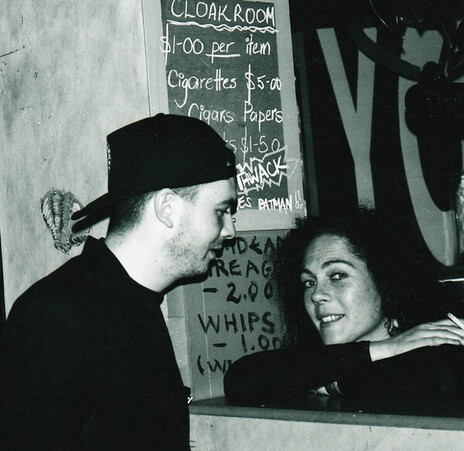
Roger Perry and Vive Lock, Roma, Queen Street, 1989. - Brigid Grigg-Eyley
Roger was hired to play music there, and moved across after we had left The Playground. While it was briefly the hottest club in town, it never captured the essence and raw vitality of The Asylum, and Roger moved on after a couple of months. Mark Phillips and Peter Urlich had a new club-for-the-moment, Berlin, in the old King Creole’s on Wellesley Street, and suggested that Roger and I take over their quiet Thursdays. We did, and we called it The Trip. The playlist was almost exclusively house and techno, something we’d never done before, but it worked, and we found a growing weekly crowd.
--