With Roger Perry, it’s a matter of where to start. His influence on Aotearoa’s cultural, club, DJ, and electronic music scenes from the mid-1980s onwards was immense and pervasive. It remains omnipresent.
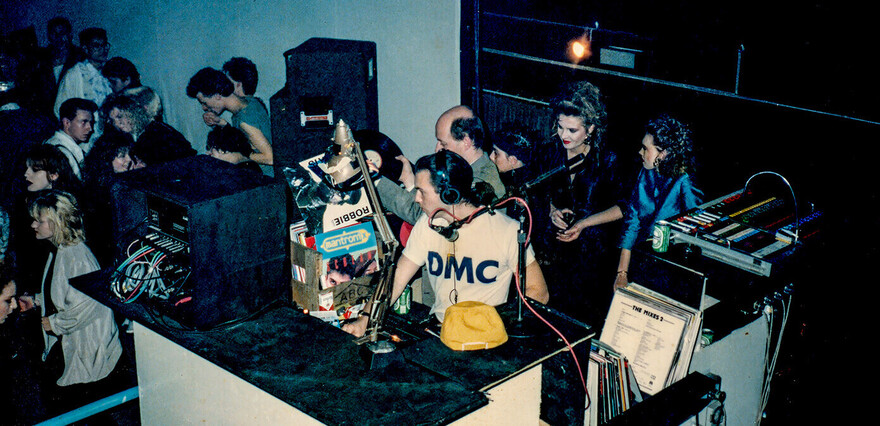
Roger Perry and Simon Grigg in The Asylum DJ booth, 1986/87. - Ian Marriott
Maybe we start with an evening at Auckland’s The Asylum? It was late 1986, and Auckland was in the full flush of 1980s club culture, with hip-hop meeting early house music in this vast cavern of a club that would later become The Powerstation. The dancefloor was packed with hundreds of kids from all tribes, all coming together to dance. Roger had just played Farley Jackmaster Funk’s Chicago anthem ‘Love Can’t Turn Around’, and the floor was expectant.
He stopped the record. Silence ... for what felt like an eternity. And then, bam! A huge guitar riff dropped in, and the crowd went totally nuts. It was a moment of pure genius. ‘I Love My Leather Jacket’ by The Chills was a long way from the Chi-town and NYC rhythms that dominated the club, but it was ours, and it was all over student radio at the time.
Roger had only been headlining around the city for two or three years, since his first tentative steps into a DJ booth at Russell Crowe’s The Venue on Symonds Street in 1984, but he was already the name. His tastes and the intuitive way he played music, together with his mix of soul, funk, indie and edgy local pop, defined the growing scene. When he dropped The Chills that December night, he was regularly playing to 1000 people at The Asylum every club night.
The Bay of Plenty
Roger Perry was raised in the Bay of Plenty, in Ōpōtiki and Whakatāne. His family was locally prominent. Roger's grandfather was Sir Norman Perry, whose distinguished life included 12 years as an advisor and secretary to the political and cultural Māori leader Sir Apirana Ngata. Sir Norman was also the only Pakeha to serve with the Māori Battalion. It was a heritage that helped define Roger's own life, especially as he traced his own Māori bloodline later in life.
Roger's mother also hosted a jazz show on the local Whakatane radio station during his teen years, although it's unclear how long for. He was surrounded by music as a child.
“The first real music I can remember is T. Rex’s ‘Get It On’, Millie Small’s ‘My Boy Lollipop’, and my dad playing The Beatles on the piano. When I was little, Mum used to put me by the stereo speaker in the lounge, lay me down there, and leave the radio on.”
During his pre-teen years, his parents would take him to Auckland, where he discovered Skatopia in Manukau City. “I started skateboarding, I guess, at the age of 10. My parents just dropped my brother and me off at Manukau, and that was where I discovered XTC, the B-52s and Devo, who became a huge band for me … and the Ramones.” All selected, although he didn’t know it at the time, by Geoff Wright, who would go on to become a future friend and musical ally in future years.
When he got to high school, Roger wanted to play the guitar, but his music teacher refused his pleas to re-string it for his left-handed needs, so he booked a room at lunchtime and taught himself to play drums left-handed. “It was easy to set up for left-handed, and I just started putting headphones on and playing records and learning that way, playing along.”
The Bay of Plenty also meant he was surrounded by US and Jamaican soul, disco and reggae, which were ubiquitous: “60s soul, R&B and stuff, like the Drifters and the local versions, like Bunny Walters. Reggae was all around; it was pretty much the soundtrack that was always in the background. Black Slate, Steel Pulse, Black Uhuru, Bob Marley – every house had Uprising – Peter Tosh, Jimmy Cliff, plus The Emotions, Chic.”
In the early 1980s, Roger met the brothers Inia and Manu Taylor when they were on holiday in the Bay of Plenty (Manu founded the Papa Pacific Records label and managed 95bFM and Die! Die! Die!). They formed a teen band: “Igneous Rocker and the Fossils, basically doing Joy Division covers.” But he’d also discovered The Slits and 23 Skidoo, “stuff which had a more kind of, well, it had a bit of a bit of blackness to it.”
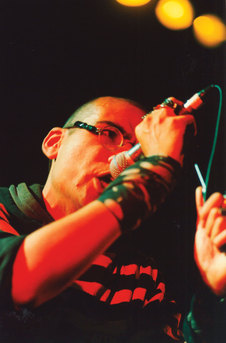
Roland (aka Harold) Rorschach - Peter McLennan collection
There was also Harold Rorschach, a teenager who had just moved from the Netherlands with his parents and shared Roger’s passion for contemporary music. The two hit it off instantly.
“The night we met,” recalls Harold, “we ended up on a truck trailer, chanting Specials songs all night, while we jumped up and down on the trailer.”
One of the records Harold had brought with him from Holland was Prince’s fourth album, Controversy, which was still relatively unknown in New Zealand. He also had edgy records by Orange Juice and early synth acts such as Orchestral Manoeuvres in the Dark and Human League, all of which were transitional sounds for Roger; they influenced his tastes going forward.
Auckland
In November 1983, Roger decided he needed to expand his horizons. “It was obvious to most of the bros, and to me, that we didn’t have a lot of future if we stayed down there. You know, with small towns, you tend to be typecast before you finish school, and we were certainly not mainstreamers.
“I think I sat my last sixth form exam, went home, packed, and the next day, I proceeded on to Auckland on my Vespa with just about everything I owned strapped onto the bike and onto me one way or another.”
In Auckland, he initially stayed with a friend, Shane Fletcher, and then, when his schoolmate Tony de Raad (the original bassist in Hallelujah Picassos and a member of David Kilgour’s Heavy Eights) also moved up, the two found a flat in Mount Eden.
In the big smoke but unemployed, the pair often spent their days in record shops.
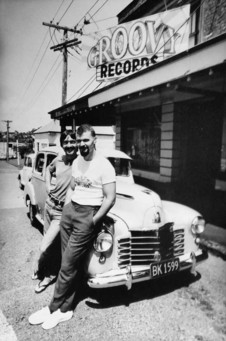
Chris Priestley and Chris Hart outside the first premises of Real Groovy Records in Mt. Eden Rd, Auckland, early 1980s.
“Real Groovy’s first shop had opened up at the top of Mount Eden Road. We would fill a lot of our days going up there – the shop was small enough that we would start, one at each side, and work our way around.
“We did that almost every day for weeks until we had a fair idea of what they had in stock and started getting a feel for when new things arrived and working out how things fitted together. I began collecting James Brown.
“We’d started discovering other record shops like Rock’n’Roll Records and Record & Cassette Warehouse. And that fellow with the beard who had the great place up on K Road [Neville Lynch]. We were enjoying being sort of unnoticeable, kind of young ruffians – enjoying the freedom of not living in that small town. Auckland was just a big playground.”
They were soon joined by more of their Whakatāne crew: Harold, Ian Marriott and Brett Evington, and clubland was proving to be a draw. Before he moved up, Roger had hitchhiked up a few times to go to Quays, the then club-de-jour owned by Gary Charlton, the lead singer of This Sporting Life. “I would literally hitchhike up on a Friday and go clubbing, and then hitch home on a Sunday and go to school on the following Monday.”
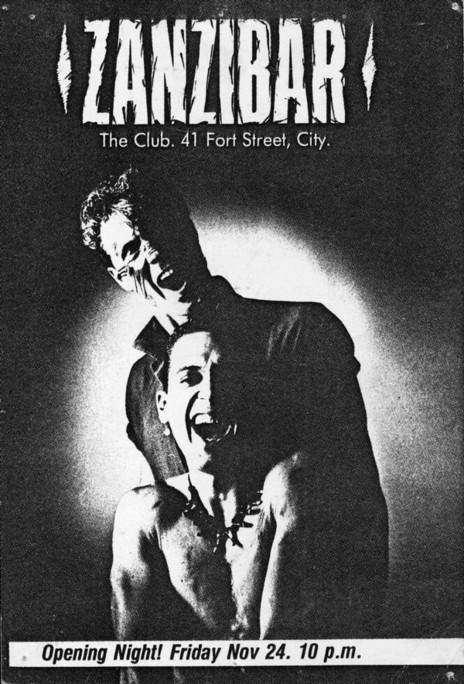
Peter Urlich and Mark Phillips on the opening invitation to Zanzibar, 1984.
In 1984, Zanzibar, hosted by Peter Urlich and Mark Phillips, was the club. Nights were spent in the Fort Street club and, Roger remembered, “We really would be living for the weekend, for Zanzibar. Every week.”
The owner of Zanzibar was Clive Frith, a UK DJ who’d moved to New Zealand. Clive taught Roger about Northern Soul, rare groove, and the deep soul scenes in his homeland. More importantly, he let him practise on his equipment. In 1984, the gold-standard deck for DJs worldwide from the 1970s onwards – the direct-drive Technics SL1200 turntable – was almost unknown in New Zealand because of the country’s fiercely restrictive import licensing regime. Almost nobody had one, let alone a pair of them to mix records.
Clive had a pair of SL1200 Mk2s, which he used on weekends. “He could really mix,” Roger recalled, “I’d never heard anyone mix as such before, and as much as Peter and Mark at the time were hugely influential musically, hearing someone mix and put music together in the way that he did …”
Roger was aware that Clive needed a DJ for Thursday nights, so he approached him. Clive: “I well remember Roger approaching me and asking if he could do a Thursday night at Zanzibar.”
Initially, Clive said yes, but then gave him nights here and there to test him. Clive recalled to AudioCulture in 2026 that “Thursdays were pretty much an open-mic night of sorts, so as well as having Roger and co-pilot Gideon Keith, we had Andy Vann, Kerry Buchanan, Anthony Corban, Murray Cammick, and others, but there are good mix DJs, and then there are the naturals. Good mixing is not just a matter of matching beats; anyone can do that. It’s about phrasing, not clashing vocals, not clashing the key of one song with the next; it’s about flow. I always thought Roger did this with very little effort. He was also unafraid of stretching the boundaries.”
Roger asked Clive if he could borrow the SL1200s and a Citronic DJ mixer early in the week to practise. Clive said yes.
Roger: “Up until then, we’d been doing stop-start tape edits and mixes. That was the extent of our mixing at the time. The Citronic mixer was pretty flash, and I got to spend a few days on it, which I thought was pretty special, because, as you can imagine, back in those days, equipment was pretty hard to come by. He didn’t really know me at all ... I was so grateful.”
Influenced by Mark and Peter, Roger’s tastes were broadening. Mark Phillips loved UK dance-pop, acts like Level 42, The Kane Gang, and other Zanzibar regulars, who turned him on to early hip-hop and gritty modern soul acts Midnight Star and Dynasty. Locally, there were records by Big Sideways, Miltown Stowaways, Katango, and Car Crash Set, with the latter a floor favourite.
Russell Crowe
At the same time, Roger was actively looking to expand his work and went through the Auckland Star’s job vacancy pages most days to see if anything that took his interest popped up. The evening paper was usually in the local dairy around 4pm, “and one day there was an advert for a new club. It said no experience is really necessary, that we’ll teach or we’ll train. So I rang that number, and that might have been on a Wednesday. I was given an address and told to be there at a certain time the next day and go in for an audition.”
Unsure what to make of it, he wandered up Symonds Street at the appointed time, to the given address.
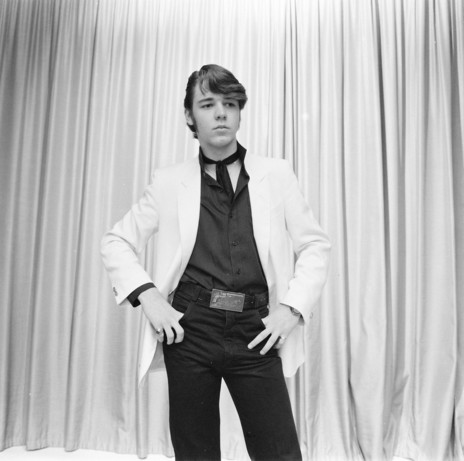
Russ le Roq (Russell Crowe), 1981 - Rykenberg - Auckland Libraries Heritage Collections 1269-Y8706-14
“And there was Russell in his full Russ le Roq look. I had a beer crate full of records, and he had this console set up, one of those cheap old-school things. He showed us how to put two records on, essentially, and then said we had to play one, say something, play another, say something about the next one, and play that.”
Roger did his thing, as did others, and was told to call in a couple of hours.
“I left and went home, then I called that number, and he said, “You got the job, and you start at seven o’clock tonight.” And that’s how I first met Russell Crowe, and that’s how things started.”
The job involved spinning records before, between and after the bands at Russell’s new underage club, The Venue.
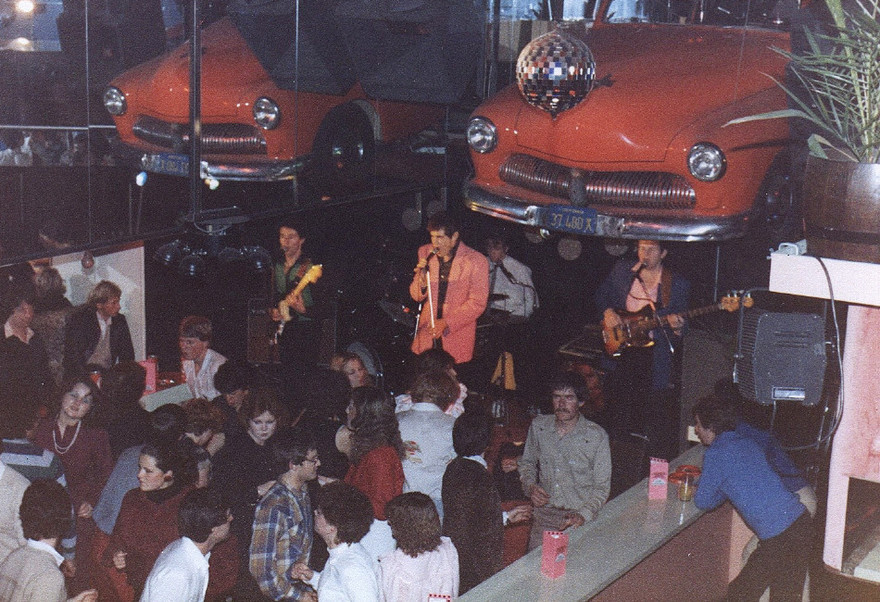
Tom Sharplin takes the stage at King Creole's, his club under the Civic Theatre. - Simon Grigg collection
“He was a genuinely nice guy, Russell, but he also showed me and mentored me in what it actually meant to be a professional DJ in the city. He also got me to play with him at King Creole’s a couple of times (Russell’s cousin Tom Sharplin’s club under the Civic Theatre in Queen Street). I guess that, having grown up listening to the radio in Whakatāne in the late 70s, I had a fairly good ear and understanding of commercial and popular music. There’s nothing inspirational or complicated about it, but it was a good grounding, and he was genuinely supportive.”
Russell took Roger to more mainstream clubs in the city, Phil Warren’s Keely’s and Johnny Tabla’s Club 21 – both in the large basement area under the Civic Building – and Stan Gordon’s Stanley’s near Durham Lane East, places where club bands covered the hits and DJs spun Top 40 records between sets. “[It was] just to get my head around how it worked, and to explain to me your job as a working DJ in the city is to keep people dancing, to keep them there, and to keep them drinking. If you didn’t do that, you didn’t last long.”
The Venue’s crowd was musically adventurous; Russell Crowe let Roger play whatever he wanted
At The Venue, however, with a younger, more musically adventurous crowd, Russell let Roger play whatever he wanted, which, as often as not, meant hip-hop, as the Beat Street movie (1984), and tunes like Afrika Bambaataa’s ‘Planet Rock’ and Grandmaster Flash provided much of the soundtrack of inner-city Auckland, along with the new wave of local synth-pop. The audience, a racially mixed crowd from the city’s schools, especially Selwyn College, Metro College and St Peter’s, was a good testing ground for new music and genre mixing. Roger learned to trust his increasingly honed instincts.
He also learned the lesson of humility and work from the future global superstar. “When there wasn’t enough money, they’d get us all around the family home and feed us. His mum would cook us up a feast. Then, the next day, I’d see this guy come in with a briefcase and those really awful kind of slip-on dress shoes with a zip up the side. I knew times were tough because he was coming to give Russell a bit of money to keep us going.
“Russell supported the bands – The Mockers, Brett Adams’ band The Bellboys, Sons In Jeopardy, Peking Man, he gave them all free rehearsal space and paid for recordings because he believed. He got behind the whole scene.”
The DJ who would transform Auckland inner-city clubland over the next couple of decades was almost there. He just needed access to the tools.
Club Mirage
Roger said I played a part. After a couple of years immersed in London’s clubland, I returned to Auckland in late 1985 with a couple of hundred 12" singles I’d bought in the city’s import and dance stores. The day I arrived, I was approached by Peter Urlich and Mark Phillips to spin records at their current club, The Six Month Club, above the Cook Street Markets, where the Aotea Centre now sits. Roger and I soon became firm friends, a friendship bonded by the music in the grooves of the records we were both playing.
“[That] was huge. Just being able to find out what some of those records were that you were playing, even though we couldn’t find them anywhere, you know, that got us going.”
We’d sit and talk music for hours, and when we weren’t doing that, we’d scour and cajole the record company offices for those samples, supplied by their UK and US parents, of 12" club vinyl they would never release locally. Throw coffee at DKD into the mix, and you had a ritual and a friendship. Add to that other like-minded souls like Daniel Barnes and Anthony Corban (later remixers and producers around town), Leza Corban (Anthony’s sister, who was a voice around town and later a guest vocalist with Strawpeople) and writer Peter Grace, who seemed to know more about hip-hop than anyone we knew, and you have the core of a scene.
Around the same time, Roger moved on from The Venue, which was winding down as Russell’s second career as an actor took off. Club Mirage was a High Street basement club, founded in the 1970s by the merchant bankers Michael Fay and David Richwhite, but in 1985 it was owned by Don Fletcher and Maurice Crosby, who also owned The Globe in Wakefield Street and leased Hotel Debrett further down High Street.
Club Mirage had kept the bankers and lawyers, but in the mid-1980s stockmarket boom, it had also added banks of brokers and traders, along with the crowd that followed that money. They had crowds, champagne and a DJ called Jimmy Hendriks.
Again, Roger saw an advert in the Auckland Star. He was asked in for an interview, and Russell arranged for Roger to play at King Creole’s for Crosby, with Mirage managers Jody Lawless and Julie Smith in attendance to hear the DJ. None of the Mirage trio (Lawless, Smith, Don Fletcher) turned up, but Julie and Jody gave him the thumbs up anyway, and he was offered a gig playing Tuesday, Wednesday and Saturday, with Jimmy playing Thursday and Friday.
Initially, Roger partnered with another Auckland DJ, Gideon Keith (later a graphic artist of some note – “we were hanging and sort of fancying ourselves as the New Latin Rascals”), but after a few weeks he was a solo act.
At 17, Roger was playing to the Club Mirage crowd. “I didn’t relate to them socially ... it was a playground for me”
“They had this pretty flash built-in console, which had quite a wide mixer,” said Roger. “I think they had maybe four channels or eight channels for instruments, for any groups, and what have you. The DJ mixer was built into it as well, and they had these Garrard turntables with a rotary-type pitch control. But they were direct-drive, so that’s where I really honed my mixing. And the first mix I ever got right was Cindy Lauper’s ‘Girls Just Want to Have Fun’ with INXS’s ‘Original Sin’!
“I was still 17, playing, playing to this audience, that, to be honest, I was so far removed from in every way you could think of. I didn’t relate to them socially. I didn’t relate to the whole wealth Auckland thing that was happening. So it was just a playground for me, and obviously it was very good fun. But the soundtrack there was pretty commercial. And as I got better at mixing and general DJing, the challenge was to slip something I liked into the mix and make it work. That was the reward.”
Jimmy Hendriks worked during the day, handling promotion for WEA Records NZ, and had access to a lot of unreleased or forthcoming music, which he filtered through to Roger. One was the pre-release copy of ‘I Can’t Wait’ by the Oregon band Nu Shooz. The song had been released on a tiny local US label, Poolside Records, and was picked up by WEA’s Atlantic after European DJ play. Before it was reissued in the US, a white-label copy found its way to the Auckland record company and from there into the Club Mirage record bins, where Roger found it and started spinning it. It quickly became a Mirage dancefloor hit, long before it broke in its homeland.
“I broke it down there, and it became huge. Jimmy came down one night, and he’s like, fuck, what’s this? And I said, ‘Oh, it’s one of yours’. And he said, ‘Oh, shit, I’ve got to tell [WEA NZ boss] Tim Murdoch about this’. And so it grew from there.”
New Zealand reported back to the US Atlantic label, which prioritised the record, and it became a global smash. Roger Perry’s instinctive feel for what would fill a dancefloor would define him in the months and years ahead.
Mirage offered Sunday nights to Roger too, and he built a night targeting the hospitality industry on what was, for most, a night off to relax. Working with David, the DJ from Alfie’s – the gay club nearby, under High Street’s Imperial Arcade – they slowly built a loyal audience that grew week after week, one that would feed into Roger’s future clubs and parties. It was a night with a playlist that didn’t draw from the Top 40, unless it was a future Top 40 hit that Roger was playing. It was also, unlike almost every other club in the city, a playlist filled with local tunes.
One Mirage memory stayed with Roger: “What’s his name from Duran Duran was here with his yacht Drum and the [Whitbread] Around the World race, and, gosh, I can’t even remember his name anymore – Simon Le Bon, that’s it – he was down there a lot, and around that time he had his Arcadia project, and it was shit, and he would have these girls come up asking me to play these Arcadia songs so he could dance and mime along to them. It got quite terse on a couple of occasions. I just said that I didn’t believe that we had any of his records, so I couldn’t play them. Then a package arrived from the record company with just about everything they’d ever done. And so I’d have to actually play these Arcadia songs so he could pose around the dance floor and sing along to them for girls.”
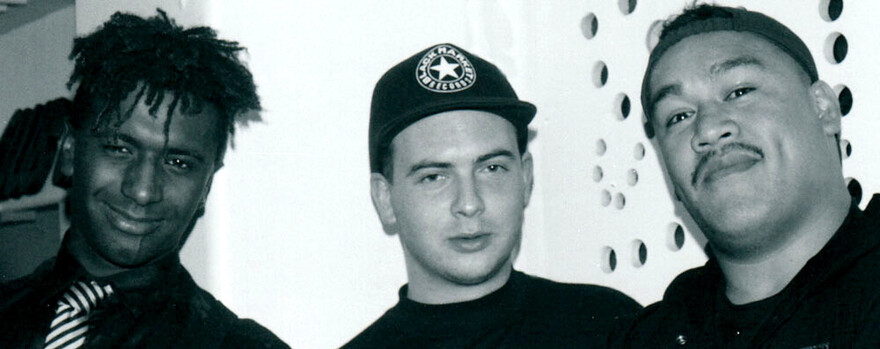
Jon Davis, Roger Perry and Time Sulusi, The Siren, 1989. - Brigid Grigg-Eyley
--