New Zealand country music exploded in the 1960s. The establishment of the Viking Record Company in the late 1950s and the emergence of new stars John Hore Grenell and Maria Dallas mid-decade saw the genre’s popularity soar. The new company was founded in 1957 when Murdoch Riley left his management role at archetype New Zealand indie label Tanza to launch Viking with partners Ron Dalton and Jim Staples. Their earliest country releases were Cole Wilson and His Tumbleweeds with the first of their Country Songs volumes. Throughout the 1960s, Viking churned out multiple long-players by Rex Franklin, with his wife Noelene Anderson and/or The Prairie Pals, Garner Wayne & His Saddle Pals, Peter Posa, Ken Lemon, and their biggest star, Maria Dallas.
His Master’s Voice (NZ) put renewed vigour into country music with albums from The Caroline Ramblers, The Overlanders, The Plainsmen, Val Elliott & The Rhythm Ramblers, and Brendan Dugan. But Mosgiel impresario Joe Brown concentrated all his label’s attention on his 1963 discovery, John Hore.
Here are 10 random LPs from the 1960s Kiwi country boom.
1,000 Miles Out Yonder – Rex Franklin and Noelene Anderson (Viking, 1961)
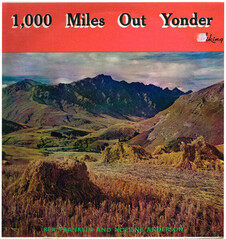
Rex Franklin and Noelene Anderson - 1000 Miles Out Yonder (Viking, 1961)
Having already released two 78rpm discs on Tanza in the 1950s, 1,000 Miles Out Yonder is husband-and-wife Rex Franklin and Noelene Anderson’s debut long-player. They re-joined former Tanza A&R man Murdoch Riley after he had left the floundering imprint to set up Viking.
Solely reliant on Franklin’s accomplished acoustic guitar playing, the duo run through 12 numbers that, according to the back cover, fall into “the category of true country music for the tunes and performances are distinctly Australasian in character.” Five were written by Franklin, including ‘Rocky Mountain Lullaby’ and ‘A Real New Zealand Cowboy Song’.
Overseen by Dannevirke recording engineer Ivan Tidswell, the album also includes a cover of Australian Johnny Ashcroft’s ‘Little Boy Lost’, the tale of four-year-old Steven Walls, who was found alive and well after missing from his family’s farm in the New England Ranges for three nights in February 1960.
Country Style – Garner Wayne with The Deaconaires (Viking, 1962)

Garner Wayne’s Country Style LP (Viking, 1962). Photo taken by George Kohlap at Ōnawe Peninsular, Akaroa Peninsula.
Since the mid 1950s, Garner Wayne had been playing around South Canterbury with his own band The Saddle Pals before somehow joining forces with instrumental rock-and-rollers Peter Collins and His Deaconaires. The combination released a single on the little-known Universal label in 1960 and Country Style two years later.
Country Style is a long way from The Deaconaires’s wild, vibrato-drenched instrumental ‘Fire Devil’, but lead guitarist Collins was well known around the district as a country singer. Wayne’s own material such as ‘I Love The Land’, ‘The Mainlander’ and ‘The Canterbury Plains’ is supplemented with covers of Jimmie Rodgers, Bing Crosby, Australian Buddy Williams, and New Zealander Les Wilson.
Within the next 12 months, Wayne would reconvene The Saddle Pals and write the radio request show favourite ‘Love In A Fowlhouse’, which opened his follow-up LP, Going Places.
Introducing John Hore – John Hore (Joe Brown, 1964)

Introducing John Hore, his 1964 debut album on the Joe Brown label
The first of John Hore Grenell’s 17 studio albums on Joe Brown’s eponymous label, Introducing John Hore did exactly what it said and set the scene for its successor, Encore, that would outsell The Beatles and become the biggest-selling LP by a New Zealand artist at the time.
Introducing finds 19-year-old John Grenell – still using his stepfather’s surname of Hore – taking his confident first steps in the studio with the backing of The Nick Smith Trio, Howard Morrison Quartet guitarist Gerry Merito and “vocal background”. The set begins with a trifecta of songs written by Grenell’s hero Marty Robbins. Side two kicks off with four songs by Nashville songwriting giant Harlan Howard, including Grenell’s first single ‘Mary Ann Regrets’.
There’s no mention on the package of producer, engineer, studio, or who provides the “vocal background”, but the accompaniment of The Nick Smith Trio and particularly Merito’s guitar work is faultless. Grenell’s singing is clear and true. The goalposts had been moved.
The Second Album – Ken Lemon (Viking, 1966)
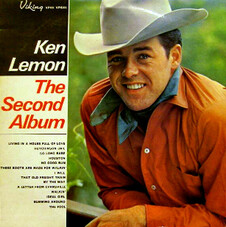
The Second Album – Ken Lemon (Viking, 1966)
Ken Lemon’s The Second Album opens with ‘Living In A House Full Of Love’, a faithful reproduction of a Buddy Knox B-side, itself a rowdy cover of David Houston’s original Nashville recording. Producer Ron Dalton was so enamoured of the fuzzed-out electric guitar of the Knox version he had guitarist Kevin Watson dirty his sound and not stop for anything, even Garth Young’s barely audible piano
By this time Dalton had hit upon a formula for Ken’s rich baritone that made the LP a more focused affair than the previous year’s This Hombre Called Lemon. Seven of the 14 tracks are written by the gravel-throated American singer/songwriter/producer Lee Hazlewood, including recent US singles by Dean Martin and Nancy Sinatra. Five appeared on Hazlewood’s 1965 album Friday’s Child.
Three of the inclusions are by New Zealand writers from Viking’s publishing arm Seven Seas (aka Sevenseas). Credited to producer Dalton and pianist Young, ‘Walkin’’ is an unabashed pastiche to Hazlewood, with a near carbon copy of Watson’s distorted guitar from the opener. Lines such as “These boots I’ve got all shined up to walk right out on you” leave the listener in no doubt as to where the inspiration lay.
My Kind Of Pickin’ – Peter Posa (Viking, 1966)

Peter Posa - My Kind of Pickin', Viking 1966.
Peter Posa’s 11th LP for Viking in just three years, My Kind Of Pickin’ is his first full foray into country music and is almost certainly the earliest New Zealand record to feature that most country of instruments, the pedal-steel guitar. Lap steels and console steels had been used on recordings up to that point, but Invercargill’s Les Thomas was the first to bring the pedal steel into a New Zealand studio.
Recorded over a weekend, the LP affords Posa the chance to exercise the Chet Atkins and Les Paul chops he had been honing since growing up listening to country music in West Auckland. Thomas’s band, The Tunesmen, are on fire after six weeks on the road, and Posa rises to the challenge. They really let loose on Santo & Johnny’s ‘Stage To Cimarron’ which features the first of broadcaster Jim Healey’s several mid-track yahoos that litter the record.
On tracks such as ‘The Race Is On’, ‘White Silver Sands’ and ‘Fireball Mail’, Posa proves he’s the equal of Atkins and Paul and is just as adept with the low twang of Duane Eddy, the clean licks of Hank Garland, and the Bakersfield sound of Don Rich.
Western Take-Off – Maria Dallas (Viking, 1967)
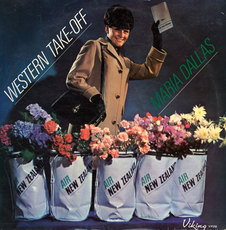
Western Takeoff was Maria Dallas' third album, released early in 1967. The sleeve was by Wellington's Hubert Sieben, who created many sleeves for Viking in the 1960s.
Just in case there was any confusion over who was subsidising, or maybe even paying in full, for Maria Dallas’s impending trip to the United States, Air New Zealand is featured on no less than nine occasions on the cover of Western Take-Off – six in Hubert Sieben’s front photograph and thrice more in the liner notes on the reverse.
Dallas’s third album in six months, Western Take-Off is one of the first New Zealand country records to credit the session musicians individually, namely Garth Young (piano and musical director), Dave Fraser (drums), Kevin Watson (guitar) and Slim Dorward (bass).
Viking’s Seven Seas songwriters contribute four of the 12 tracks. As with ‘Walkin’’ on Ken Lemon’s above LP, label co-owners Dalton and Murdoch Riley combine to provide ‘You Never’, a nonsensical homage to the novelty hits of Roger Miller, whose ‘You Can’t Roller Skate In A Buffalo Herd’ appears earlier. “You never scoot a scooter without your hooter,” indeed.
The Nashville Trend Volume One – Various Artists (Allied International, 1967)
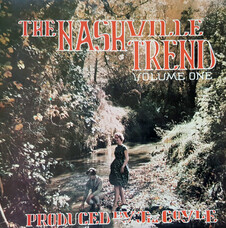
Various Artists - The Nashville Trend Volume One (Allied International, 1967)
A labour of love for Whanganui guitarist and electronics buff Jim Coyle, The Nashville Trend Volume One brings together Manawatu-Whanganui artists who, according to Coyle’s blurb, “despite their obvious talents, have found it difficult to break into the tight little ‘clique’ which constitutes the New Zealand pop industry”.
Several of the tracks are written by the performers, including Tommy Bates’s ‘Rocketship Romance’ with its sped-up “Martian” chatter. Formerly of The Overlanders, Tommy and brother Harold contribute ‘Wanganui [sic] River’ as a duet. Other artists include Coyle, Alan Sutherland, the Stewart Sisters, Ginny Peters, and 14-year-old Colleen Costello.
Peters had already had cuts on Maria Dallas and Rex Franklin albums and four singles of her own on Allied International. Unusually, she takes the male perspective of a suitor in ‘Must They Judge Me’, her song about parents refusing to allow a mixed marriage for their daughter. By the last verse, sweet Jeanie’s parents “keep her locked up in her room” where “there’s bars on her window” but, oddly, Coyle fades the track before you find out what happens.
Action Western – Des Knight and The Dusty Drovers (Viking, 1967)
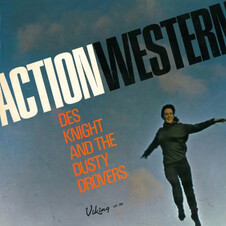
Des Knight and The Dusty Drovers - Action Western (Viking, 1967)
According to Country & Western Spotlight, Action Western is “one of the first local Viking releases in stereo”. But the listener wouldn’t be wise to that, as the unnamed producer seems content to mix everything bang in the centre with zero panning. Christchurch steel guitarist Jim Lange sits in with Des Knight and The Dusty Drovers for this, their only LP.
Apparently naming the band in honour of his love of Slim Dusty music, Knight covers Dusty’s ‘The Saddle Is His Home’ and ‘When The Rain Tumbles Down In July’, as well as Les Wilson’s ‘Rolling Wagons’. His own songs are in a similar vein. Curiously, the band turn country standard ‘Green, Green Grass Of Home’, a New Zealand hit for Tom Jones earlier in the year, into a honky-tonk shuffle complete with walking string-bass from Ivan Wilson.
Knight brings the mood right down with the Jim Reeves cover ‘Old Tige’, a recitation about a soldier returning home after three years away. He’s met at the bus by his faithful dog Tige; the night is dark and foggy and Tige leads him home safely around the newly built dam that perilously lies where the road used to be. When the soldier gets home, his mother informs him Tige has been dead for nearly as long as he’s been gone!
Country Sounds – Val Elliott & The Rhythm Ramblers (HMV, 1968)
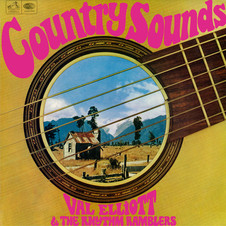
Val Elliott & The Rhythm Ramblers' 1968 album Country Sounds
Rangiora-born Val Elliott had no time for cowboy hats and yodelling when she submitted a demo tape to HMV and was invited to Wellington to record an album. Elliott and her Rhythm Ramblers were all about the Nashville sound of Porter Wagoner, Loretta Lynn, Connie Smith, George Jones and co.
The band is augmented by session stalwart Garth Young and Soundells drummer Leo George as they make their way through recent Nashville fare such as ‘Almost Persuaded’, ‘My Shoes Keep Walking Back To You’ and ‘Back In My Baby’s Arms Again’. Elliott’s one original is ‘Wait For Me’, the story of a bride-to-be returning home on the midnight train from Tennessee only to find her fiancé has passed away.
In the weeks before the LP’s release, producer Howard Gable wrote to the band. “I have edited the disc into its final order, and it really sounds quite magnificent,” he said. “It is, I think, the best country sound to have come out of New Zealand ever.” Evidently, Gable thought he could do better and so he threw everything, including the kitchen sink, into his next country production …
Can’t Keep You Out Of My Heart – Brendan Dugan (HMV, 1968)
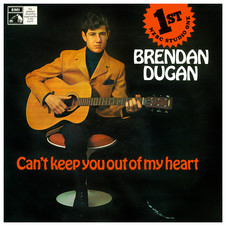
Brendan Dugan's debut album, Can't Keep You Out Of My Heart (HMV, 1968)
An overnight sensation after winning the New Faces competition on television show Studio One in 1968, Brendan Dugan was just 16 when HMV promptly poached him from South Island label Master. They then went full-on countrypolitan with lush string arrangements and the NZBC Symphony Orchestra in an attempt to cross into the pop market with his label debut Can’t Keep You Out Of My Heart.
Produced by Howard Gable and Don Richardson, the record contains Merle Haggard’s Bakersfield Sound classic ‘Swingin’ Doors’ but there’s no hint of a Fender Telecaster or pedal-steel guitar. Like the rest of the LP, the song is struggling to rise above the dense orchestration. By the time a steel guitar does show up, on the final track ‘Right Now’, it’s more Hawaii than Music City, USA.
His voice hasn’t yet developed into the weapon it becomes in the 1980s, but a teenaged Dugan does his best with material that runs the gamut from Haggard, Buck Owens and Leroy Van Dyke to Tom Jones, and his New Faces-winning song ‘There Goes My Everything’.
--
AudioCulture’s Country Music Collection