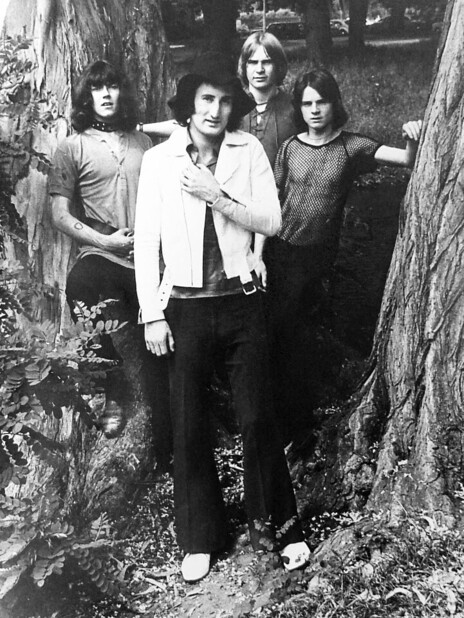
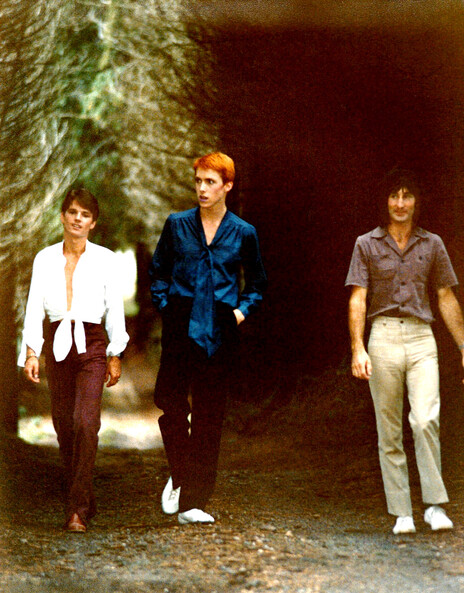
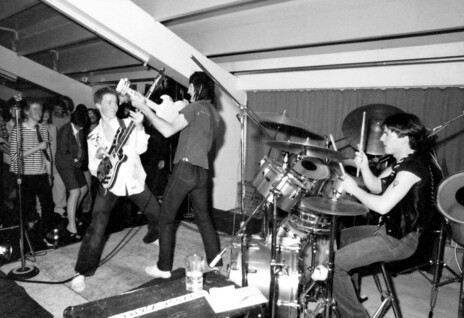
In late 1972 the three troubadours packed up their instruments and aspirations and headed north to Christchurch. Being dedicated followers of (musical) fashion, it was not lost on them that – with the 1960s now in the rear-view mirror – something revolutionary was in the wind.
That something was glam rock. Glorious, sparkling, irreverent, androgynous, outrageous glam rock. 1972 was the year of Ziggy Stardust, and David Bowie’s promise to lads like Jeff, Ronnie, and Bill was that they could make a transformation into rock’n’roll stars. So inviting! So exciting! And they could sure do with the money.
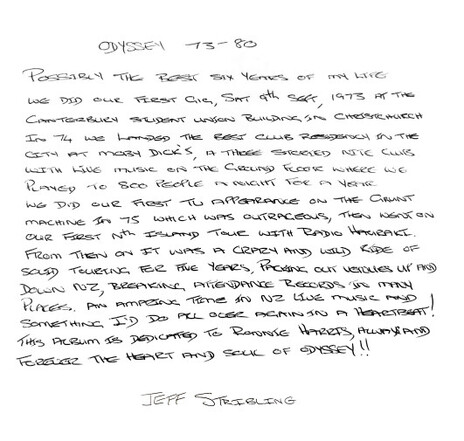
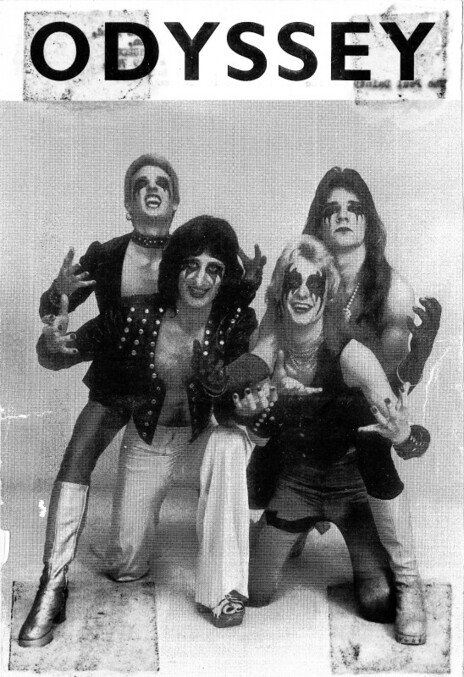
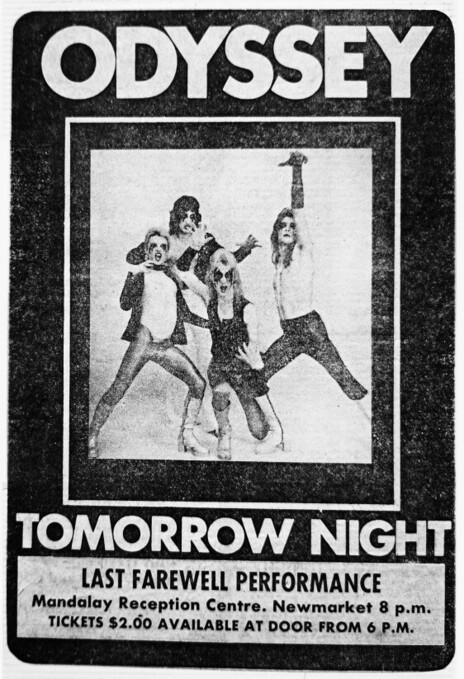
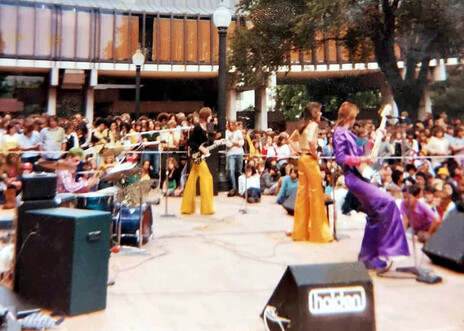
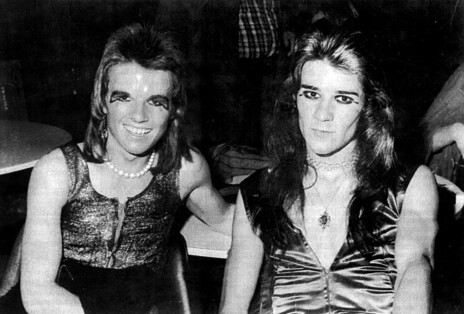
In addition to Bowie, the lads thrilled to other prime glam exponents such as T. Rex, Slade, Lou Reed, Sweet, Alice Cooper, Gary Glitter, and beyond. Shedding the denim and the dense serious textures of stoner rock, they enthusiastically reformed as Odyssey; a rejuvenated, no-holds-barred glam rock act. Adding a fourth member in Terry Gallavin on keys, their debut came on 9 September 1973. During that first gig in the Student Union at Canterbury University, Odyssey instantly knew they were onto something.
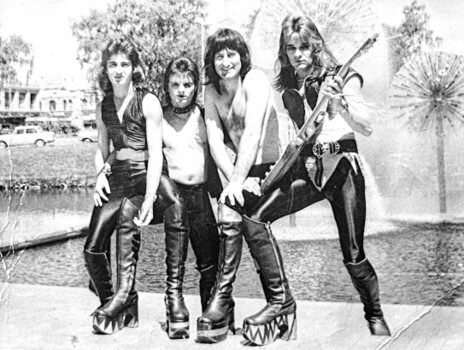
At the unbridled urging of Harris and Stribling, Odyssey became increasingly glam
Stribling: “It was a packed-out house and we appeared in glam outfits and did all of the glam hits. It went down phenomenally well and I distinctly remember sitting down with the guys after the show and all of us were thinking the same thing; ‘Hey! We’re really onto something here!’”
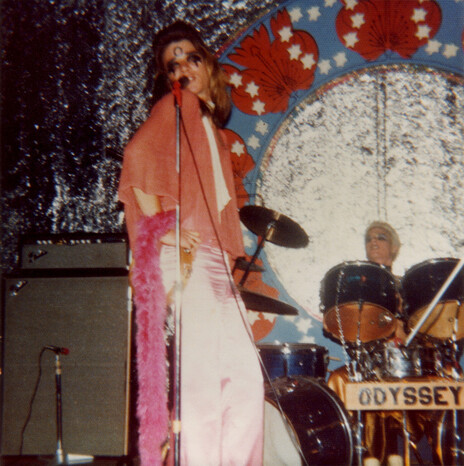
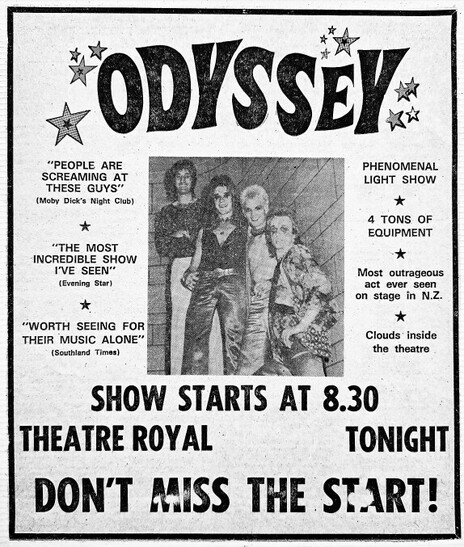
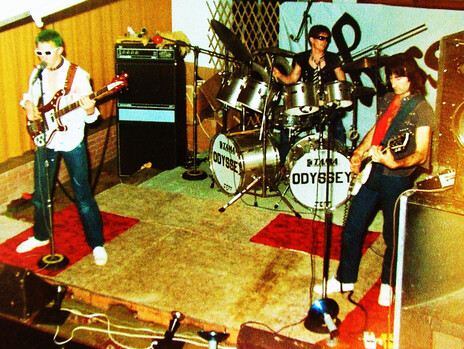
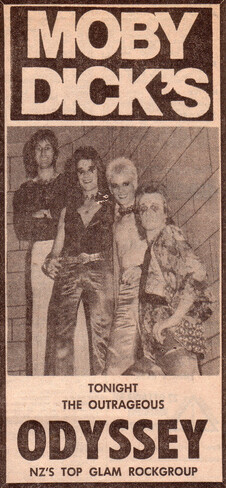
Word spread fast and in early 1974 the band scored a six-month residency at Moby Dick’s nightclub in Manchester Street. At the unbridled urging of Harris and Stribling, the band became increasingly glam and their sets became a choreographed show rather than simply another band content with standing onstage and playing the hits. Due to this increased theatricality however, an internal split developed, ultimately leading to an amicable parting of ways. Kearns and Gallavin – not so keen on the glam trappings – opted to leave the band. Thus, the Odyssey door creaked open …
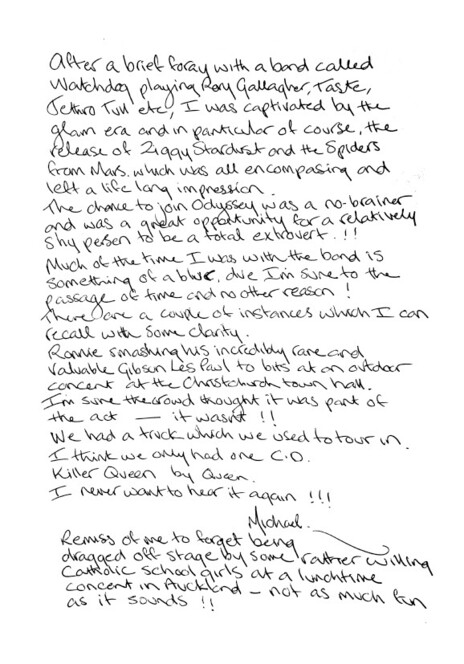
Enter singer Michael Scheele, ex Invercargill’s Watchdog, a band with whom Harris and Stribling had once played on a shared bill in Dunedin. Having also moved to Christchurch, but sans-band, Scheele had begun showing up at Moby Dick’s in full glam attire. Unmissable, flamboyant, enthusiastic and good-looking, he was perfect for Odyssey’s embrace of glam rock. Stribling and Harris invited him into the fold without hesitation.
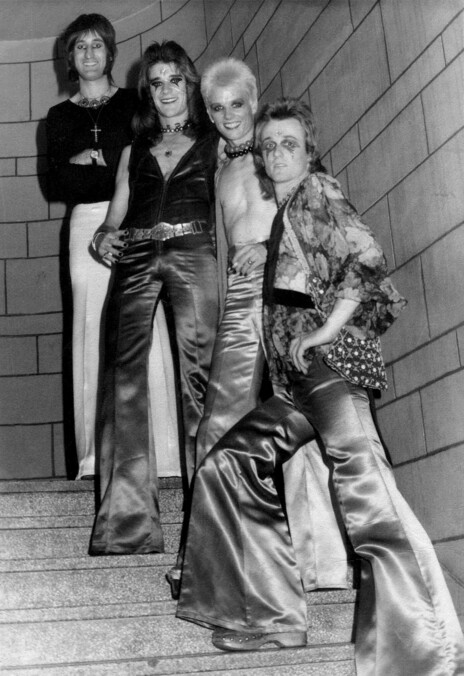
Auditioning bass players came next, and Rob Gray, then playing with Flood, stood out on both professional and personal levels. And voila! The quintessential Odyssey four-piece lineup of Harris, Stribling, Scheele, and Gray was born. Little did they know they were about to come to the attention of the nation.
Stribling: “From that point on it was full-steam ahead as a glam rock band. We choreographed costume changes, we had platform boots custom-made, we had flashpots and smoke machines … it was a complete show. Mike even went out and bought three or four rats and he’d have them crawling around on him on stage.” (Author note #1: An impressive first for New Zealand rock’n’roll.)
Unlike other Kiwi bands of the era who self-consciously adopted touches of glam iconography but avoided describing themselves as such, Odyssey proudly positioned themselves at its heart. Opined rat-handler Scheele, “We were a glam rock band – totally committed. It was a show. We used to sit down and choreograph it.”
One night at Moby Dick’s, where they were by now attracting audiences of up to 800 punters a night, local entrepreneur Gerald Henry approached them with an offer of management. Duly accepted, Henry’s goal was to launch Odyssey beyond Christchurch and out into wider New Zealand. Also, by this time, buoyed by their rapidly growing popularity, the band had developed a brace of original glam-styled songs such as ‘Rock and Roll’s Alright’, ‘Suzy Rock’ and ‘New York City’, mainly written by guitarist Harris, that sat easily within their wider repertoire.
Bonded by glitter and blood, Henry and Stribling gatecrashed TVNZ’s Avalon Studios
Soon after sealing their management pact with glitter and blood, Henry and Stribling boarded a plane to Wellington and gatecrashed TVNZ’s Avalon Studios. They were in search of Peter Blake, an all-powerful coordinator of music shows including the one to which all Kiwi rockers of the day aspired, The Grunt Machine. Told by the receptionist that they could not see Blake without an appointment, Odyssey’s new manager promptly responded that they would camp at reception until Blake deigned to meet with them.
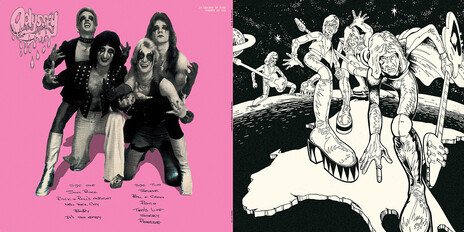
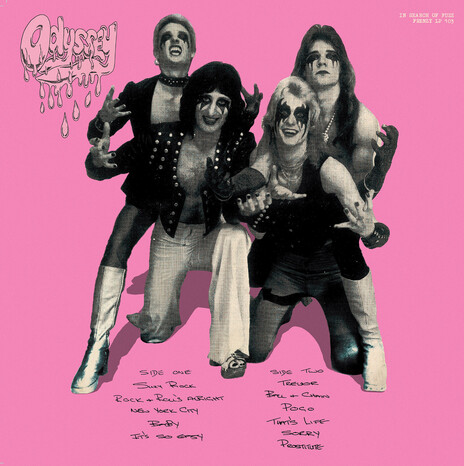
It worked. Within 10 minutes they were shaking hands and heading up to Blake’s office. Prior to the trip north the switched-on Henry had organised an elaborate photo-shoot with the band in full glam regalia and when he brandished this album, which also included a selection of live shots, Blake was impressed. Nevertheless, his response was conservative. “Let me have a think about it,” he said. At this, Henry jumped up onto the startled Blake’s desk and, legs astride and forefinger extended, loudly demanded, “YOU NEED TO PUT THIS BAND ON TELEVISION!!” His hair blown back, upon recovering the ability to speak, Blake sensibly replied, “Okay, we’ll put them on television.”
The two-man promotion roadshow then continued on to Auckland. There, Henry repeated his spiel at Radio Hauraki hoping to get Odyssey on the bill of the hugely popular Buck-a-head concerts held in Auckland and throughout the country each summer. Hauraki was interested but non-committal.
Odyssey’s debut on The Grunt Machine came mere weeks later. Flown up to Wellington, the band was filmed performing two Lou Reed songs, ‘Vicious’ and ‘White Light/White Heat’ to a choreographed stage act. The performance included Scheele brandishing a crowbar at the TV audience and discarding a glittering cape to reveal nothing underneath but a very brief lurex G-string. At a designated moment Gray stage-bit him on the neck and spat the contents of his hidden blood capsule across the lens of TVNZ’s camera. (Author’s note #2: Another first in NZ rock’n’roll history.)
Despite the rats, sadly, not making the flight, it was clear that Blake’s gamble had paid off. Odyssey had proven themselves impossible to ignore. The bouquets were many and so were the brickbats. The Letters to the Editor mailbags of the nation’s newspapers bulged at the seams with complaints. Radio Hauraki phoned the very next day and booked the band on the spot.
On Television’s ‘Ready to Roll’, Odyssey’s antics induced even more tut-tuts
Further performances on The Grunt Machine followed and Odyssey also found themselves on TVNZ’s prime-time music flagship Ready to Roll. Here – to a far broader audience demographic – their antics induced even more tut-tuts. Letters to the editor flourished once again. Tellingly, these performances found Odyssey performing some of their original material.
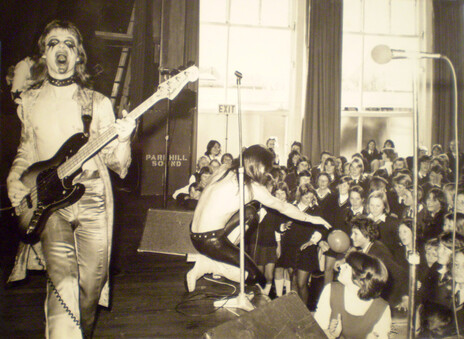
Radio Hauraki organised a tour of lunchtime concerts in high schools which saw the band being met with what can only be called Odyssey-mania. Having seen them on TV and noting with approval the generational outrage of their parents, the kids went nuts. Security guards were a necessity for the safety of both band and fans alike. Girls fainted with regularity at the antics of bare-chested frontman Scheele, while teachers lurked at the back of the halls clucking with disapproval and wondering how they’d ever get their adolescent charges calmed for afternoon classes.
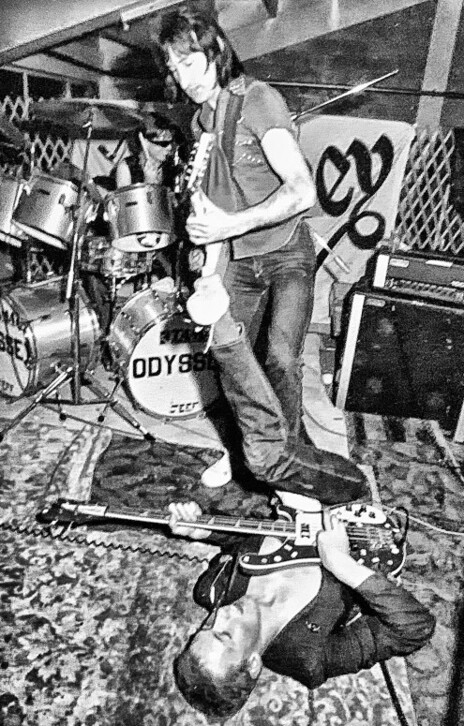
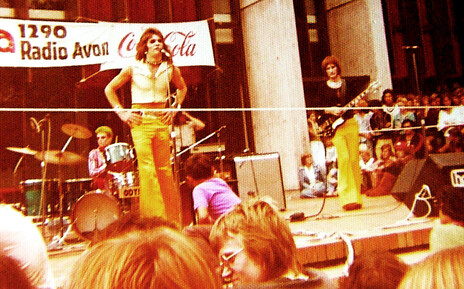
For the next several years Odyssey existed inside a maelstrom, touring the country endlessly in their own truck, supporting Lou Reed on his New Zealand tour, and continually putting bar furniture at risk. On the live scene they sat within the top echelon of Kiwi rock bands alongside the likes of Space Waltz, Dragon and Ragnarok. Their proven televisual impact found them appearing on several other programmes during the mid-1970s including Norman and Popco (both hosted by Paul Holmes), The South Tonight, TVNZ’s national news, and even a TV special of the band performing a sold-out show in Christchurch’s James Hay Theatre. Unfortunately, in a long-regretted effort to save money, these recordings – and the Ready to Roll and Grunt Machine performances – were wiped by TVNZ so that the tapes could be re-used.
Fittingly Bowie-esque, the glam part of the Odyssey story has a rise-and-fall trajectory. After their mid-1970s heyday things began to decline from late 1976. Two factors were mainly to blame. First, while embraced by their audiences, Odyssey was nevertheless somewhat reviled by a significant number of their fellow musicians. These nay-sayers would waste no time in trotting out the same accusations levelled at glam bands the world over, namely, that the band was succeeding only because of their image and calculated outrage rather than their musical talent.
the glam part of the Odyssey story has a rise-and-fall trajectory
Stribling: “The trouble with being a glam band … you just got written off as being no good as a band. That was a lot of the problem. You still had the overhang from the early-mid 70s where there were these muso bands, you know your Yeses. All those bands that were considered to be the muso bands … I mean, glam came out and all those guys just attacked you and said, ‘You’re not musicians – you’re just dressing up.’ It was all really exciting, but yeah the worst part of it all was the shit we took from the other bands.”
Being so poorly rated by their peers bothered Gray and Scheele particularly and they began advocating for trimming back the band’s theatricality. This view was diametrically opposed to that of Stribling and Harris. Something had to give and soon Gray and Scheele, their hearts no longer in it, announced their intention to leave.
In addition, pop culture had moved on. Glam was out and punk and new wave were the pre-eminent, in-vogue, musical styles of the day. If Odyssey was to survive it was clear the band would have to change. Although effectively two members down, Odyssey still had months of gigs booked around the country. There ensued a somewhat messy phase during which Scheele and Gray slowly exited and other musicians joined on a short-term basis to fulfill existing commitments. A new bassist, Marc Beecroft, was found, and then replaced by Dennis O’Connell. Jimmy Taylor joined for a time on guitar and Rob Gray took over vocals briefly for the now absent Scheele, prior to his own final exit.
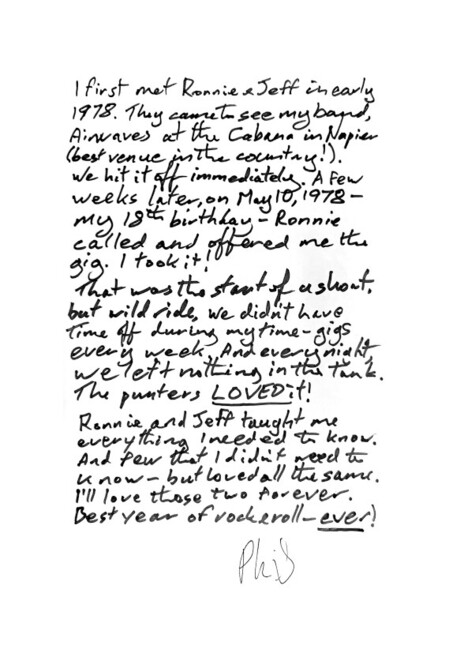
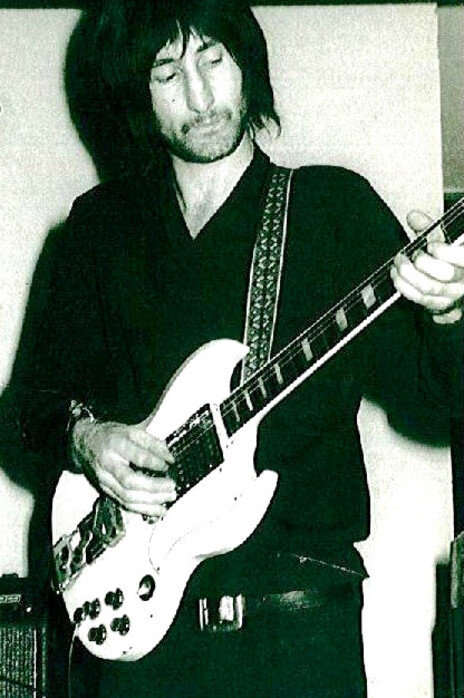
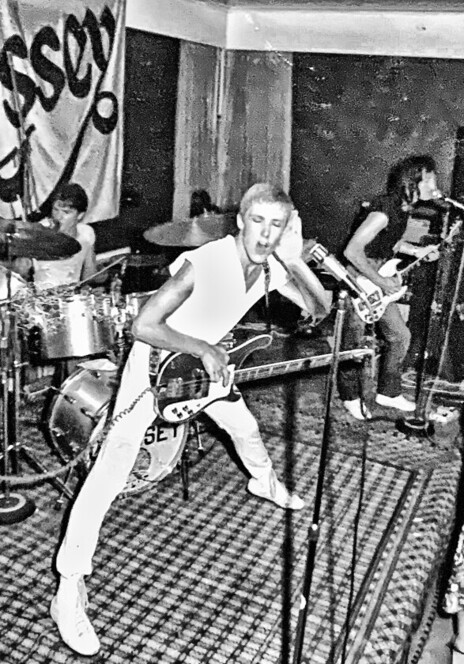
This transitional phase ended when Phil Hall was recruited. Spotted by Stribling and Harris while performing at the Cabana in Napier, Hall was a singing bassist and a fine frontman who loved putting on a show. Odyssey had started out as a three-piece and had now come full circle. Hall joined the band on his 18th birthday and so began a new phase. Gone was the glam; gone was the makeup; hair became short and spiky. A largely new repertoire was assembled that better reflected the era. Lou Reed survived along with Bowie and the Odyssey originals, but these were now joined by songs from the likes of the Stranglers and the Tom Robinson Band.
After shakedown gigs in Nelson and Motueka, the new, stripped-down Odyssey came to the attention of agent Jan Rowlinson, who began booking the band at North Island venues. Reaction from punters and management was extremely positive and, after briefly paying their dues in the early week spots, the band found themselves occupying the sought-after Friday and Saturday nights at Auckland’s rock’n’roll holy grail, The Windsor Castle. The band’s high energy package proved a winner there and they took pride in surpassing Hello Sailor’s attendance record. When subsequently booked at Hamilton’s Hillcrest Tavern they did likewise, eclipsing Mi-Sex; they then repeated the feat at Palmerston North’s Albert Tavern. Everyone, it seemed, remembered Odyssey from The Grunt Machine and Ready to Roll. Their new wave reinvention was a success.
Gone was the glam; gone was the makeup; hair became short and spiky
The rebirth lasted until Hall moved to Australia in 1980. In the months leading up to his exit, his friend Rob Wilson (Flight X7), joined them on tour, literally learning the repertoire on the road. This line-up endured for six months until founding member Stribling came to the realisation that, having been touring since 1975, he’d had enough. Fellow founder, Harris, however, was not keen to finish and, with tours still booked, he opted to continue. Drummer Alan Johnson replaced Stribling but it was to be a short-term continuation as, within months, Harris too decided to finish. By the end of 1981 Odyssey was no more. It had been a wild ride.
A brief reformation occurred in 1985 when five ex-band-members – Gallavin, Stribling, Kearns, Scheele, and Harris – took up an offered residency at Christchurch’s Bush Inn Tavern. While described as fun, when it ended a year later Odyssey disbanded once more and nothing more was heard of them for another 22 years.
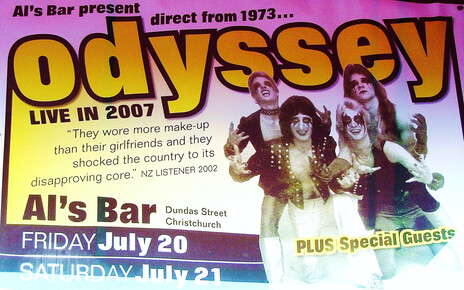
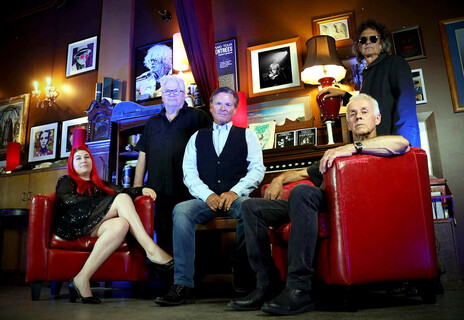
In 2007 Harris reformed the band for a two-night reunion at Al’s Bar. Ex-members were keen, albeit not without trepidation, and the band delightedly found themselves performing to a packed-out club. This kick-started Odyssey’s modern era. New and ex members have drifted in and out since and, while the band doesn’t perform often – averaging perhaps three gigs per year – Odyssey is most certainly back. The current line-up consists of Stribling, Kearns, Gallavin, Taylor and singer Layna Hunt. No longer a glam band, they nevertheless still feature David Bowie’s music – a salute to their own heyday – and their originals. A long-established local fanbase ensures that their performances regularly sell out.
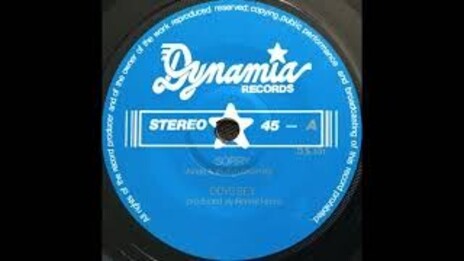
Odyssey’s live and televisual success during the 1970s was never matched in the recording studio. Although the band released a couple of singles on their own Dynamia label, including their signature tune, ‘Rock & Roll’s Alright’, they effectively left no recorded legacy. Until recently, that is. Due to the efforts of two champions of New Zealand music, Grant Gillanders and John Baker, in conjunction with founding member and lifelong Odyssey champion, Ronnie Harris, in 2024 a long-overdue compilation album aptly titled Rock & Roll’s Alright was released on Gillanders’ history-preserving Frenzy label.
Sadly, Ronnie Harris passed away in July 2023 just eight months before the album’s release. Rock & Roll’s Alright quickly sold out.