Paddy Burgin made his first guitar in an unpowered workshop on the family farm. He was in his early teens and completing a set of requirements for a Duke of Edinburgh Award. “You had to go into the mountains and do some camping and stuff like that, which I’d already done. You had to do some good work. I can’t remember what my good work was, maybe go to an old people’s home or something. The other thing was you had to make something, and so I opted to make a guitar and play some tunes. I’ve still got it. I think I can find it.”
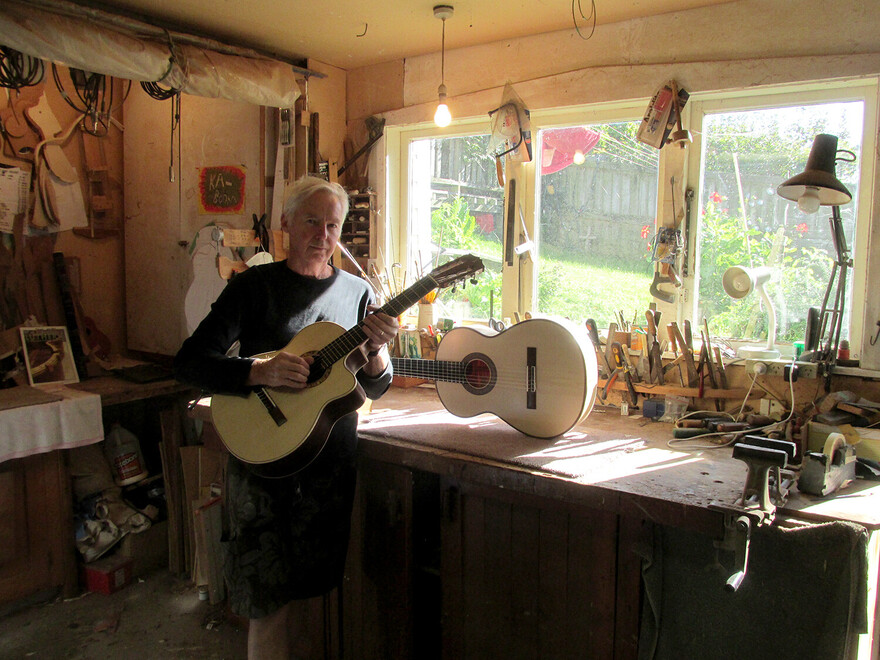
Paddy Burgin in his workshop
Paddy gets up from the dining room table where we’ve been chatting about his intertwined careers as a musician and luthier, and disappears down the corridor to rummage in a cupboard. He returns, plucking a lute-shaped instrument with a plywood body and an oak fretboard that looks well preserved for its almost sixty years of age. It still gets played occasionally. “Ryan Prebble borrowed it to use on some recordings. He likes it for its nice bluesy sound.”
Making things comes naturally to Paddy. His father was a do-it-yourselfer who had built his own steel guitar in the 1940s, at the height of the Hawaiian music craze. On the farm, father and son had worked together to make furniture, that first guitar, and even a Leslie speaker cabinet (see main profile piece.)
But Paddy wouldn’t get serious about making musical instruments until the mid-1990s. He had been building his own furniture in Wellington for a few years and was looking for a new direction. “I was making chairs, but I wanted to make boats as well. I made a couple of clinker dinghies and I thought that might be a future, but realised there’s quite a lot involved, and also there’s a safety aspect. You know, if you’re going to sell a boat to somebody, you don’t want the thing falling apart out there!”
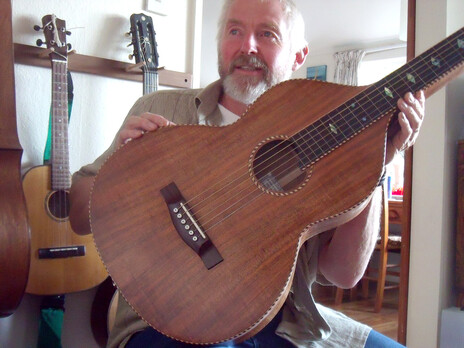
Paddy Burgin holding one of his Weissenborn guitars
A visit to the workshop of local luthier Ray Mercer reminded him of his early guitar-making effort. “He was making one of his guitars, and I was entranced by this, and I looked at him, I said, ‘Ray, how do you get to do this?’ and he just sighed. I thought, oh, well, he’s not going to tell me much, but I looked at this guitar and thought that this is really what I want to do.”
Around that time he stumbled on a magazine called Acoustic Guitar and realised that “the American culture of guitars is right here in this magazine. I bought a few more issues, and it’s like people are really celebrating the acoustic guitar, and it’s a really, really big deal.”
In the back of the magazine were advertisements for guitar making schools in North America. In early 1996 he signed up to a course at David Freeman’s Timeless Instruments School in Saskatchewan “which sounded quite cool”. It was certainly that: 25 degrees below zero on the prairies, which were flat as a pancake except for the occasional grain silo. “There’s a bunch of us from all over, one Aussie and some Americans, and we spent two months in the snow, making guitars in this workshop.”
He shows me his Saskatchewan guitar, a flat top instrument with a rosewood back and sides and intricate inlays depicting a bison and an ear of wheat. His tutor thought it was crass, but there were buffalo nearby and wheat fields for miles, and to the New Zealander it was symbolic of his Canadian experience.
Back in Wellington, Paddy began using his new instrument on gigs, mostly with Irish bands. “I thought, this is going to be easy. All I have to do is stand up here on stage with my guitar, singing in the band, and they’re going to be flocking to me, saying, “Where’d you get that guitar? I want one!”
“But no one ever said anything about the guitar. The guitar culture in New Zealand was way different to America and Canada. What I learned over there was they are obsessed with guitars. Families grow up where everyone’s got a guitar. You’d go to a household in Canada, and Mum, Dad, and the kids come over, and they’re all got their own guitars and fiddles and everything. Maybe it was just a rural thing, I don’t know, but we didn’t have the same guitar obsession that I thought I’d find back here.”
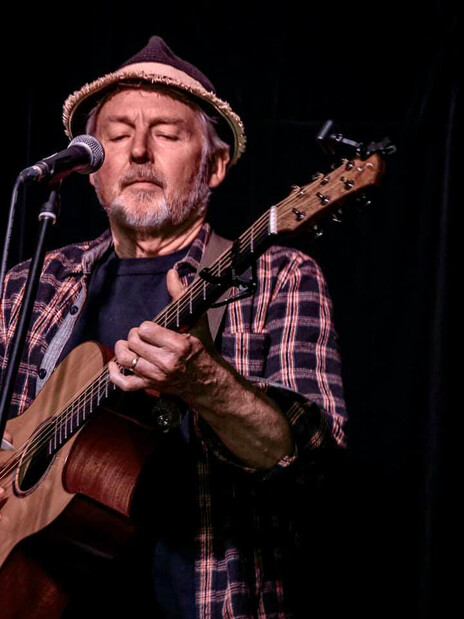
Paddy Burgin
He made up some leaflets advertising his wares and would discreetly drop them into other musicians’ guitar cases. Less discreetly, he would wait side-stage at other musicians’ gigs and ambush them with his card. But it wasn’t until his wife Madeline made a simple website that he began to get any real interest. It was the early days of search engines, and within a month of launching the site he had his first order from the United States.
For a while flat top mandolins were his specialty, a demand stimulated by the craze for Irish music. “I’d go to fairs and folk festivals, and I’d have a pagoda. I’d have mandolins and guitars, the car jammed with stuff, driving all the way to the Auckland Folk Festival. I managed to sell stuff like that.”
But what he really wanted to make was a Weissenborn – an acoustic guitar with a hollow neck, played flat with a metal slide. “I was trying to persuade someone, like [local slide guitar player] Alan Young. I’d hector Alan – ‘You need a Weissenborn!’
Arguably the greatest Weissenborn exponent was David Lindley, the Californian session musician whose delicate and expressive playing can be found on records by the likes of Jackson Browne, Linda Ronstadt and Ry Cooder.
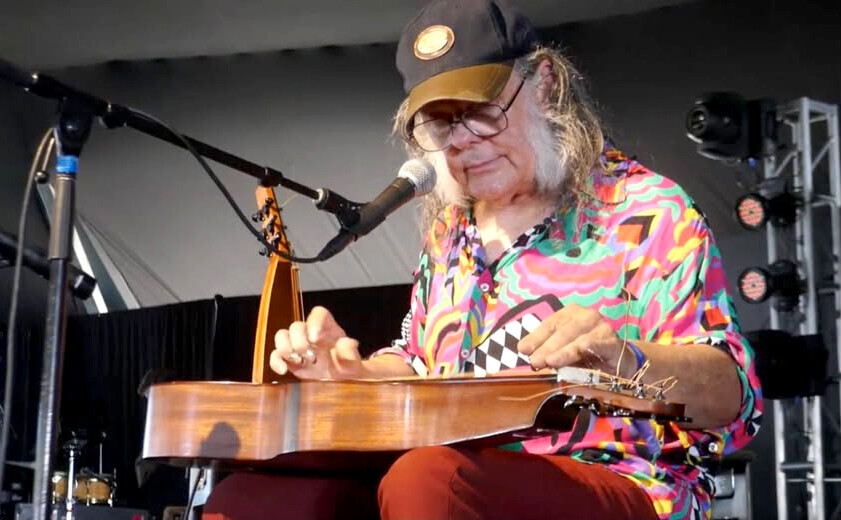
David Lindley playing a Burgin guitar
In the end he made one on spec. “And then I made more Weissenborns, and went to a guitar fair in Santa Rosa, in Northern California. I took three Weissenborns and an octave mandolin. You’re in this large hall flat top spruce-topped guitars everywhere, and my guitars looked completely different. A guy comes up and says, ‘You need to meet David Lindley.’ I said, ‘That’s why I’m here’.
The instructions that followed sounded like something out of a John le Carre novel. “He said, ‘Meet me in Mill Valley tomorrow night, seven o’clock outside the town clock.’ And then he disappeared.”
Paddy knew that Lindley was scheduled to perform in Mill Valley that evening so he went along, Weissenborn in hand, to meet his secret agent. They watched Lindley play a blinding solo show, after which fans swarmed the guitarist to have their albums autographed. By the time the crowds had cleared Lindley looked exhausted, but he came to life when Paddy produced the guitar.
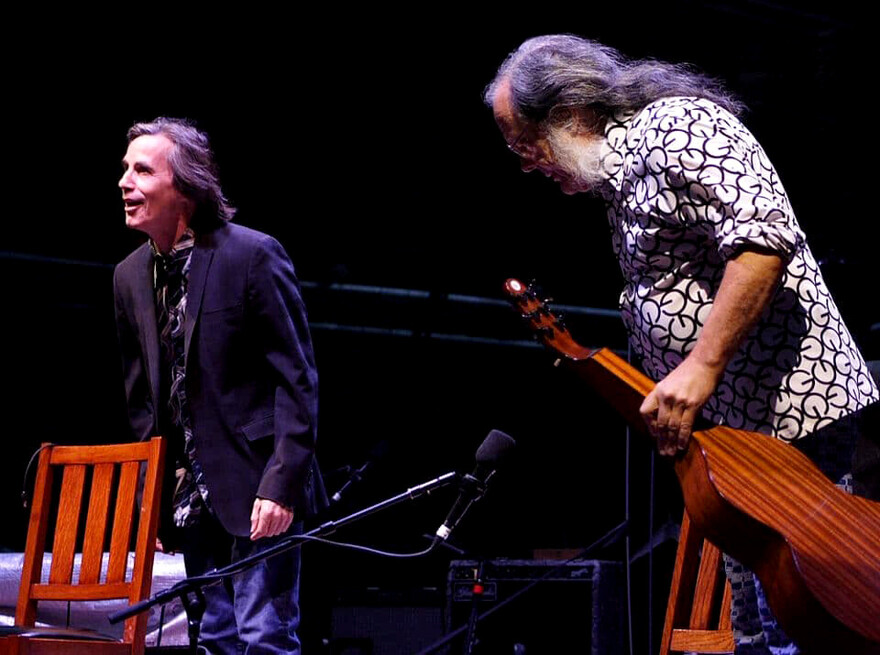
Jackson Browne and David Lindley holding a Burgin guitar
“This is naivety, but I put my finger picks on, I got my steel, I said, ‘Let me play it for you, David.’ So I just started playing it for him, and I played a tune, and he’s just sitting there, and then he picked it up and he played it, and then I played a bit more, and then he played it.
“By this time the bar was empty except for staff and roadies, everyone was standing around wanting to go home. So then he gives it back to me, says ‘That’s a great instrument’ and we went our separate ways, and I thought, ‘Oh, what happened?’”
Unsure of what to do next, Paddy left the Weissenborn with his mysterious middleman and returned to New Zealand, but sent Lindley an email. “I said, ‘If you want that guitar, it’s right there’, and he writes back straight away. He says, ‘I kicked myself as I walked out of the bar. I had just heard this fabulous instrument and I didn’t do anything about it.’ And he said, ‘I pay for my instruments, I don’t expect anything for free.’ And so he paid me for that guitar.
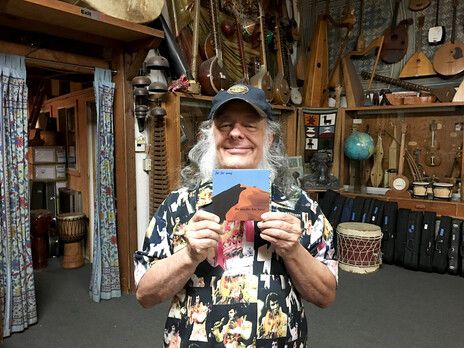
David Lindley holding a Wooden Box Band CD at the famous Claremont Music Centre
“A week later, he calls up, says, ‘Could you make me another one exactly the same?’ And I happened to have exactly the same sets of wood, and so I did that. And then, over the years, we corresponded regularly about various things, and he became a great promoter of Bergen guitars.”
Lindley’s enthusiasm opened doors to further sales, especially in the United States, not just for Bergen Weissenborns but also harps, mandolins, octave mandolins and resonator guitars. (David Lindley died in 2023.)
Surprisingly, Paddy had started building Weissenborns without an actual Weissenborn as a model. “But I was aware that the original Weissenborns had not been very well built. They were quite shallow, and I didn’t actually like that. I thought this sound was a bit tinny, and so I took what I’d learned at Dave [Freeman]’s course in making a six string guitar, took that style of bracing, and put that into a Weissenborn. The original Weissenborns had ladder bracing, really old school ladder bracing, and they would often collapse after about 10 or 15 years because they didn’t have the X bracing that you need to hold them together. So I think I’ve given it more power than the original Weissenborn used to have, and I’ve made them deeper, and that’s really become my kind of calling card. Deeper and louder.”
I wondered whether he saw other guitar makers adopting his innovations? “I think we’re probably all copying each other to a certain extent. I have seen stuff that looks a lot like mine, but this is the thing: American guitar makers are very, very generous in their information. There are magazines full of guitar makers giving away their secrets, sharing everything that they do, how they’re doing that, how they’re doing this. Nothing is kind of like secret. They will even give you plans, you know. It’s collegial.
“And it’s also like musicians, you know, when you go, “How did you play that bit? Can you show me how you played that bit?” It relies on that generosity, to keep the information flowing around, and hopefully spiralling up and going out.”
Paddy estimates that he has now made more than 400 instruments, which have found homes all over the world. How long does it take him to build each guitar?
“That’s a big question. If someone orders something, I allow about a month or so, if it’s a regular styled instrument. If it’s something funny – you know, they want an extra cutaway or something – then it could be longer.
“You don’t actually sit down, start making the instrument, finish it. It’s like, this week I’m making parts for all these other instruments, so I’m just setting up all my gear, and I’m making all the bracing, and then next week it might be I’m bending sides for five instruments. Then I’m carving, and then everything is set aside, you see, so it’s hard to say. It just makes sense to do it that way, rather than to go through all those processes for one instrument, then go back to the beginning, reset your router and all this stuff. You’re better to set it all up and just spend a day carving bracing or something like that.
“But luthiers have certain things in common, and there’s some parts that they really love, it seems.”
Paddy picks up one of his instruments to show me.
“One part the luthiers really like is when you stick on this purling and binding here, and it’s all gluey and messy and there’s tape and rope and stuff, and then you take everything off and you start scraping the glue away to reveal that line, and as long as that line’s good, that’s a really nice feeling. And the same with the rosette, there’s glue and muck everywhere when you put this in, and then you scrape it off and you’ve got that.
“And everybody loves carving braces. It’s the part that nobody ever sees, but the braces are made of spruce, and they’re inside, and so they’re put on in a sort of rectangular form. And after that, you lay the top down upside down on your workbench. But you carve the braces, and that’s kind of the mythical part. It’s really nice when your chisel’s really sharp, and you’ve got a bit of sun coming through the window, and you think, well, yeah, there isn’t anything better than this.”
--
Listen: Master Luthier Paddy Burgin discusses guitars on RNZ