Arthur Baysting began writing this article in 2016, as a snapshot of a children’s music scene that had been quietly growing across Aotearoa for years. He didn’t get to finish it. Two months before he passed away at the end of 2019, he sent through his draft and research and asked me to promise that I would complete it. It has taken longer than I expected. But nearly a decade on from when he began it, this feels like the right time to return to his words, and to honour that promise. Where needed, I’ve added small updates to reflect what has happened since. – Chris Lam Sam
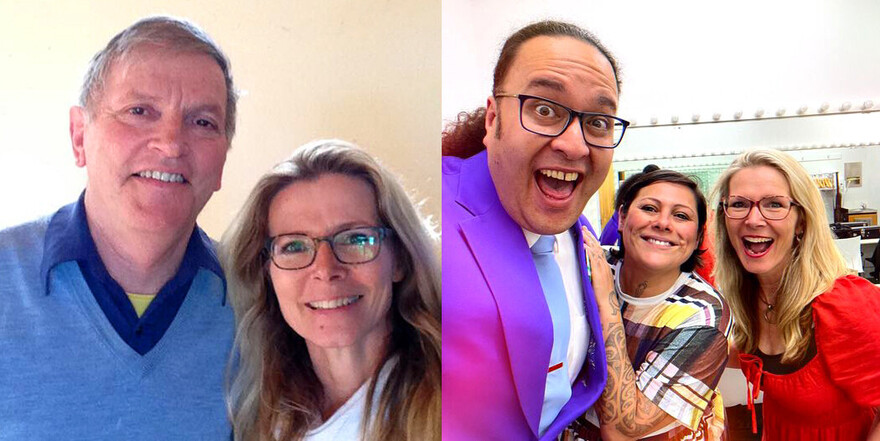
Arthur Baysting and Suzy Cato; Chris Lam Sam, Anika Moa, Suzy Cato. - Suzy Cato Collection / Chris Lam Sam Collection
If the first decade of the new century was the flowering of New Zealand music from a tiny base into an actual industry, then the past 10 years has seen a similar evolution in our children’s music.
That this has largely gone unnoticed says more about where we choose to look than what has actually been happening. Because for years now, in classrooms, kindergartens, libraries and community halls, a group of songwriters and performers have been steadily building something of their own.
They have not waited for permission, funding streams, or broadcast platforms. They have simply gone to where the children are. And the children have responded.
In February 2016, Anika Moa’s Songs for Bubbas 2 became the first children’s album to reach No.1 on the New Zealand charts. To say it surprised the industry is an understatement. Children’s records, even the successful ones from Australian groups such as The Wiggles and Hi-5, tend to tick over rather than spike. That is, until Anika.
In local terms, it was a coming of age.
Children’s music has continued to intersect with mainstream recognition since, including Craig Smith’s Wonky Donkey book of the hit song reaching No.1 across all genres on Amazon in 2018.
But like most “overnight successes” it had been building for a long time.
If there is a starting point for the current wave, it may well be 2008, when APRA hosted New Zealand’s first Children’s Music Awards. The judges were deadlocked between two very different songs: Claudia Robin Gunn’s ‘Lullaby Time’ and Craig Smith’s ‘The Wonky Donkey’. In the end, both were awarded. It was a fitting beginning.
The inaugural What Now? Award for Best Children’s Music Video was also awarded to The Funky Monkeys for ‘The Thank You Song’. This has since been adopted by NZ On Air. Baysting himself had strongly advocated for the establishment of these two awards, even gathering many children’s music artists to a “symposium of children’s music” in Wellington earlier that year to see if there was appetite for it. In 2013, the Recorded Music NZ Aotearoa Music Award Tūī for Best Children’s Album (from 2018, “Artist”) was finally reinstated after an 11-year hiatus and won by fleaBITE for Circus of Fleas.
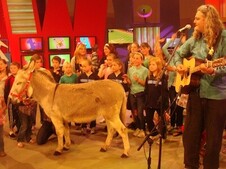
Craig Smith risks performing Wonky Donkey to children and an animal. - Craig Smith
Claudia Robin Gunn continues to write and record, drawing on a lifelong connection to song and story that began in childhood. Craig Smith’s ‘Wonky Donkey’ has since taken on a life of its own, moving from song to book and into international success well beyond anything the local industry might have predicted, including a performance of the song at Glastonbury in 2015.
These are not isolated cases. Around the country, artists have been developing their craft in close relationship with their audiences. Songs are written, tested, refined, and sometimes discarded in real time. Children become the measure. If they sing it back, it stays.
Anika Moa describes the process simply: you pretend you are the child and start there. The ideas often come directly from her own children – their language, their imagination, their way of seeing the world.
For others, the approach is less deliberate but no less connected. Rob Wigley (aka Mr Roberelli) talks about songs arriving from phrases, jokes, or moments overheard, with melody and words appearing together. What matters is that the songs feel natural – not instructional, but open enough for children to enter into them and make meaning for themselves.
There is a strong resistance to talking down to the audience. Better, as Wigley puts it, to encourage wonder than to explain everything.
Performance is where this work finds its full expression. These are not distant stage shows. They are participatory, physical, responsive. Songs are chosen not just for how they sound, but for what they allow an audience to do – to sing, to move, to imagine, to play.
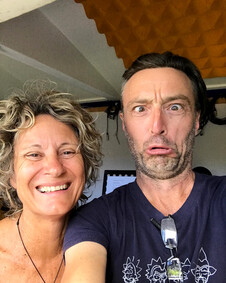
Levity Beet and Kath Bee, 2024.
Levity Beet, who spends much of his time performing in early childhood settings, describes it in terms of connection. If the children laugh, you follow that. If they move, you follow that. The work shifts in response to the room.
For Kath Bee, the pathway into children’s music came later. After initially studying contemporary music, she began writing songs for a school concert, discovering quickly that they resonated. Songs including ‘Individuality’, ‘Dad I Wanna Be a Camel’, and ‘Seasons’ have since become embedded in classrooms around the country. For Bee, the reward has been in watching children respond – dancing, singing, joining in, or simply listening intently. It is that connection, and the feedback from families, that has sustained the work.
Kath’s waiata, along with those from many other children’s musicians, among them Rahda Wardrop, Hirini Melbourne, Claudia Mushin, and John Phillips, became beloved songs for a generation of young New Zealanders with the help of the Ministry of Education’s Kiwi Kidsongs CDs that were sent to every New Zealand school from the early 2000s. In 2023, Phillips’s song ‘Bad Hair Day’ resurfaced unexpectedly in a TikTok dance craze, receiving over 1.1 billion combined views.
This relationship between artist and audience is one of the defining features of children’s music in New Zealand. It sits outside the usual structures of the industry. There is no clear pathway, no dominant platform. Instead, there is a network of people working independently, often invisibly, but with a shared purpose.
Schools have played a crucial role in this. Programmes such as Smokefreerockquest and Play It Strange have long encouraged original songwriting, creating a culture where making music is as important as performing it. Bandquest has extended this into younger age groups, where around 35% of the songs performed are original. In primary schools, teachers continue to expand repertoires, drawing on both traditional material and new local work.
At the same time, there are gatherings that reveal the scale of what is happening. At the New Zealand Ukulele Festival, over 3000 children fill the stands, many of them playing songs written here. It is a glimpse of something much larger that is otherwise easy to miss.
Beyond New Zealand, there are signs that this work is travelling. Craig Smith’s success is one example. Mr Roberelli’s music has found an audience in the UK. Jay Laga'aia has become a familiar presence in Australian children’s television, while Peter Dasent continues to contribute to Australia’s Play School and the wider music scene there.
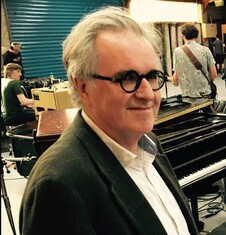
Peter Dasent, 2016 - Peter Dasent Collection
In 2026, this is still true of Dasent. Other New Zealand artists have since contributed to the development of similar children’s music initiatives internationally, including flying over to support the establishment of the Major Minor Music Awards in Sydney in 2022.
These artists are not necessarily setting out to represent New Zealand, but a distinct voice comes through nonetheless.
There have also been moments where children’s music has intersected with the mainstream in unexpected ways. Bret McKenzie’s Oscar-winning song for The Muppets in 2011, and Flight of the Conchords’ 2012 No.1 single ‘Feel Inside (And Stuff Like That)’, co-written with children, both point to the creative potential of this space, even if they sit slightly outside it.
What is striking is how much of this has developed without formal recognition. There are few funding pathways, limited media coverage, and little in the way of dedicated infrastructure.
And yet the work continues.
The funding landscape has improved. In 2025, Michal Amy Bush (aka Music with Michal) became the first solo New Zealand children’s music artist to receive substantial funding to produce an original preschool music series for YouTube. In 2026, NZ On Air continues to support new music for children through its annual New Music Kids grants of up to $55,000.
Suzy Cato, who has been at the centre of children’s media in New Zealand for decades, has seen these cycles of growth and decline before. What feels different now is the sense of momentum, and the number of artists contributing to it. She couldn’t be happier.
That growing sense of connection would soon formalise. In 2019, Baysting co-founded the Kiwi Kids Music Trust alongside Suzy Cato, myself and others, creating a national network to actively support and connect children’s artists with young audiences. The Trust has since created the annual Kōkako Award to support artists aged 15 and under who write and perform original songs.
What was once a scattered set of individual efforts is beginning to look more like a community.
One thing seems certain: there will be no shortage of performers and songs for New Zealand children and families to choose from in the future.
We call Arthur Baysting the Godfather of New Zealand children’s music for good reason. Over many years, he was a central figure in bringing together many of the country’s scattered children’s music artists. He also wrote hit children’s songs such as ‘Watermelon’ with Peter Dasent and Justine Clarke that have become part of that shared repertoire. Collaboration between Aotearoa’s children’s music artists is now the norm and, as it did with Arthur, that spirit has begun extending across the Tasman to our Australian peers. APRA’s Baysting Prize for Children’s Champion, established in 2019, honours those who continue this work. Children’s music is thriving in our nation thanks in no small part to Arthur. We miss him dearly. – Chris Lam Sam
--