Hamilton is a city of bridges – real and metaphorical. Four of the physical kind span New Zealand’s longest river, the Waikato, joining the city’s two halves: the baby boomer suburbs and the university and teachers college to the east, and the older commercial centre along Victoria Street and suburbs in the west.
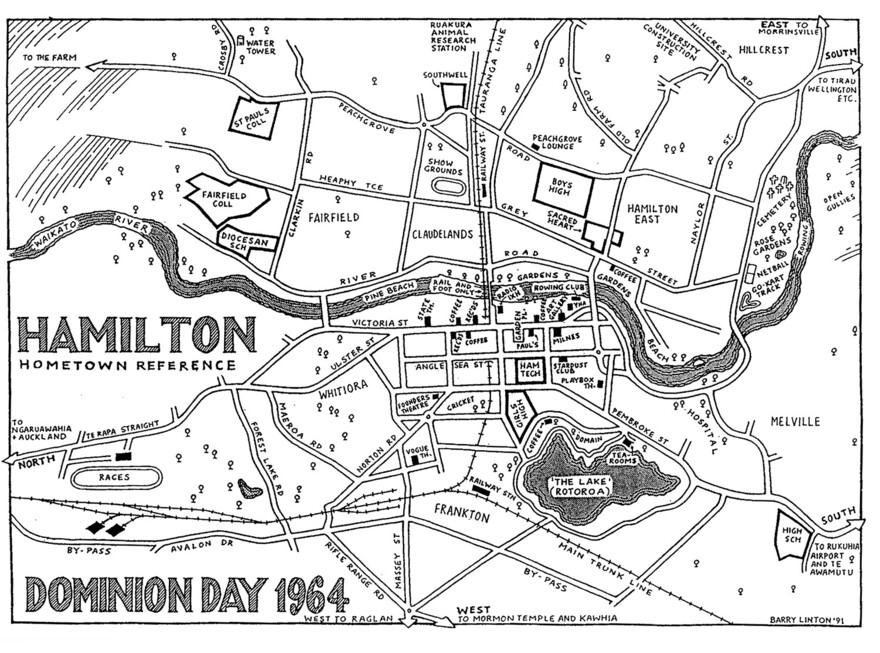
Hamilton, 1964: a map drawn by Barry Linton for Landfall #180, December 1991, a special Hamilton issue edited by Alan Brunton. - © Barry Linton, courtesy Lily Linton
In a broader sense, Hamilton is a bridge to Auckland in the north and to the New Zealand heartland to the south, and the centre of the surrounding hinterland towns of Huntly, Ngāruawāhia, Morrinsville, Te Aroha, Raglan, Cambridge, and Te Awamutu, which feed and help define it.
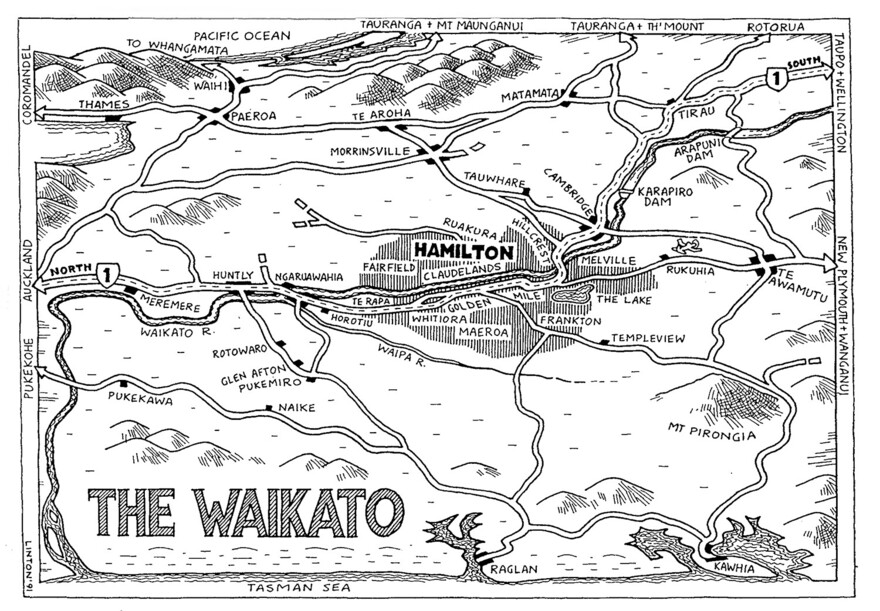
The Waikato: a map drawn by Barry Linton for Landfall #180, December 1991. - © Barry Linton, courtesy Lily Linton
One of New Zealand’s busiest rock’n’roll scenes developed there in the late 1950s and early 1960s, drawing bands from its confines and provincial surrounds for city and rural hall slots alike. It helped inspire one of the nation’s greatest rock’n’roll achievements, Richard O’Brien’s Rocky Horror Show, which would achieve international success as O’Brien drew on his Hamilton roots to create the show in London.

The Hamilton County Bluegrass Band c. 1970. Left to right: Alan Rhodes, Lyndsay Bedogni, Colleen Bain, Paul Trenwith, Dave Calder.
Bolstered by the largest young per capita population in New Zealand, rock’n’roll, beat, R&B, folk and psychedelic music vibrated in the city through the 1960s and into the 1970s. Country and pop star Maria Dallas performed early shows in Hamilton before heading overseas, as did The Hamilton County Bluegrass Band.
In the 1970s, the Finn brothers from Te Awamutu in Split Enz left the region for Auckland, then Australia, and finally the world. (Similarly, the Hunter brothers left Taumarunui, further south, with Dragon.) Two Chris Thompsons headed to England that decade, one to enhance his reputation as a folk musician, the other to international hits and high regard. Garth Porter from Swellsfoot Assembly headed for Australia and international success with Sherbet.
The 1970s and early 1980s saw the city’s rural hinterlands become the staging points for huge multi-day music festivals with Sweetwaters to the north near Ngāruawāhia, before shifting west to Pukekawa, and finally, in 1999, to Auckland’s edges in Manukau. The Nambassa festivals and their precursors of a more countercultural mindset played out in and around the Karangahake Gorge, where they drew unexpectedly large crowds.
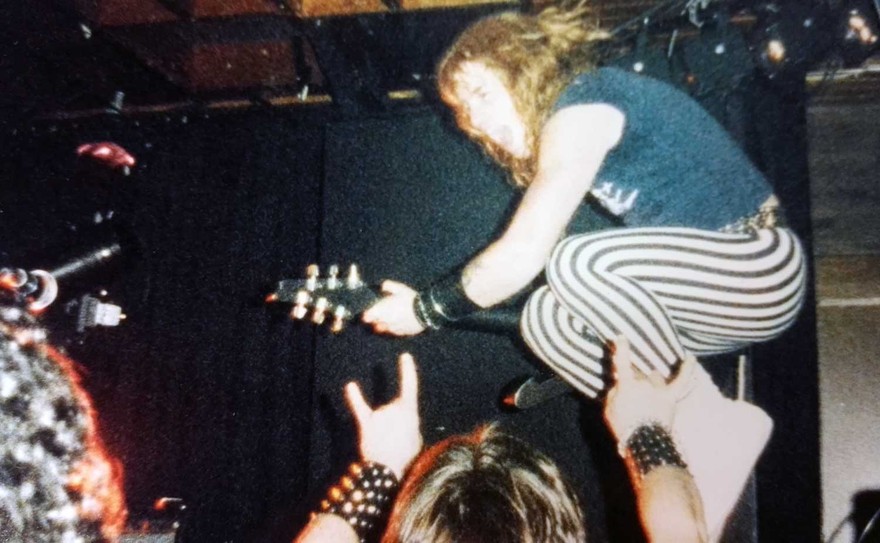
Paul Martin in the air with Knightshade - Paul Martin collection
Modern music never stopped resonating in and around Hamilton. In the 1970s and 1980s, the city developed a hard rock heart, as shown by national chart group Knightshade, and Stonehenge amongst others. Punk rock would have a say as well. The 1990s would see an indie movement swelled and driven by increasing numbers of students.
The music made or inspired there – as diverse and musically successful as it was – is one of the least compiled and revisited catalogues of any New Zealand city. The Reataz, Ivor Fisher, The Satellites, The Fenders, Tomorrow’s Love, the late period The Rayders, The Mods, The Accessories, Pieces of Cod,The Politicians, Stonehenge, Desperate Chaps, Book of Martyrs, Watershed, The Nerve, and Ritchie Pickett, to name just a few, all have musical gems awaiting exhumation.
Ivor Fisher (with The Satellites) – Lookie Lookie Lookie (1960)
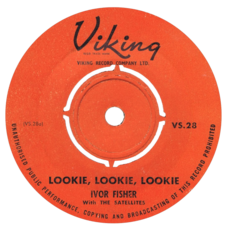
Ivor Fisher with the Satellites - Lookie Lookie Lookie (Viking, 1960)
Waikato rock’n’roll perennials The Satellites had their own dedicated singer in Ivor (Paul) Fisher. They held down regular spots at the Starlight Ballroom on Angelsea Street and in the Waikato hinterland. Soon enough they toured nationally. In Fisher’s hands ‘Lookie Lookie Lookie’, written by Texan DJ and rocker Ronnie Smith and Buddy Holly producer Norman Petty, is a sly wink of a song with an infectious rhythm that no doubt got bums off seats in North Island dancehalls.
The Reataz (with The Satellites) - Daddy Cool (1960)
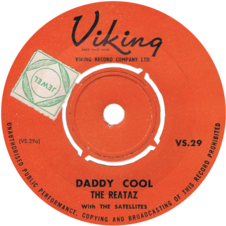
'Daddy Cool', the 1960 single from Hamilton rock and roll group The Reataz with The Satellites, on the Viking label
Kiwi girl group doo wop from Hamilton? In 1960? And a spirited and enduring take at that! Ably backed by The Satellites, the teenage Reataz – Coralie Wilson, Claire Beale and Jan Jones – squeeze out a tempting bad-girl vibe for the flipside to ‘Fancy Nancy' on Auckland’s Viking Records, a primary outlet for Hamilton’s bands.
The Mods – It’s In Her Kiss (1965)
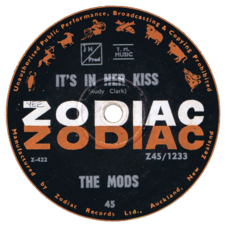
The Mods - It's In Her Kiss (Zodiac, 1966)
Infectious, harmony-rich Merseybeat from The Mods – Kevin O’Neill, John Bissett, Neil Reynolds, and Wayne Reynolds – who were constants on the Waikato circuit. The quartet split in 1966, having released two singles. Kevin O’Neill joined The Rayders, an Auckland group who were resident in Hamilton, for their blistering Who-style rocker, ‘A Working Man’. John Bissett headed for Auckland and The Action, staying with them when they jumped the ditch to Australia’s east coast, where he soon joined Adelaide’s Fraternity.
The Fenders - High Heel Sneakers (1966)
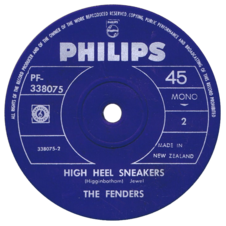
The Fenders - High Heel Sneakers (Philips, 1966)
The other side of the beat-boom coin was R&B, interpreted and reimagined by young Pākehā. Regulars at the Eastside and Starlight Ballrooms, The Fenders recorded a sharp take on Tommy Tucker’s ‘Hi-Heel Sneakers’ with all the requisite sass and pointed lead guitar needed to pull the R&B chestnut off live. Released on Philips Records, which also had The La De Da’s on board.
The Rayders – A Working Man (1966)
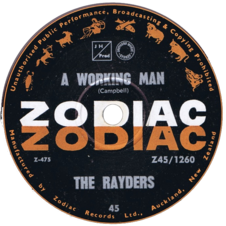
The Rayders - A Working Man (Zodiac, 1966)
The Rayders seemed unlikely candidates to record a searing mod anthem. They started life with Owen (aka Danny) and Gene Campbell, Ray Mulholland, and Brian McCarthy, who had an early hit with a cover of Leiber & Stoller’s ‘Little Egypt’. With the Mods’ bassist Kevin McNeill replacing later-day recruit Chris Collier, The Rayders gigged around the Waikato for eight months, tripping to the capital and to their old stomping ground in Auckland, the Galaxie ballroom. With a return to Australia mooted, Campbell and McCarthy got their heads together to record four original songs for an EP, two of which were released as a single with ‘A Working Man’ – as tough and tuneful as The Easybeats’ ‘Friday On My Mind’ and prime Who – on the top side.
Tomorrow’s Love – 7 & 7 Is (1968)
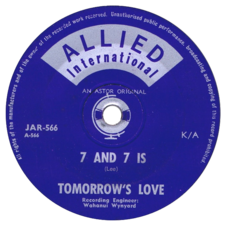
7 and 7 Is - Tomorrow's Love (Allied, 1968)
Ron Jenkins’ ‘Tomorrow’s Love – a group of ex-pat South Islanders and one Ngāruawāhia chap – staked their enduring claim to recording fame with a convincing take on Love’s minor US chart hit, ‘7 & 7 Is’, unleashing a storming garage rocker with a psychedelic edge that was heard live in the Old Folks Hall in Clarence Street and venues across the river and surrounding towns. Much compiled now, the recording was lost for years, until in 1994 Kiwi garage rock collector John Baker tracked down Jenkins in his home town of Invercargill.
Chris Thompson – Back In The City (1977)
The year punk’s rumble became a roar, Hamilton folkie Chris Thompson released a superlative collection of eastern-influenced psychedelic folk. The album was brave musically, housed in a bright gold sleeve, showing Thompson with a blazing red haze around a blue-tinged guitar, the word “Minstrelsy” imposed on his fretboard. There was a unity and confidence to the 1977 compilation album, which belied its scattered origins. Opening track ‘Back In The City’ is an early version of ‘London Blues’ (aka ‘Chelsea Style’) recorded with Bill Leader at Sharp House in London in 1971. The album’s high point brings a swooning, lysergic mix of tabla, sitar and acoustic guitar, with fragile words spun throughout.
The Hamilton County Bluegrass Band – Mercedes Benz (1972)
Produced by Christchurch-born, Australia-based Rod Coe, The Hamilton County Bluegrass Band’s trans-Tasman album Kersbrook Cottage added horns to the group’s driven acoustic sound on a strong take on Janis Joplin’s ‘Mercedes Benz’, a hit for her as the B-side of ‘Cry Baby’ in 1971.
The Accessories – The Accessory (1982)
There’s a great song lurking behind the timid vocal and subdued recording on The Accessory, Hamilton’s first vinyl of the post-punk era from The Accessories, who began playing out in the city in 1979 and survived until 1983. The equally rare follow-up EP, Veges and Potatoes, soon followed. In the following decades band members would go on to play in The Human Lawnmowers, Hand of Glory, Huge Industrial Art Snobz, The Simpletons (whose brilliant cover of The Beatles’ ‘Rain’ appeared on 1989’s Surf Music compilation tape in 1989), and Watershed.
The Politicians – Down in Baghdad (1984)
EMI Records’ silver custom-press labels were a common sight in the early to mid 1980s as New Zealand groups bypassed slow-moving mainstream record labels and released their own records. The Accessories had them on both their releases and so did the Politicians. English-born, Tokoroa-raised Tim Armstrong’s ‘Down In Baghdad’ kicks off with an upbeat spy-theme bass, as it contemplates cities further afield on the Politicians’ self-released debut single, heralding one of the city’s most high-profile young groups of the mid-1980s.
Knightshade – Free Love (1986)
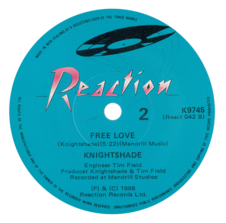
Knightshade - Free Love, flipside to Out For The Count 7" (Reaction Records, 1986)
If you liked your rock hard and metallic, Knightshade had it covered. Free Love appeared first on 1984’s Three Points of Metal compilation, which pointed to the coming wave of New Zealand hard rock and heavy metal groups. The hard rock anthem reappeared two years later as a standout B-side on the Out For The Count 12” EP and single, a Top 30 hit for the group, released – like much of the hard rock and heavy metal at the time – on independent labels. In Three Points of Metal’s case, it was Jayrem Records out of Wellington. Out For The Count was released on Auckland indie label Reaction Records.
Pieces of Cod – Upon The Heath (1986)
Two 1986 recordings from Fairfield College’s finest, Pieces of Cod, were released posthumously in 1990 and 1994: ‘Amphetamine’ (on Celebrate The Sonic Arts) and ‘Fall In A Hole’ (on Discordia Concurs). Both are infectious and upbeat garage rock tunes. The unreleased and, until recently, unavailable ‘Upon The Heath’, another 1986 recording, has a Shakespeare-referencing lyric, an engaging, jagged, velvety riff and tone reminiscent of The Dream Syndicate.
Stonehenge – Easy Livin’ (1986)
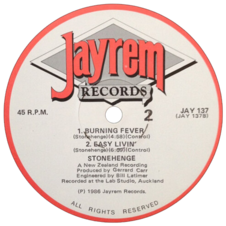
Stonehenge - Easy Livin'(Wings of Steel EP, Jayrem, 1986)
‘Easy Livin’’ storms along on a dirty, metallic riff with heavy metal crunch and punk rock fury, a sign of hard rock crossovers to come. The Hamilton band managed only one 12” EP, 1986’s three-song Wings of Steel, from which ‘Burning Fever’ was plucked for the British compilation, Attack From Downunda. A third EP track, ‘Wings of Steel’, highlighted the group on the K Tel metal compilation from the same year, Masters of Metal, which found Stonehenge in fine company among international heavy metal’s best. As with Attack From Downunda, they were joined on the track list by Knightshade.
Joe 90 – Walls Surrounding Me (1987)
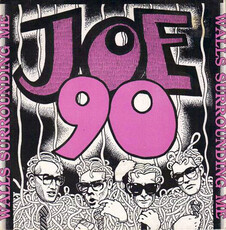
Joe 90 - The Walls Surrounding Me (EMI, 1987)
Joe 90 had a deliberate nerdy image, but the sound here is way cooler: a synth and guitar workout for EMI Records that is in tune with the times and has aged well. The band – Shaun Joyce, Darryl Monteith, Kevin Webb, and Chris Oaks – would often finish their live set with a version of ‘Time Warp’ from The Rocky Horror Show.
Knightshade – Last Night In The City (1989)
Hamilton’s hard rock titans had a good way with a power ballad. They’d already hit with ‘You Don’t Need Me’ in 1988, but to my ear, ‘Last Night In The City’ tops it. The record-buying public certainly thought so, rewarding Knightshade with a Top 10 hit in New Zealand. Signed to Mushroom Records in Australia and Festival Records at home, ‘Last Night In The City’ joined a long list of Trans-Tasman classics.
Watershed – Airhead (1989)
They’re all impossible to find now, but the periodic Hamilton compilations, often on tape and later CD – such as Suicide City 86/ 87, Surf Music (1989), Discordia Concurs (1994) and Green Eggs and Hamilton (1997) – are a vital window into the city’s busy music scenes. Greg Locke’s Orange Recordings highlighted an exciting slice of the river city’s sound on Surf Music, where ‘Airhead’, captured on four-track in 1989, first appeared, and on dedicated releases of individual acts, including Watershed’s Jeanna – an aeroplane from 1990. Watershed – the key band in Hamilton’s indie resurgence of the late 1980s and early 1990s – was a powerful live group, supported The Clean, The Chills, JPSE and Bailter Space, and was a regular presence on stages in the Waikato capital.
Desperate Chaps – She Couldn’t Love Me (1989)
I picked this rare self-released 45 up in a Hamilton op shop a few years back. The flipside, ‘Surfin’ Hamilton’, pointed to Waikato roots, but outside of the credited composer and main instrumentalist, Steve Jackson, information about the Desperate Chaps is hard to find. That leaves us just the record: a quality pop-rock composition with an infectious hook.
Book of Martyrs – Skin In Blue (1991)
Arriving in Hamilton in 1990 from Rotorua – which had its own busy scene in the late 1980s – Book of Martyrs brought an adventurous sound, some welcome gothic style, and a more fastidious approach to presentation and recording to the city’s emerging indie music scene. ‘Skin In Blue’ is plucked from Purified Seven Times, the the group’s 1991 tape, self-released on Bomb Records. Bass player and vocalist Alan Deare is now an award-winning graphic designer.
The Nerve – Coming Down Harder (1995)
The Nerve’s Jamie Stone (guitar, vocals, synth, bass, slide guitar) is in fine voice on this standout track from the band’s first and only album, Gobby, from October 1995. The CD’s standout track, ‘Coming Down Harder’, won Stone a deserved best songwriter award at the short-lived Waikato Rock Awards in 1996.
Scooter – Dayroom (1997)
Scooter was a trio of old Hamilton hands: Stan Jagger (drums), formerly of King Biscuit and Book of Martyrs, Kent Ericksen (guitar/ vocals) of the Human Lawnmowers and Watershed, and Steve Grey (guitar), once of The Parkers and Frybrain. The group formed in 1994 and later released a compelling EP on which ‘Dayroom’ nailed the 1990s US indie slacker sound. Scooter toured New Zealand in July 1998 and three songs were included on NZ On Air Indie Hit Discs.
Ritchie Pickett – 3am Hamilton Sunday Morning (1998)
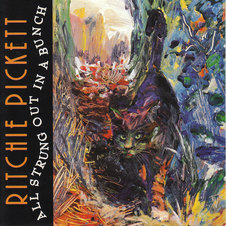
All Strung Out In A Bunch, released 1998
Morrinsville’s Ritchie Pickett’s musical life washed around the Waikato and Bay of Plenty like an ice cube in a whiskey tumbler. His records were sporadic, but brimmed with Pickett originals. There was the well-regarded Ray Columbus-produced New Zealand country classic Gone For Water from 1984, with his backing group, The Inlaws. Fourteen years later came All Strung Out In a Bunch, featuring his quiet, reflective ballad, ‘3am Hamilton Sunday Morning’. You can almost hear the fog rolling off the mighty Waikato River in the early hours as Ritchie, in his cups, finds the city’s sad heart rhythm.
‘3am Hamilton Sunday Morning’ on YouTube
--