I used to see him in bars around Wellington in the early 1990s, when I was a working bass player. He was Māori, middle-aged, his hair was silver and hung down the back of his collar, and his trouser-cuffs dragged slightly over the heels of his shoes. In my mind, he was the Ancient Mariner; the way he would enter a bustling bar and stop, stock-still in the centre, staring at the musicians on stage, eyes glittering, as though he was about to regale us with the story of a voyage he had made long ago. He would stand there for maybe half a song, eyes fixed on the bandstand while the rest of the crowd drank and hollered over the music. Then he would turn and head back out into the night, making it clear that whatever it was he had hoped to hear, we weren’t playing it.
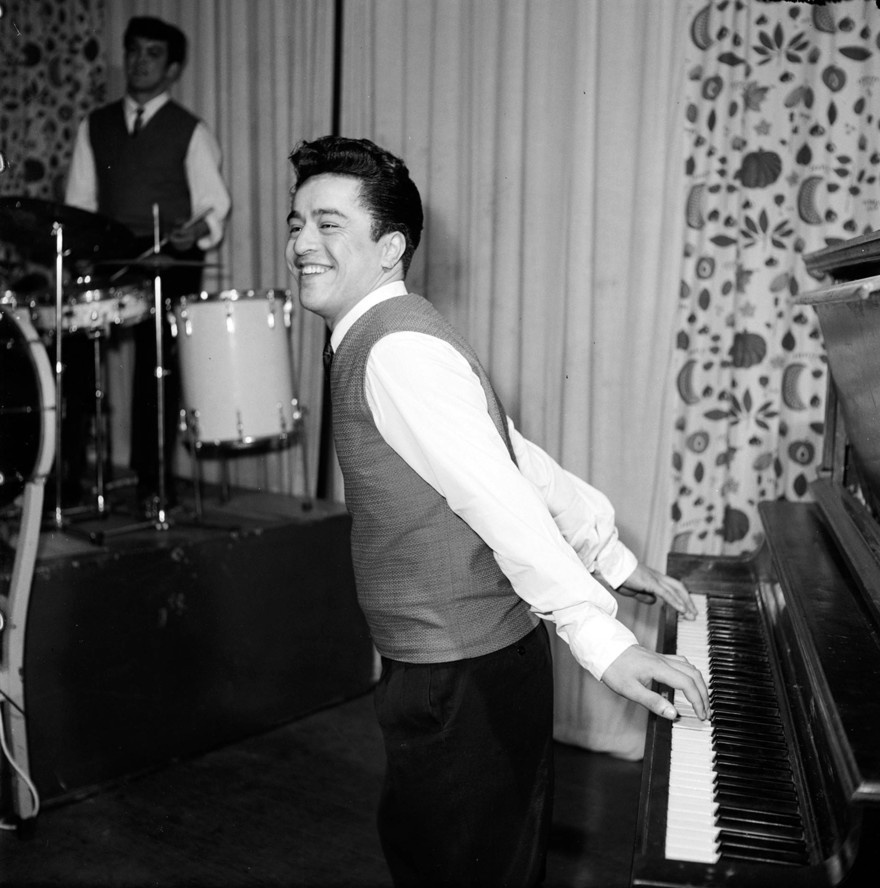
Hector Epae with the Quin Tikis, Māori Community Centre, 1961 - Auckland Libraries Heritage Collections 1269-L0592-08
One night I was performing with John Grenell, the great New Zealand country singer. John was not so much an ancient mariner as a horseback troubadour. In the 1960s, when he was known as John Hore, he had been this country’s best-selling artist. For a while, he even outstripped local sales of The Beatles. He had had a local hit with ‘I’ve Been Everywhere’ (written by Australian Geoff Mack, and a US No.1 for Canadian Hank Snow), and though it was true he had played from Nashville to Cape Town like it says in the original lyric, the place names he recited in his version were all in New Zealand: “Ruatoki, Matahura, Taupiri, Maketu, Kyeburn, Sowburn, Wedderburn, Mossburn, Washdyke, Arawhata, Paparoa, Kaponga …”
More recently his career had been revived with his recording of ‘Welcome To Our World’, which had been widely broadcast in a television commercial for Toyota. As I discovered on my first gig with John, he never used a set list, nor did he believe in taking breaks unless someone in the band – who he always introduced as the Saddle Blasters, though the line-up changed from gig to gig – pleaded on humanitarian grounds. He would invariably open with ‘Welcome To Our World’, after which the show could go anywhere, and would last until the venue manager indicated it was time to finish. He’d take audience requests, or else draw songs, both well-known and obscure, from his seemingly bottomless well of remembered material.
On this occasion, we’d been playing for perhaps an hour and a half when I spied the Mariner occupying his usual position. But when we came to the end of whatever song John was singing – I think it was ‘Home on the Range’ – I noticed he had taken a few steps closer to the bandstand. Then, to my surprise, I saw John unclip his microphone from its stand and hand it to the Mariner, who turned to the musicians and announced, in a professional tone I hadn’t expected: “ ‘Green Green Grass of Home’. In G”.
John struck the opening chords on his guitar and the Mariner, now facing the crowd, began to croon in a voice as lush as velvet:
“The old home town looks the same …”
When the song ended, John took back the microphone and thanked our guest. “Hector Epae, ladies and gentlemen. Hector Epae!”
There was applause, but by this time the Mariner was already on his way out the door.
Hector Epae. The name rang a bell. A few years earlier I had interviewed the singer Maria Dallas. As a teenager she had had a national hit with a song called ‘Tumblin’ Down’. The song, she explained to me, had been written especially for her by a very talented guy named Jay Epae. She had been halfway through recording her first album when he turned up one day at the studio. Producer Ron Dalton asked whether he might have any material for Maria to sing, and he had gone away and written the song overnight.
Maria had also mentioned that Jay had a brother, Hector, who she thought lived in Wellington. While Jay was making his name in Scandinavia, Hector and yet another brother, Wes, had been touring the world with some of the original Māori showbands. Wes travelled as one of the Māori Hi-Five, as they took their combination of comedy and musical class through Australia, Europe, North America, and Asia. He was renowned for his dancing, which was on a par with that of the great African-American entertainers. “He danced like James Brown,” Frankie Stevens would recall in awe. “He was Michael Jackson before Michael Jackson was thought of.”
In London, Wes was an extra in the Walt Disney film In Search of the Castaways, starring Hayley Mills. Walt Disney shook his hand. In Hong Kong, with the Hi Five, he opened for The Beatles, who were en route to New Zealand in June 1964 on their only South Pacific tour. The Beatles shook his hand too.
Hector had started out in Auckland with The Quin Tikis, then roamed the globe with other showbands: the Sydney-based Māori Troubadours, led by the larger-than-life Prince Tui Teka; through Asia, Europe and North America with the Māori Volcanics. He played guitar, saxophone, piano, did comic skits, and sang. “Hector Epae: Man of a Thousand Voices” the posters proclaimed. His impersonation of Yma Sumac, a Peruvian girl with an extraordinary vocal range, was a particular crowd pleaser. Even if he had sung only in the voice I heard that night in Wellington, he would have been spectacular.
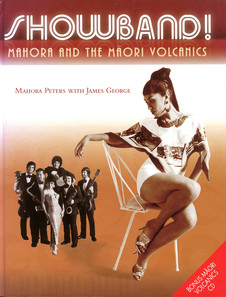
Showband! Mahora and the Māori Volcanics - Mahora Peters with James George, 2005.
But from many accounts, his greatest gift was his humour, on stage and off. During a residency in Bermuda, Hector had fallen in love and married a Bermudan woman named Beth. Mahora Peters, a constant member of the Volcanics throughout their long career, wrote a vivid memoir, Showband!, in which she shared some stories. In one, Hector goes out to buy some milk and bread and returns 10 hours later. By this time Beth is furious and demands to know where he has been. Hector looks apologetic and explains that he had to go to the movies. “Ten hours to see a movie?” she asks. “Well,” he replies calmly, “I went to see two movies.”
There were literally dozens of Māori showbands criss-crossing the planet in the 1960s and 70s. From Okinawa to Waikiki they could be found in upscale hotels, nightclubs and cabarets, their shows shaped partly by their own eclectic tastes, partly by the audience demand for novelty: jazz standards, pop songs, comedy skits, dance routines, instrumental virtuosity and – their most distinct point of difference – kapa haka.
As Louise Kewene-Doig puts it: “Māori showbands were able to weave Māori stories and deliver them to audiences from many nationalities in a way which not only expressed being Māori, but also being from New Zealand, in a way no other form of New Zealand entertainment had been able to do.”
The showbands were far better known overseas than they were at home. Bruce Morley was a Pākehā musician, originally from Hastings, who played drums professionally in New Zealand and Australia from the early 1960s up until his death in 2012. Reviewing the launch in 1994 of Nga Matua, a compilation of recordings from the showband era, he recalled: ‘When I went to Sydney in 1964, I discovered something quite extraordinary and unexpected. All over Sydney and Australia in general and in the East and Vietnam and probably Papua New Guinea and other places, there were more Māori performers than I had ever seen at home, working as solo performers or in groups of all shapes and sizes. There were groups with names like the Māori Hi-Five, the Māori Troubadours, the Māori Hi-Liners, the Quin Tikis, the Māori Volcanics, the Sheratons, the Māori Premiers, Te Pois, Te Kiwis, the Māori Minors, Māori Hakas, the Milford Sounds and many more … When I returned to New Zealand some years later I discovered that very few of the general public knew much about the performers I’ve just mentioned, apart from the most prominent ones. It was as if it had happened somewhere else, in a dream.”
The Volcanics were one of several Māori showbands to tour Vietnam at the height of the American war, entertaining American and New Zealand troops. In Saigon in 1968 their vehicle was shot at by “white mice” – a nickname for the South Vietnamese police, on account of their white uniforms – who suspected them of smuggling weapons. At an outdoor show at a base near Da Nang, fighting broke out nearby and the band wound up in a foxhole, still wearing their sequins and satin suits.
But Māori have always been seafarers and adventurers. Even after the heroic waka journeys that had brought them from Hawaiki to Aotearoa, probably in the 13th century, they had continued to travel the open seas, sailing as far as the Kermadecs and Chathams. Waiata often refer to the journeys of the ancestors. After colonisation, singers and performers were some of the first to travel the Pākehā seaways. In 1863 William Jenkins, a Wesleyan lay preacher and “native interpreter”, took the first party to London to perform Māori songs and dances as part of a series of illustrated lectures. In the early 20th century Mākeriti (Maggie) Papakura took a concert party to Australia and England, leading the way for a procession of touring groups, from kapa haka to showbands.
*
Pākehā also looked to the sea. In English mythology, crossing oceans was associated with conquest, and Pākehā songs often reflect this. The 1982 Split Enz hit ‘Six Months In A Leaky Boat’ takes its central image from the long sea voyages Pākehā settlers made, coming from Britain to New Zealand. “The tyranny of distance didn’t stop the cavalier, so why should it stop me?” asks Tim Finn, defiantly. The lyric is dotted with cliches of the colonial hero: the “rugged individual”, the “pioneer” who “will acknowledge no frontier”. Similar imagery was used by British boosters in the 1960s when The Beatles became Britain’s most successful cultural export ever. It was repeatedly boasted that the Liverpool pop group had “conquered the world”.
They certainly conquered the imaginations of musicians in Britain’s farthest-flung colony. While The Māori Volcanics were dodging bullets in Vietnam, many group of teenagers were doing their best to become New Zealand’s Beatles. The Fourmyula came from Upper Hutt and started out playing Top 10 covers at youth club dances, but were more interested in writing their own songs. In their early days, as the Southern Auroras, their lead vocalist had been Frank Stevenson, later successful in his own right as the Māori entertainer Frankie Stevens. But by time they became the Fourmyula it was an all-Pākehā lineup. In Alistair Richardson and Wayne Mason they had a built-in Lennon-McCartney songwriting team.

The Fourmyula at Trafalgar Square, London, 1969. From left: Ali Richardson, Carl Evensen, Martin Hope, Wayne Mason, and Chris Parry.
When they eventually secured a recording contract with HMV they fought successfully to have their originals released as singles, a rare achievement at a time when local hits were usually overseas covers. By the year’s end the Fourmyula were the country’s best-known pop group, with a string of appealingly Beatle-esque hits: ‘Come With Me’, ‘Alice Is There’, ‘I Know Why’, ‘I’ll Sing You A Song’.
Could they repeat their triumph on the world stage? In late 1968 they took up the prize they had won earlier that year as victors in the Battle of the Sounds competition at Lower Hutt’s Horticultural Hall: a trip to Britain aboard the MV Fairsky. They only began to suspect they might, in effect, be paying for their own prize when they were told they would be expected to perform nightly for passengers on the ship, for no fee. There would be theme nights, in which they were required to dress as pirates, dance the can-can and – with a cultural disregard typical of the times – perform a haka. They put up with it. After all, they were going where they wanted to be: Britain, home of The Beatles and the pop sounds they loved.
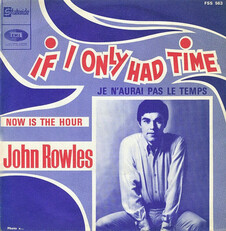
John Rowles - If I Only Had Time (Stateside, 1968)
Earlier that year John Rowles, a young Māori singer from a showband background, had scored a huge British hit with his English-language version of a big French ballad, ‘If I Only Had Time’. Before long he would be headed for Las Vegas in the footsteps of Tom Jones and Engelbert Humperdinck, his stylistic peers. But London was not so welcoming to the Hutt Valley hitmakers. The variety of tuneful, whimsical pop that had brought the Fourmyula success at home had already reached saturation point there, and the new British bands were working in a heavier, more ostentatious style. Led Zeppelin had begun. Yes were playing at the Lyceum Ballroom, and some of the Fourmyula went along to see them. The young New Zealanders were so awed by the virtuosic rock that they thought about giving up.
Their time in London was not without its rewards. Through their relationship with HMV, they were granted a session in the Abbey Road studios of HMV’s parent company EMI, where they found themselves recording in the room next door to The Beatles themselves. Songwriter Wayne Mason even had a brief surreal exchange with John Lennon, a moment he had dreamed of for years. It went: (Kiwi accent) “Hi, I’m Wayne Mason from New Zealand.” (Scouse accent) “Ah, the land of butter.”
But by July 1969 they were sailing home, Britain unconquered. Back on board the Fairsky, drummer Chris Parry searched for words to convey the strangeness of the whole experience. Years later he told me: “It was full moon and we were out on the Indian Ocean and that was the moment Neil Armstrong landed on the moon. They broadcast it on the ship’s Tannoy system, and just as they were doing that we passed this little island in the middle of nowhere and you could imagine you were there with them really, in this wilderness”.
*
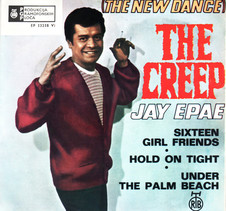
Jay Epae - The Creep / Hold On Tight 7" released on PGP RTB in Yugoslavia, 1967.
The Epae brothers kept on moving. After writing ‘Tumblin’ Down’, Jay made a few more records of his own in New Zealand, the standout being ‘The Creep’, a slinky R&B tune promoting a dance craze of his own invention. But before the decade was over, he had set sail again, this time for Australia’s Gold Coast. Wes played residencies with the Hi-Five in Las Vegas and the Bahamas, until the group split in the 1970s. He then launched a solo career that took him through the lounge bars of the Midwest and cruise ships of the Caribbean, eventually setting him down in Florida where there was a perennial market for an impersonator who could do Ray Charles and Pavarotti with equal ease. Hector continued to perform with the Volcanics, from Paris to Puerto Rico, Bermuda to Berlin.
The Fourmyula had one more crack at Britain, returning there at the end of 1969. For another year they subsisted on mince, made multiple journeys up and down the M1 to play second-tier gigs in workingmen’s clubs, and recorded an album that would contain their finest work. But they were dropped from their record label, and the album would remain unreleased for the next 40 years. In their absence they achieved their greatest New Zealand hit with ‘Nature’, a song of Wayne Mason’s that would go on to have a long life. But The Fourmyula as a commodity had passed its expiry date, and all but one of the members would individually make their way back home.
Tim Finn found a metaphor for his own disillusionment in ‘Six Months In A Leaky Boat’, but his song might equally speak for the Fourmyula or any one of a number of New Zealand bands who set out with conquering dreams. The bravado of the first verse masks an underlying insecurity. Before long the boat springs a leak; tempers flare, shipwreck looms. And though by the end of the song he is boasting that he now has the wind back in his sails – and the jaunty hornpipe that forms the instrumental centrepiece seems to chime in agreement – there is still a strong suggestion that the whole adventure has been a delusion and a folly.
This scenario is revisited in The Chills’ ‘Ocean Ocean’, written by the group’s leader, Martin Phillipps. The ship is the music industry, and Phillipps recounts the band’s mortally bruising experiences on board.
We drifted as we fought with the sails
Some lives were lost – there are so many tales …
Time is still when you’re out here
Separate lives leading nowhere
And all together getting pretty tired of this ocean
Out in the open
But don’t rock the boat – don’t cause a commotion
Numerous other popular songs by New Zealanders use the image of the ocean voyage. Perhaps only the Irish have written as many songs about the sea. Hello Sailor, the most myth-conscious local songwriters of the 70s, constructed an entire identity around seafaring tropes, starting with their name. In their biggest hit, ‘Gutter Black’, written by guitarist Dave McArtney, the order to “get to sea, boy” represents the lure of a rock’n’roll life.
Lead singer Graham Brazier, who colourfully depicted the band’s home suburb of Ponsonby as a port town populated by Polynesians and pirates, would draw on the emigrant journey of his Liverpool-born, merchant seaman father in ‘Billy Bold’, one of his best-known songs – though, as he notes, “it wasn’t the call of the sea / it was the sound of poverty” that drove him to New Zealand. As the song reminds us, there were some who brought their dreams to this place rather than the other way round.
*
It’s been universally remarked that the job of a touring musician is incompatible with most people’s idea of a normal life. There are the extreme highs and cruel lows: the adrenalin that drives you through a performance and the dopamine rush of the applause, followed by the monotonous hours of travel and long nights in strange towns and cities. Though you are constantly meeting new people, you are also forever saying goodbye, moving on to the next gig. It is an insular world. The only people you see consistently are the other members of your own touring party. And unless your fellow musicians also happen to be your partner and children, a stable family life is hardly possible.
Dave Dobbyn captured that ambivalence in the DD Smash song ‘Whaling’. Once again, it’s the musician as mariner; in this case a whaler, the occupation that brought some of the first Pākehā to New Zealand, and he’s longing to be back on shore, back in his sweet baby’s arms. Until such time, all he has to sustain him is his own swagger, though as he sings in the song, “I know it's just bravado”.
And when you finally return to shore, who understands the things you have done and seen? Who shares your points of reference? Like soldiers returned from the war, touring musicians, encountered on the streets of their hometown, can seem to be suffering from a form of shell shock. Or give the appearance of ancient mariners.
I thought of the way Chris Parry of the Fourmyula had described standing on the deck of the Fairsky at night, out in the Indian Ocean as men walked on the moon, and identifying with the astronauts’ cosmic isolation. As it turned out, he was the one member of the group who stayed on in England after their second visit, and ultimately did very well there, going on to produce British bands like the Jam and the Cure.
Perhaps it wasn’t the journey away from New Zealand, but re-entry to New Zealand’s atmosphere that was the problem.

Dalvanius and the Fascinations, Sydney, 1970s
As for the show bands, occasionally a genius entertainer such as Billy T James, Prince Tui Teka or Dalvanius Prime would return to New Zealand to break through the cultural barriers of television and radio programming and become a national star, however most of their peers remained little known to the general public. In her 1994 thesis on the showbands, Suzanne Ormsby wrote that “People in Aotearoa are mostly unfamiliar with the way Māori entertainers have acted as unacknowledged ambassadors for this country in various parts of the world for more than one hundred years.” Where, she asked, was the Māori Music Hall of Fame?
*
It was some time after my encounter with the Mariner, Hector Epae, that an item in the local paper caught my eye. It was an obituary to Jay Epae, Hector’s eldest brother, the one who wrote ‘Tumblin’ Down’ and danced ‘The Creep’. He had spent most of the 1970s paying the Australian club circuit, the article said, but had eventually dropped out of sight. Hearing he was in Brisbane and in bad shape, yet another brother, Roy, had brought him back to Wellington, where he died in the street on 25 July 1994, age 61.
I wondered about Hector, who I hadn’t seen since that night with John Grenell. A long time passed before it occurred to me that maybe he would want to tell me his story. When I finally went looking he wasn’t hard to find. His name was in the phone book and he picked up first time I rang. I introduced myself and burbled something about his fascinating career, his extraordinary musical family. I mentioned Jay. His reply sounded dreamy and distant. “Ah, yes. Jay. That beautiful voice …”
I told him he had a beautiful voice too, and that I would love to interview him. He said he didn’t know why anyone would want to do that. I wanted to hear about his journeys, I said. The places he had played, the people he had met. “Well Nick, that might be tricky. You see, I’ve got this job to do, cleaning at the hospital at night.”
In what sort of world should a gifted artist who had devoted his life to the craft of music and now – in his sixties and in poor health – have to work as a cleaner just to survive?
I persevered. What about some time during the day then? “Well I usually sleep during the day.”
In the end, he agreed that there might be an afternoon when I could visit and talk to him, though he still couldn’t understand why I would want to. A couple of days later I called again, but there was no reply. I tried a few more times over the next few weeks but no one ever answered the phone.
Out in the world he had been a star, had been treated like one, and lived like one. But all that had happened somewhere else, in a dream.
--
Musician, broadcaster, and writer Nick Bollinger is the author of a memoir, Goneville; a history of the New Zealand counter-culture, Jumping Sundays; and 100 Essential New Zealand Albums. He is working on a book of essays about New Zealand music, researched while the 2023 Douglas Lilburn fellow at the National Library. This essay, and his 2026 podcast series for Radio New Zealand, Song Navigator, have emerged from that research.