Bass guitarist Sid Limbert has been there, done that and often done it twice. From meeting Dalvanius on the first day of high school to recording with The Surfires, from briefly joining the navy to blowing saxophone in a rock’n’roll band, and braving the infamous Parapara road to Whanganui, to turning down Delbert McClinton’s offer of a gig, Limbert recounts some stories from his life in music.
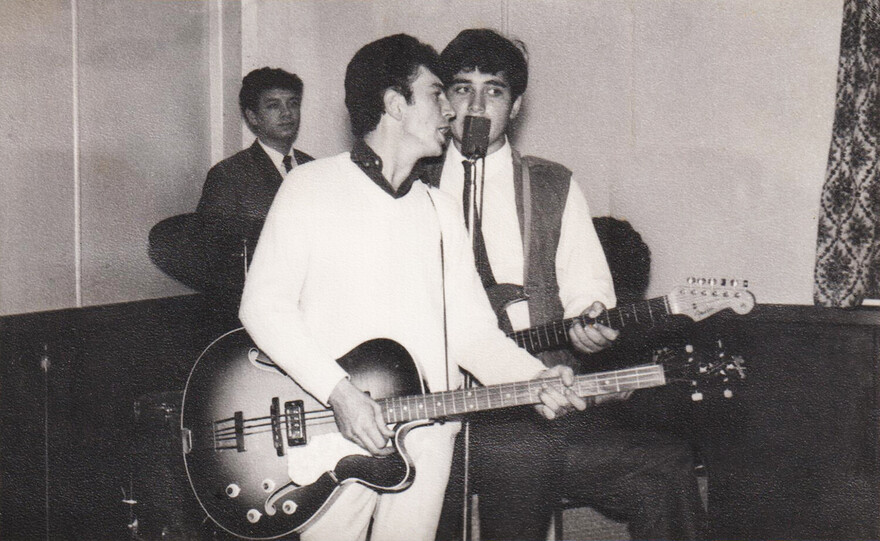
Sid Limbert on bass with Wayne Te Paa (drums) and Pinky Te Paa (guitar, vocals) in The Dominoes, 1965. - Sidney Limbert collection
A connection with Dalvanius
“The day I started [Church College of New Zealand]; the day I enrolled, the guy in front of me was sort of a slightly biggish Māori guy and slightly sort of effeminate. Anyway, we got talking about what we do, and he said, ‘Oh, I play the piano,’ and I said, ‘Oh, I play the guitar.’
“So, once we’d enrolled, we went over to the music room. He said, ‘It’s really cool over here. Have you been here?’ Because I was a day student and most of the people were boarders. There was only about a dozen day students back then. Anyway, we went over to the music room and spent the rest of the day, him just banging out this stuff on the piano. He was fantastic. And it was Dalvanius Prime.
“So, during the course of both of our careers, we’d run into each other, and it was like brotherly love; it was really tight-knit. We did a show on TV, Midge [Marsden]’s band, called The New Year’s Eve Do, and the Pātea Māori Club were doing ‘Poi E’. Dal grabbed me and he introduced me to everybody, and I had a hongi with everybody in the group. He told them all that I was his brother from up north.”
How to foster a young musician
“Junior Enoka, he was a guitar player as well and he played with Henry [Harrison]. A really nice player, he took me aside one night and he said, ‘I heard you playing that thing.’ He said, ‘This is how the little middle bit goes.’ So, he showed me this little bit. He put his arm around me, he said, ‘You’re doing alright. I’m gonna take you under my wing and show you everything I know.’
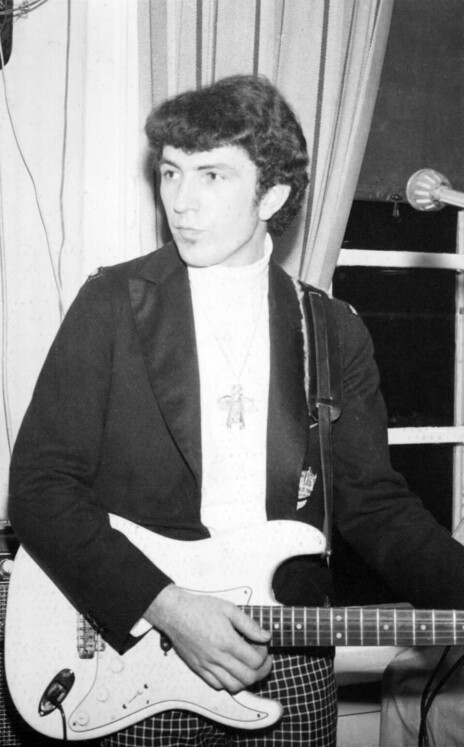
Sid Limbert on guitar, 1967. - Sidney Limbert collection
“So, he used to come around to my mum and dad’s house on Saturday mornings. He was a guy who had no teeth, they’d been smashed out, rough as guts. He loved me with a passion, this dude. Anyway, he showed me a lot of stuff. I learned a lot of stuff in those days. He used to come around, and he’d knock on the door and say, ‘I’ve come to see Sid.’
“My dad used to buy a lot of shit at auctions and stuff, and he’d bought a radiogram with a tape recorder in it, and a tape recorder. Junior had heard how Les Paul recorded onto one and then played it back and would play it again on to the other one. He played that song ‘America’ [from West Side Story]; he played the rhythm part and then two or three guitar parts. It showed me how it could be done and how Les Paul did it.
“Junior went away to Waikeria Prison for several years, but I met him years later. I was doing a Telethon. I was up on stage. He’d brought all his kids and grandkids up to be able to play, and he had this huge whānau there. And he saw me up on the stage and he started to cry. He was going, ‘Oh, you’ve come so far, man’.”
How to alienate a young musician
“I’d been in Stebbings a couple of times, in their former studio, which used to be in Eldred Stebbing’s … under his house. That was where I recorded with The Surfires. John [Shade Smith of The Rumour] and I had worked out this thing. He said, ‘I want you to play this.’
“So, I learned it and we got in the studio, and [English engineer] John Hawkins, he had everything ready and he said, ‘Okay.’ So, away we went and I played this thing. And all of a sudden, ‘Stop!’ And he comes in the studio, and he stands there looking at me.
“You know, I’m 18 years old, never had any of this sort of thing. And he says, ‘That’s the most amateurish thing I have ever heard. You’ll have to do better than that.’ And he turned around and walked out. I was shattered. So, I learned then, never do that to somebody. You know, there are other ways of saying, ‘It’s not quite happening.’”
In the navy
“My whole life I’d wanted to join the navy; I wanted to be a sailor. So, I’d applied to join the navy. All of a sudden, my call-up came right in the middle of when we [The Ways And Means] were doing really well in Auckland. We’d just scored another gig at the Monaco.
“So, I had to sit the boys down on a Sunday afternoon and say, ‘Hey, listen, I’m sorry, but tomorrow morning I’m flying to join the navy.’ And Clive [Coulson] abused me. He said, ‘Have you seen those wankers down the street in their uniforms?! You don’t wanna be one of them, do you?!’
“Anyway, I didn’t last long in there. After about a week I wanted to get out, but I’d signed up for eight years. Well, we spent two weeks and then you go and sit in this room, and they tell everyone, ‘If you don’t wanna do it, stand up and just leave the room now and everything’s okay.’ I thought, ‘No, I came here to bloody join.’
“I just wanted to get out of there. It was such a process, but I managed to get out. I spent three months there. And, again, it wasn’t all bad. Some of it was good for me, and I learned a lot about human nature, too. You give someone a badge and they can be quite nasty, and they’re allowed to be. I didn’t like the navy, and the navy didn’t like me, basically.”
Exit The Surfires
“We [The Surfires] used to pair up with other bands to make things work for everyone, and there was a band called The Exit. And their lead guitarist was Billy Rangiawha, the guy that taught me the very first thing on guitar. I hadn’t seen Billy for years; since primary school. They lived just up the road from town, so we used to always end up at their place, this flat, and party, party.
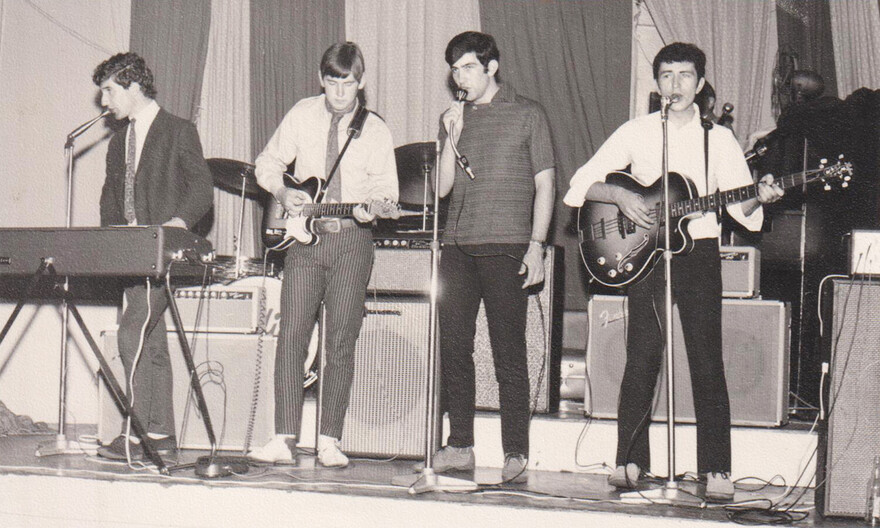
The Surfires at the Starlight Ballroom, Hamilton, c. 1966/67. From left: Shade Smith, Wayne Reynolds, Gerard Smith, Sid Limbert, Sharky Coolan (drums) obscured. Shade and Gerard Smith later formed The Rumour. Wayne Reynolds had been in The Mods. - Sidney Limbert collection
“So, playing with The Surfires, they were very straight Catholic boys. Not that I’ve got anything against Catholic boys, but they were very straight Catholic boys. They all worked in banks. Gerard [Smith] was a teller in Hamilton, Sjaaki [Koolen] was a teller in a different bank. Not that there’s anything wrong with that. Shade [Smith], he went to university and he was quite intellectual. While the rest of the boys were running around trying to get laid, Shade was more interested in finding a girl that would listen to a good poem.
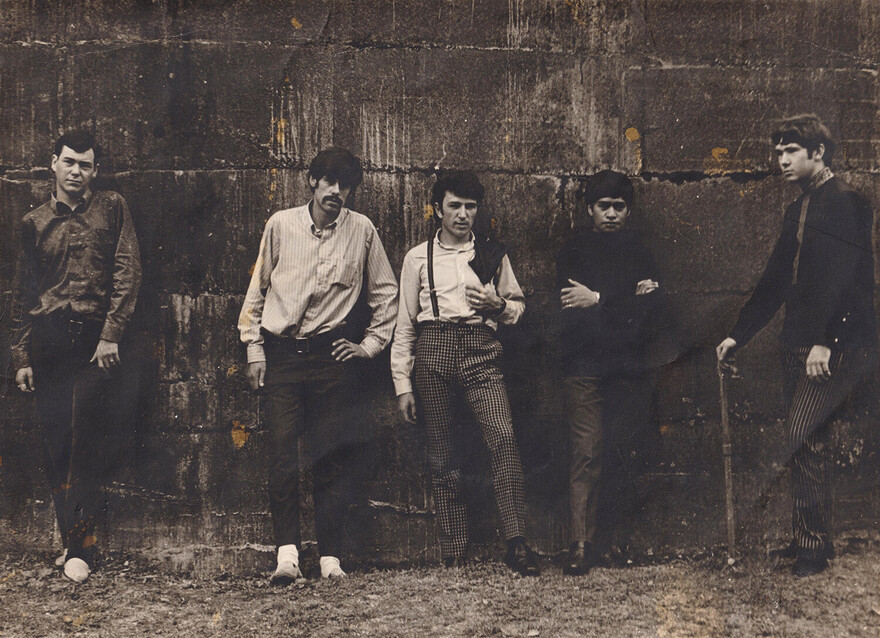
The Exit, 1967 (L-R): John O'Donoghue, Greg Banks, Sid Limbert, Billy Rangiawha, Murray Armstrong. - Sidney Limbert collection
“Anyway, I found that I was having more fun with the other band and so I arranged for the bass player in The Exit to join The Surfires so it wouldn’t be too much of a thing. And he’d heard a lot of the songs anyway. So, I told the boys I’m leaving, and Shade said, ‘Why are you leaving?’ And I said, ‘Well I don’t seem to have much fun in this band. I have more fun in the other band.’”
Joining The 1953 Memorial Society Rock’n’Roll Band … on saxophone
“The 1953 Memorial Society Rock’n’Roll Band had a gig in Auckland for the architectural students finishing up. Robbie Lavën said, ‘Could you play with us?’ And I said, ‘Yeah, okay. I know all the songs.’
“So, Robbie came and picked me up. I chucked my bass in the back of his car and off we went to Auckland. We got there, I pulled my bass out of the car, and he pulled a tenor sax case out, handed it to me and said, ‘You’re playing the tenor tonight.’ And I said, ‘Eh?!’ Mitch Park, the bass player turned up and I said, ‘Hang on a minute.’
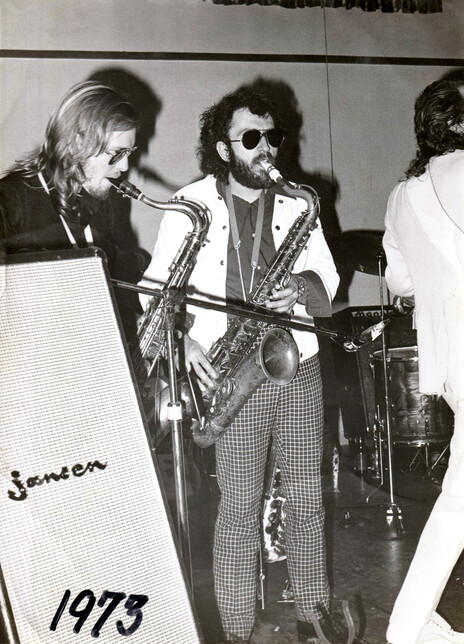
Sid Limbert on tenor saxophone in the 1953 Memorial Society Rock n Roll Band. - Sidney Limbert collection
“And, so, Robbie said, ‘I bought the sax for you. It cost $250. You get $75 tonight, we’ve got another gig next Friday night, so you get another $75 there, and then another gig … and, so, then your saxophone will be paid for, and you can decide whether you wanna stay with the band or leave.’ I said, ‘Jesus, Robbie!’
“I’d had a few squeaks on one of his horns at one of the gigs and I’d played ‘Can’t Take My Eyes Off You’. I used to fiddle around at school with all the different instruments, but I hadn't played sax for years. So, I went into the toilet, and I tried to play the one, six, four, five notes in a few different keys so if I knew where the chords were going, I could sort of … I got through the night and quite enjoyed it, so I joined the band.
“We did gigs in Wellington and all over the place. It was quite amazing. Rick Bryant made me feel a bit funny. He asked me how long I’d been playing, and I said a month, and he said, ‘I’ve been playing for five years and I’m not good enough to play on stage yet.’ That was just Rick being Rick.”
The Parapara road with Midge Marsden’s Kiwi Connection, 1980
“Our first gig was [Oceanview Rock Concert] in Whanganui. It was about a five-week tour. That first gig, there was Split Enz, there was Russell Morris from Australia, Phil Manning Band from Australia, who Midge had been playing with. There was a lot of quite big names. But we didn’t make it to the first gig.
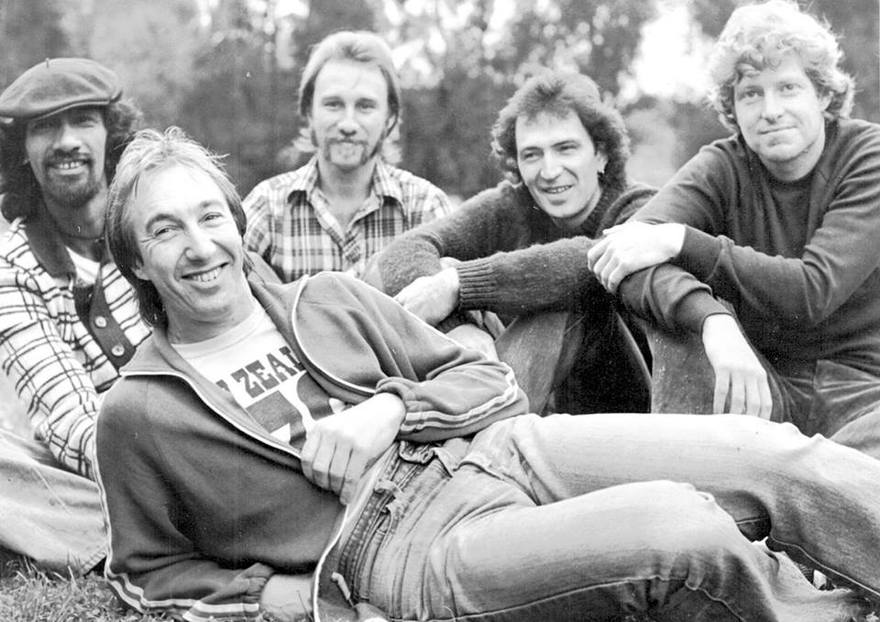
From the Kiwi Connection tour, 1980. From left: Sonny Day, Ray Chaber, Sidney Limbert, Bruce Dennis, and Midge Marsden in front. - Sidney Limbert collection
“The sound guy and the lighting guy had a trailer which was way overloaded, and there’s a road called the Parapara, and it’s like a snake going down to Whanganui. And we came around this corner and here’s the roadies’ van parked across the road, and the roadies standing right in the middle of the road.
“And we pulled up, ‘What’s going on? Where’s the trailer?’ ‘Down there.’ And way down there, there was a tree, and the trailer had caught up on this tree, otherwise it would have kept going, and there was a river way down there. So, we’re all standing around the top of this thing, and I remember Sonny [Day] saying, ‘Ho-ho-ho, paying the dues to play the blues.’ He said, ‘That’s our tour down there.’ And I thought, ‘Yeah, he’s dead right.’
“Anyway, people started turning up. Fortunately, some Māori guys turned up from a marae which was up the road somewhere and they had these huge, big ropes, and they said, ‘You might be needing these, boys.’
“So, I took Bruce [Dennis] and we climbed down this bloody thing and got to the trailer and it was all bent and twisted. We ripped the back open, the aluminium, and started pulling the … We had 4560s, you know, those big JBLs? So, we had four of those in there.
“And I’d been working as a fisherman in Raglan and was pretty good with knots and ropes and things, so I made these sorts of harnesses and tied them up, and the boys and all the crew up top hoisted them up one at a time.
“And I remember standing there looking up, and Bruce Dennis saying, ‘I hope your knots are good, because if they’re not, we’re dead.’ And we would have been. We would have been just squashed. There was nowhere to go. Anyway, it took us nearly all day to unload this thing.
“Somehow, we got another trailer sent out or something, and, so, off we went to the gig, finally, absolutely trolleyed from the whole ordeal. And we had to be at the gig two hours before concert time and we got there one hour, 50 minutes prior, and they said, ‘Sorry, guys, but you’re late. The contract states quite clearly …’”
Ready Freddy
“I’d booked a gig for a 21st birthday for this family. We’d done about four of the kids’ 21sts, so we were sort of part of the family by that stage. And I’d had a call from the drummer to say he couldn’t make it. This was on the day. So, I started ringing around all the drummers, and I spent the rest of the day, and I couldn’t find a single one. All the guys would say, ‘Try so-and-so. He might be available.’
“It got to about six o’clock at night and I rang Dave [Maybee] and I said, ‘Mate, I can’t find a drummer. We’re gonna have to do it without a drummer.’ And [son] Freddy piped up and he said, ‘I’ll play, Dad!’ He was eight. He was the star of the show. He did a solo about 11 o’clock and everyone was crowding around Freddy. It was just amazing. So, he was away.”
Turning down a place in Delbert McClinton’s band
“When Midge [Marsden] had a gig at the Outback pub in London, he took Rooda [Peter Warren] with him and left Lynne [Campbell], Chris [Nielson] and me in Austin, Texas. Rooda stayed on in England. Lynne and I went round all the gigs in Austin. We had to go around and find another drummer before Midge got back. So, we had a couple of weeks of no gigs but looking for a drummer.
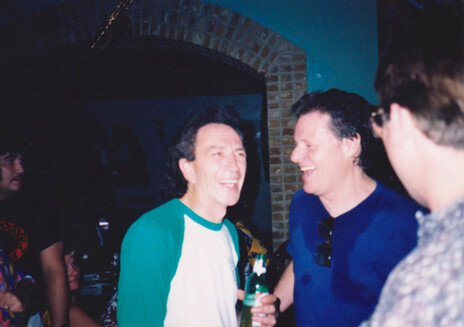
Sid Limbert sharing a laugh during a break with Delbert McClinton. - Sidney Limbert collection
“So, we found this guy, Kenny Felton, who was playing sort of jazzy stuff. Kenny informs us one Friday night – we were playing at a place called Babe’s, on 6th Street – he says, ‘I’m auditioning for Delbert McClinton’s band tonight. Delbert’s flying in. He’s staying at the hotel just down the street.’
“Anyway, middle of that first set, see Delbert come through the door, and he walks right up, right in front of the band and sits right down there. And Midge is going, ‘Oh, fuck, man, what do I do?’ I said, ‘Just do what you always do.’ ‘Oh, fuck, that’s Delbert McClinton.’ I said, ‘Yeah, and you’re Midge Marsden.’
“This bar had windows that opened out into the street, and Delbert got up and went out and was standing on the footpath behind the band. So, when we took a break, Jim [Rowe] said, ‘You’d better have a word with Delbert, man. He said to me that he’d have you in his band in a heartbeat.’ I said, ‘Really?’
“Next thing, Delbert came over and he said, ‘Hey, Sid, I’ve been watching you, man. I love the way you play. You know something …’ And it was the biggest compliment I ever had. He said, ‘I ain’t heard a guy in the whole USA who plays like you, man. I’d have you in my band anytime.’
“We stayed on with Kenny and eventually finished up in San Diego. Kenny and I were sharing a room at the Holiday Inn and the phone rings and it’s Delbert. So, he’s checking with Kenny, because he was flying from there to Nashville. He says, ‘Is Sid there? I want to offer him a gig.’ He hands me the phone and I said, ‘You just broke my heart. I haven’t seen my wife and family in nine months, man, and I’m going home tomorrow. There’s no way I cannot go tomorrow.’ I said, ‘What if I go home and then come back again?’ He said, ‘Well, I need a guy right away.’ So, that didn’t happen, but it was that close.”
Becoming The Remarkable Beat Roosters
“My friend Noel Coutts, a great songwriter and singer, said, ‘Listen, Sid, I’ve got a gig that I can’t do on Friday night. I wonder if you and Freddy and Brian [Harley] can maybe put something together and play.’ I said, ‘Oh, shit, Noel, what kind of gig is it? We haven’t got a repertoire or anything.’ He said, ‘It’s just high-school kids. I played for their party last year and for some reason they asked me to come back, and I can’t make it.’
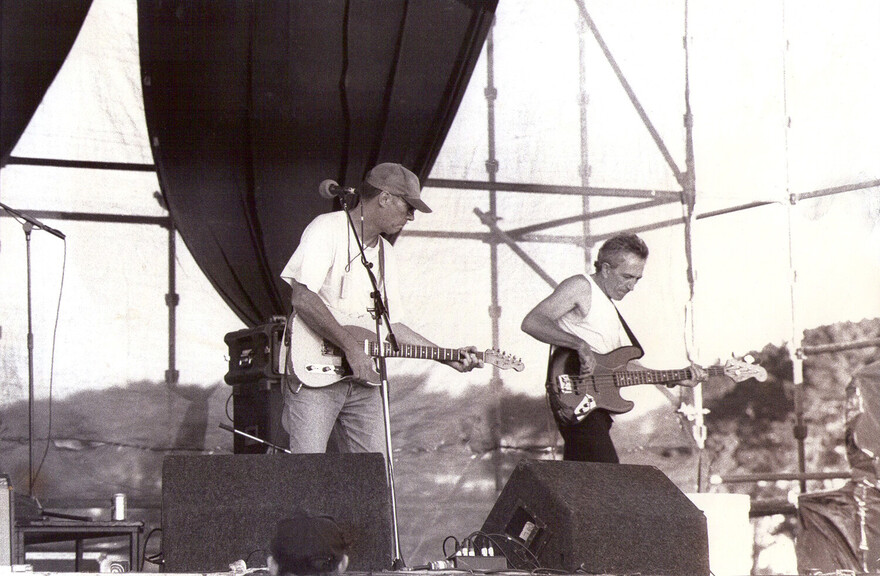
Mike Farrell (left) and Sid Limbert with The Remarkable Beat Roosters at Sweetwaters 1999. “It was Mike’s last big gig,” Limbert said. “He had just joined The Beat Roosters, and we’d been rehearsing a new album with mostly Mike’s songs, and a couple of Ted Clarke songs. We came off stage after a fantastic set to find The Amazing Rhythm Aces in our tent raving about our band.” - Farrell Family Collection
“So, the lady rang me up on the phone, she said, ‘What do you call yourselves?’ I’ve got a nickname, the Rooster, that young surfers gave to me. They call old people roosters, and I was the oldest surfer out there, so they called me the Rooster. So, I said, ‘Oh, we’ll just call it The Roosters.’
“So, we get there and we set up, and people start arriving, and all these girls start arriving really overdressed, and it was the school prom! The headmaster comes over and he’s like, ‘I’d like some strict-tempo stuff. So, I’d like you to start with a Veleta.’ I said, ‘I’ve been playing for nearly 40 years, and I’ve never been asked for a Veleta. I know what it is and I know how it goes, but these guys wouldn’t. Do the students know what a Veleta is?’ He said, ‘Yes, they’ve learned all the dances. They do the tango,’ he starts raving on. I said, ‘We can’t play those sorts of things. We’ll just play what we can play.’
“So, I was dragging up songs from my memory bank from all over the place. I’d just play them and Brian would just follow them, and Freddy’s been playing with me since he was three years old. We got through half of the night and bullshitted our way, but everyone was quite happy. We had sort of a talent quest and they just loved it. The headmaster came over at the end and said, ‘That was amazing. I’ve never seen the kids enjoy a prom like this.’
“That was how The Beat Roosters got started. About two days later, Brian and Freddy walked into the house, and Freddy said, ‘We’ve got all these gigs booked.’ And I said, ‘Wait a minute. Who’s this?’ And he said, ‘Us three.’ I said, ‘We haven’t even got a repertoire. We can’t do those gigs.’ He said, ‘They’re booked anyway.’ So, away we went.
“So, we played probably for about a month and I kept adding songs, and all of sudden we became the most popular thing in town. Brian said, ‘I played in a band in Auckland called The Beat Roosters, but you can’t use it because it’s already been used.’ And we were driving past the Remarkables on our way out to the gig and I said, ‘Oh, we’ll be The Remarkable Beat Roosters’.”
--