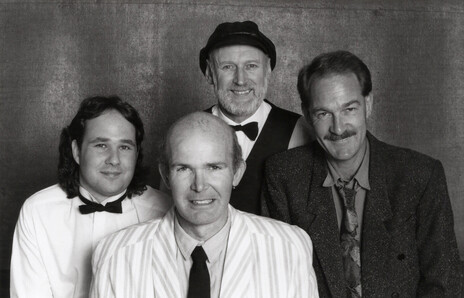
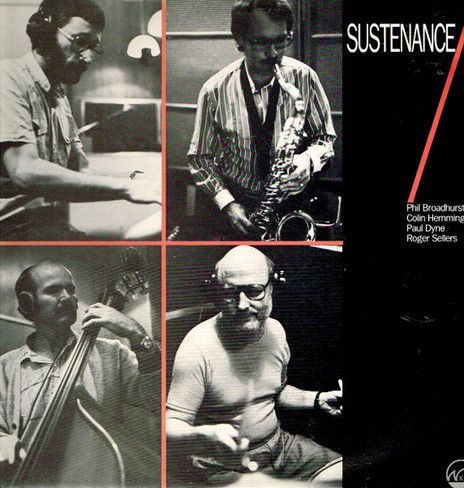
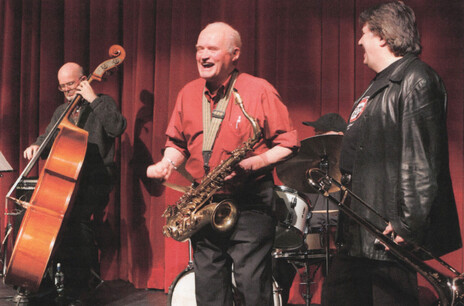
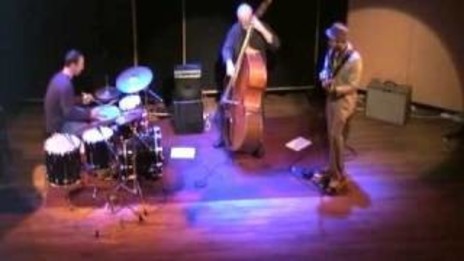
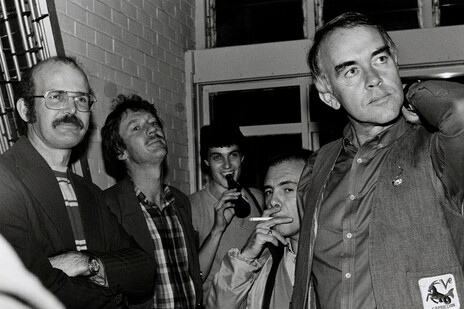
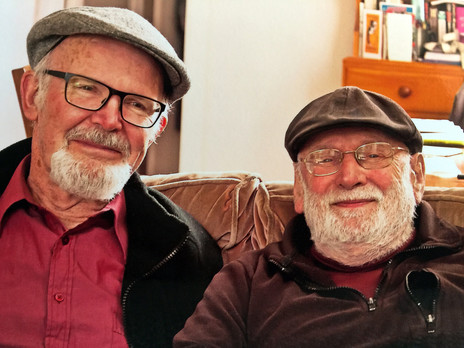
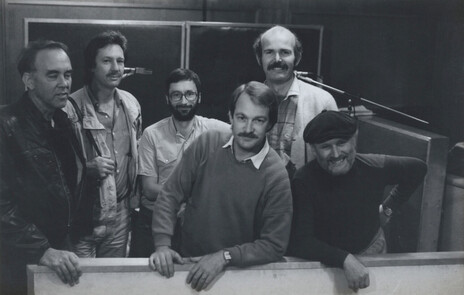
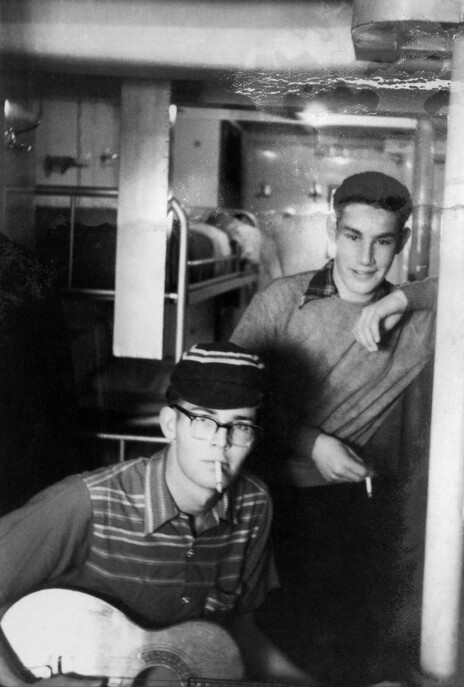
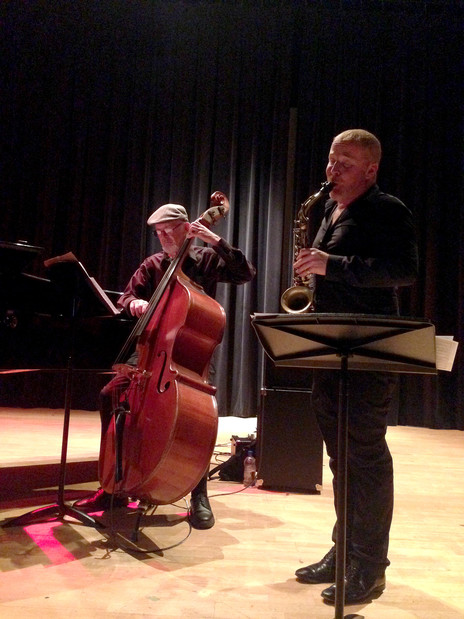
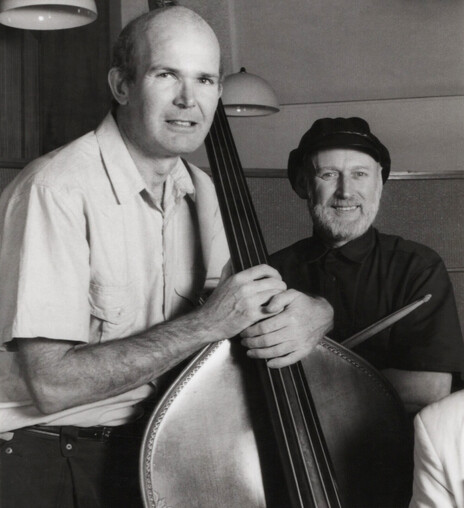
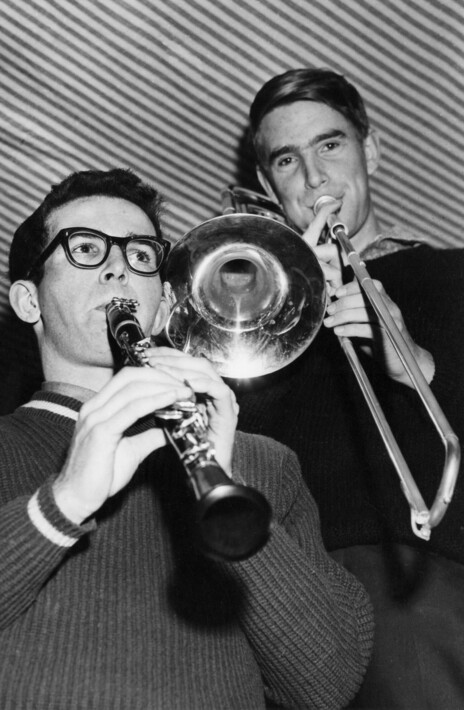
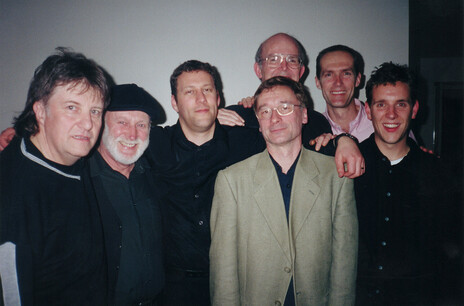
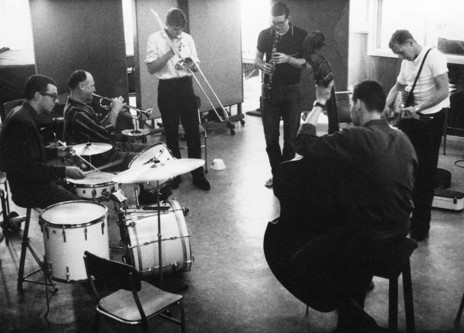
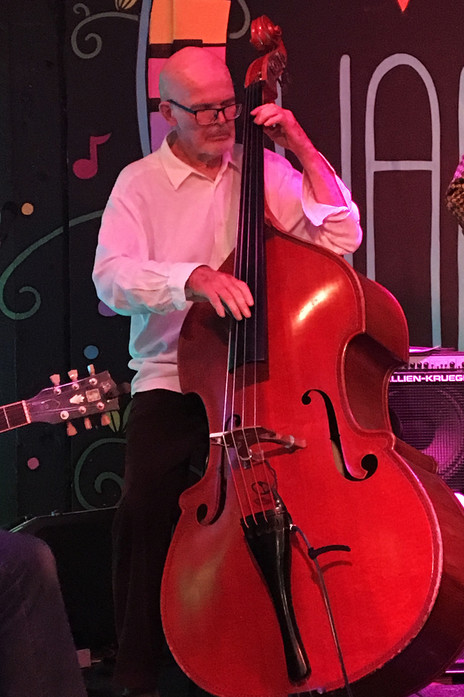
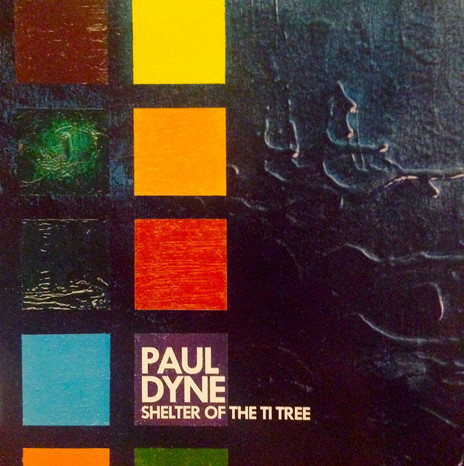
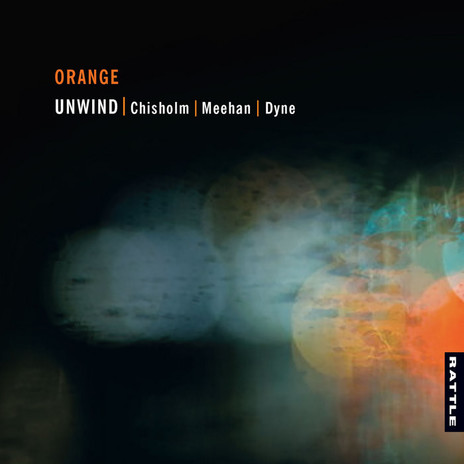
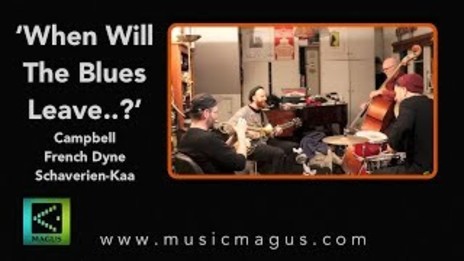
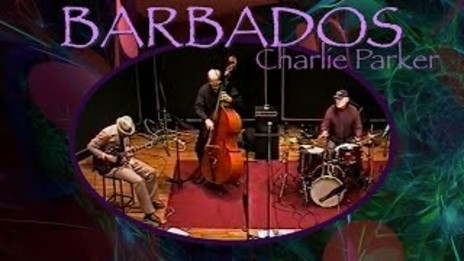
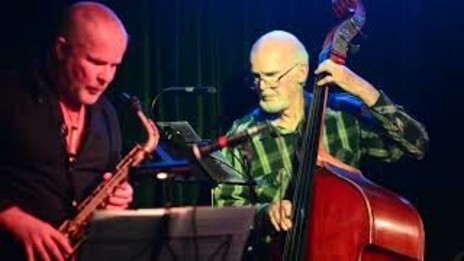
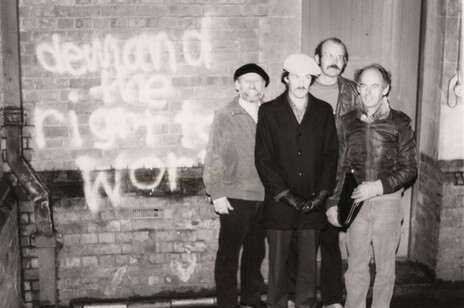
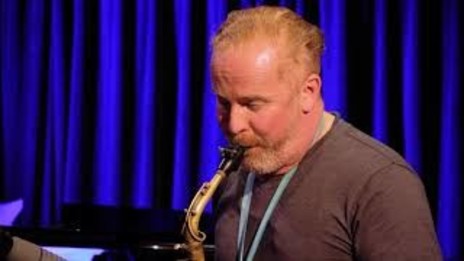
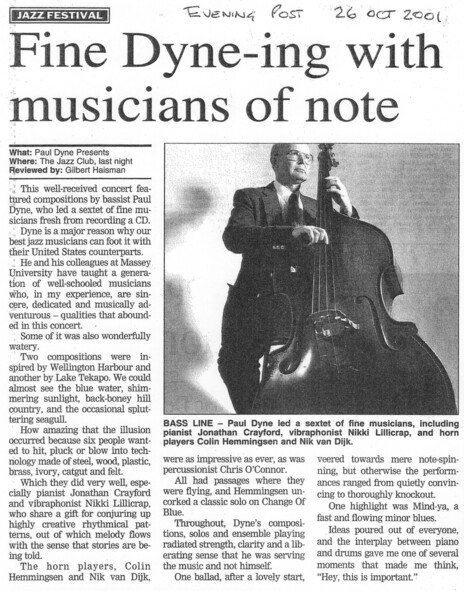
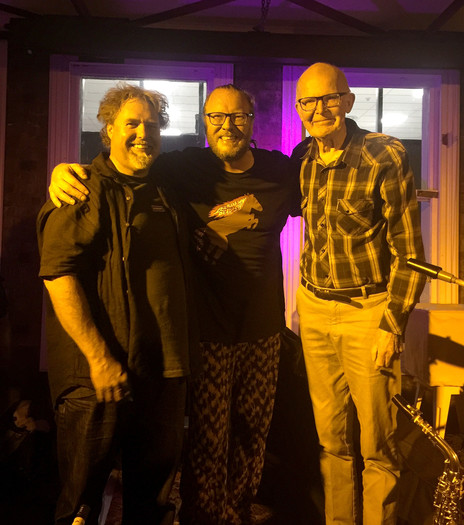
Dyne has recorded his own compositions and those of contemporaries. He made several collaborative recordings with taonga pūoro expert Richard Nunns, and among his most recent work are performances and national tours with new-music group Unwind, featuring Norman Meehan, Europe-based New Zealand saxophonist Hayden Chisholm and, when available, his son Julien Dyne on drums.
Of all the notable musicians Dyne has worked with, Roger Sellers name stands out
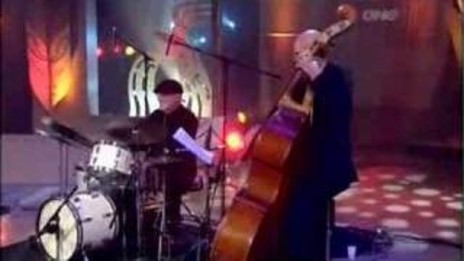
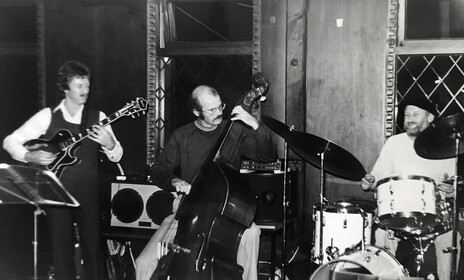
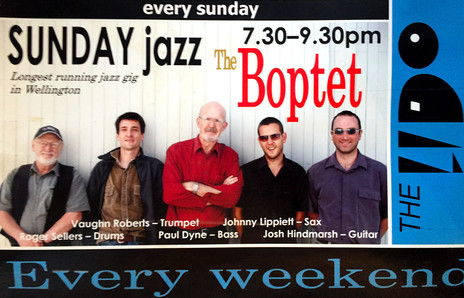
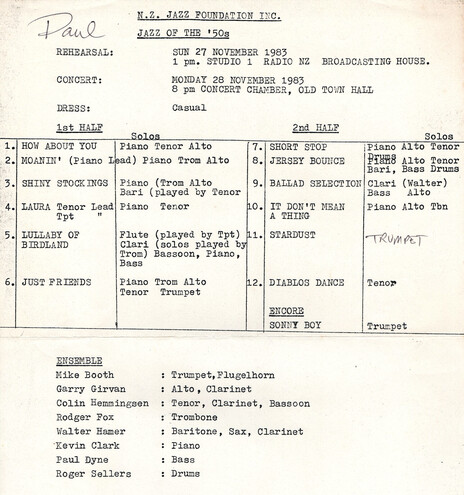
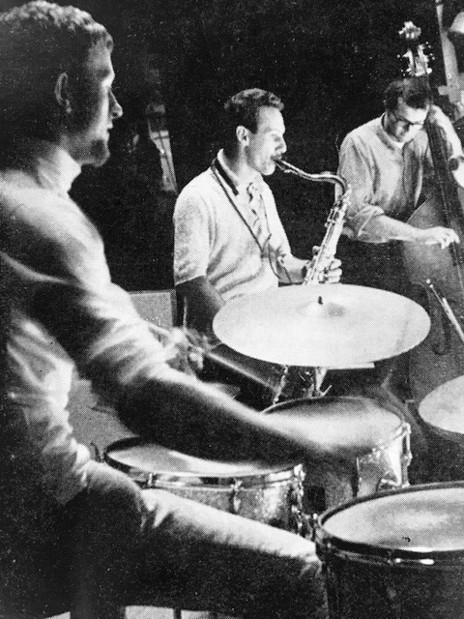
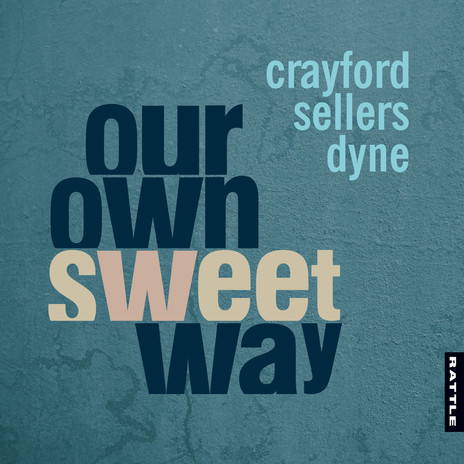
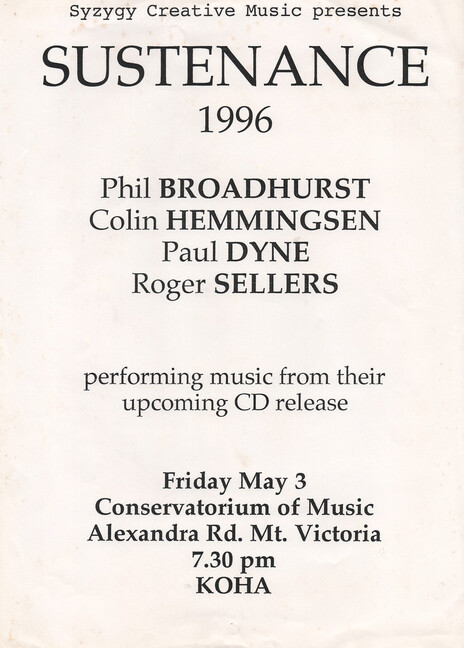
Of all the notable national musicians Dyne has worked with (Rodger Fox, Mike Nock, Jim Langabeer, Aleister Campbell and Terry Crayford, and many more), one name stands out: preeminent jazz drummer Roger Sellers, who died in 2018. Their musical partnership and friendship stretched over 25 years. Melbourne-born Sellers had drummed and toured in various ensembles internationally. He played gigs and festivals in Europe with Nucleus and worked in key London jazz clubs before landing a prime gig in the house band at Ronnie Scott’s. Dyne and Sellers met at Wellington’s Cricketers Arms hotel after Sellers returned to New Zealand on Rodger Fox’s invitation. They hit it off musically from the start.
The pair also had a 22-year residency at the Lido bistro in Wellington, were a tight session unit at RNZ, and daytime colleagues at the NZSM where Dyne predominantly taught jazz bass, jazz theory, ear-training, and improvisation, but also on occasion history, musicianship, combo and keyboard lab. In the Stuff obituary of Sellers, Dyne says, “We were kind of like the engine room for a whole lot of groups.” Live, Sellers was “… a master of deep swing jazz drumming … It was the kind of playing that made people want to dance. He could keep time like no other drummer I know.”
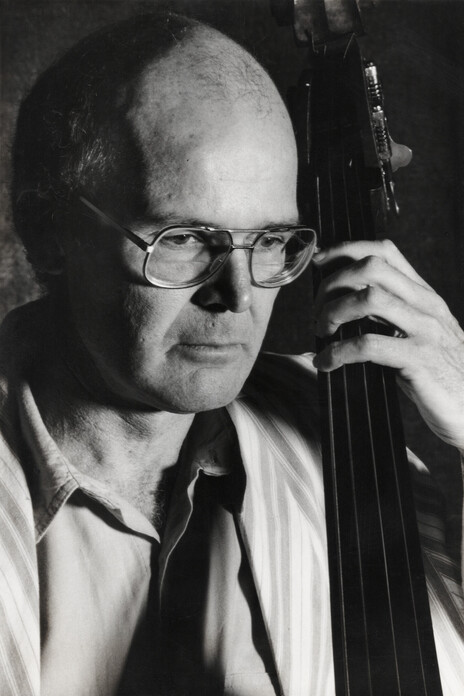
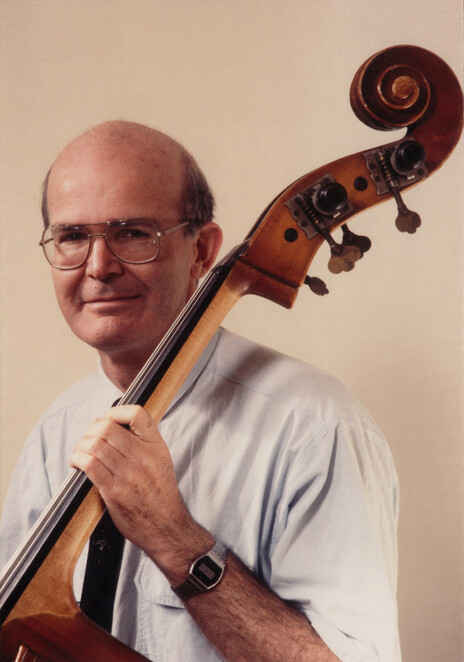
Largely self-taught musically, Paul Dyne has been seen most often with the tall timber of the string section – his long-time fascination, the double bass – but it took some years before he found this as his true musical anchor.
Born in Christchurch in 1942 and raised in Timaru, Paul Dyne grew up to a background of radio tunes, his mother’s piano and the musical all-sorts on his auctioneer father’s short-wave radio, including big bands on the Voice of America network. Melodies piqued his interest early on; he enjoyed working out pop songs on the chromatic harmonica he urged his parents to buy for him after he saw a movie about a lonely boy attracting friends with his harmonica.
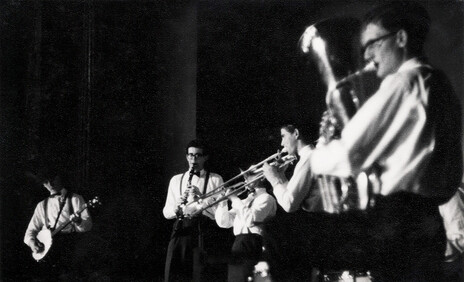
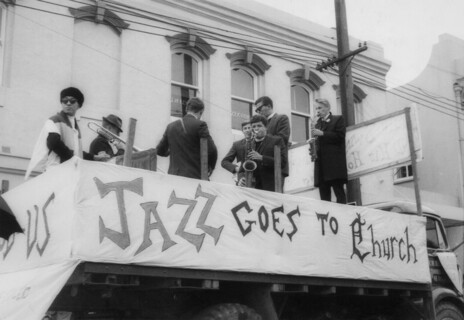
As a musician-to-be, he aced it when Waimataitai Primary was chosen as his first school. This had the rarity of a full marching brass band like the works bands in England. His mate, A G “Tony” Lewis, later a well-known Canterbury trombonist, was in the band and already owned a trombone. He told Dyne they would let him in if he turned up with an instrument, which they did after his parents found him a cornet-trumpet hybrid.
With this he taught himself rudimentary sight-reading by pencilling numbers on the music correlating to each note’s fingering. Although his facial muscles and embouchure were struggling with the practice required, he persisted, not wanting to miss out on the ice-cream Tony’s father bought for all the band after its Saturday morning marches around the town. These were his first experience of playing in public, and the band music had a foretaste of what he would later spend his days pursuing.
“Marching band music is mostly 6/8,” Dyne says, speaking from his Wellington home, “but there’s a hint of jazz there and you can see where that ended up in New Orleans when the Black people picked up the brass instruments left behind after the American Civil War. March music is almost hinting at swing, and people stomp along and bring it back to 4/4, so to speak, or 2/4.”
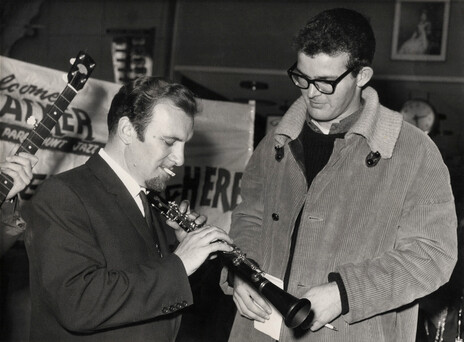
He tried various instruments at school: a cowboy guitar, the piano, recorder, clarinet ...
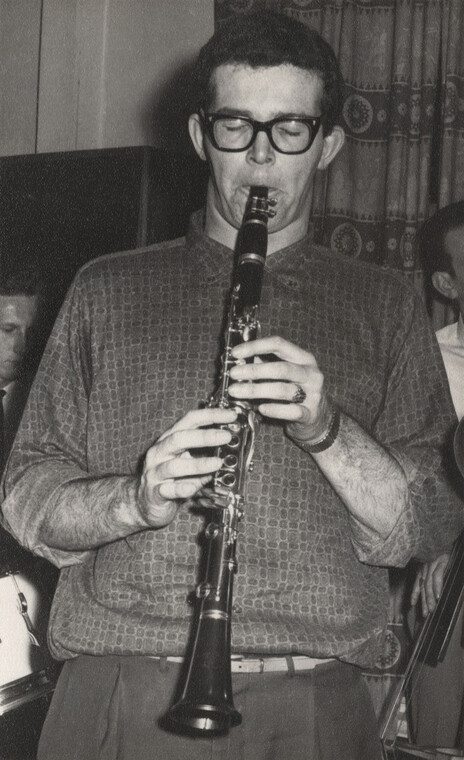
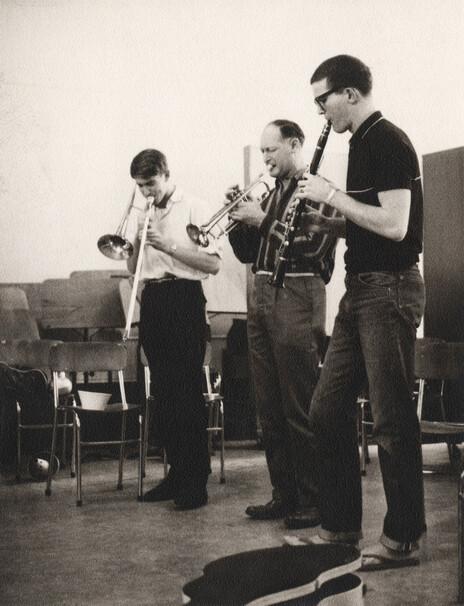
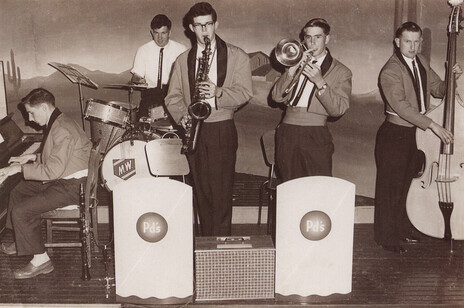
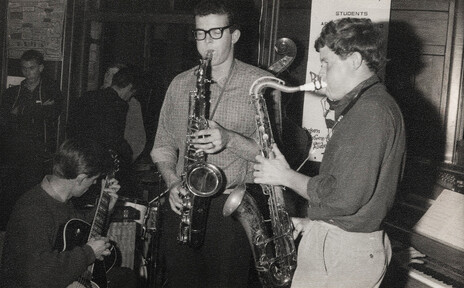
He tried various instruments through school years. There was the old cowboy guitar he found at the auction house and he enjoyed working out his favourite pop tunes by Elvis, Little Richard and so on, on the piano. At high school he joined the recorder band and it was a relatively easy transition for him onto clarinet and later saxophone; the two instruments use the same Boehm fingering system as the recorder. The move to clarinet had been inspired by seeing The Benny Goodman Story biopic, and by then he was spending more and more time tuning in to radio stations with jazz and, with Tony Lewis, played along to the jazz masters. As their repertoire expanded, other nascent musicians joined them, including John Densem on piano, Lex Sinclair bass, and Mel White on drums.
“I’d had about a year on clarinet by then, and when my mates knew their parents wanted to have a little band we’d go along and play. We probably only knew three or four tunes, so we played those tunes. It was semi-professional, because we often got paid 30 shillings or £1, which was huge then.”
The clarinet and the tenor sax he bought later – with part-time work at the auction house and his father subsidising – would be his musical armoury for some years. “The day I bought the sax, I did a gig. It was a church dance at the St John’s Anglican Church Hall and I couldn’t get the bottom three or four notes, but I was able to play most of the tunes that Tony and I had learned.”
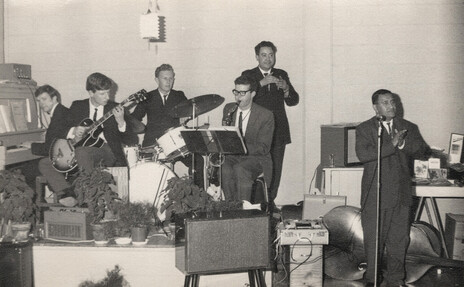
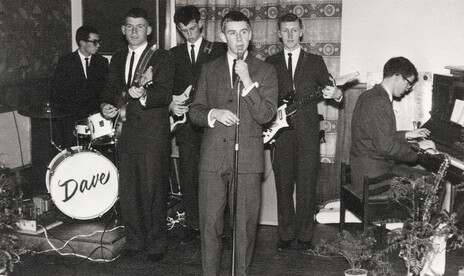
Their band morphed into the “PDs” in his sixth form year and they gained a regular spot at the Hacienda club in Timaru. Music was now taking up the bulk of his spare time and while he sensed his father might have, perhaps, wanted him to have followed his own rugby-playing career, he was surprised later at what he found after his father’s death.
“I spent a couple of weeks helping Mum and found all these little Dictaphone tapes with a whole bunch of my radio programmes on them. He’d obviously sat up at night and not only listened to them, but recorded them. When I found that, it was like the sun rising. I thought, oh, he was interested and possibly even proud.”
In his seventh form he gained an American Field Service Scholarship (AFS) and spent a school year at Burlington Free High School in Wisconsin, billeted with a family whose son was a trumpet player in the school’s concert band. Dyne joined him in the band with his tenor sax. “The first hour of every morning was either choir, the concert band or the marching band. Five hours a week of total music. A lot of the concert band material was semi-jazz and a lot of the marching band material was popular songs turned into march music.”
His American “family” took him to hear the Dave Brubeck Quartet and at the end of the year he and the other AFS students were presented to President John F Kennedy at the White House. On the way he had been billeted in New Jersey with another jazz-loving family, who took him to a club in New York where the Dixieland swing drummer Cosy Cole (“Topsy”) was playing. “I think Gene Krupa had a band there as well, but it might just be a fantasy of mine.”
While in the US, he heard the Dave Brubeck Quartet and met President John F Kennedy
Before he moved to Christchurch to attend Canterbury University, Dyne auditioned for a touring opera company’s orchestra for Die Fledermaus. He could read music by then, but his burgeoning style was more jazz aligned than classical and he missed out. “I played a lot of things that were not considered au fait, but if I had got it, I would’ve toured with that orchestra and then done a classical degree.”
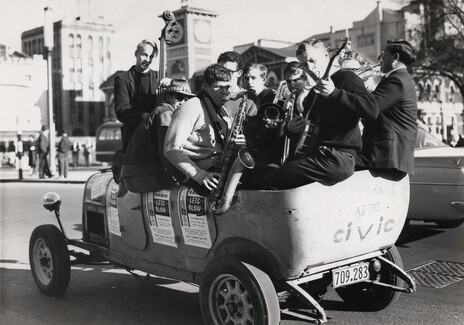
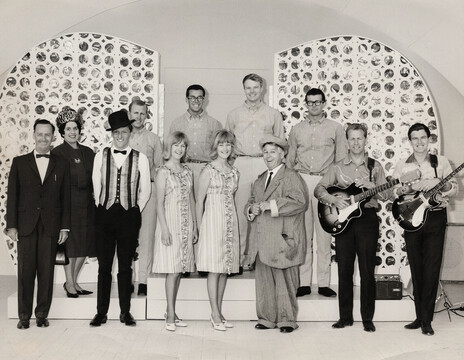
Also at university with Dyne was Neill Pickard, another Timaru musician and educator who later founded and headed CPIT Jazz School at Christchurch polytechnic (now Ara Institute). They started the River City Stompers with Tony on trombone, (New Zealander) Les Brown on trumpet, Dyne on clarinet, Pickard on banjo, Dave Innes on drums, and bass player Pim Terhuppen. “I’ve still got a tape somewhere of our radio stuff, but we didn’t make any recordings.”
Dyne, Pickard and Innes also played in Lloyd Scott’s pop-covers band, Lloyd and the Undergrads. Dyne was by now getting more work outside of university on clarinet and sax, but everything changed when they decided to resurrect the defunct university jazz club. Hidden away in a forgotten cupboard was a double bass.
“I pulled it out, started playing it and kind of fell in love with it. There were a lot of good sax players in Christchurch – for example Stu Buchanan, Geoff Low, Dennis Bryson – and I thought even if I practise I’m never going to be as good as them, but I like the bass, so I’ll do that. Somebody told me they were selling this Czechoslovakian bass for £40 [40 pounds sterling, or $2100 in 2026], and I bought it. It’s got a proper spruce top and bass neck, so it looks exactly like a bass, but the sides and back are plywood. Presumably, the flat backs are not quite as good as arched backs, but it’s always had a good sound. All the early recordings I did with Doug Caldwell and the huge amount of radio work I did in Christchurch were on that bass.
His first double bass had a proper spruce top and bass neck, but plywood sides and back
“I left it in the attic in my parents’ place in Timaru when we went to Montreal in 1970 and it was still in tune when I pulled it out seven or eight years later. There was just a tile roof with a bit of black insulation paper and my bass sat on top of the insulation. I didn’t even loosen the strings. It was remarkable that it hadn’t exploded, because of the glue and so on. I brought it to Wellington and had it in the studio for teaching and playing when I gave lessons, and when people like American bass player Tom Warrington came out without a bass they borrowed it. Tom got a much better sound than I ever could. I still have it and leave it in [holiday home] Tekapo so I can play it down there when we go.”
In early 1967, after graduating, Dyne and mate Bruce King hopped on a boat and headed to the US, Dyne in search of live jazz and King looking for folk music. Dyne’s catholic taste saw him enjoying some of the top folk performers, too, such as Peter, Paul and Mary, and folk revivalists the New Lost City Ramblers. But the highlight for him was witnessing a Miles Davis Quintet gig featuring pianist Herbie Hancock, Wayne Shorter on tenor sax, bassist Ron Carter, and drummer Tony Williams. It was a set so affecting, he told NZ Musician, that “… I had to leave after a while as I was actually shaking; my whole body was shaking with the intensity.”
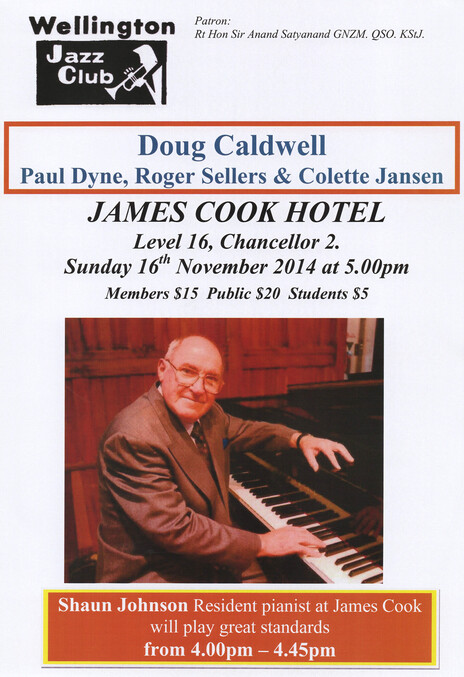
On his return, Dyne married Jane Johnstone, also a Masters graduate, and in early 1968 did a post-graduate year at Teachers’ Training College. He taught at Cashmere High School and played nights in Doug “The Maestro” Caldwell’s band at the Malando Restaurant in Colombo Street, where touring musicians often dropped in after their own concerts at the nearby Christchurch Town Hall. Caldwell’s trio, with Bas Carroll on reduced-kit “cocktail drums”, was Dyne’s first fully professional gig and at that time pianist, composer and arranger Caldwell was the only full-time professional musician in the city. Dyne absorbed much about chordal invention by watching Caldwell’s hands like a hawk and leaning into Caldwell’s arrangements.
“I’d only just got married and I remember Jane looking me in the eye saying, ‘You love that *$%# bass more than you love me!’” He laughs. “Just married and I’m out every night, seven till eleven. Doug gave me all his radio work, because George [Campbell] had moved on. That was amazing, all of it. Before that, I’d done the gig with Stu Buchanan on Saturday nights at the New Brighton Shoreline cabaret with Stu on sax, Kevin Nicholl guitar, and Dave Innes drums.”
After teaching for a year, Dyne and his wife moved to Montreal in 1970. They lived there until 1980, Dyne working at Vanier College, an intermediary school between high school and university. Jane Dyne continued in applied research in clinical psychology through a job at Jewish General Hospital. They took out naturalisation and soon the first of their three sons arrived. Music there was a major part of Dyne’s day and night life. The college’s jazz programme regularly featured teachers, such as big band arranger and movie composer Al Baculus and others who had played with such major artists as Ella Fitzgerald and Charlie Parker. After Dyne began working at jazz club L’Air du Temps, his playing began attracting attention and he became the on-call bassist for touring musicians such as Claude Ranger, Alvin Queen and Billy Robinson aka Jathiya A. Samad.
While living in Montreal, a highlight was a playing a week’s gig with saxophonist Sonny Stitt
The highlight of these experiences for him was a week’s gig with saxophonist Sonny Stitt. The drummer was Marvin Jolly, who had worked with US jazz organist Shirley Scott, and pianist was Montreal’s Art Roberts. There was no rehearsal, just talking through the set list on the night and with Stitt improvising around the correct chords if he heard someone was on the wrong track. He also highlighted Dyne’s playing by featuring him as a soloist playing the melody on a certain tune each night.
Dyne told NZ Musician, “He came out to New Zealand in 1980 and a whole team of us made the trip to Auckland. After the concert I went out the back, walked up to him and shook his hand. ‘Hey, Sonny, my name is Paul Dyne,’ and his face lit up: ‘I played with you 10 years ago. I remember. It was at the Rising Sun.’ He asked what I was doing here in New Zealand and I said, ‘Oh, I’ve come back here to woodshed, ya know,’ or something like that. He said, ‘No, no, man, you don’t need to woodshed, you can play.’”
Come 1980, the call for the Dynes to return home was strong and various reasons contributed. “My oldest boy had just started school in a French-immersion school. He was going to be learning in French and English, but we watched him walk off with his mate and thought, holy cow! All the boys were born there, but I had this upbringing in Timaru where I joined the Boy Scouts, had a great time, and as I grew out of the Scouts I still went on bike rides down to Pareora and the gorge. Sometimes I went with just a bike, a sleeping bag roll and a bit of plastic to put over me, with a rabbit trap to try and catch a possum or a rabbit. There are eels through there, too.
“I loved all that stuff of being in the New Zealand countryside and living close to the sea. I missed that. Caroline Bay was just a bike ride away, but you could walk there from our place in Timaru. I discussed it with Jane and we realised we wanted our boys to have all that. And I couldn’t teach them ice hockey. I could possibly have taught them a bit of basketball, because I played a bit of that, but the long, snowy winters there – six months you’re in them ...”
Through their citizenship they could have stayed in Canada, and Dyne took a leave of absence from Vanier College to keep his options open just in case, before they packed and moved back, choosing Wellington for family reasons as their city base and a holiday home in Tekapo for the call of the south. “I checked out the Wellington music scene and found it very healthy. It’s also central and the New Zealand Conservatorium of Music is there.”
Returning home, he “checked out the Wellington music scene and found it very healthy”
He enjoys keeping a close eye on the current music scene by watching international voice and talent contests, and continues to expand his piano playing, learning favourite tunes from songwriters from various pop genres.
“I love a good song, especially a song that tells a little story,” he told NZ Musician. “There are songs that I just get joy out of hearing them all the time. ... On piano I’ve been learning a whole lot of Elton John songs, Jimmy Webb, ’By the Time I Get to Phoenix’, ‘Wichita Lineman’ – fabulous songs, wonderful. I’m still hoping that I can one day play the definitive solo with the right mix of melody, interest and a little bit of bebop alteration, not too much.”
Dyne’s first professional gigs post-graduation with those two legends of New Zealand, Doug Caldwell and Stu Buchanan taught him much music and the professional music arena. Like them before him, he has spent decades with countless dots, bars and time signatures shaping his life, focused on the never-ending learning that jazz and music demand, searching for that elusive perfection where melody, rhythm and invention coalesce. And observing the progress of his son Julien Dyne, a baby when they left Montreal, and now an acclaimed drummer.
--
Read more: Paul Dyne on the bass