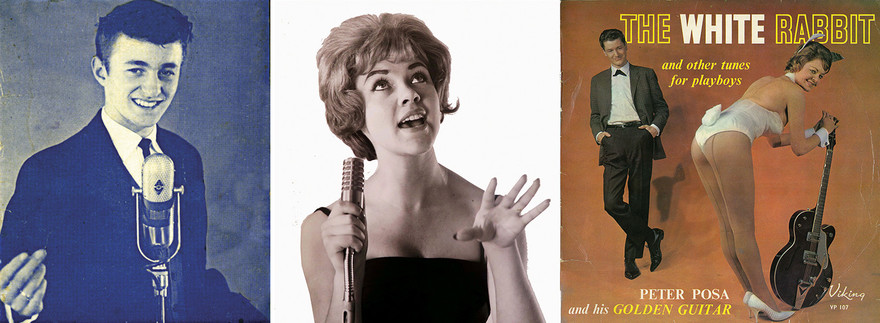
Pop goes 1963: Ray Woolf, Lyn Barnett, and Peter Posa
Fred Gebbie sets the scene: “From 1958 to 1964, I was the general manager of Phil Warren’s Prestige record label. One morning, Phil burst into my office and exclaimed, ‘Boy, oh boy – have I got a great opportunity for you!’ Whenever Phil started with a line like that, it always set off alarm bells in my head – and this occasion was no exception.
“ ‘Look, Fred,’ continued Phil, ‘Billboard magazine have just approached me to be their New Zealand correspondent. As if I’ve got all the time in the world! Anyway, you’d be perfect for it. You know more about the scene than I do. All you’d need to do is toss them a few hundred words each week. I can already see your name in lights.’”
Gebbie: “I had to admit, Phil had a point. I knew the industry well, and he was notoriously short on time even on a good day. So that’s how I became Fred Gebbie, New Zealand Billboard Correspondent.
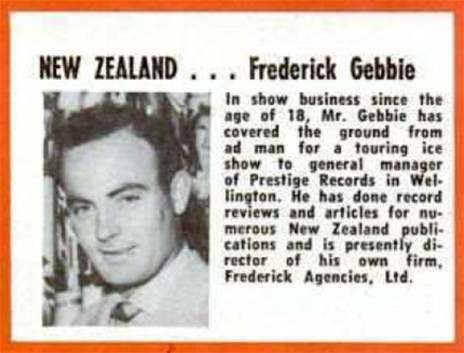
Billboard introduces its New Zealand correspondent, Fred Gebbie, 3 August 1963
“Now, I know what you’re thinking! Cushy little number with a nice little retainer, VIP press pass, free records, cocktail party invites, and tickets to shows. Yes, there was all of that, but geez it wasn’t the stroll in the park that I thought it would be. Johnny Devlin had left for Australia at the end of 1959 and pretty much turned the lights off as he left. Musically the country treaded water for the next few years.
“I had to make my bulletins worthy of inclusion in the world’s biggest music trade publication. Bugger all was happening with local artists, the only acts that seemed to be recording were the Howard Morrison Quartet, Toni Williams, and Peter Posa [before his ‘White Rabbit’ period]. I sure as hell couldn’t write about them every week. My job was to spotlight the exciting local scene, even though the lights were dim and flickering.
“Luckily for me there was a lot happening on the business side of the industry which was still in its infancy, hence I was able to report on the comings and goings of the various overseas labels and the constant changing of distributors who were all vying for opportunities, including Phil. During this period we were blessed by the amount of big overseas names touring [on the back of their Australian tours] which gave the impression that we were quite the destination. I very rarely named an overseas hit that was selling well locally because their follow-up was usually charting in other countries. We were generally one release behind, so I would mention that a certain artist was selling well here without mentioning a title.
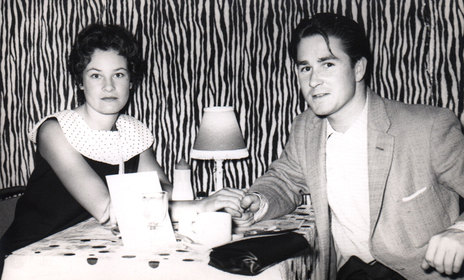
Industry gadfly Phil Warren with unknown friend, at the Monaco Club, early 1960s. - Phil Warren collection
“The big elephant in the room for me was that I had to supply a national record chart, Phil forgot to mention that one. We were seemingly the only country in the civilised world that didn’t have a national chart, that we could hang our hat on, there were a few regional radio station ones but nothing national. The Lever Hit Parade Top 5 wasn’t an option but that didn’t count anyway, the rumour that was doing the rounds in the industry at the time was that the sponsor’s wife picked the tracks – very scientific.
“So I had to start from scratch, because of my role at Prestige Records I was dealing with all of the country’s labels, retailers, and pressing plants. I got the bulk of the retailers to send me their sales figures and matched that off against the labels and pressing plant figures to make the most accurate chart possible. The only one that always tried to diddle things was HMV, they were a pack of crooks at the time, but I won’t go there. They would have everyone believing that Cliff Richard and Russ Conway alternated at No.1 for every week of the year.
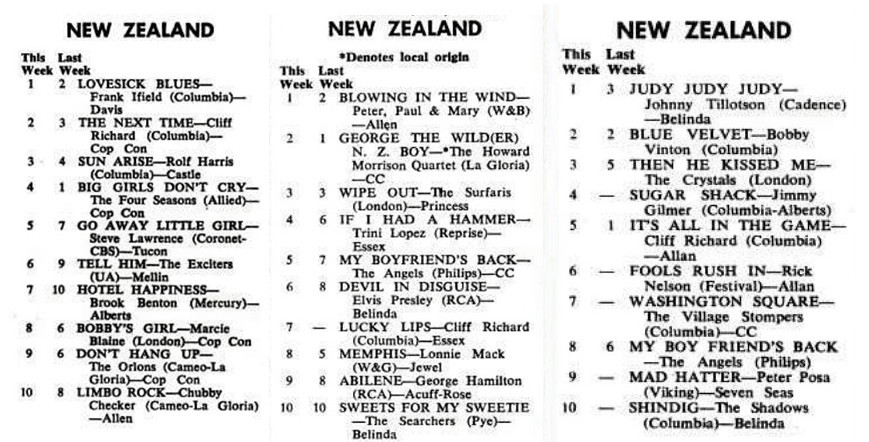
Three of the New Zealand charts compiled for Billboard by Fred Gebbie in 1963: 23 February, 26 October, 2 December
“I would say that my chart figures were the most accurate representation for several decades or whenever they went fully computerised, whenever that was. Unfortunately, while I submitted reports weekly, Billboard didn’t always publish them. They were flooded with updates from around the world, and space was limited.
“My job got a hell of a lot easier towards the back end of 1962, to the point that my bulletins were virtually starting to write themselves. ‘You could hear a few guitars twangin’ and drums a thumpin’ in the far distance.’ Then we turned the corner into 1963 and somebody turned the lights back on and it was, Lights, Camera, Action: rock’n’roll, baby!
“Is that enough superlatives for you? I can give you more if you want? Anyway I think you get the idea: the sleeping beast that was New Zealand music came alive in 1963.”
--
At first glance it may appear that Fred Gebbie may have exaggerated his story slightly, but a quick tally of all the local releases between 1960 and the end of 1962 show that nearly a third of them were indeed from The Howard Morrison Quartet, Toni Williams and Peter Posa. And to confirm the nonchalant local attitude towards the charts, Dave Wellbrock – son of Wellington jazz musician, Allan Wellbrock – recalls, “Dad was the station manager at 2YC in the early 1960s, he was a dyed in the wool jazz man, as were all of the staff at the station, they all absolutely loathed pop music, the mere mention of rock’n’roll, pop music or Elvis would have them all in convulsions. So Dad approached a 12-year-old me to put together a weekly Top 20 playlist for the station”. I did this for a year or two, it was like a covert spy mission and I couldn’t even tell my mates.”
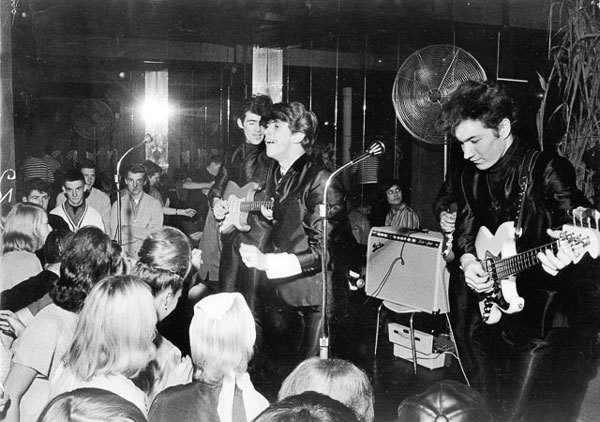
Ray Columbus and The Invaders take their Fenders to Auckland, 1963
On New Year’s Day 1963, Ray Columbus and The Invaders rolled into Auckland, to start a short 10-day residency at Dave Dunningham’s Jive Centre club. It was a residency that would change the musical landscape in Auckland, as they had gone as far as they could in their home base of Christchurch.
At the time, the Auckland scene was dominated by instrumental combos, and the Invaders energy lifted the bar, sending every local group scrambling to find a singer. Yuk Harrison (The Embers’ bassist): “We were on the same bill as Ray and The Invaders on numerous occasions, usually at the Shiralee night club. Even though they were about the same age as us, I always felt really old next to them.” Glyn Tucker: “Ray and The Invaders had all of the Auckland groups scuttling back to the drawing board.”
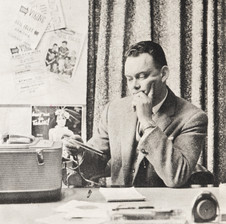
Pop-picking is a fast and furious business: Keil Isles' manager and Jive Centre proprietor Dave Dunningham.
Dave Russell of The Invaders: “We stayed at Dave Dunningham’s house. On our first night at the Jive Centre we got out of the taxi at the top of town in Karangahape Road and wandered down Queen Street. This was the big smoke for us and we were in awe. We followed the sound of music and stumbled into a club in full swing with guitar cases in hand – the Bel-Air from memory – we hung around for a few songs before legging it up to the Jive Centre. We were a bit apprehensive about playing at the Jive Centre as it had a bit of a reputation for trouble … oh, and sometimes dancing. We didn’t encounter any problems during our short stay, but then again it wasn’t overly busy as it was the Christmas/New Year holiday break and most Aucklanders had headed out of town”.
After their short residency Ray and The Invaders returned home to Christchurch with an offer from Phil Warren. The Jive Centre temporarily closed after The Invaders left, to allow the replacement of the dance floor. After seven years as a dance hall, it was virtually worn out and pitted with stiletto heel marks that rendered it looking like the surface of the moon.
The Invaders accepted Warren’s offer: to return within the month, on a full-time basis.
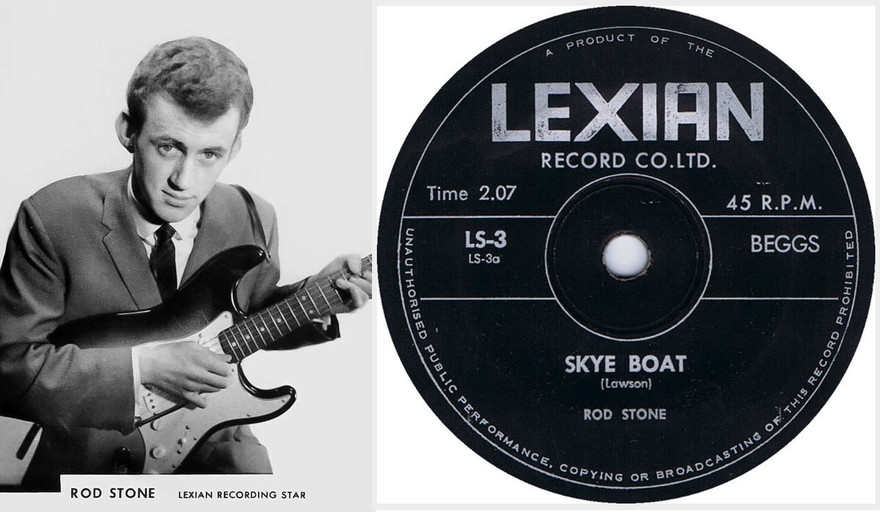
Rod Stone - Skye Boat (Lexian's third single). Stone was guitarist with the Librettos, who backed him on this 1963 solo release
Fred Gebbie: “I remember my first day back in the office after the Christmas break and waiting for me was a parcel from Wellingtonian, Alan Jennings. It was his first three 45s on his just-launched Lexian label. I was mightily impressed, here was a man with a vision and who took a big risk to present Wellington musicians to the world. I always thought that HMV with all of their resources could have done a lot better, the Wellington scene was heaving with excellent talent.
“Alan saw this and signed up an impressive roster of artists that he could see potential in: Tommy Adderley, Garth Young, Rod Stone, Lou Parun, Lyn and Christine Barnett, all of whom would have long careers both locally and internationally. So he knew his stuff, and as an arranger/producer he had a good ear. I promoted him as much as I could in my Billboard bulletins.”
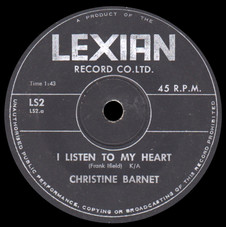
Christine Barnett - I Listen To My Heart (Lexian's second single, 1963)
Christine Barnett: “I was riding the Wellington trolley bus one afternoon, when the bus conductor introduced himself to me as he clipped my ticket. His name was Alan Jennings and he said that he knew who I was, as he had seen me performing on stage with my sister Lyn. He then told me about a record label that he was starting up and asked if I would like to be a part of his roster. Of course I said yes, sitting there in my school uniform.”
The year that followed was electric. More singles were recorded locally in 1963 than any other year – a record that wouldn’t be matched for approximately 30 years.
The initial catalyst was driven by Ron Dalton of Viking Records, with his ambitious plan to conquer the local and international market with local talent. In February, Viking relocated their operations from Wellington to Auckland, where they purchased the Mascot recording studio. By the end of the year they had acquired the La Gloria label from owner Harry M. Miller, a deal which included its major artist The Howard Morrison Quartet.
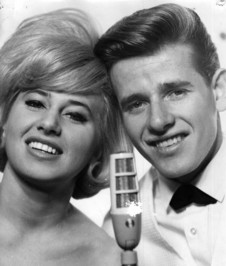
Auckland brother and sister duo, Anne and Jimmy Murphy. Anne was earlier signed to Zodiac and Viking as a solo act. They moved to Australia in the mid-1960s and then to the USA.
Dalton made bold moves, first luring guitarist Peter Posa away from Eldred Stebbing’s Zodiac label, then poaching Herma Keil and The Keil Isles: two of New Zealand’s biggest stars at the time. His smooth salesman pitch and big promises soon had others following, including Jimmy Murphy and his sister Anne, an act which had been named “The Face of 1963” by Playdate magazine.
Jimmy Murphy: “A few of us were lured to Viking. There was a promise of an album, but that never eventuated. Eldred was a one-man band with an orchestra of stars. Some felt that they weren’t getting the priority and left, but it was never the same: most came back. Me and Anne felt guilty for leaving as we both got on very well with Eldred and his wife Margaret.”
Eldred Stebbing wasn’t one to take a hit lying down. Within days he had signed Herma’s cousin Freddie Keil and his band The Kavaliers, and within hours had replaced Posa with emerging guitarist Graeme (Gray) Bartlett.
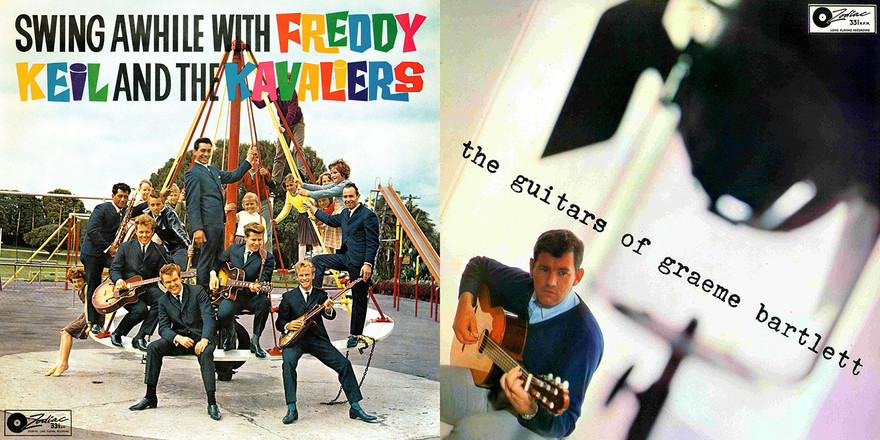
Freddy Keil and the Kavaliers, The Guitars of Graeme Bartlett, both on the Zodiac label
Peter Posa: “I had been with Eldred at Zodiac for three years, and felt that it was time to move on. Eldred was keen for me to continue recording in a Les Paul multi-track style. I thought that that technique had had its day and it was time to start afresh. Ron put an attractive proposition to me that included a publishing deal. I would have been a fool to turn down his offer.”
The rivalry between Viking and Zodiac sparked a recording boom and a label war of sorts, which filled the market with a potpourri of local releases. By mid-year, Viking had upped the ante by signing Australian saxophonist and musical director Jimmy Sloggett as both artist and arranger-producer; this gave their releases a more unified sound.
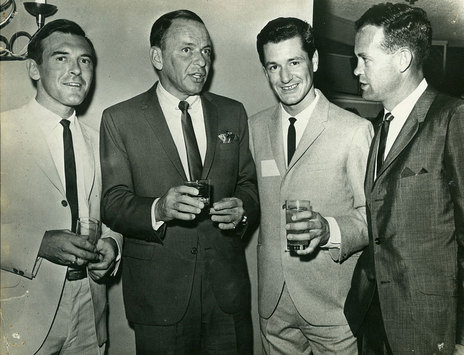
Peter Posa with Frank Sinatra in 1964 in Las Vegas. On the right is Posa's manager Jim Haddleton; on the left, Viking Records co-owner and producer Ron Dalton.
Not to be outdone, Stebbing played his trump card: hiring John Hawkins, a producer from England. Hawkins was desperate to leave the UK and had talked up his resume in a bid to land the job. He was a very private person and a devout fan of The Goons which usually saw serious questions asked of him replied in a Spike Milligan/Neddy Seagoon accent.
He confided to only a few people during his time in New Zealand that his wife’s parents were high up in UK diplomatic circles and they had been offered a posting to the UK embassy in West Germany. His wife was keen to follow her parents there, whereas Hawkins regarded it as a fate worse than death: living with or close to his in-laws and in a city full of Germans.
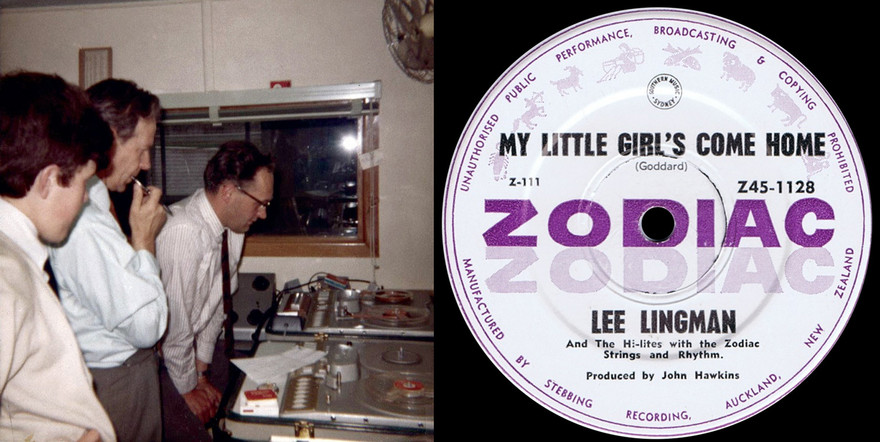
Stebbing producer John Hawkins, at right; My Little Girl's Come Home - Lee Lingman (Zodiac, 1963), written by a Joe Meek associate.
So when a position on the opposite side of the world became available, Hawkins saw this as a great escape. Hawkins told Eldred Stebbing that he was part UK whizz producer Joe Meek’s team that recorded The Tornados’ worldwide smash hit ‘Telstar’. The first US No.1 hit by a British group, it had been released six months previously. There is no direct evidence of Hawkins’s involvement and it is feasible that at best he belonged to Meek’s wider circle of friends and acquaintances. It was revealed at the time that he had been a producer for Cannon Records, a budget label that recorded cover versions of popular current chart hits which were sold at Woolworths stores in the UK.
After starting at Zodiac and maybe in a bid to strengthen his Joe Meek connection, Hawkins recorded several local artists in a Joe Meek style including Lee Lingman and the The Hi-Lites’ Zodiac single ‘My Little Girl’s Come Home’, written by Meek associate Geoff Goddard.
Ray Woolf: “It was John’s idea for me to record ‘Just Like Eddie’ with The Invaders. The original version by Heinz was a Joe Meek production [and] he told me that he had worked with Joe in the UK. I think he may have been keen to emulate the Meek sound. It was also one of The Invaders’ favourite songs and they went to enormous lengths to get the song sounding right. Dave Russell and Wally Scott spent hours practicing the guitar riff, and Jimmy Hill was after a certain drum sound. So he was experimenting by trying different layers of cloth which he tied around the tips of his drum sticks. I think he eventually settled for three hankies.”
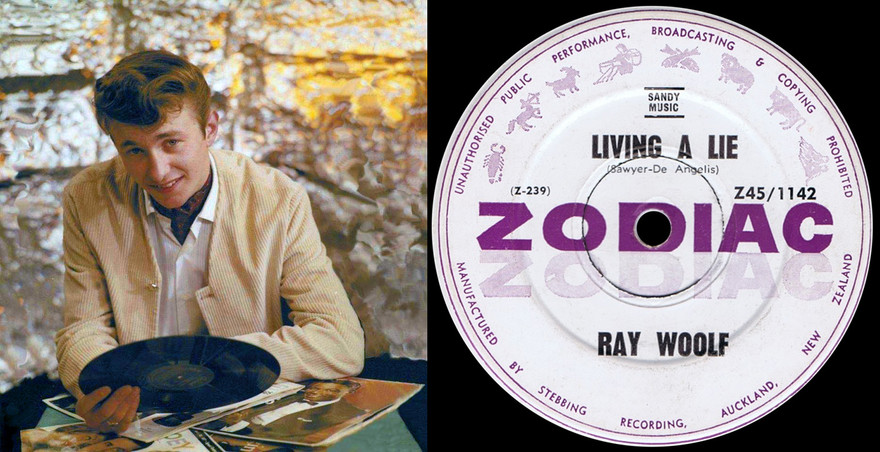
Ray Woolf checks out some Nat King Cole; Woolf's 1963 single Living A Lie (Zodiac)
Wherever Hawkins learned his craft, he was well connected within the UK and he quickly proved his worth in our local scene. Although he had to work with more primitive gear than he was used to, his ear and innovation shone through. For the next six years, he helped shape many of New Zealand’s most celebrated records and artists, including The La De Da’s, Ray Columbus and The Invaders, The Hi-Revving Tongues and a host of others.
Under the headline “Calling NZ Songwriters” in the February edition 1963 of Playdate local promoter Dave Dunningham highlighted that New Zealand had a lot of great talent but bemoaned the fact that more local songwriters needed to emerge. In the article an anonymous song publisher agreed and added, “there are many, many local songwriters, there are a few capable of producing a hit. If you put an ad in the newspaper calling for original compositions I can tell you now, you’d get scads of material. But practically all of it would be junk.”
In a bid to lure any promising composers out of the woodwork, Viking Records – in conjunction with Playdate – announced a national songwriting competition, Search For a Song. Three songs would be chosen, to be recorded by a suitable artist on the Viking roster. The winner was announced four months later as 20-year-old Rai de Graine of Newmarket, in Auckland. At year’s end, his song ‘The Wisest Fool In Town’ was recorded and released by Anne Murphy, with The Embers backing. None of the other finalists’ songs were recorded, and there is no mention of Rei after his three minutes of fame.
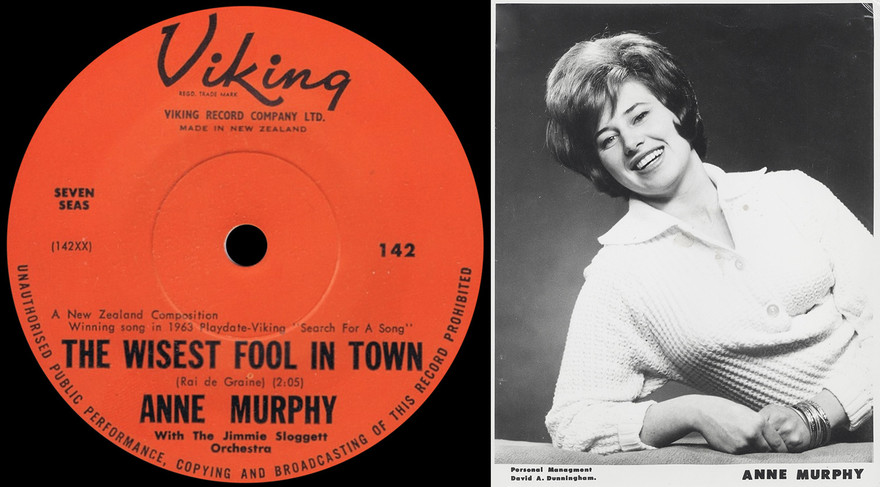
Anne Murphy - The Wisest Fool In Town (Viking, 1963). Written by Rai de Graine, and the winning entry in the Playdate-Viking 'Search for a Song' competition.
By the time of the competition, Viking had already assembled a small group of promising writers including Des Gibson, Bill Ivory, Graham Rosling and Ray (Raphael) Morgan.
Ray Morgan: “We all lived in different parts of town, I was out west, Bill and Graham were down south and I think that Des was more central. We wrote separately and would meet up once a week or so at the Viking studio, to either collaborate or help each other with any problems that we had. It was a bit like the famous Brill Building in New York, the 11-floor building with lots of small offices where songwriters would work from. [But] we weren’t the Brill Building, it was the kitchen at the Viking studio.
“I remember on one occasion when we were all gathered, Ron was holding up a copy of the new Herma Keil single which was a duet with Anne Murphy. It was one of Des Gibson’s songs called ‘We’re Goin’ Dancing’. Ron was espousing its virtues and highlighted that this is the standard that we have to attain to crack the US market. His intention was to find an American distributor for the record, but he never did.
“As he spoke I can still remember visualising John, Paul, George, and Ringo tiptoeing up behind him – ready to jump on him, before wrestling him to the ground yelling out ‘surprise surprise, we’re here!’ Ron was infatuated with the American market and as good as the song was, I couldn’t help feeling that it was a bit like selling ice to the Eskimos. To me it was too similar to what the Cameo-Parkway label was doing with their Chubby Checker/Dee Dee Sharp duets at the time.”
--
Read more: 1963: Lights, Camera, Action – rock’n’roll, baby! Part Two. Pop television arrives ... In The Groove ... Teen 63 ... Royal Command Tour ... Dinah Lee and the Playboys ... Twist fever ...