It’s a Friday afternoon in late summer 1976. My sister and I are in the back seat of a putting-green Vauxhall Velox, parked on the Napier side of the one-lane Brookfields Bridge, as a driver crosses over from the opposite bank of the Tūtaekurī River.
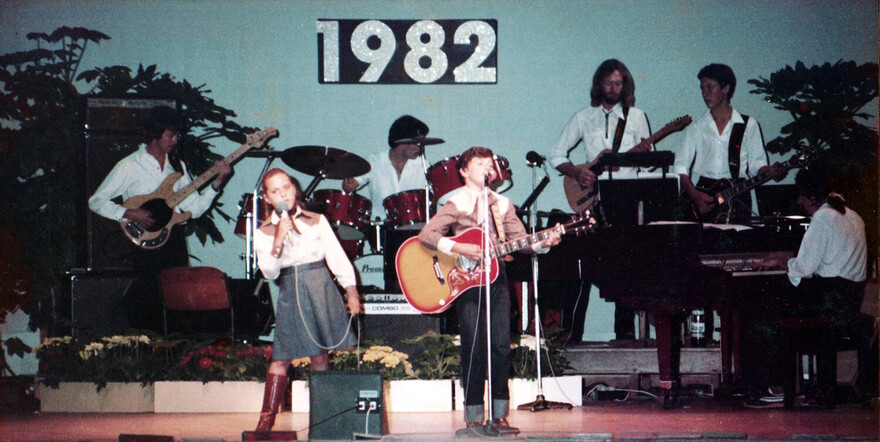
Glen Moffatt and sister Sharlene on stage at the New Year awards in Country Music, Municipal Theatre, Napier, 1982. Musical director Ritchie Pickett on piano. - Glen Moffatt Collection
When the way is clear, Mum accelerates and we ease off to my grandparents’ home in Hastings to collect Nanna and make the weekly excursion to Heretaunga Street East, where my mother will put a bit of cash on her Bon Marche account and pick up her magazines and our comics from the bookstore.
It’s a ritual that will be repeated for the best part of a decade as the means of transportation evolves, from the Vauxhall with no radio to a Holden Torana with a radio, and then a Mazda RX-4 with a cassette player. No more will we sing along to my mother’s best-remembered songs of her youth; now we have Bay City Radio 1278.
On a good Friday, we’ll stop in at Bunker’s toy shop, get a free saveloy from the corner butcher, and drive home with fish and chips cooked up by the Haliciopoulos family at the Dominion Restaurant. On a really good Friday, we’ll cross the railway line by the clock tower and visit Sutcliffe’s Music Store.
Back at my grandparents’ during one of these trips, a trio appears on the television playing acoustic guitars and singing in front of a pipe band. “He used to be a beetle!” my mother declares. Well, that’s how I hear it, anyway. My devotion to The Beatles is a few years off yet. For in the 1970s, I have no need for The Beatles, I have John Hore.
Long before reverting to his family surname of Grenell, John Hore was revered by my family
Long before reverting to his family surname of Grenell, John Hore was revered by my family. My mum and dad had his first three LPs, my grandfather in Hastings had the next three, my aunties in Waikaia, near Gore, had his early singles, as well as his posters on their walls.
I grew up on those first three records – Introducing John Hore, Encore, and My World. As far as I was concerned, ‘I Fall To Pieces’, ‘El Paso’, ‘Half As Much’, ‘Streets Of Laredo’, ‘Love’s Gonna Live Here’, and ‘Act Naturally’ were all John Hore songs. I was yet to discover what the Howard, Robbins, Williams, Owens, and other names contained within brackets represented.
My earliest musical memories centre around the little two-bedroom house my parents rented for about a year in Meeanee, south of Napier; it was flanked by orchards to the west and the Brookfields Vineyards at the rear. I remember Wombles posters on my bedroom wall and the records of John Hore, Ken Lemon, and Maria Dallas on the turntable.
The LP collection of Ken and Jenny Moffatt could best be described as haphazard. Besides those three New Zealand singers, there were “best of” compilations by Glen Campbell, Johnny Cash, Val Doonican, Julie Felix, and Freddy Fender, a handful of the first dozen or so Solid Gold Hits volumes, Elvis Presley’s It Happened At The World’s Fair, 40 Pop Country Hits on Music World, the Viking compilation Country Jamboree, and the Jesus Christ Superstar movie soundtrack.
And few, if any, of those records played all the way through; the stylus popping, skipping and sticking all the way to the run-out groove. Family legend had it that Mum’s teenaged cousins babysat my sister and I one night and spent their time skimming the vinyl discs across the timber floor. Suffice to say, they were never asked to mind us again.
Around autumn 1976, the Moffatts moved to the newly built house in York Avenue, in the burgeoning Napier suburb of Tamatea, where we would stay for the next 14 or 15 years. I think it was our second Christmas there that I received a guitar. There was never any thought put into me learning to play it, I would just bang away on the strings and sing along to records.
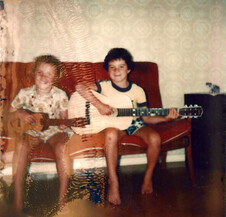
“The only photo I have of my first guitar is a damaged Polaroid where I’m sitting next to my sister Sharlene with her ukulele in the lounge at York Avenue in Tamatea,” Glen Moffatt says. “I reckon it’s early 1978.” - Glen Moffatt Collection
But in standard three at Porritt Primary School, all that changed when a young teacher by the name of Ross Corbett started giving guitar lessons. Ross had played the part of Peter in the Napier Operatic Society’s 1980 production of Jesus Christ Superstar, in which Debbie Harwood played Mary Magdalene.
I was not a natural on the instrument. While it seemed to come naturally to classmates Jason Neera and Lyndon Gray, I struggled to change from D to A, let alone bringing in G or E minor. I was the worst in the class. But something happened during the Christmas break of 1980-1981. I sat in my bedroom with that photocopied booklet of two-chord and three-chord songs and practised till my fingers had deep grooves in them. When I returned to Ross’s class in 1981, I was one of the most proficient.
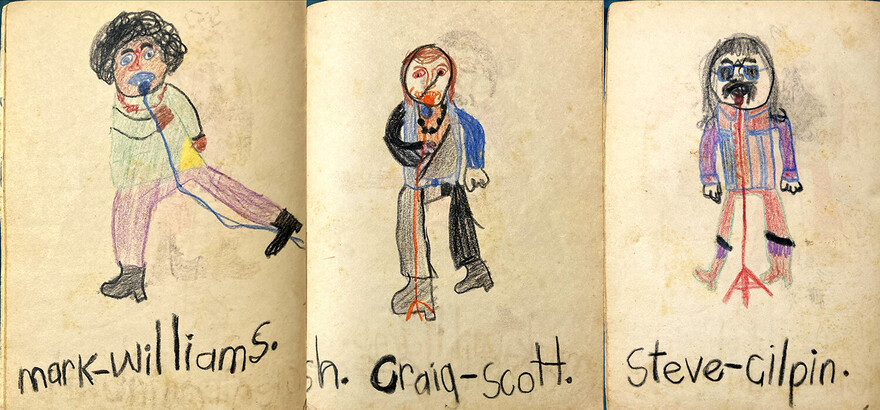
Mark Williams, Craig Scott and Steve Gilpin, drawn by a young Glen Moffatt. - Glen Moffatt Collection
That’s Country and Ready to Roll were essential viewing. I reckon we were watching Ready to Roll in black and white in Meeanee because my scrapbook from that time is full of crayon drawings of Mark Williams, Craig Scott and a long-haired and fully bearded Steve Gilpin. I can’t think where else I would have seen them. Later, I managed to collect the autographs of several of the That’s Country crew including John Grenell, Brendan Dugan, Jodi Vaughan, Gray Bartlett, Noel Parlane, Patsy Riggir, Suzanne Prentice, and Jeff Rea.
Also in 1981, we happened upon the Napier City Country Music Club. Founded in 1975 by Scotsman Jim Toner, the club met every Sunday night at the Lions Hall in Vautier Street. Dad took me along to sing with my guitar, but when I saw the audience and the other singers, and the band led by guitarist Aussie James, I changed my mind. A $10 bribe got me on the stage where I did my best impression of John Hore with ‘Streets Of Laredo’. I was 10 and I didn’t want to get off.
Over the next six or so years, the Moffatts rarely missed a club night. As my guitar playing improved, I would sit in in the backing band alongside the likes of Jim Toner, Renny Hantler, Doug and Pai Fletcher, and Jim Reid. It was where I tuned my ears and learnt a massive repertoire of songs that would hold me in good stead when I moved north years later.
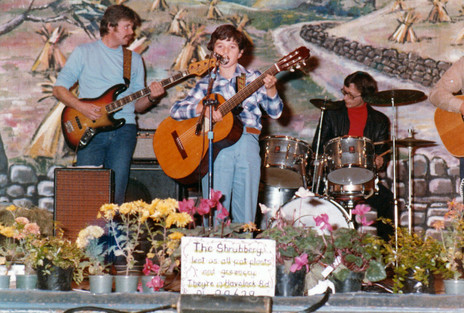
Glen Moffatt aged 10, on stage at the Hastings Municipal Theatre, June 1981. Neil Harrison on bass, Malcolm Thorpe on drums. - Glen Moffatt Collection
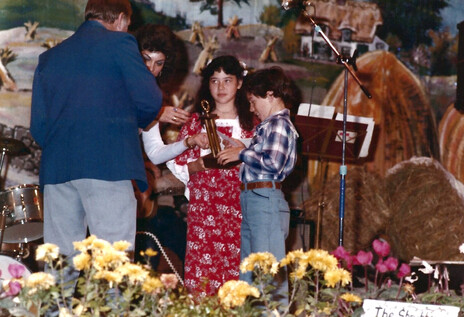
It’s a tie! Australian country star Jean Stafford (rear) presents Natalie Roberts and Glen Moffatt with the Greenwood Trophy for best junior at the Hawke’s Bay Country Music Stars Awards, Hastings Municipal Theatre, Queen’s Birthday Weekend, 1981. - Glen Moffatt Collection
Country music clubs had sprung up all over New Zealand and there was a thriving awards circuit. The first one I was entered into was the Hawke’s Bay Country Music Stars Awards in 1981, hosted by the HB Country & Western Club. I was over the moon to tie for first with Wellington’s Natalie Roberts in the junior section. Natalie’s dad Ritchie won the old-time hillbilly section and runner-up overall, her mum Briony won the instrumental section, and the three of them combined to win the group award.
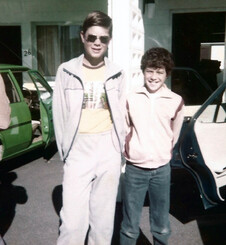
Wellington guitar picker Darren Minnoch (left) and Glen Moffatt at the Puhi Nui Motel, Rotorua, for the NZ National Golden Clef of Country Music, Easter weekend, 1982. - Glen Moffatt collection
From 1981 to 1986, Dad would drive us around the country to compete at awards in Wellington, Palmerston North, Rotorua, Taupo, Auckland, Invercargill and, in 1983, the New Zealand Gold Guitar Awards in Gore. In 1982, my sister Sharlene and I started singing duets together. Often, I’d come away with a trophy or two and some prize money that would almost always be spent on Hank Williams Jr or Kiss LPs.
There weren’t a lot of boys taking part in these competitions. Auckland’s Quentin Martin was a big ballad singer, but the other young men were mostly guitar pickers: Robert Katipa Jr (Auckland), Alex Wallace (Whangārei), and Darren Minnoch (Wellington).
Among a bevy of girl singers were Michelle and Louise Jackson from Auckland, Kiri Nehemia from Featherston, Andrea Cruickshank from Southland, and Sheree Ellen from Feilding. By the second half of the decade there was a new wave of young wāhine that included Camille Te Nahu from Gisborne, and Aucklanders Amanda Joyce, Gail Tipene and Sharon Emirali.
The Napier City Country Music Club had an abundance of gifted young singers in the first half of the 1980s, and Jim Toner corralled some of them to form The Ramrod Country Showband. Joining him on rhythm guitar, his teenaged son Peter on bass, Doug Fletcher on lead guitar, and Francis Seumanu on drums, were vocalists Kym Stanford, Donna Paramore, Brenda Thomson and Jon Fletcher, none of them yet 20.
The huge talent pool was attracting singers to Napier, as well. In the mid-1980s, the irrepressible Rowland Burns moved from Wellington, and 1982 Gold Guitar winner Craig Loader relocated from Masterton. When the shy Lesley Pahuru began boarding at St Joseph’s Māori Girls’ College, we would pick her up for club nights as we lived only 2km away. Lesley was mortified the principal made her wear her school uniform out.
I was about 11 when I first crossed paths with Ritchie Pickett, who was then the New Zealand Country Music Association’s musical director and would attend or organise bands for the awards. Although I had started writing songs around the same time, it was Ritchie’s writing on his Gone For Water LP that opened my eyes to writing about your own place and time.
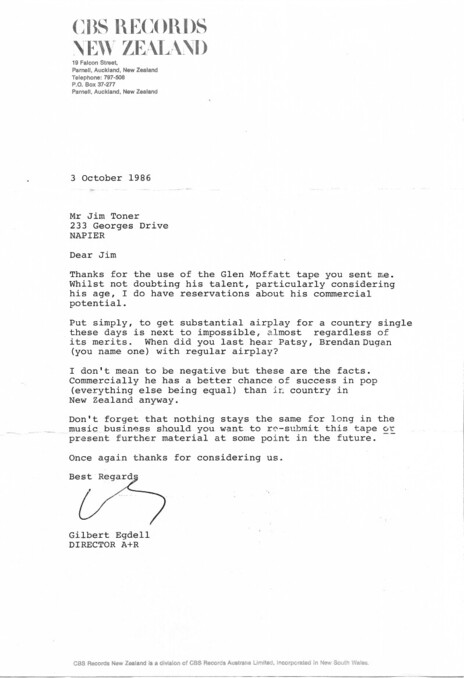
A letter from CBS Records NZ regarding 15-year-old Glen Moffatt’s ‘Like Father, Like Son’ demo cassette. - Glen Moffatt Collection
When my song ‘Like Father, Like Son’ was runner-up in the NZCMA’s Entertainer of the Year in 1986, Jim Toner organised the recording of a demo and sent it to CBS Records, which had released his daughters Lynne and Celine’s ‘Cryin’ In The Rain’ three years earlier. We got a very nice rejection letter from their A&R director Gilbert Egdell.
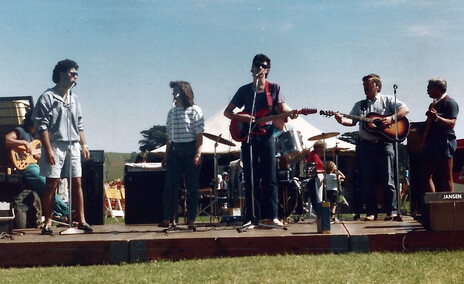
Napier City Country Music Club members perform at a picnic day at the Tamatea end of Anderson Park, Napier, circa 1987. Left to right: Pai Fletcher (obscured), Jon Fletcher, Adrienne Toner, Glen Moffatt, Simon Beattie (drums), Jim Toner, Doug Fletcher. - Glen Moffatt collection
After Ramrod ended, Doug Fletcher and his sons Jon and Pai formed The Fletcher Connection. Jim and his kids Pete, Rick and Adrienne started Jim Toner & The Overtones with Canadian drummer Artie Pole, and guitarist Gordon Wong, who used to play at the Top Hat with The Matloes. He was later replaced in The Overtones by another Hawke’s Bay stalwart, John Bailey.
In the middle of 1987, Rick Toner moved to Palmerston North and Jim invited me to take his place in The Overtones. I’d been trying for around a year to get a band going with drummer Simon Beattie, but we could never find anyone else to play with, so I jumped at Jim’s offer.
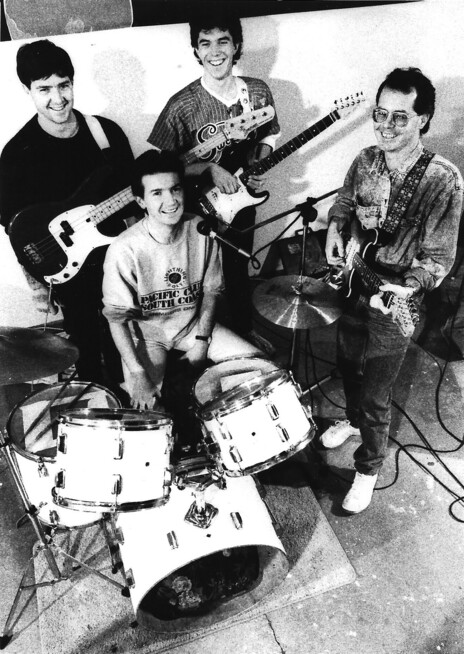
The Infamous James Gang circa 1989. Left to right: Pete Toner, Rick Toner, Glen Moffatt, Ian Turbitt. - Warren Buckland
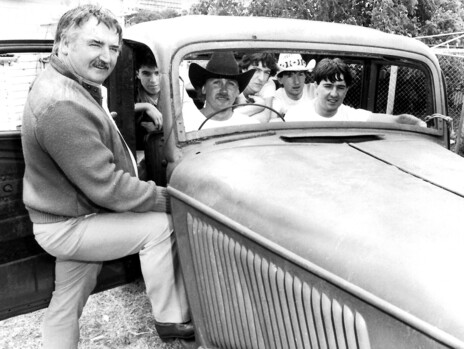
The Infamous James Gang with manager Jim Toner, 1988. Left to right: Jim Toner, Glen Moffatt, roadie Steve Matheson, Simon Beattie, Rick Toner, Peter Toner. - Warren Buckland
It soon became evident though that Pete was itching to try something independent of his dad. After he left, The Overtones lasted probably another six months before Pete, Simon and I formed The Infamous James Gang. We had no idea Joe Walsh already had a James Gang, we just thought he was the crazy Eagle. Jim managed us and Rick sat in when he was back in town. Guitar duties were shared between Ian Turbitt and Graeme “Mouse” Keelan.
By 1988, I was a cadet reporter at The Daily Telegraph. When American country music star Slim Whitman came to town I was assigned to review the show. But I was more excited to see his opening act, Aucklander Al Hunter. I had bought Al’s Neon Cowboy album from the Record Cellar in Emerson Street and was an instant fan.
But on the morning of the Hastings show, Jim Toner took an SOS call from the promoter Gray Bartlett. After a disagreement about payment, Al Hunter and his bass player Alastair Dougal had left the tour and taken Al’s PA system with them. Could Jim provide a PA, and did he have any ideas for a support act?
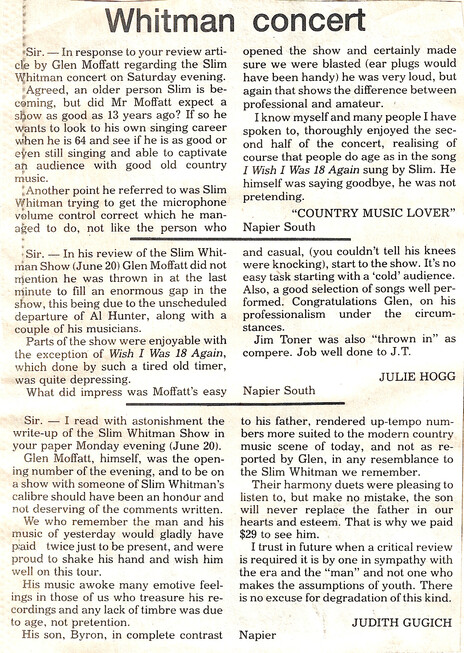
Letters to the editor, Daily Telegraph, Wednesday 22 June 1988, in response to Glen Moffatt’s review of the Slim Whitman concert in Hastings. - Glen Moffatt collection
So, that was how I found myself opening for Slim Whitman at the Hastings Municipal Theatre on Saturday 18 June 1988; a concert I was set to review for the newspaper. I decided to make no mention in the write-up of my inclusion, but I wanted to present a truthful assessment of 65-year-old Slim. Being a cocky 17, I said Slim was “a tired old pretender.” Let’s just say for the following three days the Letters to the Editor columns ran hot both with indignation and support.
In early 1990, The Infamous James Gang had run its course. Lead guitarist Ian Turbitt and I decided we wanted to drop the rock’n’roll songs and go fully country so formed The Colonials, initially playing as a duo before adding Simon Beattie on drums and Tamihana Johnston on bass. Jim reckoned a totally country repertoire in Hawke’s Bay wouldn’t work, but it did. Though we sounded more like Joe Ely and The Clash than the polished neo-traditional stylings of my new heroes Dwight Yoakam, Steve Earle, and Randy Travis.
Ian had been the singer/songwriter in folk band Homegrown who had released two albums on the Cityfolk label in the early 1980s. His fearlessness in performing his own songs to pub audiences inspired me to write more and to introduce my efforts to the band’s song list. The Colonials released a DIY cassette in 1991 called Living In Overdrive. It consisted of five of Ian’s songs and three of mine, including an updated ‘Like Father, Like Son’. We launched it at the Masonic Hotel in Napier, where The Warratahs turned up after their gig in Hastings and Wayne Mason sat in on piano accordion.
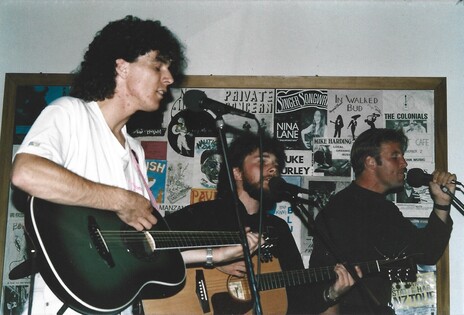
These Things Happen at the Iron Pot Café, Napier, 1990. From left: Glen Moffatt, Liam Farris, Mark Luscombe. - Glen Moffatt Collection
The Colonials found a home at the Iron Pot Café in Ahuriri. The seafood restaurant hosted Thursday night jams and touring acts such as Darren Watson and Dave Murphy, and Paul Ubana Jones. I’d been lucky enough to join a sideline trio called These Things Happen with singer Mark Luscombe and singer/guitarist Liam Farris. We became popular with our Crosby, Stills and Nash, and Beatles covers and were often tapped to support touring acts that came to the Iron Pot.
“Take it away, Red,” said Al Hunter at the King’s Arms. That had to be Red McKelvie on Pedal Steel
My dad was promoted sometime in the late 1980s and moved to Auckland, where he was later joined by my mother and sister. Whenever I went up to visit, I would scour the gig guide in Rip It Up to see where The Al Hunter Band was playing. I remember the first time I saw them, at the Kings Arms, and Al uttered the words, “Take it away, Red.” There couldn’t be more than one pedal-steel guitarist called Red, could there? That had to be Red McKelvie, whose name I’d read on the back of nearly every New Zealand album I owned.
After three or four visits to Mum and Dad’s, and the Kings Arms, I decided Auckland was where I needed to be to progress my musical aspirations. But before going, I helped my mentor Jim Toner with his latest venture, a run of Thursday nights at the Stortford Lodge in Hastings, under the group name Bandanna.
On the eve of the residency, the intended singer Scotty Smith, another former member of Homegrown, had fallen sick and so I joined a readymade line-up of Hawke’s Bay’s finest in bass guitarist Paul du Fresne, guitarist Richard Nicholson, and drummer Ivan Sawyer. Three or four Thursdays in, we were joined by a touring John Hore Grenell, my boyhood hero. As he graciously gave me a verse in ‘Come On Home, Boy’ from his first LP, my mind couldn’t help but hark back to those distant days in Meeanee.
Handing in my resignation at The Daily Telegraph and wrapping up the final Colonials gigs in December 1991, I packed my Cortina station wagon to the brim with my stereo and records – and the PA system that would prove so integral to securing work with Red McKelvie in the next few months – and headed off.
As I passed the Summit Kiosk on the Napier-Taupo road, and the last glimpse of Napier disappeared from my rear-view mirror, I could nary imagine what lay in store. Being taken under the wing of Red McKelvie, finding the Java Jive Café, meeting Michael Donnelly and Bernie Griffen, writing ‘Somewhere In New Zealand Tonight’, reuniting with Ritchie Pickett, co-writing with Arthur Baysting, befriending that champion of New Zealand music Neil Hannan, moving to Australia, writing for AudioCulture, being inducted into the Gold Guitar Awards Hands of Fame ... that would all unfold during the next 30-plus years.
--
On 31 May 2026, Glen Moffatt will be inducted into the 2026 Hands of Fame, as part of the Mataura Licensing Trust New Zealand Gold Guitar Awards. Glen has written most of the profiles and articles in the AudioCulture Country Music Collection.