Sixteen samples of Aoteoroa funk, as described in 2015 for the compilation Alright in the City (Universal NZ, 2015). For an overview, see “Funk Aotearoa 1: The Rap”. A Spotify playlist is at the end of this story.
Quincy Conserve – Alright In The City
Formed by singer Malcolm Hayman in Wellington in late 1967 and featuring battle-scarred veterans of The Underdogs, The Quin Tikis, The Trademarks, Sounds Unlimited, The Soundells and Bari & the Breakaways, Quincy Conserve rapidly became a huge live drawcard, kicking up a righteous horn-heavy racket that recalled US funk-rock acts Blood, Sweat & Tears and Tower Of Power.
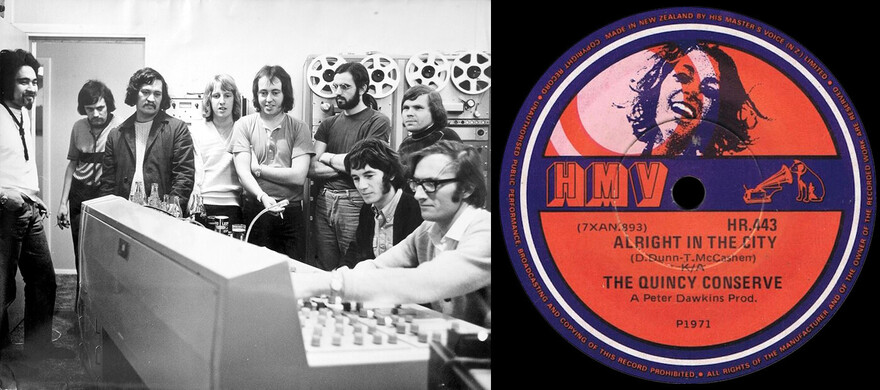
Producer Peter Dawkins with Quincy Conserve at HMV studio in early 1971. From left: Denys Mason, John McCormick, Rufus Rehu, Barry Brown-Sharpe, Dave Orams, Richard James Burgess, and Malcolm Hayman. Seated are Peter Dawkins and engineer Peter Hitchcock. At right, Alright in the City (HMV, 1971)
The band recorded four albums and a handful of great singles for EMI before they split in late 75, interspersing originals with tight covers of James Brown, Kool & The Gang, Deodato, Average White Band and Curtis Mayfield. The remake of an obscure gem by Don Dunn and Tony McCashen of 60s San Diego band Mobius, ‘Alright In The City’ appeared on Quincy’s second album Epitaph (1971) and it’s a miraculous pile-up of blaring horns, syncopated hand claps and Hayman’s distinctive husky howl, all nailed to the floor by drummer Richard Burgess, who just won’t quit banging out those funky breaks.
The horns are extraordinary throughout, kicking off with cascading ‘Payback’-style drops before adopting a regal trumpet theme near the final fade. “Johnny McCormick arranged those horns,” says bass player Dave Orams. “At the beginning, when they all come in on that unison note, you can hear that he had this buggered baritone sax that’s slightly out of tune, but that only adds to it, somehow. After that, me and Richard just worked out the feel for the rhythm part, and we were away.”
The Quincy rhythm section seems almost supernaturally tight here, the result, says Orams, of relentless practice. “We used to rehearse every Monday, Tuesday and Wednesday, then play the other four nights, so there was very little down time. After Quincy’s, Richard became a very successful producer in England, and was also co-inventor of the first electronic drum kit. Actually, it was me and Richard who nudged Malcolm toward a funkier sound, with more guts to it. When he first formed the band, he was doing commercial pop, like Tom Jones ballads. Malcolm was a very pale, fragile sort of guy. He got TB years earlier when he lived in Noumea which seriously damaged one lung, then he’d chain-smoke all night long on stage, and he also had to inject himself every day for diabetes, which is what killed him in the end. I was amazed that he could sing so well, night after night, on one lung!”
Orams, meanwhile, spent much of his down time listening to soul records, in particular Sam and Dave, Otis Redding, and early Motown bass lines. “The black bass players back then were a huge inspiration for me. Back in the 60s, the bass and drums were often just lightweight support, tinkling away in the background, but during the soul and funk era the rhythm section evolved into the main event. Suddenly it was right out in front, the engine that drove everything along, and as you can imagine, I had no problem with that!”
Lutha: Stop – The Music Is Over
Formed in Dunedin in 1970 from the remnants of two excellently named bands, Throb and Pussyfoot, Lutha released two albums Lutha and Earth for HMV in 1972, and four singles were drawn from these before the band’s demise in 1973. Short, punchy, catchy as the clap, with heavy percussion breaks and an a capella mid-section, ‘Stop – The Music Is Over’ is the best of the bunch, thanks in large part to a gritty lead vocal from Garry McAlpine, who became a TV producer in Singapore, and some scorching lead guitar from Graham Wardrop.
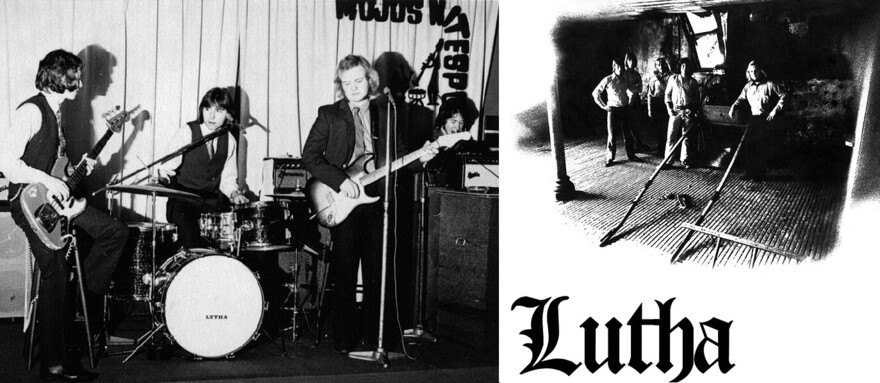
Lutha at Mojos Nightspot, Dunedin, 1971. From left: Peter Fraser, Peter Edmonds, Graham Wardrop, Kevin Foster. At right, Lutha's 1972 self-titled album, produced by Peter Dawkins at HMV in Wellington.
“Garry wrote that song with his mate Gordon Spittle, and we recorded it at EMI in Wellington” says Wardrop from his Christchurch home. “It ended up on our debut album, and became our biggest hit because everything just somehow aligned on that track – the right song, a great singer, edgy guitar, good vocal harmonies and all those unexpected stop-start bits that really make it stick in your head.”
Wardrop reckons the track’s cranking groove is mostly down to bass player Peter Fraser, who died in 2011. “I was into The Beatles and acoustic folk music back then, and Garry and Gordon idolised The Rolling Stones, but Peter was a very clever player who modelled his playing on that really percussive bass sound you hear on early Motown records. Our drummer Peter Edmonds loved Motown too, so the rhythm tracks on a lot of Lutha material had that as a strong influence. The Motown sound opened up a whole range of new possibilities because the bass was so prominent, so syncopated, so funky and dynamic, and a lot of rock’n’roll bands of the era picked up on that. Really, the 70s was a very creative time for New Zealand music. The band scene was extremely active, with live music happening everywhere. If you managed to do a recording, it was more about leaving something behind, but to earn a living, you played live in the pubs or after-hours clubs, and we played six nights a week in Dunedin for the entire duration of Lutha, as well as touring to Christchurch, Wellington and Auckland. Making records had a certain prestige, but it was live shows that paid your rent, and for a lot of bands, it probably still is.”
Link – Highway Driver
After Christchurch band Chapta folded in 1972, singer/guitarist Dave Kennedy formed Link, whose entire recorded output consists of one three-track “maxi single” released in 1973, containing radio hit ‘Only Time Could Let Us Know’ on the A-side plus ‘The Day You Came Into My Life’ and the mighty ‘Highway Driver’ on the flip.
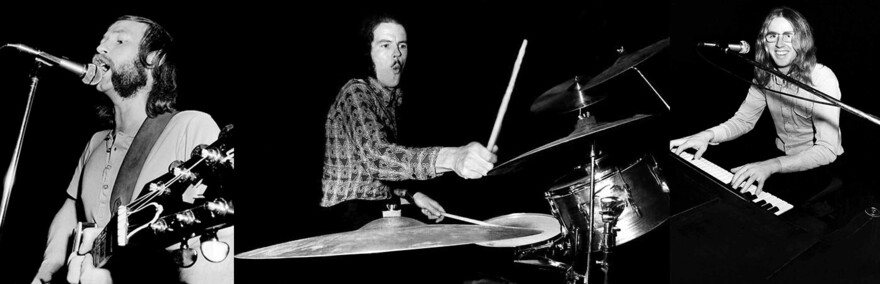
Link, 1973: Dave Kennedy (left) and Dave Gillies (right), both at Christies nightclub; drummer Chris Fox is at the Bishopdale Hotel. Photos by Kevin Hill
After an irresistible cowbell-clanking intro, the songs drops into a propulsive organ/bass groove recalling ‘Peace Frog’ by The Doors, slathered with a little Santana-esque guitar on the middle eight. The lyrics suggest a volatile mix of yearning, loneliness, and speed as our protagonist hoons through the New Zealand countryside in high summer, pining for a distant girlfriend: “The highway’s dry, my revs are high, everything seems just fine, but it’s a long road without you, baby …”
Now a luthier in Nelson, Neville Claughton was the bass player. “I used a very heavy pick in those days, and I had the mentality that less was more when it came to bass playing. Some guys go flying off into wild bloody solos all the time, but then the soul of the track gets lost. It was sad we never managed to record more songs, but in those days, you didn’t need an album to get pub gigs, because the live music scene was huge. Down in Christchurch, you had endless covers bands, with heaps of groups playing things like Average White Band at headbanger pubs like the old Hillsborough and The Gladstone. Really funky bands like Baby and Beam played a lot, too, and I even remember guys with distortion units built into their bass, but unfortunately, most of these people never got recorded.”
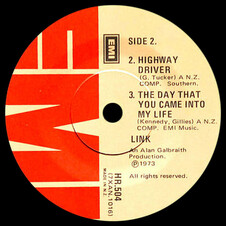
Link - Highway Driver (EMI, 1973)
‘Highway Driver’ was written by former Gremlins singer Glyn Tucker, who went on to establish Auckland’s Mandrill Studios in 1975. Tucker subsequently produced and engineered hundreds of New Zealand songs, but in the early 70s, he was still doing big miles as a travelling sales rep for a musical instrument wholesaler.
“I vividly remember writing that song,” he says from his Auckland home. “I was driving back to Auckland from Whangārei, thinking about my job. You’re out there on your own on the road – and there wasn’t even a lot of traffic in those days – and you feel like you’re in this vast desolate place, like the desert road between LA and Las Vegas, and you’re just alone with your thoughts. I remember it was summertime, and really hot, and I pulled over into a little gravel picnic area and wrote half the song, then finished it off when I got home.”
Tucker submitted the song to the Studio One talent competition, and the Studio One people suggested Link record it. “I was rapt! I loved bands that had a funky feel, like Steely Dan and early Doobie Brothers, and Link gave that song a really soulful sound. One great thing about that era is that people were taking the soulful grooves from black music and marrying it with rock music, so you suddenly had these white guys from Wellington or Christchurch or wherever playing with a really funky feel.”
Collision – Run Run Run
Could Tokoroa band Collision be New Zealand’s answer to the mighty Commodores? On the evidence of this shit-hot song, you’d have to say yes. Written by guitarist Ali Morgan and sung by his saxophonist brother Harry, ‘Run Run Run’ has it all: tighty-wound horns, crisp chicken-scratch guitar, a bassline that bumps like newlyweds’ hips on wedding night, a singer who keeps it loose and greasy, and a feeling that the rhythm’s continually expanding and contracting throughout, like it’s made of highly-stressed knicker elastic.
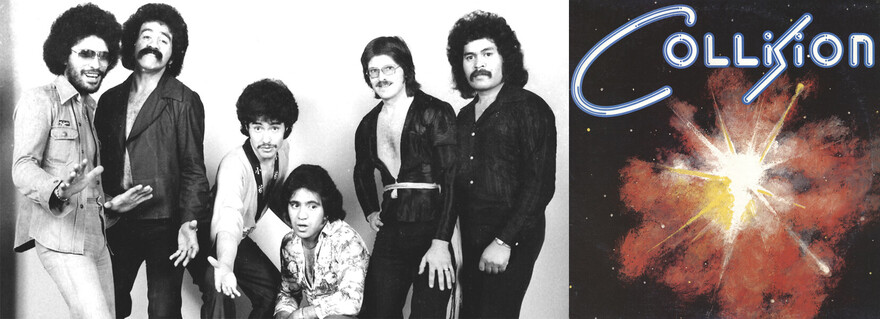
Tokoroa's funkiest export Collision, and their self-titled 1978 album (Infinity)
“I met those guys after they came down to Wellington,” says the band’s sole Pākehā member Mike Booth, who played trumpet. “They were the resident band at The Speakeasy in Manners Street, which was a pretty rugged place in those days. Two of the guys, Hira and Ali, were brothers, and they all used to be a band called Shriek Machine. Fantastic name, eh? They had wild-coloured clothing and big hair and looked seriously psychedelic, and they played funk and heavy rock.”
Collision succeeded Quincy Conserve as residents at Wellington’s Cornhill Tavern in 1974 and carved out quite a reputation. “There were other good funk bands in those days, but Collision really specialised in that sound. Eventually Dalvanius Prime got to know about us, and he was gigging a lot in Singapore, Australia and Hong Kong back then, and in 1976 he convinced us we should move to Sydney.”
Collision spent the next few years as the resident band at Les Girls nightclub in Kings Cross, living for a time in a nearby brothel. The band cut two singles and a self-titled album at Sydney’s Festival Studios in 1978, with musical mentor Dalvanius insisting they write as many of their own songs as possible. “Ali and Hira were really resistant to writing at the time, but in the end, they wrote the best songs on there! And I think that record proves that Charlie Hikuroa was the most exceptional bass player ever to come out of this country.”
The album remains the greatest 70s funk LP ever recorded by a New Zealand band, but it never found a larger market. Things might have been very different; Booth recalls Collision making contact with The Commodores when they toured Australia in the late 70s, and Lionel Richie was so impressed by the album, he tried to convince them to relocate to New York. “We didn’t go, because most of us didn’t want to move so far from home. We split up in 1979, and I haven’t seen those guys since, but we made contact again recently and we’re thinking of doing a few reunion gigs. [Collision briefly began playing again in 2020.] We’d love to get that album reissued someday, too, because it’s impossible to find now. It would be great for people to be able to hear it again.”
Mark Williams – Disco Queen
Soon after his second solo single ‘Yesterday Was Just The Beginning Of My Life’ topped the charts in 1975, I saw Dargaville-born singer Mark Williams live at New Plymouth’s Bowl of Brooklands, playing support for The Hollies – he was a homegrown disco-soul star, dancing about the stage in a tight white trouser suit and puffball afro. I even filmed his funky manoeuvres with my Super-8 camera, but sadly, my dear old mum later chucked out the footage.
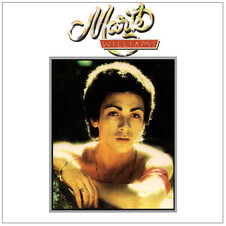
Mark Williams' debut album, featuring Disco Queen (EMI NZ, 1975)
Williams now lives in Sydney, but I caught up with him in 2012 when he toured New Zealand fronting Dragon. He told of his early experiences singing in a school band called The Face when he was 16, learning his chops, playing pubs, marae and country halls “way up north” during the late 60s. “We would generally start our sets with waltzes and foxtrots then move onto Jimi Hendrix and Led Zeppelin covers once the crowd had a few drinks under their belts. I remember one night we played this Mormon social somewhere near Whangārei, where they were only drinking orange juice. That was the most boring night we ever had! God, it was terrible! But you had to be versatile those days, and so we learned to play anything and everything.”
His first love, however, was American soul. “Once I became a solo singer, my biggest inspiration was Aretha Franklin’s Live At Fillmore West. I would listen to that record nice and loud at home before I drove off to do these half-hour solo spots around the pubs, and I’d imagine playing gigs like that, with such great backing singers. The sound of her voice moved me deeply every time, and I’d go out there and wail away, and lose my voice every single night! I felt pretty alone, to be honest, because very few others were singing soul here at that stage, so that Aretha Franklin record became my rock.”
‘Disco Queen’ was lifted from Williams’ self-titled 1975 debut album and tells the story of a dancefloor diva who derives more sexual satisfaction from funky music than she does from any man. With its swampy bass groove, hot horns, gratuitous cowbell and tasty percussion break, you can imagine this unlikely feminist fable getting everyone’s flares a-flapping at packed Papatoetoe nightclubs back in the day.
Mantis – Island Suite/ Firewalker
“It really was a huge surprise” says this track’s producer Ed Morris from his Hutt Valley home. “I came back from a session one sunny day in 1972, walked up the path into my backyard and there were all these Islanders draped around the place! They thought I was expecting them, but I had no idea who they were.”
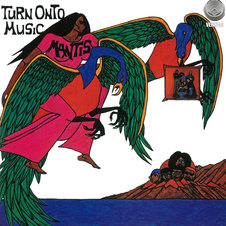
The 1973 Mantis album Turn Onto Music, produced by Ed Morris at EMI Studios in Wellington and released on Philips' Vertigo label.
Also known as Eddie O’Strange, Morris is now in his 70s and has been involved with all manner of music over the years, from country yodellers to BLERTA, experimental electronic music to community radio stations. For a time he ran Wellington nightclub Ziggy’s, which burnt down in the early 70s. And somewhere along the way, he found himself producing an LP for a visiting Fijian psych-rock band.
“They just turned up, with no money and no place to stay! They ended up sleeping on the lounge floor for a while, then found places in the Fijian community in Wellington. It turned out one of my flatmates had gone to Fiji and seen them at the Golden Dragon Club in Suva, calling themselves the Golden Dragon Band. He told them to come New Zealand and I’d be able to get them recorded, but he never told me. And so they came.”
Morris gave the newly christened Mantis a few gigs at his nightclub and found them sporadic session work, then eventually set up two recording dates as a full band. “PolyGram paid for half the recording, and they were such incredible players, they recorded about six songs in the time set aside for a single. They covered some more poppy tracks in that session, based around a box of singles Polydor gave them, but I really wanted them to find their own style, so I paid for another session where we could try something more adventurous.”
Engineered by former Abbey Road technician Michael Grafton-Green, the brain-bending three-part ‘Island Suite’ came from that second four-hour session, and ‘Firewalker’ is the blazing first movement. Laid down by Paul Stephen (drums), Joe Heritage (bass) and Reuben Davui (guitar/ congas), the background rhythm recalls another island funk classic – ‘Funky Nassau’ by Bahamas funk band The Beginning Of The End – but Waisea Vatuwaqa’s overdriven wah-wah lead and Ronnie Sammuel’s righteous organ freak-out nudge the sound deep into prog/psych territory.
“I wanted to hear what they might do if they weren’t confined to the sorts of things you’d play in a night club, so I’d listen when they were riffing between tracks and encourage them to jam on those bits. I was in there with them, conducting, letting them know when to bring different instruments in or out, giving it some structure, like I did with string sections on other records. At the time I was into making my own avant-garde electronic soundscapes, with tape recorders running at different speeds and so on, so I encouraged that kind of freedom on that session and they had the skill to do it. From playing in clubs, they knew the limits of how screechy a guitar solo could be, and how much distortion would work on a Hammond organ, so they could take things right to the edge.”
The band’s only album Turn Onto Music eventually came out in tiny quantities in 1973 on Philips’ prog-rock subsidiary Vertigo, followed by two singles. Morris reckons only 200 copies were ever pressed at the PolyGram plant in Miramar, with the covers run off at the print shop right next door. “Really, it cost the record company very little to release it, so there was no great investment in it having to sell. We could do whatever we liked, so on that second session, we did! I thought – I’m paying for this, and it’s the B-side of an album that may never come out, so these guys need the chance to just do what they love, playing pure music that had no connection with commercial imperatives or mainstream entertainment. You can really hear that sense of freedom in ‘Island Suite’.”
Human Instinct – Highway
Neil Edwards is a damn fine bass player. His booming bottom-end graces two cuts here: ‘It’s A Blessing’ by The Underdogs and this spooky funk-blues road song by Human Instinct, recorded just six months later. His decision to jump ship from one band to the other was motivated by an Indian deity.
Human Instinct - Highway (Pye NZ, 1971)
“When it was down to just me, Harvey [Mann] and Glenn [Absolum], The Underdogs was a shit-hot band,” says Edwards from his Auckland home. “But then Harvey and Glenn got deep into Hare Krishna, and I didn’t, so suddenly things weren’t too good. Meanwhile, Human Instinct were having a few issues with their bass player, Larry Waide, who was also into Krishna, so we ended up swapping bass players at a fortuitous time.”
Arising out of earlier Auckland band The Four Fours, during its career Human Instinct had more line-up changes than a fourth form footy game, with Palmerston North-born singer/ drummer Maurice Greer the only constant member. After moving to the UK in 1966 and changing its name, the band released three singles on the Mercury label, all written by rhythm guitarist David Hartstone. Following two more singles on Decca/ Deram, Greer returned to New Zealand in September 1968 and formed a new line-up, drafting in his 21-year-old mate from Palmy, Billy TK, already a veteran of The Rubyairs, The Premiers and The Sinners, as lead guitarist.
Another three-month foray to the UK followed, during which the band hooked up with fellow ex-pat Doug Jerebine; they later recordied seven of Jerebine’s songs on their first two albums, Burning Up Years (1969) and Stoned Guitar (1970). Edwards replaced Waide in February 1971 and, soon after, this new line-up recorded the third Human Instinct album Pins In It, with ‘Highway’ a highlight.
“When I joined, Human Instinct were looking to develop their sound with some new blood,” says Edwards. “I’m pretty sure Billy wrote ‘Highway’ after one of our rehearsals. You can hear Jimi in there, eh? When Hendrix came out, every band that I knew was floored by him! Mate, we heard ‘Hey Joe’ and everyone just melted at the knees! We all tried to learn to play it, with varying levels of success.”
But on ‘Highway’, the guitars are more garnish than main course. What really makes this track special is that lurching double-time acceleration into the chorus, and Edwards’ skilfully syncopated bass. “I wouldn’t call myself a soul guy, but there were about 20 nightclubs around Auckland in those days, and we had to be diverse in what we played to make a living. All of us had come through bands that played Sam & Dave, The Four Tops and so on, so we had a grounding in that music, alongside The Kinks, The Stones, and blues stuff like Big Bill Broonzy. Then a time came when people suddenly decided playing covers was rubbish, and everyone started writing their own songs, though not many ever got recorded. I gotta say – I’d forgotten all about ‘Highway’, and it’s a blast hearing it again. I’m 64 now, and I don’t play music at all these days. I’ve lost the hunger for it now. What did I do with my bass? Good question. I think it’s somewhere out in the garage.”
Doug Jerebine/ Jesse Harper – Hole In My Hand
A misty, wide-sky groove bolted to a persistent cowbell, ‘Hole In My Hand’ is lifted from the album Doug Jerebine Is Jesse Harper (Drag City), a psych-rock gem that languished unreleased for 43 years before finally seeing the light of day in January, 2012.
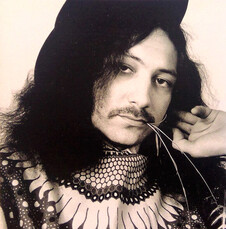
Doug Jerebine aka Jesse Harper
Raised in rural Northland, a veteran of The Embers and The Brew and a close collaborator with Human Instinct, Jerebine washed up in London during the late-60s and cut this demo under the alias Jesse Harper before travelling onward to India on a spiritual quest.
This fabled “lost album” was eventually transferred from a surviving studio acetate, and it’s as soulful as a cemetery. With Jerebine’s searing guitar, warm drawl and penchant for acid-soaked funk-blues grooves, the closest touchstone is early Hendrix, especially on album standouts ‘Midnight Sun’ – all phased drum breaks, pumping wah-wah and explosive lead runs – and ‘Ain’t So Hard To Do’, which hurtles headlong towards a tripped-out outro of screaming feedback, fuzz bass and Jimi-esque “Ughh!” grunts.
Other cuts reference jazz, country, 60s psych-pop, Indian classical music and, in the case of ‘Hole In My Hand’, a percolating Eastern-inflected funk. “Well, you know, I always loved the rhythmic drive of bass and drums” says Jerebine from his current home in Taumarunui. “Motown’s James Jamerson was a big influence, and Hendrix of course, and also Sly and The Family Stone, who had powerful rhythms but also a lot of beauty and lyricism about them because they were good jazz players.”
‘Hole In My Hand’ is partially about the difficulties in acquiring and retaining money, he says, but also has spiritual references to the crucifixion. “Dave Hartstone from Human Instinct wrote the lyrics after he’d moved over to England and set up a business hiring out amplifiers; you’d walk in the door of his London flat and you couldn’t get down the passageway because it had about 25 Marshall amps stacked in there! I was there one night when he wrote those lyrics, then him and his wife went to the movies. I was left on my own in his flat with two tape recorders, so I thought I’d surprise him by coming up with some music for it, then we put it down soon afterwards with me on bass and guitar and Dave Preston on drums.”
These days, Jerebine has largely forsaken guitar in favour of an Indian classical instrument called the Veena. “It’s the grandmother of the sitar, with moveable frets so you can get the kind of micro-tones I was always looking for when I bent the strings on my electric guitar. Back in those early days, my music had jazz and soul in it, blues, Bach progressions, Indian classical themes – everything that was passing through my genes at the time, you hear it in those songs. An interviewer once said to me ‘You’re New Zealand’s answer to Jimi Hendrix,’ and I told him, ‘Nobody answers to Hendrix!’ Even so, I’ve always felt some sort of brotherhood with Jimi. He had some powerful grooves, and I felt his influence strongly, but I travelled my own path. There’s no copyright on the funk!”
Underdogs – It’s A Blessing
The Underdogs went through numerous line-up changes after forming as a blues band in Auckland in the mid 60s, but their most enduring album is 1971’s Wasting Our Time, credited to “The Underdogs – Pig, Mann and Edwards” and featuring the tight trio of Mt Maunganui guitar hero Harvey Mann, bassist Neil Edwards and drummer Glenn “Pig” Absolum.
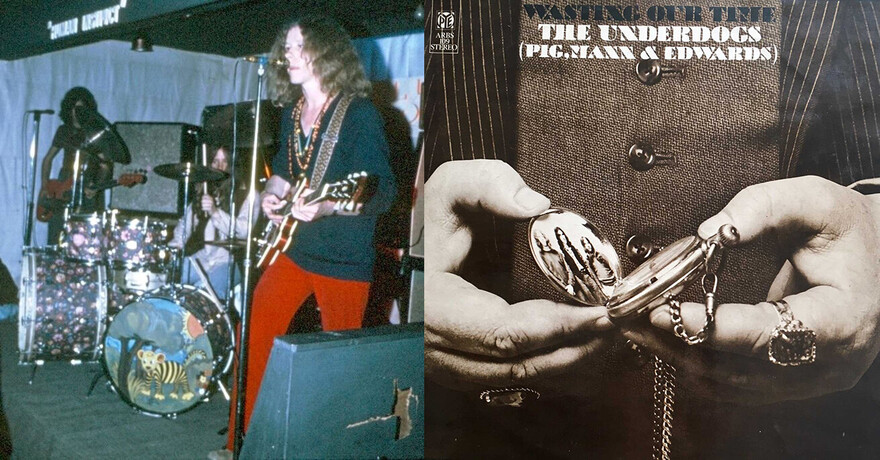
The Underdogs in 1970: Neil Edwards, Glen Absolum, Harvey Mann, and their 1971 album Wasting Our Time
Edwards left soon after to join Human Instinct, while Mann and Absolom went on to form Space Farm, but ‘It’s A Blessing’ remains a highlight of their time together. With its rhino-heavy drum breaks, there’s little doubt this funky New Zealand psych-rock scorcher has been sampled by hip hop producers around the globe. Harvey Mann sounds seriously seedy throughout, with his petulant nasal whine and grubby off-mic groans, and his treble-heavy guitar solo is sharp enough to draw blood.
“That was a Telecaster, and they sound best when they’re banged on!” says Mann from his home studio on Australia’s Gold Coast. He hasn’t heard the track in years and is delighted when I play it to him down the phone. “I sound like the kinda guy you wouldn’t let date your daughter, don’t I? There’s a lot of funk in that tune, but some early punk, too. There’s a pugnacious punk-funk vibe throughout, really. It’s nasty and raw, partially because that entire album was knocked out in a few days at Mascot, so it has a lot of spontaneity and heat to it. In those days, we listened to everything from Sly and The Family Stone, Cream and Hendrix to Chinese opera records, and there were heaps of Māori guys playing great live funk in the bars, then, too. We listened to all of it non-stop, and it all influenced what we did.”
Back in Auckland, bassist Neil Edwards agrees. “That’s a killer track, for sure. ‘It’s a Blessing’ was written by Harvey, and heavily influenced by Doug Jerebine, because we used to cover a lot of Doug’s songs at that time. Glenny Pig had two bass drums back then, and about seven cymbals – it was a monster kit! I’d say that record sounds so tight because of how often we played. Maurice Greer from Human Instinct and his brother Frank used to do fit-outs of nightclubs back then, and Frank eventually became our manager, sending us off on this never-ending tour of the North Island. It was full on, mate, you have no idea. The Underdogs used to play the Bo Peep in Auckland on Mondays and Tuesdays, then have Wednesday off, then play Rotorua on Thursday night, then Wellington for Friday and Saturday, and then do a Sunday afternoon gig in Palmerston North on the way home. Then we’d start all over again! Every week, mate! No wonder all our best songs got written in the van!”
Mary and The Maoris – Funky Broadway
To be honest, this isn’t really a 70s track at all – it snuck out in 1969 – but with such a hi-octane vocal and cranking rhythm section, it deserved to be here nonetheless. ‘Funky Broadway’ is, of course, a cover. Dyke and The Blazers’ 1967 original was the first charting American single with the word “funky” in the title, and Wilson Pickett had another huge hit with his version just four months later. Also known as The Māori Hi-Five, Mary And The Maoris took it out for another spin around the block two years after that.
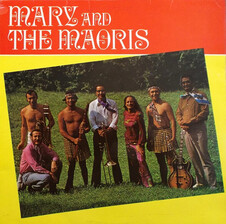
Mary and the Maoris - Funky Broadway (1969)
The Māori Hi Five began as a mambo band in Wellington in the mid 50s, and rapidly went international; a fascinating overview of their career can be found in an Unsung Heroes Of Māori Music doco on YouTube. During their time together they released three singles, two EPs and four albums, and this heroically hectic track is lifted from their final LP Mary and The Maoris, recorded in 1969 while the band were residents at the Nassau Hotel in the Bahamas.
“We made that album as a promotional record for the airline that took us there,” recalls Wes Epae, who sings lead on that track. Epae has lived in Florida for decades, but today he’s talking into his cellphone on a freeway near Las Vegas, where he’s visiting his former bandmate, Kawana Pohe. “I can’t remember if the studio was in England, America or The Bahamas, but it turned out pretty good, eh? Three people in the band sang lead – Me, Solly Pōhatu and Mere Nimmo – and I’d sing all the more soul-flavoured songs. I really loved Wilson Pickett’s version, you know, how the groove of 50s rock’n’roll had gotten blended in with black music. I play bass on there, too, and Peter Woolland’s on the drums.”
Epae remains extremely proud of what The Māori Hi-Five achieved on the world stage after humble small-town beginnings. “Ike Metekingi from Whanganui started the band, and Kawana Pohe became our leader. There were members from Wairarapa, Gisborne, Levin, Taranaki. After we got popular in Wellington, we sailed to Sydney in 1960, then sailed on to England the following year.”
The band toured extensively, sometimes playing three shows a day in American military bases around Europe, blasting out US soul covers alongside Māori waiata and rapidly becoming super-tight on stage. In 1963 they moved on to Las Vegas, working constantly in local clubs and touring regularly to resorts in Tahoe, Hawaii, The Bahamas and Hong Kong. Along the way, they played shows alongside Louis Prima, Count Basie, Harry James and, at a beauty pageant in Hong Kong, The Beatles. They even charted in Sweden (with ‘Poi Poi’).
“We worked with a lot of the big stars back then, and eventually broke up around 1972. After that I went solo, and worked the cruise lines for many years. Now I’m 73, still trying to get a hit! It’s all about the song, how it’s presented, and how good the backing band is. That, and timing, and money. Who knows? It could still happen.”
Soundproof – The Bruiser
The B-side of a hard-to-find 1976 single on the Cherokee label, with KC & The Sunshine Band’s ‘Sound Your Funky Horn’ on the flip, ‘The Bruiser’ sounds like a lost demo from West Africa, with a loose-limbed groove that lopes along under airy flute improvisation, sharp organ stabs and choppy rhythm guitar.
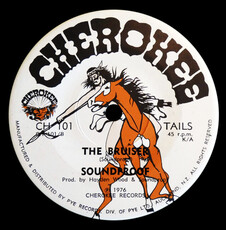
Soundproof - The Bruiser (Cherokee, 1976)
In truth, it’s a cover of a track by Los Angeles jazz fusion flautist Tim Weisberg, and the band hails from Palmerston North. “We spent 15 years together, but only ended up recording three singles!” sighs singer/guitarist Mike Griffin, who still plays several nights a week in Palmy and runs a local motel. “It’s tragic, really, but we weren’t the only ones in that boat. The funk bands of that era were generally a lot stronger than the rock bands, but unfortunately, it was the rock bands who got recorded! Our first single came out on Ode, but it’s not great. Too fast, you know. ‘The Bruiser’ is from our second single, and it came about because Hayden Wood from Cherokee said he’d cough up for the studio time if we backed him on a couple of his own recordings.”
Soundproof formed in Palmerston North around 1970 and soldiered on until 1985. “While everybody else was listening to The Beatles, we were listening to Wilson Pickett and Tower Of Power, and when Quincy Conserve folded in Wellington, we ended up with their brass section. The flute on ‘The Bruiser’ is Quincy’s John McCormick; we cut that track to feature him, really, because he’s such a great player. I played the guitar through a phase pedal to get that churning effect, and we used the Hammond that was sitting in the old EMI studio in Wellington. Back then, EMI used to give musos day jobs in their warehouse to keep them fed, but it also meant that if they needed a sax player or whatever during a session, they could just go into the warehouse and shout for one! In fact, if you hunt around, you might find a single by a band named Warehouse, which is actually Quincy Conserve during their days working in the EMI warehouse.”
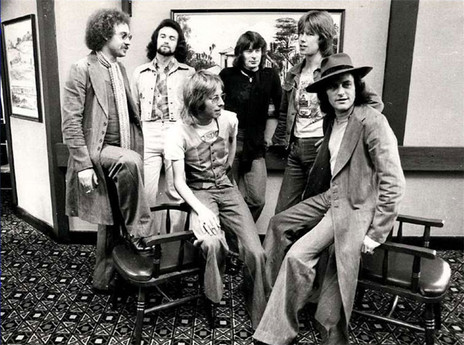
Soundproof circa 1976. In alphabetical order, the members were Mike Griffin guitar and vocals, Graham ‘Jamie’ James bass, Johnny McCormick sax, Mike Miers keyboards and guitar, Trevor Prout trumpet, and Wayne Simpson drums.
Soundproof only left behind a very slim recorded legacy, but Griffin says there was no shortage of live work in Palmerston North during the 1970s. “For many years we played six nights a week and Saturday afternoons at the Fitzherbert, then moved on to the new Lion Tavern on Tremaine Avenue. Back then, long pub residencies honed your skills. You really got your chops together working so much. It was full noise, eh”.
Headband – The Laws Must Change
Originally from Birmingham, England, merchant seaman Tommy Adderley jumped ship in Sydney in 1959, moved to Wellington,and had a substantial effect of our local music culture until his early death in 1993, aged just 53.
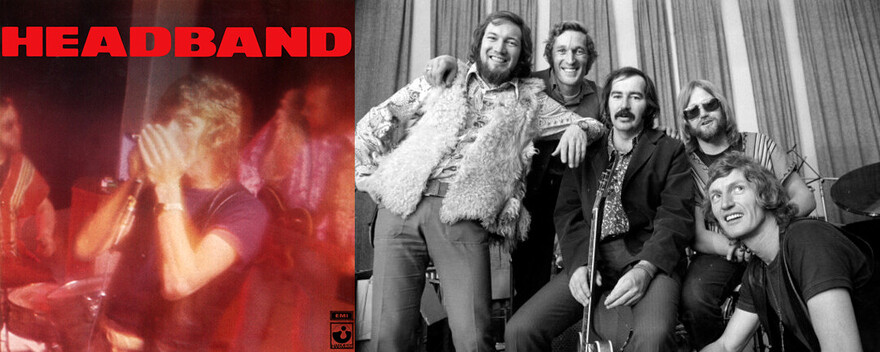
Headband's debut album, Happen Out (Harvest, through HMV NZ, 1972). Headband (L-R): Billy Kristian (Billy Karaitiana), Dick Hopp, Ronnie Craig, Jimmy Hill, and Tommy Adderley, 27 November 1971. Dominion Post collection, Alexander Turnbull Library EP/1971/5931-F.
After singing with the Hound Dogs, he became a solo star in the early 60s, releasing numerous singles and LPs, touring extensively in rock’n’roll roadshows (billed as New Zealand’s “Mr. Rock’n’Roll”) and as part of a short-lived jazz combo (The Adderley Walker Movement) and becoming a fixture of the TV and cabaret circuit, both here and in Australia. In 1970, he formed the looser, louder Headband to play in the Molly Hatchett’s nightclub, then owned by the Greer brothers, and in 1971 bought Auckland’s Bo Peep nightclub himself, renaming it Granny’s and installing Headband as residents.
Epic funky blues shit-kicker ‘The Laws Must Change’ is from the band’s 1971 debut album Happen Out (a sly dig at resolutely square early 70s New Zealand TV pop show, Happen Inn), and it’s a kick-arse cover of a track from The Turning Point, a 1969 live album by British bluesman, John Mayall. With exhortations to “open up your mind” and lyrics that rail against repressive pot laws, ‘Laws Must Change’ is very much a product of its era, but Headband’s version dials up the 70s freak-out factor considerably. It’s a marathon jam that goes for what seems like several decades without letting up, and why not? You got somewhere else you need to be? When the playing’s as unhinged as this, the answer would have to be “No”.
Adderley’s harmonica locks onto the groove like a limpet mine and his voice closely resembles Mayall’s with its high, lonesome overtones. And Dick Hopp’s tight but weightless flute soloing is very much of a piece with early US jazz/funk fusion LPs of the time, with a side order of prog-rock over-blowing à la Jethro Tull’s Ian Anderson. But the real meat in this particular sandwich is the rhythm section of Billy Kristian (Billy Karaitiana, bass) and Jimmy Hill (drums), both veterans of Ray Columbus and The Invaders. Underneath the hectic soloing, this dynamic duo holds it all together, with Hill’s cymbals and snare smacking away, punchy as nailguns, and Kristian’s bassline darting and diving like a manic wasp.
“’Laws Must Change’ was a song Tommy brought into rehearsal one day, and I really liked the basic riff,” says Kristian from his home in Northland. “As for Tommy, it was probably the lyrics that drew him to it. We were all fairly enthusiastic pot smokers at the time, and some of us probably still are! We recorded it at HMV in Wellington sometime in 71, and tried to give it some extra energy by recording it live in front of a studio audience of around 20 or so friends.”
Originally from Christchurch, Kristian now lives north of Kaitaia, at Taupo Bay. “I’ve been here 18 years now; it’s a beautiful place, way up high, overlooking the sea. I’m 69 now, still making music, but yes, there was something special about that Headband record, and a lot of that was down to Jimmy Hill’s drumming. Jimmy had come from The Invaders and Max Merritt’s Meteors, and he had a lot of range. He could cover the kind of jazz and soul feels a lot of other rock drummers couldn’t.”
Kristian, meanwhile, had spent the previous few years playing with a horn-heavy club band called Renaissance in Hong Kong, Bangkok, Singapore and Japan. Earlier still, he spent 67/ 68 in the studio house band for early New Zealand pop TV show C’mon and, before that, he played piano with Max Merritt and The Meteors. “On the C’mon show we played a lot of Tamla Motown stuff, and the heavy funk grooves that you hear in some Headband tracks probably came from there. Also, I wanted to stand out as a player, rather than just being the guy stuck up the back. That’s why there’s a bass solo in the middle of that track. I always thought the bass player should be right up front, sharing the spotlight with the lead singer!”
Billy TK: Marbles
After quitting Human Instinct during a 1972 tour of Australia, Billy “TK” Te Kahika returned to Aotearoa and formed Powerhouse, whose line-up eventually included Gav Collinge (bass), Ara Mete (rhythm guitar), Jamie Tait-Jamieson (keys), Arnold Tihema and Bud Hooper (percussion), Dick White (sax), Mahia Blackmore (vocals) and Neil Storey (drums). Demos for their debut album were recorded in Wellington’s EMI studios in 1972, then languished in a tape vault for nearly 40 years. Rumours circulated that they had simply been taped over, but Billy never gave up hope that a copy might have survived.
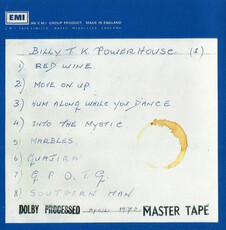
Billy TK & Powerhouse's 1972 sessions, released 2009.
“Eventually, one of our mates was down there, poking around the archives, and he asked about it,” says Te Kahika, who now lives in Little Wanganui, 20 kms south of Karamea. “Sure enough, the tape was still there. If he hadn’t found it, it could’ve sat there for another 40 years!”
Those eight studio tracks were belatedly released on CD in 2009 as Move On Up: The Unreleased 1972 HMV Tapes, and ‘Marbles’ is the standout, a bracing mix of hard rock and funky jazz fusion that stands up well alongside the 1970 original by British guitarist John McLaughlin (which he recorded mere months after cutting fusion classic Bitches Brew with Miles Davis).
Liberally marinated in distortion, Te Kahika’s version has more bite that a famished Rottweiler, and the rhythm section errs on the right side of relentless; the percussion break in the middle stretches a full 45 seconds, building tension for the return of that searing guitar.
“Our version is based on a live recording I heard of Carlos Santana playing with Buddy Miles, and part of the reason it works so well is that Neil Storey was such a great drummer. He went on to join Mandrake and Dragon, but when he was with us, he was real young. In fact, when he auditioned for Powerhouse, he turned up at the nightclub still wearing his school uniform! He was standing way up the back, and I yelled out – ‘What you want, kid! You here to play? Okay then, hop on and show us what you got!’ And he was great. He was the one.”
Te Kahika’s own playing at the time drew from a wide variety of influences. “I was into all the great new guitarists that were coming through – Hendrix, Jeff Beck, Clapton, Jimmy Page, the stuff John McLaughlin was doing with Miles on Bitches Brew. All the giants, you know? Earlier still, I was raised on Motown and Stax/Volt acts. I loved Otis, Aretha – the whole lot. Funk and soul were a big part of the blues I loved, because they all come from the same black roots.”
Like Doug Jerebine, TK has often been touted as “the Māori Jimi Hendrix”, but admits to mixed feelings about the title. “In one way, you gotta be flattered, but right through that period with Human Instinct and Powerhouse, I tried to shape my own sound. The New Zealand guitarists who were really honkin’ at the time were me, Doug, Harvey Mann, and Chaz Burke-Kennedy, who played with The Roadrunners, Fresh Air, Jigsaw and BLERTA. My favourite guitarists always had a strong sense of melody as well as raw power and speed, and hopefully you can hear all those things on ‘Marbles.’ You know, we played that track live at the Great Ngāruawāhia Festival in 1973, just after Black Sabbath finished. Man, it rocked the place to bits!”
Farmyard – All In Your Mind
Formed in 1970 and together for less than a year, Wellington quintet Farmyard released three singles and two LPs before calling it a day in late 1971. ‘All In Your Mind’ is lifted from their second album, 1971’s Back to Fronting, and it really is a ripper: a high-fat treat structured like a doughnut, with chewy grooves around the outside and a big open hole in the middle that’s essentially one long drum break with some spacious guitar improvising on top. When the other players all kick back in at the end with that greasy southern sax groove, it’s like Otis Redding’s backing band returning to the stage, reinvigorated after few backstage spliffs.
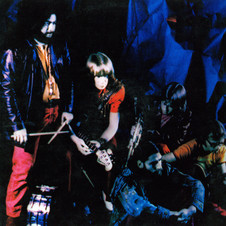
Farmyard - Back to Fronting (Polydor, 1971)
“It still sounds pretty good, doesn’t it?” agrees Farmyard founder and bass player, Rick White, also a veteran of 60s band, Tom Thumb. He’s spent the last 30 years making bespoke furniture in Wellington. “Tom Swainson the drummer came with me from Tom Thumb, so we really understood each other as a rhythm section. When we first formed Farmyard, we rehearsed an entire repertoire of covers, but then someone gave us a joint! All the covers went out the window, and we started doing strange progressive rock songs like that one.”
White recalls singer Paul Curtis writing ‘All In Your Mind’ not long after joining the band. “He was 18, I think, just a baby, and we’d seen him sing in this Tauranga band that came through Wellington, so we poached him. He’s got a great howl on that track, eh? To be honest, Farmyard was a pretty weird band. Andy the sax player was a crazy Scientologist who played flute in the New Zealand Symphony Orchestra at the time; we just handed him a sax and he worked out how to play it. And Milton Parker, the lead guitarist, was probably clinically mad. But me and Tom the drummer were good mates from playing together heaps over the years, and we brought the rhythm section right up front, you know? Tom Thumb and Farmyard were both my bands, and I was the bass player, so the bass was very prevalent in both those bands. You’d never listen to our records and think – Fuck, where’s the bass?”.
Ticket – Highway Of Love
During the early 70s, Ticket was widely regarded as this country’s premier acid rock band, and it’s easy to see why: guitarist Eddie Hansen could flip with ease between scorching Hendrix-style solos and jazzy Traffic-esque R&B chops, singer Trevor Tombleson had a richly soulful wail, future Hello Sailor drummer Ricky Ball smacked his drums as heavy as a man with a grudge but never lost a sense of swing, and bassist Paul Woolright – who also went on to Hello Sailor – played hard rock with a deft, springy undercarriage of funk.
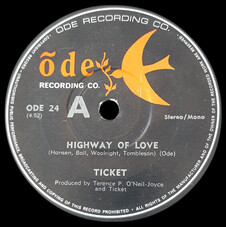
Ticket - Highway of Love (Ode, 1971)
The band cut two albums and five singles before pulling the pin in 1973, and for our purposes, it was a toss-up between two songs: 1972 single ‘Mr. Music’, with its stinging jazz chops, Aotea-frican vocal chant and admirably inane lyric (“Can you feeeeel it? That funky kinda music…”), or rollicking 1971 Ode B-side, ‘Highway Of Love’.
In the end, ‘Highway Of Love’ had the edge due to its mammoth drum breaks, wild wah-wah action and pounding bass. “Actually, that song was just written in the studio while we were recording something else,” says Woolright. “And I’m glad someone has finally picked up on how funky it was. The rhythm section in that band was always acid-funk, really, with really tight grooves and a Hendrix influence in the guitars over the top. And believe me, that’s no accident. Me and Rick were brought up on early soul, like Wilson Pickett and Stax and so on, but then we somehow found ourselves in a band taking LSD!”
He laughs a thoroughly disreputable laugh. “We loved American funk, but in Ticket that was meshed with a lot of loose guitar from the psychedelic era, with a bluesy Hendrix or Santana-influenced funk undercurrent to it. To me, a lot of the rock we all made during that era was early New Zealand soul music. Most bands from back then were mates, and we all grew up on black soul stuff as well as rock. We loved heavy guitar sounds, but we loved them even more if they were attached to a driving funk-rock rhythm section. After our own shows, we’d go down and listen to bands like Quincy Conserve and Rufus, ’cos to us, they were funky as fuck.”
The 1860 Band – That's The Kind Of Love I've Got For You
“The 1860 Tavern was upstairs on Lambton Quay, with a restaurant at the front and a bar at the back,” recalled trombone player Rodger Fox, who became a jazz tutor and big band leader based in Wellington. Busy as a beaver, Fox formed The 1860 Band in mid 70s and was also a member of Quincy Conserve, Soundproof and the Golden Horn Big Band around the same time. “I played with Quincy for a few months when I was 18, straight out of Mana College, then started Golden Horn in 1973 with my mates from Quincy and some other jazz and brass band guys. Then around 1975, a lot of bars started doing jazz/rock sessions on Saturday afternoons, so I put together The 1860 Band to do that.”
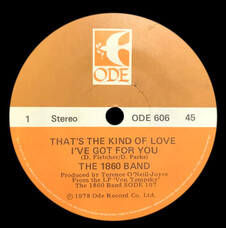
The 1860 Band - That's The Kind Of Love I've Got For You (Ode, 1978)
For the 1860 Tavern residency, Fox roped in Peter Blake, Billy Brown and Geoff Culverwell from Quincy Conserve, plus bassist Dave Pearson, who was later replaced by Rob Winch. “We played the 1860 on Saturday afternoons as the 1860 Band, then we’d go off and do our Quincy gig at The Downtown club or The Speakeasy later that night. Later on, after Malcolm disbanded Quincy’s, The 1860 Band started playing four weeknights as well as Saturday afternoon, and that 1860 Band album is really just songs we played every night live.”
He’s referring to the band’s self-titled LP, released on Ode in 1978, and the record’s crowning glory is this disco-funk juggernaut – a cover of an obscure 1974 track by Californian singer Rita Jean Bodine that somehow also became a minor hit for unlikely disco diva Dusty Springfield in 1978. This local version rides a bassline that just cannot be denied, and Rob Winch has a soulful catch in his voice that recalls Average White Band singer, Alan Gorrie. That screaming guitar solo near the end is an odd embellishment for a disco tune, admittedly, but no doubt made perfect sense after six pints in the 1860 on a Saturday arvo. ‘That’s The Kind Of Love I’ve Got For You’ was also released as a single, with a killer Moog-heavy version of Les McCann’s funk-fusion classic ‘Us’ on the flip.
“I always loved things like Tower Of Power, Cold Blood and The Meters,” said Fox. “And you can hear all those things in what we ended up playing in that band. Audiences preferred jazz-rock fusion to straight jazz back then because they could dance to it, and on the funkier tracks, the horns operate almost like another percussion instrument, so it was great fun to play.”
While we’re on the subject of the horn section, 1860 Band trumpet player Geoff Culverwell became an “equine remedial muscle therapist and freelance jazz soloist”, living near Ōtaki. “Yes, that’s right, and a bloody good jazz soloist he is, too! In fact, the 1860 Band was crammed with mighty players. Even now, you listen to that record and you can hear that it was a very sharp band.” (Culverwell died in January 2026, Rodger Fox in May 2024.)
--
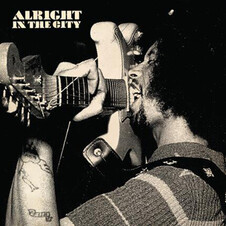
Various Artists - Alright in the City (Universal Music NZ, 2015)
All rights reserved © Grant Smithies. Alright in the City was released – in a limited edition of 300 vinyl copies – in 2015 on Universal NZ as a single album of 11 tracks.
Read more: Funk Aotearoa 1: The Rap
Read more: New Zealand funk – finding the real groove
Or just get down ...