Between the self-titled debut album by Dr Tree in the mid 1970s to the hip-hop influenced jazz of Nathan Haines two decades later, jazz albums in Aotearoa New Zealand have shown an unexpected breadth of styles.
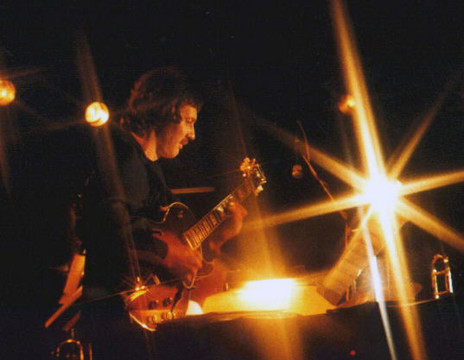
Martin Winch playing with the Rodger Fox Big Band at the 1980 Montreux Jazz Festival
Regrettably few of the records – many through Kiwi Pacific Records out of Wellington, or Ode Records in Auckland – have been reissued. Fortunately many are available digitally.
You don’t have to be too smart to note the lack of women here. During this period many women played live – Truda Chadwick, Jacqui Fitzgerald (her Kindred album in 1991), Beaver (in 1987 she recorded Live at Ronnie Scott’s, released the following year), trumpeter Edwina Thorne and Hattie St John among them – but they were rarely represented on albums and mostly recorded standards.
But here is a chronological sampling of 10 albums worth seeking out, depending on your taste.
Rodger Fox Big Band: Live at the 14th Montreux International Jazz Festival (Ode, 1980)
Rodger Fox was many things: trombonist, band leader, promoter, entrepreneur, teacher, mentor ... He was also ambitious, not just for himself but the scores of musicians and students he worked with. He brought international musicians to New Zealand and had them give workshops and he regularly toured his various bands.
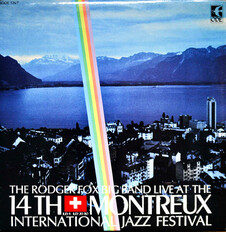
Rodger Fox Big Band: Live at the 14th Montreux International Jazz Festival (Ode 1980)
Taking a big band to play at the famed Montreux Jazz Festival – the first New Zealand band to do so – was ambitious, perhaps foolhardy, but ultimately successful. Also at the festival were Marvin Gaye, Al Jarreau, Art Blakey and the Jazz Messengers, Dizzy Gillespie, Stanley Clarke, Van Morrison and others.
The Fox Big Band played a number of originals by Fox, the album opening with ‘TONJ Stomp’ (a tribute to producer and Ode Records’ Terence O’Neill-Joyce) and closing with his vigorous and well received Montreux Suite, the three parts written by Fox, keyboard player Peter Blake (Quincy Conserve, The 1860 Band led by Fox) and singer Rob Winch (1860 Band).
Other original material came from Clive Cockburn (the former Avengers guitarist, with ‘Fat Mama Blues’) and singer Dave Feehan (‘Consequences’) alongside Cole Porter’s ‘I’ve Got You Under My Skin’, Count Basie arranger Sammy Nestico’s ‘The Heat’s On’, a furious treatment of Esther Phillips’s ‘One Night Affair’ (sung by Feehan and with a searing guitar solo by Martin Winch) and others.
The Fox Big Band sound was characterised by punchy horns and a jazz-rock attack. Their set was energetic and impressive. The audience heard on this double album certainly thought so and so did the festival organisers. Fox took the band back the following year.
David Paquette with Lindsay Meech and the Vintage Jazz Band (Ode, 1982)
In the early 1980s most jazz listeners – especially anyone under 50 – would relegate the New Orleans/Dixieland sound to history and of little interest, and for sure no one needed to hear ‘When The Saints Go Marching In’ again.
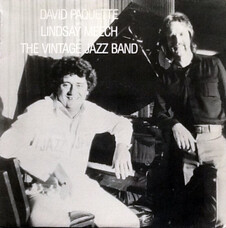
David Paquette with Lindsay Meech and the Vintage Jazz Band (Ode, 1982)
But when the unknown pianist and singer David Paquette arrived in Auckland at the invitation of Pat Shaw of the Cotton Club he was entertainment personified.
Although living in Hawaii, Paquette had spent his formative years in New Orleans where he played alongside and learned from legends such as Roosevelt Sykes. He soaked up the atmosphere of the Big Easy and studied Fats Waller and Jelly Roll Morton.
Only 30 at the time of his visit, Connecticut-born Paquette had a raw vocal style and was clearly a gifted player of stride, boogie-woogie, and ragtime. With annual visits to play for the Cotton Club, he became a welcome fixture in the jazz calendar but there was no album available.
Hooking up with the well-seasoned Vintage Jazz Band led by trumpeter Lindsay Meech – who pulled crowds to their Wednesday night gigs at Birkenhead Trust bar on Auckland’s North Shore – was a smart move because their album is a rollercoaster of sounds and styles from the 1920s and 1930s, with Paquette appearing in trio and quartet settings. And the VJB having their own spotlights on mostly little-known material.
There’s no ‘Saints’ here but raucously enjoyable songs like 1923’s ‘Last Night on the Back Porch’ and especially ‘Blues My Naughty Sweetie Gives To Me’ from 1919.
Paquette eventually moved to New Zealand and in the early 1990s founded the long-running Waiheke Jazz Festival while continuing to tour internationally and record, over 50 albums now to his name.
Far from stuffy or staid, this album breathed authentic life and humour in traditional jazz.
Space Case – Space Case 2 (Ode, 1983)
Although Dr Tree didn’t record again after their self-titled album in 1974, the core of those musicians – who grew up on the great jazz of the late 1950s and 1960s but were still young enough to be inspired by Miles Davis’s electric work and rock influences in the 1970s – hung together for Space Case.
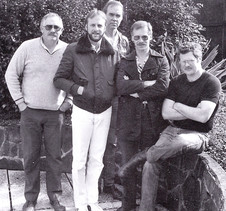
Space Case, from left: Andy Brown, Frank Gibson Jr, Brian Smith, Kim Paterson, Murray McNabb. - Kim Paterson collection
From Dr Tree (which won the band most promising group and top group at the music awards, both in the rock category) came drummer Frank Gibson Jr and keyboard player Murray McNabb (they had been friends since high school), and trumpeter Kim Paterson.
With saxophonist Brian Smith (who spent 20 years in London forming the groundbreaking Nucleus in 1970) and bassist Bruce Lynch, they recorded Space Case’s Executive Decision debut album at Auckland’s Mandrill Studios (with Ode’s O’Neill-Joyce producing).
This wasn’t Dr Tree 2.0 but a pull back from the electric, rock-influenced style and a return to where they came from … but with similarly energised playing.
The album probably got more attention for its striking cover – the naked backsides of two shapely and unnamed women – than it did for the music.
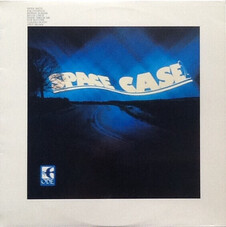
Space Case 2 (Ode, 1983)
Their self-titled follow-up – in a more measured cover – is a better album which had Gibson’s longtime fellow rhythm player Andy Brown on bass for one tune (Gibson’s ‘Beaver Fever’) and brought in some international players: New York-based Brazilian trumpeter, percussionist and flugelhorn player Claudio Roditi and American bassist Ron McClure, who had worked with Chet Baker and Herbie Mann. Both had visited New Zealand in 1981 and played with various members of Space Case.
The album is a showcase for the collected talents; a particular highlight is the playing of McNabb on electric piano for his swinging original ‘Funk City’, and piano for the rest of the album. But check also Roditi and Smith on McClure’s ‘Sunburst’, McClure electric bass on his ‘Boat People’ and Smith’s ‘Paratutu’.
Gibson even got away a drum-centric track (inventively titled ‘The Drum’) which he’d long promised himself, with Paterson and McNabb on supporting percussion.
Ivan Zagni and Steve Garden – A Selection of Trouble Spots (Ode, 1984)
Perhaps this pushes our definition of jazz a bit far? But this collection by guitarist/composer Ivan Zagni (a prime mover behind the Unsung collective in Auckland which released albums by Big Sideways, Avant Garage, 3 Voices and Miltown Stowaways) with drummer/producer Steve Garden (who runs Rattle Records) has all the hallmarks of experimental jazz and improvised music which nudges alongside post-punk avant-rock.
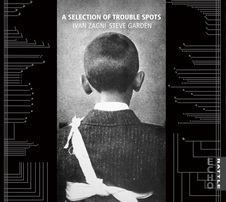
Reissued on Rattle's Echo imprint, Ivan Zagni and Steve Garden's A Selection Of Trouble Spots album was first released in 1984 on Ode
With additional musicians Peter Scholes (clarinets, saxes, flutes, recorders), Don McGlashan (bass, percussion, vocals), and Amanda Hollins (flutes, vocals), it is a free-wheeling and inventive collection of 11 very diverse pieces, many of which had their origins in improvisations in the studio.
Those familiar with the Avant Garage album and Zagni’s 1982 album Standards with McGlashan (on Propeller) will be quite at home with this one which weaves chipping guitar riffs overlaid by Scholes and Hollins.
In 2020 Garden returned to the album and some other material recorded around the same time to remix the tracks and incorporate additional material. That appeared as the album Trouble Spots on Rattle.
Mike Nock, Frank Gibson – Open Door (Ode, 1986)
A rarity in local jazz: expat pianist Mike Nock (over from Sydney where he was teaching at the New South Wales Conservatorium) goes into the studio with drummer Frank Gibson Jr and just a few ideas but the willingness to risk all by simply improvising together.
The result was seven original pieces – four co-credited, three to Nock – plus a treatment of the standard ‘Danny Boy’.
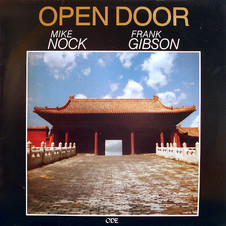
Frank Gibson, Mike Nock - Open Door (Ode)
By this time in their careers both Nock and Gibson had enjoyed international successes: Nock in the US where he’d arrived on a scholarship to Berklee College of Music in Boston in 1961 and in San Francisco in the late 1960s with three influential jazz-rock albums by his group Fourth Way; Gibson in the late 1970s living in London playing with rock artists (Rick Wakeman, Elton John, David Essex) and jazz groups (Kenny Wheeler, Dick Morrissey, George Coleman) then returning home to be New Zealand’s “house rhythm section” with bassist Andy Brown for touring greats such as Sonny Stitt, Joe Henderson, John Scofield, Lee Konitz and many others.
For this album however both players were in a spare duo setting where there is no place to hide.
Nock brings a whimsical quality to his mercurial playing in the appropriately titled ‘Yin/Yang’ and the title track as a snakes’n’ladders approach to the keyboard in runs up and down before settling into empty space and plucking the strings.
Gibson, often a forceful drummer in sessions with his later group Jazzmobile, brings the lightest of touches to many of these pieces but for the more strident ‘Harriet Street’ he pushes Nock onward. ‘Phaedra’s Lullaby’ is a gentle piece which cries out for lyrics and they approach ‘Danny Boy’ with reverence.
By its very nature there was nothing like this in local jazz at that time. It was reissued on CD in 2005.
Primitive Art Group – 1981-1986 (2024 compilation)
In the 1980s there was considerable suspicion and not a little envy among Auckland musicians about the Braille Collective in Wellington.
While well-established Auckland musicians struggled and only recorded albums intermittently, groups in the Braille collective – many of whom in those post-punk days openly acknowledged they weren’t trained musicians – were springing albums with astonishing regularity.
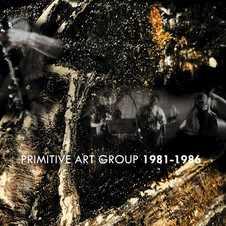
Primitive Art Group 1981-1986 album cover, released in 2024.
And with a suspiciously revolving door of the same players in different configurations.
What smarted too was that many of these albums came with assistance from the Wellington-based Queen Elizabeth Arts Council. It seemed Braille had a direct tap into the funnel of recording grants.
Many of the albums by the likes of The Black Sheep, Rabbitlock, Six Volts, Jungle Suite, The Family Mallet etc were only released in limited quantities so are now much sought after.
But the key group from Braille was The Primitive Art Group and in 2024 – to coincide with Daniel Beban’s excellent book Future Jaw Clap overview of Braille and the PAG – material from the PAG’s 1984 double album Five Tread Drop Down and their 1985 Future Jaw-Clap was collated onto a vinyl double album.
Whereas many of the other Braille albums suggested people coming to terms with their instruments and improvisation, the compilation confirmed PAG as a coherent and clever ensemble with broad outlines of ideas to improvise around.
And Beban’s book put the group into the context of the time as well as the musicians’ lives and influences.
For many the book-album pairing proved a vindication of this music which was witty, thoughtful, courageous, and a journey onto free jazz and improvised music without boundaries.
Just a lotta fun too.
Superbrew – Africa/Aroha (Ode, 1987)
Multi-instrumentalist, teacher and Zen student Jim Langabeer was one of the prime movers behind inventive and exploratory local jazz but was, given his lengthy career, woefully unrecorded.
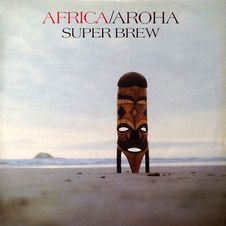
Superbrew - Africa/Aroha.
While still a schoolboy he began his career playing piano with groups like The Keil Isles and the Zodiacs, added trumpet to his armoury and joined dance bands, then played saxophone and flute with small combos and backing touring musicians such as the Four Tops, Sammy Davis Jr and the Bee Gees, as well as playing in pit orchestras for shows including West Side Story, Mahogany and Evita.
In 1984 he received a scholarship to the Creative Music Studio in Woodstock, New York, where he studied and played with the likes of Roswell Rudd, Nana Vasconcelos, Weather Report bassist Jaco Pastorius and others.
Inspired by sessions with African musician Baba Olatunji – whose music had influenced him as a teenager – on his return to Auckland he formed the eight-piece Afro-jazz group Superbrew with drummer Barry Young.
It was special if short-lived unit – just one album – and included a cross-generational array of talented players: saxophonists David Colven, Rick Robertson and St Martin; bassist Kenny Pearson; guitarist Graeme Webb and percussion player Brian Waddell.
On their Africa/Aroha album – produced by Ode founder and owner Terence O’Neill-Joyce – they interpreted material by Abdullah Ibrahim/Dollar Brand (‘Namibia’), John Coltrane (‘Afro Blue’ in a furious version), Mike Nock (‘In Out and Around’) and Paul McCandless (‘Moon and Mind’).
Of special interest are drummer Young’s lively West African-influenced ‘Agbekor’ – very Manu Dibango in style – and Langabeer’s ballad ‘Aroha’ (the album’s CD reissue in 2010 I described it as the group inventing “a kind of Ellington’n’Pacific soul”).
An unexpected local jazz album at the time, although Jim Langabeer often delivered the unexpected.
Nathan Haines – Shift Left (1994)
The game-changer and still this country’s biggest-selling jazz album.
Just as those in Dr Tree in the 1970s were musicians schooled in the great tradition of Charlie Parker, Miles Davis, Thelonious Monk and so on but hooked in to the possibilities of fusion and jazz-rock, so too saxophonist and flute player Nathan Haines came up in the tradition but also tapped into the zeitgeist which, for him and his generation, was hip-hop.
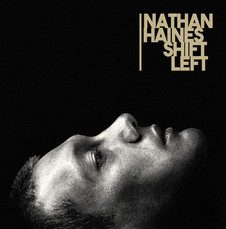
Nathan Haines - Shift Left 2019 reissue (Huh! / Universal Music New Zealand)
Haines grew up with jazz – his father bassist Kevin – and with his dad and guitarist younger brother Joel, they played at jazz festivals, the Cotton Club andconcerts when they were still at school.
By the time he was in his late teens Nathan had found his way to hip-hop and acid jazz, had played in bands like the Jazz Committee and Freebass with Joel and, after time in New York, he returned to a residency at Cause Célèbre in Auckland, the hippest club in town where jazz and Pacific-influenced hip-hop rubbed shoulders.
The Shift Left album had Haines on soprano and tenor sax, Joel on guitar, Manuel Bundy (turntables), vocalists Sonny Sagala, Hame and Pauly Fuemana bringing the rap elements, as well as Haines’s seniors such as Peter Woods (vibes), Tony Hopkins (cymbals), percussion player Miguel Fuentes and others. It remains a sophisticated, measured amalgam of jazz with subtle hip-hop elements.
And again in an echo of the Dr Tree album which was reissued on vinyl in 2024 with extra tracks from sessions, so too Shift Left was reissued on vinyl in 2019 with remixes by Haines with Frank Booker, Julien Dyne and P-Money.
An album born of its time, but ultimately timeless.
Mark de Clive-Lowe – Six Degrees (Kog, 1999)
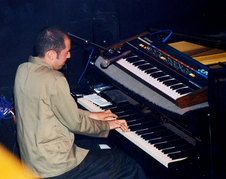
Mark de Clive-Lowe at the 1999 APRA Silver Scroll.
As with Nathan Haines, Auckland keyboard player Mark de Clive-Lowe had been schooled in standards from the jazz repertory but in the group Jazz in the Present Tense began to play some of his originals.
Of the same generation as Haines, and moving in the same circles through inner-city clubs and bars, he too explored aspects of hip-hop and contemporary soul.
A trip to London and Cuba, tuning in to the likes of French DJ St Germain’s global vision (sometimes referred to as “nu jazz”), and accepting his own restless ambition, meant de Clive-Lowe found his own voice very quickly.
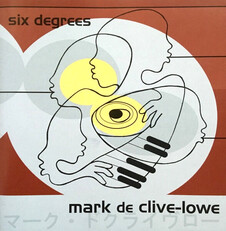
Mark de Clive-Lowe - Six Degrees (Kog, 1999).
This album – the third under his own name after First Thoughts and Vision, prior to that the Jazz in the Present Tense album Tap – was his breakthrough into a more contemporary style with Manuel Bundy (scratching), vocalists King Kapisi, Teremoana Rapley (Moana and the Moahunters, Upper Hutt Posse), and Cherie Mathieson, bassist Matt Gruebner, guitarist Joel Haines, and others.
Playing Fender Rhodes, using samples and a vocoder, de Clive-Lowe stretched into Latin-flavoured urban funk with conga player Juan Muzzio (‘El Dia Perfecto’, ‘Por La Manana’), a kind of clubland space-funk (‘Cosmic Echoes’), and atmospheric house aimed at the dancefloor.
The album was picked up by Universal Jazz and given wide international distribution so became de Clive-Lowe’s passport which he has been getting stamped ever since playing in Japan, South Africa, Britain, all across Europe, Cuba and the US.
Born to Japanese and New Zealand parents, he now makes his home in Japan and has a vast catalogue of albums, singles and remixes to his name.
Dan Sperber/Luke Casey – The Relaxomatic Project (2000, EMI)
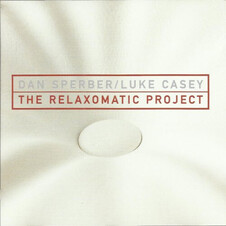
The Relaxomatic Project (Antenna/ EMI, 2000).
Although credited to guitarist Dan Sperber from The New Loungehead and Nixons/Eye TV drummer Luke Casey, also on hand for this album of slippery tunes, space, samples, scratching (Manuel Bundy again) and more ,are saxophonists Cameron Allen and Godfrey de Grut, bassist Justyn Pilbrow, percussion player John Hystead and – on the brooding ballad ‘At the Onset’ – singer Anna Coddington with a string section of Simeon Broom, Julia Dibley, Julia Broom, and Georgina Cooper.
The hypnotic opener ‘Every Day There is Something’ was licensed to a compilation for Blue Note France. The follow-up album Relaxomatic Projections of 2002 is also worth locating, but that was it – the two main players went their separate ways.
Very much living up to its title, this was cool, chill-out jazz which has aged extremely well.
--
Graham Reid founded the Auckland Jazz News in the late 1970s and in 1984 launched the magazine Passages, The Magazine of Jazz and Elsewhere which covered everything from albums by New Zealand artists, free jazz smuggled out of the Soviet Union and Duke Ellington to From Scratch, Don McGlashan and local jazz of all persuasions.
At the invitation of the artists he contributed liner notes to some of the albums and reissues mentioned above.